Bouillon Cubes Market Size
According to Deep Market Insights, the global bouillon cubes market size was valued at USD 5,800 million in 2025 and is projected to grow from USD 6,165.40 million in 2026 to reach USD 8,368.11 million by 2031, expanding at a CAGR of 6.3% during the forecast period (2026–2031). The bouillon cubes market growth is primarily driven by rising demand for convenient cooking solutions, increasing penetration of packaged food products, and expanding foodservice industries across emerging economies. Growing urbanization and changing dietary habits are further accelerating adoption, especially in Asia-Pacific and Africa, where affordable flavor-enhancing products are widely used in daily cooking.
Key Market Insights
- Convenience-led cooking trends are driving global demand, as consumers increasingly prefer instant seasoning solutions for home-cooked meals.
- Household consumption remains the dominant end-use segment, supported by high penetration in emerging markets such as India, Nigeria, and Indonesia.
- Asia-Pacific dominates the global market, driven by strong culinary traditions and large population base.
- Health-conscious reformulations are gaining traction, including low-sodium, organic, and clean-label bouillon cubes.
- E-commerce and modern retail expansion are significantly improving product accessibility and brand competition.
- Foodservice industry adoption is rising steadily, particularly in hotels, restaurants, and quick-service restaurants.
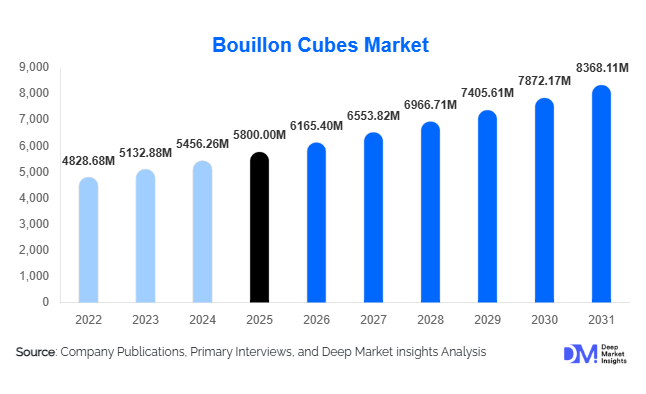
What are the latest trends in the bouillon cubes market?
Shift Toward Clean-Label and Health-Focused Formulations
Manufacturers are increasingly reformulating bouillon cubes to meet growing consumer demand for healthier food options. Products with reduced sodium, no artificial additives, organic certification, and plant-based ingredients are gaining strong traction, particularly in developed markets such as North America and Europe. This shift is also driven by regulatory pressure and rising awareness of diet-related health issues such as hypertension and obesity. Companies are investing in natural flavor extraction technologies and transparent labeling strategies to build consumer trust and premium positioning in a competitive market.
Expansion of Ethnic and Region-Specific Flavors
The globalization of food culture is encouraging manufacturers to develop region-specific bouillon cube variants. Asian-style broths, African spice blends, and Latin American seasoning profiles are being introduced to cater to localized taste preferences. This trend is particularly strong in urban multicultural markets where consumers experiment with global cuisines. Product diversification is also enabling companies to penetrate untapped markets and increase shelf space in supermarkets and online platforms, strengthening overall brand visibility.
What are the key drivers in the bouillon cubes market?
Rising Demand for Convenience Foods
The growing urban population and fast-paced lifestyles are driving demand for quick and easy cooking solutions. Bouillon cubes provide instant flavor enhancement without the need for complex preparation, making them a preferred choice for households worldwide. This is especially relevant in developing economies where affordable meal preparation solutions are essential for daily cooking. Increasing participation of working populations and dual-income households is further boosting demand for ready-to-use seasoning products.
Expansion of Foodservice and Processed Food Industry
The rapid growth of the global foodservice industry is significantly contributing to bouillon cube consumption. Restaurants, catering services, and QSR chains rely on standardized flavoring solutions to ensure consistency in taste. Additionally, the expanding processed food sector, including instant noodles, soups, and frozen meals, is increasingly incorporating bouillon bases to enhance flavor profiles. This industrial demand continues to strengthen long-term market stability and volume growth.
What are the restraints for the global market?
Health Concerns Related to Sodium Content
One of the major restraints in the bouillon cubes market is increasing consumer concern regarding high sodium levels and artificial additives. Health-conscious consumers in developed regions are shifting toward fresh broths and natural seasoning alternatives, which limits growth potential in certain segments. Regulatory scrutiny on processed food ingredients is also pushing manufacturers to reformulate products, increasing production costs.
Availability of Substitutes
The market faces strong competition from substitutes such as liquid stocks, seasoning powders, and homemade broth preparations. These alternatives are often perceived as healthier or more natural, particularly among premium consumers. This substitution effect poses a challenge for bouillon cube manufacturers, especially in mature markets where culinary preferences are evolving toward fresh and minimally processed ingredients.
What are the key opportunities in the bouillon cubes industry?
Growth in Emerging Markets
Emerging economies in Africa, Asia-Pacific, and Latin America present significant growth opportunities due to increasing urbanization, rising disposable incomes, and growing adoption of packaged food products. Countries such as India, Nigeria, and Brazil are witnessing rapid penetration of affordable seasoning products. Manufacturers focusing on localized flavors and affordable pricing strategies are well-positioned to capture large untapped consumer bases.
Digital Retail and E-commerce Expansion
The rapid growth of online grocery platforms is transforming product distribution. E-commerce enables brands to reach wider audiences, offer product variety, and implement targeted marketing strategies. Subscription-based food delivery models and direct-to-consumer channels are also emerging, creating new revenue streams for manufacturers and increasing brand engagement among urban consumers.
Report Scope
| Report Metric | Details |
|---|---|
| Market Size in 2025 | USD 5800 Million |
| Market Size in 2026 | USD 6165.40 Million |
| Market Size in 2031 | USD 8368.11 Million |
| CAGR | 6.3% (2026-2031) |
| Base Year for Estimation | 2025 |
| Historical Data | 2022-2024 |
| Forecast Period | 2026-2031 |
| Report Coverage | Revenue Forecast, Competitive Landscape, Supply Chain Disruption, Growth Factors, Environment & Regulatory Landscape and Trends |
| Geographies Covered | North America, Europe, APAC, Middle East and Africa, LATAM |
| Countries Covered | U.S., Canada, U.K., Germany, France, Spain, Italy, Russia, Nordic, Benelux, Rest of Europe, China, Korea, Japan, India, Australia, Singapore, Taiwan, South East Asia, Rest of Asia-Pacific, UAE, Turky, Saudi Arabia, South Africa, Egypt, Nigeria, Rest of MEA, Brazil, Mexico, Argentina, Chile, Colombia, Rest of LATAM |
Explore more data points, trends and opportunities Download Free Sample Report
Product Type Insights
The global bouillon cubes market exhibits a well-defined segmentation by product type, with chicken bouillon cubes firmly establishing themselves as the leading category, accounting for approximately 34% of total market share in 2025. This dominance is not incidental but is driven by a combination of culinary versatility, cost efficiency, and widespread cultural acceptance across both developed and emerging economies. Chicken bouillon cubes are deeply embedded in daily cooking practices, particularly in regions where soups, stews, rice-based dishes, and one-pot meals form dietary staples. Their mild yet savory flavor profile makes them universally adaptable across cuisines, from Asian broths and African stews to Western comfort foods. The leading segment growth is primarily driven by increasing demand for convenient flavoring solutions that can replicate slow-cooked taste in minimal preparation time, aligning with modern consumer lifestyles characterized by time constraints and a preference for quick meal solutions.In addition, seafood and specialty herb-based bouillon cubes, although relatively niche, are witnessing steady growth due to increasing culinary experimentation and the premiumization of food products. Consumers are exploring diverse flavor profiles inspired by global cuisines, which is encouraging manufacturers to innovate with unique ingredients such as shrimp, fish, and exotic herbs. These segments are further supported by the expansion of gourmet cooking trends and the rising influence of digital food content, which exposes consumers to new recipes and flavor combinations. As a result, the product type landscape is becoming increasingly diversified, with manufacturers focusing on innovation, clean-label formulations, and region-specific flavors to capture evolving consumer preferences.
Form Insights
In terms of form, standard bouillon cubes continue to dominate the market, holding an estimated 72% share. Their leadership is primarily driven by their convenience, long shelf life, ease of storage, and affordability, making them a staple in both household and commercial kitchens. The leading segment driver for standard cubes lies in their ability to deliver consistent flavor with minimal effort, which is particularly appealing in fast-paced urban environments where cooking time is limited. Additionally, their compact size and portion control capabilities reduce waste and enhance usability, further strengthening their market position.Paste-based bouillon formulations, while currently representing a smaller share of the market, are experiencing increasing adoption in premium and gourmet applications. These products offer enhanced flavor depth and customization, allowing chefs and culinary professionals to fine-tune taste profiles according to specific recipes. The growth of this segment is driven by the rising demand for high-quality, artisanal food products and the growing influence of professional cooking techniques in home kitchens. Consumers are becoming more adventurous and willing to experiment with premium ingredients, thereby supporting the expansion of this niche category. Overall, the form segmentation reflects a balance between traditional convenience and evolving demands for efficiency, quality, and culinary sophistication.
Distribution Channel Insights
The distribution landscape of the bouillon cubes market is characterized by a strong presence of traditional retail channels, with supermarkets and hypermarkets accounting for approximately 41% of total market share. These outlets remain the primary point of purchase for consumers due to their extensive product ассортимент, competitive pricing, and high visibility. The leading segment driver for this channel is the ability to offer a wide range of brands and product variants under one roof, enabling consumers to compare options and make informed purchasing decisions. Promotional activities, in-store displays, and bulk purchase discounts further enhance sales through this channel.Foodservice distributors also represent a critical component of the distribution network, supplying bulk quantities of bouillon cubes to restaurants, hotels, and catering services. The expansion of the global hospitality industry and the increasing demand for consistent flavoring solutions in commercial kitchens are driving growth in this segment. Manufacturers are increasingly collaborating with foodservice providers to develop customized products that meet specific culinary requirements, thereby strengthening their presence in this channel.
End-Use Insights
From an end-use perspective, household consumption remains the largest segment, accounting for approximately 48% of total market share. The leading segment driver is the widespread use of bouillon cubes in everyday cooking, where they serve as a convenient and cost-effective means of enhancing flavor. The increasing number of working individuals and dual-income households has led to a growing preference for quick and easy meal preparation solutions, further boosting demand in this segment. Additionally, the cultural significance of home-cooked meals in many regions continues to sustain high consumption levels.The food processing industry also represents a significant growth avenue, as bouillon cubes are extensively used in the production of instant soups, ready-to-eat meals, and packaged food products. The increasing demand for convenience foods, particularly in urban areas, is driving the integration of bouillon-based flavoring solutions into processed food formulations. Moreover, the expansion of export-oriented food manufacturing in developing countries is contributing to the growth of industrial usage, as manufacturers seek to meet international quality standards and consumer preferences.
Explore more data points, trends and opportunities Download Free Sample Report
Bouillon Cubes Market Segmentations
By Product Type
- Chicken Bouillon Cubes
- Beef Bouillon Cubes
- Vegetable Bouillon Cubes
- Seafood Bouillon Cubes
- Herb & Specialty Flavor Cubes
By Form
- Standard Cubes
- Granulated/Crushed Cubes
- Paste-Based Bouillon Concentrates
By Distribution Channel
- Supermarkets & Hypermarkets
- Convenience Stores
- Online Retail / E-commerce
- Foodservice Distributors
By End Use
- Household Consumption
- Foodservice
- Food Processing Industry
Regional Insights
Asia-Pacific
Asia-Pacific leads the global bouillon cubes market, accounting for an estimated 38% share in 2025. The region’s dominance is underpinned by a combination of demographic, economic, and cultural factors. High population density and deeply rooted culinary traditions that emphasize flavorful broths and soups create a strong foundation for sustained demand. Countries such as China, India, Indonesia, and the Philippines are major consumption hubs, where bouillon cubes are widely used in daily cooking due to their affordability and convenience.Government initiatives supporting food processing industries and the increasing penetration of e-commerce platforms are also contributing to market expansion. The growing influence of Western cuisines, combined with the preservation of traditional cooking practices, is creating a dynamic and diverse demand landscape in the region.
Europe
Europe accounts for approximately 27% of the global market, with key contributions from countries such as Germany, France, and the United Kingdom. The region is characterized by a mature market structure and a strong preference for high-quality and premium food products. One of the primary drivers of regional growth is the increasing demand for organic, natural, and clean-label bouillon cubes, as consumers become more health-conscious and environmentally aware. Regulatory frameworks supporting food safety and transparency are further encouraging manufacturers to innovate and improve product quality.The rise of vegetarian and vegan diets is driving the growth of vegetable-based bouillon products, while the increasing diversity of culinary preferences is encouraging the adoption of international flavors. Strong distribution networks, including supermarkets and specialty stores, ensure widespread availability and accessibility of products across the region.
North America
North America holds nearly 20% of the global market share, driven primarily by the United States and Canada. The region benefits from a highly developed food processing industry and a strong culture of convenience-oriented consumption. One of the key drivers of regional growth is the high demand for processed and ready-to-eat foods, where bouillon cubes are extensively used as flavor enhancers. The increasing adoption of multicultural cuisines is also contributing to market expansion, as consumers experiment with diverse recipes that require stock-based flavoring.The strong presence of leading market players and continuous product innovation are further strengthening the region’s position in the global market.
Latin America
Latin America contributes approximately 5% of the global market share, with Brazil and Mexico serving as key growth markets. The region is characterized by a strong tradition of home-cooked meals, where bouillon cubes are widely used to enhance flavor. The primary drivers of regional growth include rising urbanization, increasing disposable incomes, and the expanding adoption of packaged food products. As consumers shift toward more convenient cooking solutions, demand for bouillon cubes is expected to increase steadily.The gradual development of the foodservice industry and the growing presence of quick-service restaurants are further supporting demand for bouillon cubes in commercial applications.
Middle East & Africa
The Middle East & Africa region accounts for approximately 10% of the global market share, with significant demand observed in countries such as Nigeria, South Africa, the UAE, and Saudi Arabia. The region presents a diverse and rapidly evolving market landscape, with Africa emerging as the fastest-growing sub-region. One of the primary drivers of growth is rapid urbanization, which is increasing the demand for convenient and affordable food products. Bouillon cubes are particularly popular in African cuisines, where they are used extensively in soups, stews, and rice dishes.Government initiatives aimed at developing the food processing sector and enhancing food security are also playing a crucial role in shaping the regional market dynamics. Overall, the Middle East & Africa region offers significant growth opportunities, driven by a combination of demographic trends, economic development, and evolving consumer preferences.
Key Players in the Global Bouillon Cubes Market
- Nestlé
- Unilever
- McCormick & Company
- GB Foods
- Premier Foods
- Ajinomoto Co., Inc.
- Kraft Heinz Company
- Orkla ASA
- Tata Consumer Products
- Hormel Foods Corporation