Book Stand Market Size
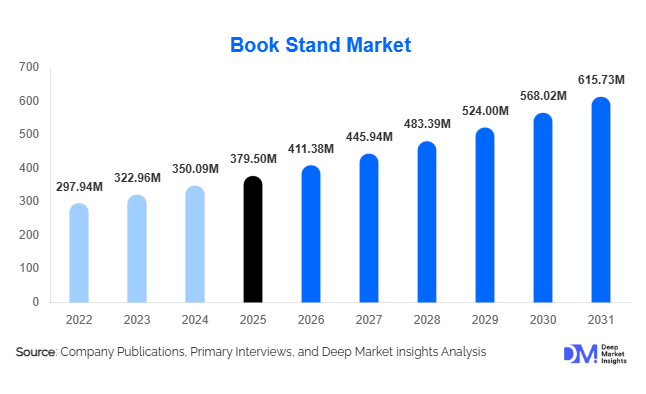
According to Deep Market Insights, the global book stand market size was valued at USD 379.5 million in 2025 and is projected to grow from USD 411.38 million in 2026 to reach USD 615.73 million by 2031, expanding at a CAGR of 8.4% during the forecast period (2026–2031). The book stand market growth is primarily driven by increasing ergonomic awareness, expansion of hybrid learning environments, and rising adoption of home-office accessories worldwide. Growing student populations, prolonged reading and screen exposure, and increasing emphasis on posture correction are transforming book stands from basic accessories into essential ergonomic productivity tools across households, educational institutions, and professional workplaces.
Key Market Insights
- Ergonomic workspace adoption is accelerating global demand, as consumers seek affordable posture-support solutions for prolonged reading and digital learning.
- Adjustable and foldable book stands dominate product innovation, driven by multifunctional usage across books, tablets, and laptops.
- Asia-Pacific leads global consumption, supported by large student populations and expanding education infrastructure.
- Online retail channels account for the fastest-growing sales segment, enabling direct-to-consumer expansion and global accessibility.
- Mid-range ergonomic products represent the largest revenue share, balancing affordability with durability and functionality.
- Material innovation and lightweight aluminum designs are improving portability while enabling premium pricing strategies.
What are the latest trends in the book stand market?
Ergonomic Workspace Integration
Book stands are increasingly positioned as ergonomic accessories rather than simple reading aids. Rising awareness about neck strain and posture-related health issues has encouraged adoption among students, remote workers, and professionals handling reference materials. Companies are integrating adjustable viewing angles, anti-slip bases, and height customization features to align with ergonomic workplace standards. Institutions and corporate offices are also incorporating ergonomic accessories into employee wellness initiatives, supporting consistent demand growth. As hybrid work models stabilize globally, ergonomic desk accessories such as book stands are becoming permanent workspace essentials rather than temporary pandemic-driven purchases.
Multi-Device Compatibility and Portable Designs
Modern book stands are evolving into multi-functional platforms capable of supporting textbooks, tablets, and lightweight laptops. Foldable and travel-friendly designs are gaining popularity among students and mobile professionals who require portability. Manufacturers are focusing on lightweight materials such as aluminum alloys and reinforced polymers to improve durability without increasing product weight. Minimalist aesthetics and compact storage capabilities are also influencing consumer preferences, particularly among urban users with limited desk space. These innovations are expanding the product’s relevance beyond traditional reading applications into digital productivity ecosystems.
What are the key drivers in the book stand market?
Expansion of Remote Work and Hybrid Learning
The global shift toward remote working and online education has significantly increased demand for home-office accessories. Students and professionals spending extended hours reading or referencing materials require ergonomic support solutions. Book stands provide an affordable productivity upgrade compared to larger ergonomic furniture investments. Educational institutions adopting blended learning models further reinforce long-term demand through institutional procurement.
Growing Awareness of Posture and Health Ergonomics
Healthcare recommendations emphasizing proper posture during reading and screen usage are encouraging consumers to invest in ergonomic accessories. Social media awareness campaigns and workplace wellness programs are accelerating adoption across developed and emerging economies. Adjustable book stands, in particular, are benefiting from rising consumer awareness regarding spinal health and eye-level reading alignment.
What are the restraints for the global market?
High Price Competition and Product Commoditization
The availability of low-cost manufacturing options has intensified competition, particularly within online marketplaces. Basic book stands often face limited differentiation, resulting in pricing pressure and reduced margins for manufacturers. Smaller brands struggle to maintain profitability without introducing innovative features or premium materials.
Shift Toward Fully Digital Reading Solutions
The increasing adoption of tablets, e-readers, and digital documentation reduces reliance on printed materials in certain regions. While multifunctional stands supporting digital devices help mitigate this impact, traditional book-only designs face slower adoption in highly digitized markets.
What are the key opportunities in the book stand industry?
Institutional Procurement and Educational Expansion
Governments worldwide are investing heavily in educational infrastructure and classroom modernization. Schools and universities adopting ergonomic study environments present significant opportunities for manufacturers to secure bulk procurement contracts. Emerging markets with growing student populations provide scalable growth potential for standardized product offerings.
Premiumization and Sustainable Product Innovation
Consumers increasingly view desk accessories as lifestyle products. Premium wooden, bamboo, and aluminum book stands targeting aesthetic workspace setups are gaining popularity among professionals. Sustainability-driven purchasing behavior also encourages adoption of recyclable materials and eco-friendly manufacturing processes, enabling brands to differentiate and command higher margins.
Product Type Insights
The adjustable book stand segment leads the global market, accounting for nearly 38% of total demand, primarily driven by increasing consumer awareness regarding ergonomic posture correction and prolonged reading comfort. The growing prevalence of hybrid learning and work environments has encouraged users to adopt flexible accessories that support multiple viewing angles and accommodate both printed books and digital devices. Adjustable designs reduce neck and eye strain, making them highly preferred among students, professionals, and remote workers, which continues to reinforce their leadership position within the product landscape. In addition, manufacturers are integrating lightweight materials, anti-slip bases, and height-adjustable mechanisms to enhance usability and product differentiation.
Foldable and portable book stands are witnessing accelerated adoption as mobility and space optimization become important purchasing considerations. Students, travelers, and mobile professionals increasingly prefer compact solutions that can be easily stored and transported, particularly in urban environments where workspace constraints are common. Fixed-angle book stands maintain steady demand among price-sensitive consumers and institutional buyers such as schools and libraries, where bulk procurement prioritizes affordability and durability over advanced adjustability. Meanwhile, multi-functional book stands designed to support books, tablets, and e-readers represent a rapidly expanding premium category, reflecting the ongoing convergence of physical and digital learning ecosystems. The integration of multifunctionality acts as a key driver supporting higher-value product adoption across developed markets.
Application Insights
Reading and study support applications dominate the market, contributing approximately 42% of global demand, supported primarily by expanding educational enrollment and increasing academic workloads across both developed and emerging economies. The rising emphasis on ergonomic learning environments, particularly among students preparing for competitive examinations and long study sessions, serves as the leading driver for this segment. Educational institutions and parents increasingly recognize the importance of posture-support tools, further accelerating adoption across primary, secondary, and higher education settings.
Professional reference applications are expanding steadily as industries such as healthcare, engineering, architecture, and legal services rely heavily on documentation review and technical reading. Ergonomic positioning improves workflow efficiency and reduces occupational strain, encouraging workplaces to incorporate book stands into office setups. Household applications are emerging as one of the fastest-growing areas of demand, fueled by lifestyle shifts toward home-based activities including cooking, crafting, religious reading, and hobby learning. The growth of self-learning culture, online tutorials, and personal development practices continues to broaden application diversity, transforming book stands from purely academic tools into versatile everyday accessories.
Distribution Channel Insights
Online retail platforms account for approximately 44% of global revenue, making e-commerce the dominant distribution channel. The leading growth driver for this segment is the convenience of product comparison, availability of user reviews, and access to a wide assortment of designs and price ranges. Digital marketplaces enable smaller manufacturers to reach global audiences while offering consumers competitive pricing and fast delivery options, significantly improving product accessibility. Seasonal promotions and bundled educational product offerings further enhance online purchasing momentum.
Office supply retailers and educational distributors continue to play a vital role in serving institutional procurement needs, particularly for schools, universities, and corporate offices that purchase in volume. Specialty ergonomic stores cater to premium consumers seeking high-quality materials, design aesthetics, and posture-focused solutions, supporting higher-margin sales. Additionally, direct-to-consumer brand websites are gaining traction as manufacturers increasingly prioritize brand storytelling, customer engagement, and margin optimization. This shift toward direct sales channels allows companies to gather consumer insights while strengthening long-term brand loyalty.
End-User Insights
Students remain the largest end-user segment, representing approximately 36% of global demand, driven by rising academic pressure, extended study hours, and increasing awareness of ergonomic study environments. The expansion of digital education alongside traditional learning has reinforced demand for adaptable reading accessories capable of supporting both textbooks and electronic devices. Growing parental investment in educational tools further strengthens segment growth, particularly across Asia-Pacific markets.
Professionals working in documentation-intensive industries contribute consistent demand expansion as workplaces increasingly emphasize employee wellness and productivity optimization. Healthcare practitioners, legal professionals, researchers, and engineers benefit from improved document visibility and reduced physical strain during extended reading tasks. Household consumers form a rapidly expanding user base, supported by evolving lifestyle patterns that emphasize home cooking, reading, religious practices, and skill development activities. Libraries, educational centers, and religious institutions contribute stable recurring demand through periodic procurement cycles, ensuring baseline market stability even during economic fluctuations.
| By Product Type | By Application | By Distribution Channel |
|---|---|---|
|
|
|
Regional Insights
North America
North America accounts for nearly 32% of global market share, led by the United States and Canada. Regional growth is strongly driven by high awareness of ergonomic health, widespread adoption of remote and hybrid work models, and strong purchasing power among consumers. Increasing investments by corporations in employee wellness programs have encouraged the adoption of ergonomic accessories, including book stands, within office environments. The region also benefits from advanced e-commerce infrastructure and strong penetration of premium lifestyle products, allowing higher-priced adjustable and multifunctional models to perform particularly well. Educational institutions and professional training centers further sustain demand through institutional procurement programs.
Europe
Europe represents approximately 21% of global demand, supported by key markets such as Germany, the United Kingdom, and France. Regional growth is primarily driven by strict workplace ergonomics regulations and heightened consumer focus on occupational health standards. Government-backed education systems and widespread reading culture contribute to stable baseline demand. Sustainability trends play a significant role in shaping purchasing behavior, with consumers increasingly favoring eco-friendly materials and aesthetically designed products. Manufacturers emphasizing recyclable materials and minimalist European design principles are gaining competitive advantage across the region.
Asia-Pacific
Asia-Pacific leads the global market with around 36% share and represents the fastest-growing regional landscape. Growth is driven by large student populations, expanding middle-class income levels, and rapid digitalization of education systems. China and India dominate regional demand due to strong academic competition and growing investments in educational infrastructure. India, in particular, is emerging as a high-growth market supported by competitive examination culture, increasing online learning adoption, and rising awareness of study ergonomics among students and parents. Japan and South Korea contribute steady demand for technologically refined and high-quality ergonomic designs, reflecting mature consumer preferences and innovation-led product development.
Latin America
Latin America holds nearly 7% market share, with Brazil and Mexico leading consumption. Regional growth is supported by improving internet penetration, expansion of online retail platforms, and increasing accessibility of educational supplies. Rising urbanization and gradual improvements in educational participation rates are contributing to steady demand expansion. Price sensitivity remains a defining market characteristic, encouraging strong sales of mid-range and value-oriented products. Local distributors and regional e-commerce marketplaces play a critical role in expanding product availability across secondary cities.
Middle East & Africa
The Middle East and Africa region is emerging as a promising growth market, driven by expanding investments in education and literacy development initiatives. Countries such as the United Arab Emirates and Saudi Arabia are investing heavily in modern educational infrastructure and digital learning ecosystems, supporting demand for complementary study accessories. Across African nations, government-led literacy programs and school expansion initiatives are gradually increasing adoption of educational tools, including book stands. Growing urban populations, improving retail networks, and rising awareness of ergonomic learning solutions are expected to create long-term growth opportunities within the region.
| North America | Europe | APAC | Middle East and Africa | LATAM |
|---|---|---|---|---|
|
|
|
|
|
Key Players in the Book Stand Market
- Fellowes Brands
- Kensington (ACCO Brands)
- Rain Design Inc.
- 3M Company
- Avantree Corporation
- Nulaxy
- Readaeer
- Songmics (VASAGLE)
- Amazon Basics
- HUANUO
- Lamicall
- TAVR Furniture
- UGREEN Group
- Mind Reader LLC
- Aidata Co., Ltd.