BioSteel Sports Nutrition Market Size
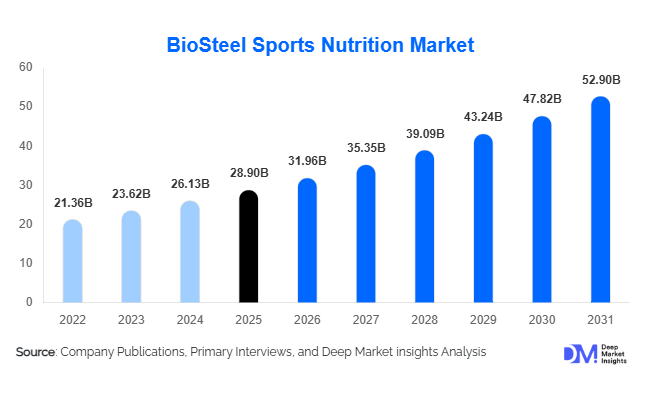
According to Deep Market Insights, the global BioSteel sports nutrition market size was valued at USD 28.9 billion in 2025 and is projected to grow from USD 31.96 billion in 2026 to reach USD 52.90 billion by 2031, expanding at a CAGR of 10.6% during the forecast period (2026–2031). The market growth is primarily driven by the increasing adoption of hydration-focused performance beverages, growing consumer participation in fitness and wellness activities, and rising demand for clean-label sports nutrition products among both athletes and mainstream consumers.
The market has evolved significantly from traditional bodybuilding supplements into a broader performance wellness category encompassing hydration drinks, protein beverages, plant-based nutrition, and recovery-focused functional products. Consumers are increasingly seeking low-sugar, natural, and electrolyte-rich formulations that support daily wellness alongside athletic performance. This shift has enabled sports nutrition brands to expand beyond professional athletes and attract lifestyle consumers, office workers, recreational fitness enthusiasts, and aging active populations.
North America continues to dominate the global market due to strong fitness culture, advanced retail penetration, and high consumer spending on premium wellness products. Meanwhile, Asia-Pacific is emerging as the fastest-growing regional market, fueled by rapid urbanization, expanding middle-class income, and growing gym memberships in countries such as China and India. Online retail channels, athlete endorsements, and social-media-driven fitness culture are further accelerating global product adoption.
Key Market Insights
- Hydration-focused sports beverages are rapidly outperforming traditional supplements, driven by increasing demand for sugar-free electrolyte drinks and clean-label formulations.
- Plant-based and natural ingredient sports nutrition products are gaining strong traction, particularly among millennials and Gen Z consumers focused on wellness-oriented lifestyles.
- North America dominates the global market, supported by mature fitness infrastructure, premium product penetration, and strong consumer spending on sports nutrition.
- Asia-Pacific is the fastest-growing regional market, led by expanding fitness culture, rising disposable incomes, and increasing e-commerce accessibility.
- Direct-to-consumer and online distribution channels are reshaping the market, allowing brands to engage consumers through subscriptions, influencer marketing, and personalized nutrition offerings.
- Technology integration, including AI-driven nutrition recommendations, wearable-device synchronization, and performance-tracking applications, is transforming consumer engagement and product personalization.
What are the latest trends in the BioSteel sports nutrition market?
Clean-Label and Functional Hydration Products Gaining Momentum
Consumers are increasingly shifting toward sports nutrition products formulated with natural ingredients, low sugar content, and functional health benefits. Hydration beverages enriched with electrolytes, vitamins, amino acids, and immunity-support ingredients are gaining mainstream popularity among athletes and everyday consumers alike. This trend is encouraging companies to reformulate existing products by removing artificial sweeteners, colors, and preservatives while emphasizing ingredient transparency and sustainability. Brands are also introducing multifunctional beverages that combine hydration, recovery, and cognitive wellness benefits within a single formulation. Functional hydration products are increasingly positioned not only for athletic recovery but also for workplace wellness, daily energy management, and active lifestyle support.
Digital Commerce and Personalized Nutrition Expanding Rapidly
The rapid growth of e-commerce and direct-to-consumer platforms is reshaping the global sports nutrition landscape. Brands are increasingly leveraging influencer-led marketing campaigns, subscription models, and AI-powered nutrition personalization tools to improve consumer engagement and retention. Wearable fitness devices and health-tracking apps are also supporting personalized product recommendations based on hydration levels, exercise intensity, and recovery needs. Younger consumers are particularly responsive to digital-first nutrition brands that integrate convenience, community engagement, and customized wellness experiences. Companies are further investing in online-exclusive product launches, athlete-driven social media campaigns, and data-driven loyalty programs to strengthen customer acquisition and long-term brand positioning.
What are the key drivers in the BioSteel sports nutrition market?
Growing Global Fitness and Wellness Participation
The increasing participation in fitness activities, gym memberships, endurance sports, and home workout programs is significantly driving demand for sports nutrition products globally. Consumers are increasingly incorporating hydration beverages, protein supplements, and recovery products into their daily routines to support active lifestyles and long-term wellness goals. The expansion of organized sports participation among women, teenagers, and older adults is also broadening the addressable market for performance nutrition products. Corporate wellness initiatives and workplace fitness programs are further contributing to sustained product consumption beyond traditional athletic demographics.
Rising Demand for Sugar-Free and Clean-Label Sports Nutrition
Consumers are actively seeking healthier alternatives to conventional energy drinks and sugary beverages, accelerating demand for clean-label hydration products. Sports drinks with natural sweeteners, transparent ingredient sourcing, and clinically supported formulations are gaining strong market acceptance. The growing awareness regarding obesity, diabetes, and metabolic health is further supporting the transition toward low-calorie and functional hydration beverages. Companies that emphasize natural ingredients, banned-substance testing certifications, and sustainable sourcing practices are strengthening brand loyalty among health-conscious consumers globally.
What are the restraints for the global market?
Raw Material Price Volatility
The sports nutrition industry remains vulnerable to fluctuations in the prices of whey protein, amino acids, packaging materials, and specialty ingredients. Rising dairy costs, supply chain disruptions, and transportation inflation can significantly impact manufacturer profit margins and retail pricing strategies. Smaller and emerging brands are particularly affected by raw material volatility due to limited procurement scale and reduced pricing flexibility. In addition, increasing demand for premium natural ingredients and plant-based proteins is creating sourcing challenges across global supply chains.
Regulatory and Labeling Compliance Challenges
The market faces increasing regulatory scrutiny regarding product claims, ingredient transparency, athlete safety certifications, and nutritional labeling standards. Different regulatory frameworks across North America, Europe, and Asia-Pacific create operational complexity for multinational manufacturers. Sports nutrition brands must also comply with strict testing protocols related to banned substances and performance-enhancing ingredients. Failure to meet evolving compliance standards can result in product recalls, reputational risks, and restricted market access, particularly within professional sports and institutional purchasing channels.
What are the key opportunities in the BioSteel sports nutrition industry?
Expansion into Mainstream Wellness and Lifestyle Nutrition
The growing convergence between sports nutrition and everyday wellness presents a major opportunity for industry participants. Consumers increasingly use hydration beverages, protein drinks, and functional supplements for general health, energy management, and daily recovery rather than exclusively for athletic performance. This trend is enabling sports nutrition companies to target office workers, aging populations, wellness-focused consumers, and preventive healthcare segments. Functional beverages with added immunity support, stress management, collagen, and adaptogenic ingredients are expected to create new high-growth product categories within the broader market.
Emerging Market Expansion and Digital Penetration
Asia-Pacific, Latin America, and the Middle East are creating substantial growth opportunities due to expanding urban populations, increasing fitness awareness, and rising e-commerce penetration. Countries such as China, India, Brazil, Saudi Arabia, and the UAE are witnessing growing demand for hydration beverages and premium sports nutrition products. Digital retail channels are enabling global brands to enter these markets with lower operational barriers while directly engaging consumers through social media, athlete endorsements, and subscription-driven sales models. Personalized nutrition services and app-connected performance ecosystems are also expected to strengthen long-term growth potential across emerging economies.
Report Scope
| Report Metric | Details |
|---|---|
| Market Size in 2025 | USD 28.90 Billion |
| Market Size in 2026 | USD 31.96 Billion |
| Market Size in 2031 | USD 52.90 Billion |
| CAGR | 10.6% (2026-2031) |
| Base Year for Estimation | 2025 |
| Historical Data | 2022-2024 |
| Forecast Period | 2026-2031 |
| Report Coverage | Revenue Forecast, Competitive Landscape, Supply Chain Disruption, Growth Factors, Environment & Regulatory Landscape and Trends |
| Geographies Covered | North America, Europe, APAC, Middle East and Africa, LATAM |
| Countries Covered | U.S., Canada, U.K., Germany, France, Spain, Italy, Russia, Nordic, Benelux, Rest of Europe, China, Korea, Japan, India, Australia, Singapore, Taiwan, South East Asia, Rest of Asia-Pacific, UAE, Turky, Saudi Arabia, South Africa, Egypt, Nigeria, Rest of MEA, Brazil, Mexico, Argentina, Chile, Colombia, Rest of LATAM |
Explore more data points, trends and opportunities Download Free Sample Report
Product Type Insights
The global BioSteel sports nutrition market is witnessing substantial expansion across multiple product categories as consumers increasingly prioritize hydration, recovery, performance optimization, and preventive wellness. Among all product categories, sports drinks and hydration beverages continue to dominate the market, accounting for the largest revenue share globally. The dominance of hydration beverages is primarily supported by growing consumer awareness regarding electrolyte balance, physical recovery, and sustained energy management during both athletic and everyday activities. Consumers are increasingly shifting away from high-sugar carbonated beverages toward clean-label hydration solutions formulated with electrolytes, vitamins, minerals, and natural ingredients. This transition is significantly strengthening the market position of sugar-free and low-calorie sports drinks across professional sports, fitness training, and mainstream wellness consumption.Plant-based sports nutrition products are witnessing particularly strong momentum as vegan, vegetarian, and flexitarian dietary trends continue to expand globally. Consumers are increasingly seeking dairy-free, allergen-free, and environmentally sustainable protein alternatives formulated using pea protein, brown rice protein, soy protein, and other plant-derived ingredients. The rapid adoption of clean-label nutrition and ethical consumption patterns is encouraging sports nutrition manufacturers to diversify their plant-based product portfolios while investing in natural ingredient sourcing and transparent labeling strategies. As sustainability and health-conscious purchasing behaviors continue to influence global consumer preferences, plant-based performance nutrition products are expected to represent one of the fastest-growing product segments throughout the forecast period.In addition to hydration and protein categories, recovery supplements, branched-chain amino acid (BCAA) formulations, creatine products, pre-workout supplements, and endurance-enhancing nutritional solutions are also witnessing expanding market demand. Rising participation in high-intensity interval training, endurance sports, strength conditioning, and professional athletic programs is increasing the need for scientifically formulated recovery and performance optimization products. Sports nutrition companies are increasingly investing in research and development activities focused on clinically supported ingredients, functional blends, and personalized sports nutrition solutions tailored to different fitness objectives and consumer demographics.
Application Insights
Hydration and electrolyte balance applications represent the leading segment within the global BioSteel sports nutrition market, supported by growing awareness regarding physical performance, heat stress management, muscle recovery, and everyday wellness hydration. Increasing consumer understanding of dehydration-related fatigue, reduced athletic performance, and recovery delays has significantly accelerated the adoption of electrolyte-enhanced beverages among athletes, fitness enthusiasts, recreational sports participants, and mainstream consumers. The widespread popularity of fitness routines, outdoor recreational activities, and active lifestyle trends continues to strengthen demand for hydration-focused sports nutrition products globally.The hydration application segment is further benefiting from rising consumption among non-athletic consumers who increasingly view sports beverages as part of broader health and wellness routines rather than products exclusively intended for professional athletes. Functional hydration drinks enriched with vitamins, minerals, antioxidants, and immunity-support ingredients are gaining substantial traction among health-conscious consumers seeking healthier beverage alternatives. This evolving consumer perception is significantly broadening the addressable market for sports hydration products across diverse age groups and lifestyle categories.Energy enhancement and endurance performance applications are also witnessing significant growth driven by increasing participation in marathons, cycling events, endurance sports competitions, esports activities, and physically demanding recreational activities. Consumers are increasingly seeking products that improve stamina, reduce fatigue, and support sustained physical and mental performance. This trend is encouraging manufacturers to introduce innovative formulations containing natural caffeine sources, adaptogens, electrolytes, and functional ingredients that support both physical endurance and cognitive alertness.Furthermore, the growing integration of immunity support, stress management, and mental wellness ingredients into sports nutrition products is expanding the application scope of the industry. Functional beverages and supplements that combine hydration, recovery, and wellness benefits are becoming increasingly popular among consumers seeking holistic health solutions. As personalized nutrition trends continue to evolve, sports nutrition brands are expected to increasingly develop application-specific products tailored to individual fitness goals, lifestyle preferences, and age-specific nutritional requirements.
Distribution Channel Insights
Offline retail channels continue to dominate the global BioSteel sports nutrition market, supported by strong consumer preference for immediate product availability, physical product evaluation, and established retail purchasing habits. Supermarkets, hypermarkets, specialty nutrition stores, pharmacies, convenience stores, and fitness club retail outlets remain critical distribution channels for sports nutrition manufacturers worldwide. The widespread presence of organized retail infrastructure across developed economies continues to strengthen offline product accessibility while supporting high-volume sales across hydration beverages, protein products, and nutritional supplements.Specialty nutrition stores and fitness center retail outlets remain particularly important for premium sports nutrition products targeting professional athletes, bodybuilders, and serious fitness enthusiasts. Consumers purchasing advanced performance supplements and protein products often prefer specialized retail environments that provide personalized recommendations, product education, and access to premium formulations. This trend continues to support the relevance of specialty retail channels despite the rapid growth of digital commerce platforms.Direct-to-consumer (DTC) sales channels are becoming increasingly important for sports nutrition brands seeking stronger customer engagement, personalized marketing capabilities, and improved profit margins. Through proprietary e-commerce platforms, brands can directly communicate with consumers, collect valuable purchasing data, launch exclusive product offerings, and implement loyalty programs that strengthen long-term customer retention. Subscription-based purchasing models for hydration beverages, protein supplements, and wellness products are also supporting recurring revenue generation for market participants.Social commerce, influencer marketing, athlete endorsements, and digital fitness communities are further accelerating online sales growth globally. Fitness influencers, professional athletes, and wellness content creators increasingly shape purchasing decisions through social media engagement and product recommendations. As digital fitness ecosystems continue to expand, online retail channels are expected to play an increasingly critical role in driving global sports nutrition market growth throughout the forecast period.
Consumer Type Insights
Fitness enthusiasts represent the largest consumer segment within the global BioSteel sports nutrition market, supported by increasing gym memberships, expanding home fitness participation, and growing awareness regarding performance-focused nutrition. Rising consumer focus on physical fitness, muscle recovery, endurance enhancement, and healthy lifestyle management continues to drive strong demand for hydration beverages, protein supplements, amino acid products, and functional wellness nutrition solutions. The increasing influence of social media fitness culture and digital wellness communities is also encouraging broader adoption of sports nutrition products among mainstream consumers.The leading position of fitness enthusiasts within the market is largely driven by the rapid expansion of commercial gyms, boutique fitness studios, online workout platforms, and personalized training programs. Consumers are increasingly integrating sports nutrition products into their daily routines to support exercise recovery, maintain energy levels, and improve overall physical performance. This trend is particularly prominent among younger demographics who prioritize active lifestyles and preventive health management.Women-focused sports nutrition represents one of the fastest-growing consumer categories within the global market. Increasing female participation in fitness programs, sports activities, yoga, wellness training, and active lifestyle routines is driving demand for specialized products tailored to women’s nutritional preferences. Consumers are increasingly seeking low-calorie, clean-label, plant-based, and multifunctional wellness products that support hydration, metabolism, recovery, and overall wellness. Sports nutrition companies are responding by introducing gender-specific formulations and marketing strategies designed to appeal to female consumers.Additionally, aging active populations are emerging as an important growth driver within the sports nutrition industry. Older consumers are increasingly prioritizing protein intake, joint mobility support, muscle maintenance, and active aging solutions. As awareness regarding age-related muscle loss and preventive wellness continues to increase, demand for protein-enriched beverages, collagen supplements, and mobility-support nutritional products is expected to strengthen significantly over the forecast period.
Packaging Format Insights
Bottle packaging dominates the global BioSteel sports nutrition market due to the strong popularity of ready-to-drink hydration beverages, electrolyte drinks, and protein shakes. Bottled packaging formats provide superior portability, convenience, product safety, and ease of consumption, making them highly preferred among athletes, gym users, commuters, and everyday consumers seeking on-the-go nutrition solutions. The increasing pace of modern lifestyles and growing preference for convenient functional beverages continue to support the widespread adoption of bottled sports nutrition products.The dominance of bottle packaging is particularly evident within the hydration beverage category, where consumers prioritize portability and instant consumption during workouts, travel, sports participation, and daily activities. Manufacturers are increasingly investing in ergonomic bottle designs, resealable packaging technologies, and lightweight materials to enhance user convenience and strengthen product differentiation within highly competitive retail environments.Tubs and jars continue to maintain a strong presence within the protein powder and bulk supplement category, particularly among serious fitness enthusiasts, bodybuilders, and professional athletes who consume sports nutrition products regularly. Bulk packaging formats offer cost efficiency, higher product volumes, and long-term usability, making them highly suitable for consumers focused on sustained training and nutritional supplementation routines.Sustainability trends are increasingly influencing packaging innovation across the global sports nutrition industry. Consumers are becoming more environmentally conscious and increasingly prefer brands that utilize recyclable materials, reduced plastic content, lightweight packaging solutions, and environmentally responsible production processes. In response, manufacturers are investing in sustainable packaging technologies and eco-friendly supply chain strategies to strengthen brand positioning while meeting evolving consumer expectations regarding environmental responsibility.
Explore more data points, trends and opportunities Download Free Sample Report
BioSteel Sports Nutrition Market Segmentations
By Product Type
- Sports Drinks & Hydration Beverages
- Protein Powders & Protein Shakes
- Performance Supplements
- Recovery & Electrolyte Nutrition
- Sports Nutrition Bars & Gummies
- Plant-Based Sports Nutrition
By Application
- Hydration & Electrolyte Balance
- Muscle Building
- Muscle Recovery
- Energy & Endurance Enhancement
- Weight Management
- Daily Wellness & Active Nutrition
By Consumer Type
- Professional Athletes
- Fitness Enthusiasts
- Recreational Gym Users
- Bodybuilders & Strength Athletes
- Lifestyle & Wellness Consumers
- Women-Focused Sports Nutrition Consumers
By Distribution Channel
- Online Retail & D2C Platforms
- Supermarkets & Hypermarkets
- Specialty Nutrition Stores
- Pharmacies & Drug Stores
- Fitness Clubs & Gym Retail
- Convenience Stores
By Packaging Format
- Bottles
- Sachets & Stick Packs
- Tubs & Jars
- Cans
- Single-Serve Packs
Regional Insights
North America
North America remains the largest regional market for BioSteel sports nutrition products, accounting for a substantial share of global revenue in 2025. The region benefits from a highly developed sports culture, advanced retail infrastructure, strong consumer purchasing power, and widespread awareness regarding fitness-focused nutrition. The United States dominates regional demand due to extensive participation in professional sports, recreational fitness activities, endurance events, and organized athletic programs. High gym membership penetration, strong wellness spending, and increasing consumer preference for premium hydration and recovery products continue to support market expansion throughout the region.Canada also represents a significant regional market supported by growing demand for clean-label hydration beverages, plant-based proteins, and scientifically formulated wellness products. The strong popularity of outdoor sports, recreational fitness participation, and healthy lifestyle trends continues to strengthen long-term market growth across both the United States and Canada. Additionally, the rapid expansion of e-commerce platforms, influencer-driven marketing campaigns, and personalized nutrition solutions continues to enhance consumer accessibility and market penetration across North America.
Europe
Europe represents a mature yet steadily expanding sports nutrition market led by Germany, the United Kingdom, France, Italy, and Spain. The region benefits from growing health awareness, increasing participation in fitness activities, and rising consumer demand for clean-label nutritional products. Germany remains the largest European market due to strong fitness culture, advanced sports nutrition retail infrastructure, and increasing adoption of plant-based performance nutrition products.The United Kingdom continues to witness growing demand for hydration beverages, ready-to-drink protein products, and functional wellness supplements driven by increasing health-conscious consumer behavior and rising participation in fitness and recreational sports activities. France, Italy, and Spain are also experiencing steady market growth supported by increasing wellness awareness, expanding gym memberships, and broader acceptance of sports nutrition products among mainstream consumers. The growing convergence of sports nutrition and functional food industries is expected to further strengthen long-term regional market development.
Asia-Pacific
Asia-Pacific is the fastest-growing regional market within the global BioSteel sports nutrition industry and is forecast to register exceptionally strong growth throughout the forecast period. Rapid urbanization, expanding middle-class populations, rising disposable incomes, and increasing awareness regarding fitness and preventive healthcare are significantly accelerating regional market expansion. China dominates regional demand due to its large consumer base, rapidly expanding fitness industry, and increasing adoption of western wellness trends among younger consumers.Southeast Asian countries are also experiencing growing sports nutrition adoption supported by increasing western fitness influence, urban lifestyle changes, and expanding participation in organized sports and recreational fitness activities. The region’s young population demographics and rapidly growing digital commerce ecosystem are expected to create substantial long-term growth opportunities for sports nutrition manufacturers.
Latin America
Latin America is gradually emerging as a promising sports nutrition market led primarily by Brazil and Mexico. The region is benefiting from increasing urbanization, rising health consciousness, expanding fitness center penetration, and growing awareness regarding hydration-focused nutrition products. Brazil represents the largest regional market due to its strong sports culture, widespread participation in football and fitness activities, and growing consumer interest in protein supplements and electrolyte beverages.Mexico continues to witness rising consumption of protein products, hydration beverages, and wellness supplements due to increasing urban health awareness and broader wellness trends. International manufacturers are actively strengthening regional distribution networks while leveraging e-commerce platforms, athlete endorsements, and localized marketing strategies to improve product visibility and consumer engagement throughout Latin America.
Middle East & Africa
The Middle East & Africa region is experiencing steady growth within the global BioSteel sports nutrition market driven by increasing investments in sports infrastructure, rising wellness tourism, and expanding government-led fitness initiatives. Countries such as the United Arab Emirates and Saudi Arabia are emerging as important premium sports nutrition markets due to their high-income consumer populations, expanding fitness industries, and increasing participation in organized sports and wellness activities.South Africa remains a significant regional market supported by strong sports culture, increasing gym memberships, and growing awareness regarding recovery-focused nutrition and hydration products. Rising urbanization, expanding retail infrastructure, and increasing digital commerce penetration are also supporting sports nutrition accessibility across several African markets. As consumer awareness regarding fitness, wellness, and preventive healthcare continues to improve, the Middle East & Africa region is expected to witness sustained long-term growth within the global sports nutrition industry.
Key Players in the BioSteel Sports Nutrition Market
- PepsiCo
- The Coca-Cola Company
- Abbott Laboratories
- Glanbia plc
- MusclePharm Corporation
- Herbalife Ltd.
- Nestlé Health Science
- Nutrabolt
- GNC Holdings LLC
- BioSteel Sports Nutrition Inc.