Beauty Devices Market Size
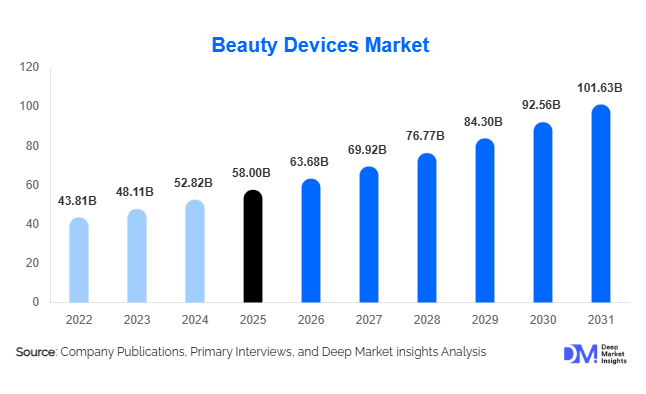
According to Deep Market Insights, the global beauty devices market was valued at USD 58 billion in 2025 and is projected to grow from USD 63.68 billion in 2026 to reach USD 101.63 billion by 2031, expanding at a CAGR of 9.8% during the forecast period (2026–2031). The beauty devices market growth is primarily driven by the rising demand for at-home aesthetic solutions, increasing consumer focus on skincare and anti-aging treatments, and rapid technological advancements in laser, LED, and radiofrequency-based devices.
Key Market Insights
- At-home beauty devices are dominating global adoption, as consumers increasingly prefer cost-effective and convenient alternatives to clinical treatments.
- Anti-aging and skin rejuvenation devices remain the most in-demand category, driven by aging populations and rising skincare awareness.
- North America leads the global market due to strong purchasing power and early adoption of advanced cosmetic technologies.
- Asia-Pacific is the fastest-growing region, fueled by expanding middle-class populations and increasing beauty consciousness in China, India, and South Korea.
- E-commerce channels are transforming distribution, with online retail accounting for a majority of global beauty device sales.
- Smart and AI-enabled beauty devices are emerging as a key innovation trend, offering personalized skincare diagnostics and treatment recommendations.
What are the latest trends in the beauty devices market?
Rise of Smart and Connected Beauty Devices
One of the most significant trends shaping the market is the integration of AI and IoT technologies into beauty devices. Modern skincare tools now offer real-time skin analysis, personalized treatment plans, and app-based tracking systems. These smart devices enhance user engagement by providing measurable results and adaptive recommendations. Consumers are increasingly attracted to devices that combine diagnostics and treatment in a single ecosystem, enabling data-driven skincare routines. This trend is also encouraging subscription-based models for consumables and software upgrades, creating recurring revenue streams for manufacturers.
Expansion of Non-Invasive Aesthetic Treatments
There is a growing shift toward non-invasive beauty treatments that eliminate the need for surgical procedures. Technologies such as laser therapy, microcurrent stimulation, and radiofrequency skin tightening are gaining rapid acceptance. These solutions offer professional-grade results with minimal downtime, making them highly appealing to working professionals and younger consumers. Manufacturers are focusing on improving safety, portability, and ease of use, which is further accelerating adoption in home-use segments. The increasing acceptance of dermatology-inspired at-home devices is bridging the gap between clinical and consumer beauty care.
What are the key drivers in the beauty devices market?
Growing Demand for At-Home Beauty Solutions
The shift toward at-home personal care is a major growth driver for the beauty devices market. Consumers are increasingly opting for devices that offer salon-like results without the recurring cost of professional treatments. This trend was significantly accelerated by the pandemic and continues to persist due to convenience and affordability. Devices for facial cleansing, hair removal, and skin rejuvenation are particularly popular, supported by easy availability through e-commerce platforms and strong influencer-driven marketing campaigns.
Rising Awareness of Skincare and Anti-Aging
Global awareness regarding skincare routines and anti-aging solutions is rising rapidly, especially among millennials and Gen Z populations. Social media platforms and beauty influencers have significantly contributed to educating consumers about advanced skincare technologies. This has led to increased demand for devices targeting wrinkles, pigmentation, acne, and skin tightening. Additionally, aging populations in developed regions are driving sustained demand for anti-aging technologies, further strengthening market expansion.
What are the restraints for the global market?
High Product Costs and Limited Affordability
Advanced beauty devices, particularly those using laser and RF technologies, remain relatively expensive for a large segment of consumers. While entry-level products are widely available, premium devices with clinical-grade performance often carry high price tags. This limits penetration in price-sensitive markets, especially in developing economies. Additionally, maintenance costs and consumable replacements further increase the total cost of ownership.
Regulatory and Safety Compliance Challenges
Beauty devices are subject to strict regulatory frameworks in several regions, particularly for laser-based and medical-grade equipment. Compliance requirements can delay product launches and increase development costs. Furthermore, improper usage by consumers due to a lack of professional supervision can lead to safety concerns, impacting consumer confidence and slowing market adoption in certain segments.
What are the key opportunities in the beauty devices industry?
Expansion of Personalized and AI-Driven Skincare Ecosystems
The integration of artificial intelligence presents a major opportunity for manufacturers to develop fully personalized skincare ecosystems. Devices that analyze skin conditions and recommend tailored treatments are gaining strong traction. Companies can expand into subscription-based services, offering continuous updates, skincare analytics, and personalized product recommendations. This shift toward personalization enhances customer loyalty and creates long-term revenue opportunities beyond hardware sales.
Growth in Emerging and Untapped Markets
Emerging economies in Asia-Pacific, Latin America, and the Middle East present substantial growth potential due to rising disposable incomes and increasing beauty consciousness. Localized product innovation tailored to regional skin types and environmental conditions can significantly improve adoption rates. Additionally, expanding digital infrastructure and e-commerce penetration in these regions are enabling global brands to reach new consumer bases efficiently, supporting long-term market expansion.
Report Scope
| Report Metric | Details |
|---|---|
| Market Size in 2025 | USD 58 Billion |
| Market Size in 2026 | USD 63.68 Billion |
| Market Size in 2031 | USD 101.63 Billion |
| CAGR | 9.8% (2026-2031) |
| Base Year for Estimation | 2025 |
| Historical Data | 2022-2024 |
| Forecast Period | 2026-2031 |
| Report Coverage | Revenue Forecast, Competitive Landscape, Supply Chain Disruption, Growth Factors, Environment & Regulatory Landscape and Trends |
| Geographies Covered | North America, Europe, APAC, Middle East and Africa, LATAM |
| Countries Covered | U.S., Canada, U.K., Germany, France, Spain, Italy, Russia, Nordic, Benelux, Rest of Europe, China, Korea, Japan, India, Australia, Singapore, Taiwan, South East Asia, Rest of Asia-Pacific, UAE, Turky, Saudi Arabia, South Africa, Egypt, Nigeria, Rest of MEA, Brazil, Mexico, Argentina, Chile, Colombia, Rest of LATAM |
Explore more data points, trends and opportunities Download Free Sample Report
Product Type Insights
Skin rejuvenation and anti-aging devices represent the leading product segment, accounting for approximately 30% of the global market share in 2025. This dominance is primarily driven by the rising global demand for non-invasive aesthetic treatments such as wrinkle reduction, skin tightening, and collagen stimulation. Increasing aging populations in developed regions, combined with growing awareness of preventive skincare among younger consumers, have accelerated adoption. Technological advancements in radiofrequency (RF), microcurrent, and ultrasound-based devices have further enhanced treatment efficacy, positioning this segment as the primary revenue generator. Hair removal devices follow closely with nearly 28% share, supported by the widespread adoption of IPL and laser-based at-home systems that offer long-term convenience and cost savings compared to salon treatments. Cleansing devices maintain steady demand due to their integration into daily skincare routines, while acne treatment devices are gaining traction among Gen Z consumers, driven by rising skin health awareness. Hair growth devices are expanding steadily due to increasing cases of hair thinning and alopecia, particularly in urban populations. Additionally, the growing preference for multifunctional devices that combine cleansing, anti-aging, and acne treatment features is reshaping product innovation strategies and driving premiumization across the segment.
Application Insights
Anti-aging and skin rejuvenation applications dominate the beauty devices market, contributing the largest share due to strong demand for solutions addressing wrinkles, fine lines, and skin elasticity. This segment is primarily driven by aging demographics in North America and Europe, along with increasing adoption of preventive skincare among millennials. Facial cleansing and acne treatment applications are among the fastest-growing segments, fueled by rising skincare awareness and strong digital influence among younger consumers. Hair removal continues to be a key application area due to its long-term cost efficiency and convenience, particularly with the growth of at-home laser devices. Skin tightening and rejuvenation applications are also witnessing robust growth across both home-use and professional settings, supported by technological advancements and increasing acceptance of non-invasive procedures. Emerging applications such as oxygen infusion therapy, LED-based dermatology treatments, and combination therapies are further expanding the functional scope of beauty devices, creating new revenue streams for manufacturers.
Distribution Channel Insights
Online retail remains the dominant distribution channel, accounting for approximately 55% of total global sales in 2025. This leadership is driven by the rapid expansion of e-commerce platforms, increasing consumer preference for convenience, and the influence of digital marketing and social media endorsements. Brand-owned websites and direct-to-consumer (D2C) platforms are gaining traction as they allow companies to offer personalized recommendations, subscription models, and better pricing control, thereby improving profit margins. Offline channels, including specialty beauty stores, dermatology clinics, and large-format retail outlets, continue to play a critical role, particularly in the premium segment where consumers prefer in-store demonstrations and expert consultations before purchasing high-value devices. Additionally, omnichannel strategies are becoming increasingly important, with brands integrating online and offline experiences to enhance customer engagement and drive conversions.
End-Use Insights
The personal/home-use segment dominates the beauty devices market, accounting for nearly 65% of total demand in 2025. This segment’s leadership is driven by the increasing consumer preference for convenient, cost-effective, and private beauty treatments. The availability of affordable, easy-to-use devices has significantly expanded the consumer base, particularly among urban populations and younger demographics. The commercial segment, which includes salons, dermatology clinics, and medspas, continues to grow steadily, supported by rising demand for professional-grade treatments and advanced aesthetic procedures. A key trend shaping this segment is the convergence between medical aesthetics and consumer beauty, leading to hybrid usage models where devices are used both in clinical settings and at home. Additionally, export-driven demand remains strong, with Asia-Pacific serving as a major manufacturing hub supplying devices to North America and Europe, thereby supporting global market expansion.
Age Group Insights
Consumers aged 31–50 years represent the largest share of the beauty devices market, driven by higher disposable incomes and a strong focus on anti-aging and preventive skincare solutions. This demographic is the primary adopter of premium devices, particularly those offering skin tightening and rejuvenation benefits. The 18–30 age group is the fastest-growing segment, fueled by increasing awareness of skincare, strong social media influence, and demand for acne treatment and cleansing devices. Consumers aged 51–65 years contribute significantly to the premium segment, particularly for advanced anti-aging and therapeutic devices designed to address mature skin concerns. Meanwhile, the above-65 segment, although smaller in size, is emerging as a niche market with growing demand for gentle, easy-to-use, and safety-focused devices tailored for aging skin. This diversification across age groups is enabling manufacturers to develop targeted product portfolios and expand their consumer reach.
Explore more data points, trends and opportunities Download Free Sample Report
Beauty Devices Market Segmentations
By Product Type
- Hair Removal Devices
- Skin Cleansing Devices
- Acne Treatment Devices
- Skin Rejuvenation & Anti-Aging Devices
- Hair Growth Devices
- Oxygen & Steaming Devices
- Dermaplaning & Skin Tightening Tools
By Technology
- Laser-Based Devices
- Light/LED-Based Devices
- Radiofrequency (RF) Devices
- Ultrasound-Based Devices
- Microcurrent Devices
- Mechanical Devices
By Application
- Hair Removal
- Skin Cleansing
- Acne Treatment
- Anti-Aging & Skin Rejuvenation
- Hair Growth Stimulation
- Skin Tightening
By End-Use
- Personal/Home Use
- Commercial
By Distribution Channel
- Online Retail
- Offline Retail
Regional Insights
North America
North America leads the global beauty devices market, accounting for approximately 32% of the total market share in 2025. The United States dominates regional demand due to high disposable income levels, strong consumer awareness of aesthetic treatments, and early adoption of advanced technologies such as AI-enabled skincare devices. The region benefits from a well-established dermatology and medical aesthetics industry, which supports both professional and at-home device adoption. Additionally, the strong presence of leading market players, extensive e-commerce penetration, and high spending on personal care products are key drivers of growth. Canada also contributes steadily, supported by rising interest in wellness and skincare solutions, along with increasing adoption of premium beauty technologies.
Europe
Europe holds around 25% of the global market share, with major contributions from Germany, the United Kingdom, and France. The region’s growth is driven by aging populations, increasing demand for anti-aging solutions, and a strong emphasis on sustainability and regulatory compliance. European consumers show a high preference for dermatologically tested, eco-friendly, and clinically validated devices, which is encouraging innovation in sustainable product design. Government regulations ensuring product safety and efficacy further enhance consumer confidence. Additionally, rising awareness of advanced skincare routines and the presence of established beauty brands are supporting steady market expansion across both premium and mid-range segments.
Asia-Pacific
Asia-Pacific accounts for approximately 28% of the global market and is the fastest-growing region, with a projected CAGR exceeding 11%. China leads regional demand due to its large consumer base, strong e-commerce ecosystem, and expanding middle-class population. Japan and South Korea serve as innovation hubs, driving advancements in skincare technologies and influencing global beauty trends. India is emerging as a high-growth market, supported by increasing urbanization, rising disposable incomes, and growing awareness of personal grooming. Key growth drivers in the region include rapid digital adoption, strong influence of beauty trends, and increasing availability of affordable devices, making APAC a critical growth engine for the global market.
Latin America
Latin America represents approximately 7% of global demand, with Brazil and Mexico as the leading markets. Growth in the region is driven by increasing urbanization, rising disposable incomes, and growing interest in personal grooming and aesthetic treatments. The market is witnessing a shift toward mid-range and affordable devices, as consumers seek cost-effective alternatives to salon treatments. Expanding retail networks and improving e-commerce penetration are further supporting market growth. Additionally, the increasing influence of global beauty trends and social media is driving consumer awareness and adoption of advanced beauty devices.
Middle East & Africa
The Middle East & Africa region holds around 8% of the global market share, with the UAE and Saudi Arabia leading due to high consumer spending on luxury beauty products and strong demand for premium skincare solutions. The region benefits from a growing expatriate population and the increasing influence of Western beauty standards. In Africa, South Africa is a key contributor, supported by a developing beauty and wellness industry. Growth drivers include rising disposable incomes, increasing adoption of advanced aesthetic treatments, and expansion of retail and distribution channels. Additionally, the growing presence of international brands and increasing awareness of skincare technologies are supporting long-term market development in the region.
Key Players in the Beauty Devices Market
- Philips
- Panasonic
- L’Oréal
- Procter & Gamble
- Nu Skin Enterprises
- YA-MAN
- MTG Co. Ltd.
- Foreo
- Silk’n
- Tria Beauty
- Conair
- Cynosure
- Alma Lasers
- Home Skinovations
- Candela Corporation