Bean-to-Bar Chocolate Market Size
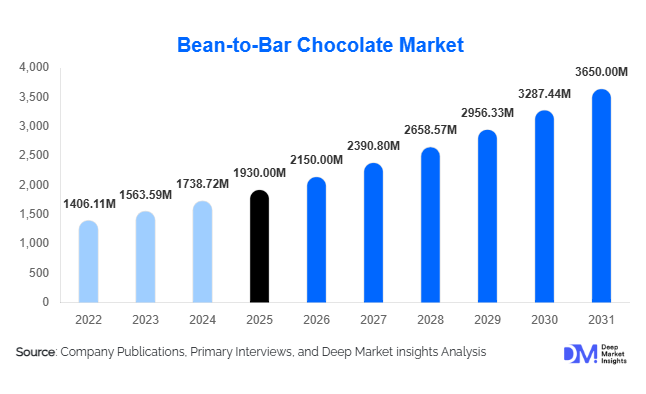
According to Deep Market Insights, the global bean-to-bar chocolate market size was valued at USD 1,930 million in 2025 and is projected to grow from USD 2,150 million in 2026 to reach USD 3,650 million by 2031, expanding at a CAGR of 11.2% during the forecast period (2026–2031). The bean-to-bar chocolate market growth is primarily driven by increasing consumer demand for premium, ethically sourced, and transparently produced chocolate, along with rising awareness regarding cocoa origin, sustainability, and artisanal craftsmanship.
Key Market Insights
- Bean-to-bar chocolate is increasingly positioned as a premium and ethical alternative, driven by growing consumer awareness of direct trade and sustainable sourcing practices.
- Single-origin and dark chocolate segments dominate, supported by demand for unique flavor profiles and perceived health benefits.
- North America leads the global market, accounting for the highest share due to strong artisanal food trends and premium consumption patterns.
- Asia-Pacific is the fastest-growing region, fueled by rising disposable incomes and evolving taste preferences in countries like India and China.
- Direct-to-consumer (D2C) channels are expanding rapidly, enabling small-scale producers to reach global audiences with higher margins.
- Sustainability and traceability technologies, including blockchain-based sourcing and carbon-neutral production, are reshaping the competitive landscape.
What are the latest trends in the bean-to-bar chocolate market?
Rising Demand for Single-Origin and Craft Chocolate
Consumers are increasingly gravitating toward single-origin bean-to-bar chocolate, which highlights the unique terroir and flavor characteristics of cocoa beans sourced from specific regions such as Ecuador, Madagascar, and India. This trend reflects a broader shift toward premiumization and culinary exploration, where chocolate is treated similarly to wine or coffee. Manufacturers are emphasizing storytelling, origin transparency, and small-batch production techniques to differentiate their offerings. Limited-edition releases and seasonal batches are gaining popularity, further reinforcing exclusivity and driving repeat purchases among enthusiasts seeking novel taste experiences.
Digitalization and Direct-to-Consumer Expansion
The rapid growth of e-commerce and direct-to-consumer (D2C) models is transforming the bean-to-bar chocolate market. Artisanal producers are leveraging online platforms, subscription services, and social media marketing to engage directly with consumers and build brand loyalty. Digital channels enable producers to bypass traditional retail intermediaries, resulting in higher profit margins and enhanced customer insights. Subscription-based chocolate boxes, curated tasting kits, and personalized gifting options are emerging as key growth drivers, particularly among urban and tech-savvy consumers.
What are the key drivers in the bean-to-bar chocolate market?
Growing Preference for Premium and Artisanal Food Products
The global shift toward premium and artisanal food consumption is a major driver of the bean-to-bar chocolate market. Consumers are increasingly seeking high-quality products with authentic flavors, minimal processing, and superior ingredients. Bean-to-bar chocolate aligns with this trend by offering handcrafted production, high cocoa content, and unique taste profiles. The willingness of consumers to pay a premium for quality and authenticity is significantly boosting market growth.
Increasing Awareness of Ethical Sourcing and Sustainability
Heightened awareness regarding ethical sourcing practices, including fair wages for farmers and environmentally sustainable production, is driving demand for bean-to-bar chocolate. Direct trade models and transparent supply chains are becoming key differentiators for brands. Consumers are actively choosing products that support sustainable agriculture and social responsibility, encouraging manufacturers to adopt certifications such as organic and fair trade.
What are the restraints for the global market?
High Production Costs and Premium Pricing
Bean-to-bar chocolate production involves small-batch processing, high-quality cocoa beans, and ethical sourcing practices, leading to significantly higher costs compared to conventional chocolate. This results in premium pricing, which limits accessibility in price-sensitive markets and restricts mass adoption.
Supply Chain Constraints and Cocoa Price Volatility
The availability of high-quality cocoa beans is subject to climatic conditions, geopolitical factors, and agricultural challenges. Fluctuating cocoa prices and supply chain disruptions can impact production consistency and profitability. Maintaining direct relationships with farmers also requires significant operational effort, posing scalability challenges for manufacturers.
What are the key opportunities in the bean-to-bar chocolate industry?
Expansion in Emerging Markets
Emerging economies such as India, China, and Brazil present significant growth opportunities due to rising disposable incomes and increasing exposure to premium food products. Localized production using domestic cocoa varieties and region-specific flavors can help brands penetrate these markets effectively. Growing urbanization and the expansion of modern retail channels further support demand growth.
Integration of Sustainability and Traceability Technologies
The adoption of advanced technologies such as blockchain for supply chain transparency and carbon-neutral production processes is creating new growth avenues. Brands that effectively communicate their sustainability initiatives and ethical sourcing practices can command higher price premiums and build strong customer loyalty. Investments in regenerative agriculture and eco-friendly packaging are also gaining traction.
Report Scope
| Report Metric | Details |
|---|---|
| Market Size in 2025 | USD 1930 Million |
| Market Size in 2026 | USD 2150 Million |
| Market Size in 2031 | USD 3650 Million |
| CAGR | 11.2% (2026-2031) |
| Base Year for Estimation | 2025 |
| Historical Data | 2022-2024 |
| Forecast Period | 2026-2031 |
| Report Coverage | Revenue Forecast, Competitive Landscape, Supply Chain Disruption, Growth Factors, Environment & Regulatory Landscape and Trends |
| Geographies Covered | North America, Europe, APAC, Middle East and Africa, LATAM |
| Countries Covered | U.S., Canada, U.K., Germany, France, Spain, Italy, Russia, Nordic, Benelux, Rest of Europe, China, Korea, Japan, India, Australia, Singapore, Taiwan, South East Asia, Rest of Asia-Pacific, UAE, Turky, Saudi Arabia, South Africa, Egypt, Nigeria, Rest of MEA, Brazil, Mexico, Argentina, Chile, Colombia, Rest of LATAM |
Explore more data points, trends and opportunities Download Free Sample Report
Product Type Insights
The bean-to-bar chocolate market is characterized by a strong emphasis on quality, origin transparency, and craftsmanship, with product type segmentation playing a pivotal role in shaping consumer preferences and brand positioning. Among the various product categories, dark chocolate continues to dominate the global landscape, accounting for approximately 52% of the market share in 2025. This leadership position is primarily driven by its high cocoa content, which not only delivers a richer and more complex flavor profile but also aligns with growing consumer awareness regarding health and wellness. Dark chocolate is widely perceived as a functional indulgence, offering antioxidant properties and lower sugar content compared to other variants. Furthermore, its ability to highlight terroir-specific characteristics—such as the unique flavor notes derived from cocoa beans sourced from different regions—makes it particularly appealing to discerning consumers seeking authenticity and premium experiences.Specialty and limited-edition products are further contributing to market differentiation and premiumization. These offerings often highlight rare cocoa origins, single-estate sourcing, or innovative production techniques such as stone grinding and small-batch roasting. By emphasizing storytelling and craftsmanship, brands are able to command higher price points and strengthen their positioning in the luxury segment. Overall, the product type landscape in the bean-to-bar chocolate market reflects a dynamic interplay between tradition, innovation, and evolving consumer expectations, with premium dark chocolate continuing to lead as the primary growth driver.
Application Insights
The application landscape of the bean-to-bar chocolate market is diverse and continuously expanding, driven by increasing consumer appreciation for high-quality confectionery and the integration of artisanal chocolate into various consumption contexts. Retail consumption remains the largest application segment, contributing approximately 61% of the global market share. This dominance is largely attributed to the growing demand for premium chocolate products for personal consumption as well as gifting purposes. Consumers are increasingly seeking products that offer not only superior taste but also ethical sourcing, clean-label ingredients, and distinctive packaging. The rise of premium gifting culture, particularly during festive seasons and special occasions, has further strengthened the retail segment’s position as a key revenue generator.In addition, the luxury hospitality sector is playing an increasingly important role in expanding the application scope of bean-to-bar chocolate. High-end hotels and resorts are integrating artisanal chocolate into their guest experiences through curated amenities, in-room offerings, and exclusive tasting sessions. This not only enhances the perceived value of the hospitality experience but also introduces new consumer segments to premium chocolate products. Collectively, these application dynamics underscore the versatility of bean-to-bar chocolate and highlight the retail segment as the leading driver of market growth.
Distribution Channel Insights
The distribution landscape of the bean-to-bar chocolate market has undergone significant transformation in recent years, driven by digitalization, changing consumer purchasing behavior, and the need for direct brand-consumer engagement. Direct-to-consumer (D2C) channels have emerged as the dominant distribution segment, accounting for approximately 38% of the global market share. This growth is primarily supported by the rapid expansion of e-commerce platforms, brand-owned websites, and subscription-based sales models. D2C channels enable manufacturers to maintain greater control over pricing, branding, and customer experience, while also facilitating the collection of valuable consumer data for targeted marketing and product development.Online marketplaces are expanding their reach, particularly in emerging markets where access to specialty retail infrastructure may be limited. By leveraging established logistics networks and customer bases, these platforms enable smaller and independent chocolate makers to access a broader audience. Meanwhile, boutique chocolate shops and cafés serve as experiential touchpoints, allowing brands to create immersive environments where consumers can learn about the production process, taste different varieties, and connect with the brand’s story.Overall, the distribution channel landscape is increasingly shaped by the dominance of D2C strategies, which serve as the primary driver of growth by enhancing accessibility, personalization, and brand engagement.
End-Use Insights
The end-use segmentation of the bean-to-bar chocolate market reflects a diverse range of consumption patterns, with retail consumers representing the largest and most influential segment. The dominance of retail consumers is driven by increasing home consumption, rising disposable incomes, and a growing preference for premium and artisanal food products. Consumers are increasingly viewing chocolate not merely as a treat but as an experience, seeking products that offer superior quality, ethical sourcing, and unique flavor profiles. The trend toward premium gifting has further reinforced the importance of the retail segment, as consumers look for high-quality and aesthetically appealing products for personal and social occasions.Export-driven demand plays a significant role in shaping the global market, with developed regions such as the United States, the United Kingdom, Germany, and Japan acting as major importers of high-quality bean-to-bar chocolate. This trend is driven by strong consumer awareness, higher purchasing power, and a well-established culture of premium food consumption. Overall, the retail consumer segment remains the leading driver of market growth, supported by evolving consumption patterns and increasing demand for premium products.
Explore more data points, trends and opportunities Download Free Sample Report
Bean-to-Bar Chocolate Market Segmentations
By Product Type
- Dark Chocolate
- Milk Chocolate
- White Chocolate
- Flavored/Infused Chocolate
- Specialty & Limited Edition Chocolate
By Cocoa Origin
- Single-Origin Chocolate
- Blended-Origin Chocolate
By Processing Type
- Organic Certified
- Conventional
- Fair-Trade Certified
- Direct Trade
By Distribution Channel
- Direct-to-Consumer (D2C)
- Specialty Retail Stores
- Gourmet & Premium Supermarkets
- Online Marketplaces
- Cafés & Boutique Chocolate Shops
By End-Use
- Retail Consumers
- Foodservice
- Corporate Gifting
- Luxury Hospitality
Regional Insights
North America
North America accounts for approximately 34% of the global bean-to-bar chocolate market share in 2025, making it the leading regional market. The United States serves as the primary growth engine, supported by a well-established artisanal chocolate industry, high consumer awareness, and strong demand for premium and ethically sourced products. Consumers in this region are increasingly prioritizing transparency, sustainability, and clean-label ingredients, which align closely with the principles of the bean-to-bar movement. The presence of numerous small and medium-sized chocolate makers, along with a thriving specialty retail ecosystem, further strengthens market growth.Canada also contributes significantly to regional demand, particularly in urban centers where consumers exhibit a strong preference for gourmet and organic products. The growth of e-commerce and subscription-based models has enhanced accessibility and convenience, while increasing interest in experiential consumption—such as chocolate tastings and factory tours—has further boosted market engagement. Overall, key growth drivers in North America include high disposable incomes, strong premiumization trends, increasing focus on ethical sourcing, and the rapid expansion of direct-to-consumer channels.
Europe
Europe holds approximately 31% of the global market share, making it the second-largest regional market. The region’s long-standing chocolate heritage and deep-rooted consumption culture provide a strong foundation for the growth of the bean-to-bar segment. Key markets such as the United Kingdom, Germany, France, and Switzerland are characterized by high consumer expectations in terms of quality, taste, and authenticity. European consumers are particularly receptive to organic, fair-trade, and sustainably sourced products, which has driven the adoption of bean-to-bar chocolate across various demographics.The presence of established premium chocolate brands, along with a growing number of artisanal producers, has created a competitive and dynamic market environment. Additionally, stringent regulatory standards and labeling requirements in the European Union have increased consumer trust and encouraged transparency in the supply chain. The region also benefits from a strong tourism sector, which supports demand for premium and locally crafted chocolate products. Key growth drivers in Europe include a strong tradition of chocolate consumption, increasing demand for organic and ethical products, high purchasing power, and continuous innovation in premium offerings.
Asia-Pacific
The Asia-Pacific region is the fastest-growing market for bean-to-bar chocolate, with a projected CAGR of approximately 13%. Rapid urbanization, rising disposable incomes, and changing consumer preferences are driving the shift toward premium and artisanal food products. Countries such as China, India, and Japan are witnessing significant growth in demand, supported by increasing exposure to global food trends and the expansion of modern retail and e-commerce channels.India, in particular, is emerging as a promising market due to its large population, growing middle class, and increasing awareness of premium chocolate products. The country’s evolving gifting culture and expanding café and bakery industry are further supporting market growth. In China, the rising popularity of Western-style confectionery and premium gifting is driving demand, while Japan’s focus on quality and craftsmanship aligns well with the bean-to-bar concept. Key growth drivers in the Asia-Pacific region include rising disposable incomes, increasing urbanization, expanding retail infrastructure, and growing consumer awareness of premium and artisanal products.
Latin America
Latin America plays a dual role in the global bean-to-bar chocolate market as both a major cocoa-producing region and an emerging consumption market. Countries such as Brazil and Mexico are experiencing growing domestic demand for premium chocolate, supported by increasing consumer awareness and the development of local artisanal brands. The region’s rich cocoa heritage provides a unique advantage, enabling producers to highlight origin-specific flavors and promote local sourcing.Government initiatives to support cocoa farming and value-added production, along with the rising popularity of specialty foods, are further driving market growth. Additionally, the increasing presence of international chocolate brands and the expansion of modern retail channels are enhancing product availability and visibility. Key growth drivers in Latin America include abundant cocoa resources, growing domestic consumption, rising awareness of premium products, and increasing investment in local chocolate manufacturing.
Middle East & Africa
The Middle East & Africa region is gradually emerging as a niche but promising market for bean-to-bar chocolate. Growth in this region is primarily driven by luxury consumption trends, particularly in countries such as the United Arab Emirates, where high disposable incomes and a strong preference for premium products support demand. The expansion of luxury retail outlets, shopping malls, and gourmet food stores has improved accessibility to artisanal chocolate products.In Africa, countries such as South Africa are witnessing increasing demand for premium chocolate, supported by urbanization and a growing middle class. The region also benefits from its role as a major cocoa producer, which provides opportunities for local value addition and the development of domestic bean-to-bar brands. Additionally, the growth of the tourism industry in both the Middle East and Africa is contributing to demand for high-quality confectionery products as part of the overall travel experience. Key growth drivers in this region include rising luxury consumption, expanding retail infrastructure, increasing tourism, and growing awareness of premium chocolate products.
Key Players in the Bean-to-Bar Chocolate Market
- Mast Brothers
- Dandelion Chocolate
- Askinosie Chocolate
- Amano Artisan Chocolate
- Original Beans
- Pump Street Chocolate
- Raaka Chocolate
- Ritual Chocolate
- Zotter Chocolate
- Hotel Chocolat
- Taza Chocolate
- Dick Taylor Chocolate
- Soma Chocolatemaker
- Marou Chocolate
- Friis-Holm Chocolate