Bake-Off Bakery Products Market Size
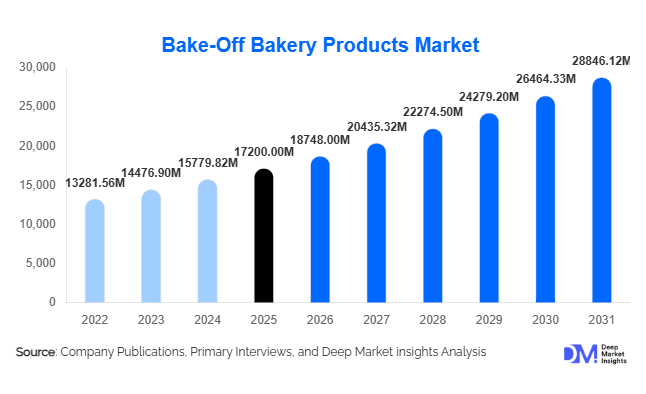
According to Deep Market Insights, the global bake-off bakery products market size was valued at USD 17,200 million in 2025 and is projected to grow from USD 18,748.00 million in 2026 to reach USD 28,846.12 million by 2031, expanding at a CAGR of 9.0% during the forecast period (2026–2031). The bake-off bakery products market growth is primarily driven by increasing demand for convenience foods, expansion of quick-service restaurants (QSRs), and the growing penetration of organized retail formats globally. The ability of bake-off products to deliver freshly baked quality with reduced operational complexity has made them a preferred choice for foodservice operators and retailers.
Key Market Insights
- Bake-off bakery products are gaining traction due to convenience and consistency, allowing retailers and foodservice operators to deliver fresh products with minimal labor.
- Foodservice dominates demand, particularly from QSR chains, cafés, and hotels that rely on standardized bakery solutions.
- Europe leads the global market, supported by strong bakery traditions and high consumption of artisan products.
- Asia-Pacific is the fastest-growing region, driven by urbanization, rising incomes, and expanding retail infrastructure.
- Clean-label and health-oriented products are emerging trends, with growing demand for organic, gluten-free, and natural ingredient-based bakery items.
- Advanced freezing technologies, including IQF and controlled fermentation, are enhancing product quality and shelf life.
What are the latest trends in the bake-off bakery products market?
Shift Toward Premium and Artisanal Offerings
Consumers are increasingly demanding high-quality, artisanal bakery products that replicate the experience of freshly baked goods. This has led manufacturers to develop premium bake-off solutions, including sourdough bread, handcrafted croissants, and specialty pastries. Retailers and cafés are leveraging these offerings to differentiate themselves and enhance customer experience. The trend is particularly strong in Europe and North America, where consumers are willing to pay a premium for authenticity and quality.
Growing Adoption of Clean-Label and Health-Focused Products
The demand for transparency in ingredients is driving the adoption of clean-label bakery products. Consumers are seeking products free from artificial preservatives, additives, and allergens. This has led to increased innovation in gluten-free, organic, and plant-based bake-off products. Manufacturers are reformulating recipes using natural ingredients and alternative flours, catering to health-conscious consumers while maintaining taste and texture.
What are the key drivers in the bake-off bakery products market?
Rising Demand for Convenience Foods
Busy lifestyles and increasing urbanization have significantly boosted demand for convenient food solutions. Bake-off bakery products offer a unique combination of convenience and freshness, enabling quick preparation without compromising quality. This makes them highly attractive to both consumers and commercial operators.
Expansion of Foodservice and QSR Chains
The rapid growth of global foodservice chains is a major driver of market expansion. QSRs and café chains require consistent product quality and efficient operations, which bake-off solutions provide. The expansion of international brands into emerging markets is further fueling demand.
What are the restraints for the global market?
High Cold Chain Infrastructure Costs
The requirement for frozen storage and transportation infrastructure increases operational costs. This acts as a barrier, particularly in developing regions where cold chain networks are still evolving.
Perception of Frozen Products
In certain markets, consumers still perceive frozen bakery products as inferior to freshly made items. Overcoming this perception requires continuous innovation and effective marketing strategies.
What are the key opportunities in the bake-off bakery products industry?
Expansion in Emerging Markets
Emerging economies such as India, China, and Southeast Asian countries present significant growth opportunities due to rising urban populations and increasing adoption of organized retail. The demand for standardized, high-quality bakery products is growing rapidly in these regions.
Technological Advancements in Baking and Freezing
Innovations such as AI-enabled ovens, automated production lines, and advanced freezing technologies are improving efficiency and product quality. These advancements are enabling manufacturers to scale operations while maintaining consistency.
Report Scope
| Report Metric | Details |
|---|---|
| Market Size in 2025 | USD 17200.00 Million |
| Market Size in 2026 | USD 18748.00 Million |
| Market Size in 2031 | USD 28846.12 Million |
| CAGR | 9% (2026-2031) |
| Base Year for Estimation | 2025 |
| Historical Data | 2022-2024 |
| Forecast Period | 2026-2031 |
| Report Coverage | Revenue Forecast, Competitive Landscape, Supply Chain Disruption, Growth Factors, Environment & Regulatory Landscape and Trends |
| Geographies Covered | North America, Europe, APAC, Middle East and Africa, LATAM |
| Countries Covered | U.S., Canada, U.K., Germany, France, Spain, Italy, Russia, Nordic, Benelux, Rest of Europe, China, Korea, Japan, India, Australia, Singapore, Taiwan, South East Asia, Rest of Asia-Pacific, UAE, Turky, Saudi Arabia, South Africa, Egypt, Nigeria, Rest of MEA, Brazil, Mexico, Argentina, Chile, Colombia, Rest of LATAM |
Explore more data points, trends and opportunities Download Free Sample Report
Product Type Insights
The product type segmentation of the global bake-off bakery products market highlights bread as the most dominant category, accounting for approximately 32% of the global market. This leadership position is primarily driven by bread’s status as a staple food across both developed and emerging economies, where it forms a fundamental part of daily diets. The widespread consumption of bread across households, quick-service restaurants, institutional catering, and foodservice outlets ensures consistent and recurring demand. Additionally, advancements in frozen dough technology and par-baked bread solutions have enabled manufacturers to maintain quality, extend shelf life, and offer convenience without compromising freshness. The leading segment driver for bread lies in its essential nature combined with operational efficiency for foodservice operators, who benefit from reduced labor costs and consistent product output.Beyond bread, the viennoiserie segment, including croissants, Danish pastries, and brioche, is experiencing significant momentum, supported by premiumization trends and changing consumer preferences toward indulgent and artisanal bakery offerings. Consumers are increasingly willing to pay a premium for high-quality, European-style baked goods that deliver superior taste and texture. The growth of café culture globally, particularly in urban centers, has further accelerated the demand for viennoiserie products. These items are frequently positioned as high-margin products in coffee chains and boutique bakeries, reinforcing their commercial attractiveness.Sweet bakery products such as muffins, donuts, cakes, and pastries are also witnessing strong growth, particularly in retail environments where impulse buying and convenience play a crucial role. The expansion of in-store bakeries in supermarkets and hypermarkets has enhanced the visibility and accessibility of these products, encouraging frequent purchases. Seasonal demand, product innovation, and flavor diversification further contribute to segment expansion. Meanwhile, savory bakery products, including filled pastries, sandwiches, and pizza bases, are gaining traction due to their alignment with on-the-go consumption patterns and quick meal solutions. The rising popularity of quick-service restaurants (QSRs) and casual dining establishments is a key growth driver for this segment, as these outlets rely heavily on standardized, easy-to-prepare bakery components to streamline operations and maintain consistency.
Application Insights
The application landscape of the bake-off bakery products market is led by the foodservice segment, which accounts for nearly 45% of the total market share. This dominance is driven by the extensive use of bake-off solutions in hotels, restaurants, cafés, and catering services, where operational efficiency and product consistency are critical. The leading segment driver in this category is the ability of bake-off products to reduce preparation time, minimize skilled labor requirements, and ensure uniform quality across multiple locations. Foodservice operators increasingly rely on frozen and par-baked products to optimize kitchen workflows and respond quickly to fluctuating demand.Retail applications are also expanding steadily, supported by the growing presence of modern trade formats such as supermarkets, hypermarkets, and convenience stores. These retail outlets are increasingly adopting in-store baking solutions, allowing them to offer freshly baked products throughout the day while benefiting from centralized production and supply chain efficiencies. The shift toward ready-to-bake and ready-to-finish products among consumers is further driving retail demand, particularly among urban households seeking convenience without compromising on freshness.Institutional applications, including airlines, hospitals, schools, and corporate cafeterias, represent another important segment contributing to market growth. These institutions require high levels of consistency, hygiene, and scalability, making bake-off bakery products an ideal solution. The ability to store products for extended periods and prepare them on demand aligns well with the operational needs of institutional buyers. Additionally, the increasing emphasis on standardized meal quality and cost control in institutional settings continues to support the adoption of bake-off solutions.
Distribution Channel Insights
The distribution channel landscape reflects the strong influence of foodservice and organized retail in driving market growth. Foodservice channels remain the largest distribution segment, supported by the widespread adoption of bake-off products across restaurants, cafés, and hospitality establishments. The leading segment driver here is the efficiency and scalability offered by centralized production and decentralized baking, enabling operators to deliver fresh products with minimal infrastructure investment.Supermarkets and hypermarkets dominate retail distribution, leveraging in-store bakeries to attract customers and enhance the shopping experience. These outlets benefit from high foot traffic and the ability to offer a wide variety of freshly baked goods throughout the day. The integration of bake-off solutions into retail operations allows for better inventory management, reduced waste, and improved profit margins. Additionally, private label offerings are gaining traction in this channel, further strengthening its position.Online retail is emerging as a rapidly growing distribution channel, driven by digitalization and evolving consumer purchasing behavior. E-commerce platforms and grocery delivery services are increasingly offering bake-off bakery products, including frozen dough and ready-to-bake items. The convenience of home delivery, coupled with the rising adoption of digital payment systems, is encouraging consumers to explore online purchasing options. This trend is particularly pronounced in urban areas, where time constraints and busy lifestyles drive demand for convenient food solutions.
End-Use Insights
From an end-use perspective, the foodservice industry accounts for nearly 50% of total demand, making it the largest segment in the bake-off bakery products market. The leading segment driver is the growing reliance of foodservice operators on standardized, high-quality bakery products that can be prepared quickly and efficiently. The expansion of global and regional QSR chains, coupled with the increasing popularity of café culture, has significantly boosted demand in this segment. Bake-off solutions enable these establishments to maintain consistent product quality while reducing operational complexities.Retail consumers represent another significant end-use segment, with increasing adoption of bake-off products for home baking. The growing interest in home cooking and baking, particularly following shifts in consumer behavior toward convenience and self-preparation, has contributed to segment growth. Consumers are increasingly seeking products that offer a balance between convenience and freshness, making ready-to-bake and partially baked items highly attractive.Institutional end-users, including airlines, hotels, and healthcare facilities, continue to leverage bake-off bakery products to enhance operational efficiency and ensure consistent quality. These buyers prioritize reliability, scalability, and cost-effectiveness, all of which are key advantages of bake-off solutions. The QSR segment stands out as the fastest-growing end-use category, driven by rapid global expansion, menu diversification, and increasing consumer demand for quick and affordable dining options. The ability to standardize offerings across multiple locations while maintaining quality is a critical factor driving adoption in this segment.
Explore more data points, trends and opportunities Download Free Sample Report
Bake-Off Bakery Products Market Segmentations
By Product Type
- Bread
- Viennoiserie
- Sweet Bakery
- Savory Bakery
- Frozen Dough
By Processing Stage
- Part-Baked
- Pre-Proofed & Frozen
- Raw Frozen Dough
- Fully Baked Frozen
By Distribution Channel
- Foodservice
- Supermarkets & Hypermarkets
- Convenience Stores
- Specialty Bakery Stores
- Online Retail
By End Use
- Foodservice Industry
- Retail Consumers
- Institutional Buyers
Regional Insights
Europe
Europe holds the largest share of the global bake-off bakery products market, accounting for approximately 35%. The region’s dominance is deeply rooted in its rich bakery heritage and strong consumer preference for high-quality, artisanal baked goods. Countries such as France, Germany, and the United Kingdom lead demand, supported by well-established bakery cultures and high per capita consumption of bread and viennoiserie products. One of the primary drivers of regional growth is the widespread adoption of frozen and par-baked technologies, which allow traditional bakeries and modern retail outlets to maintain product authenticity while improving operational efficiency. Additionally, the growing demand for premium and organic bakery products is encouraging innovation and product differentiation. The expansion of in-store bakeries within supermarkets and the increasing popularity of café chains further contribute to market growth. Sustainability initiatives, including reduced food waste and energy-efficient baking processes, are also shaping the market landscape in Europe.
North America
North America accounts for around 28% of the global market, with the United States serving as the primary growth engine. The region’s market is characterized by a strong presence of large QSR chains, extensive foodservice networks, and a high demand for convenience foods. One of the key drivers of growth in North America is the increasing reliance on frozen and ready-to-bake products to meet consumer demand for quick and easy meal solutions. The expansion of coffee chains and casual dining establishments has further boosted demand for bakery products, particularly breakfast items and snacks. Additionally, technological advancements in freezing and baking processes have improved product quality and shelf life, making bake-off solutions more appealing to both consumers and businesses. The growing trend toward clean-label and health-conscious products is also influencing market dynamics, prompting manufacturers to develop offerings with fewer additives and improved nutritional profiles.
Asia-Pacific
Asia-Pacific is the fastest-growing region in the global bake-off bakery products market, with a CAGR exceeding 11%. Rapid urbanization, rising disposable incomes, and changing dietary habits are key factors driving growth in this region. Countries such as China and India are witnessing significant increases in bakery consumption, supported by the expansion of modern retail infrastructure and the growing influence of Western food culture. One of the primary drivers of regional growth is the increasing penetration of organized retail and foodservice chains, which are introducing consumers to a wider variety of bakery products. Additionally, the rising popularity of convenience foods and on-the-go consumption is fueling demand for ready-to-bake and ready-to-eat products. The expansion of e-commerce platforms and digital payment systems is further enhancing market accessibility, enabling consumers to purchase bakery products online. Local manufacturers are also investing in product innovation to cater to regional tastes and preferences, thereby strengthening market growth.
Latin America
Latin America holds approximately 8% of the global market share, with Brazil and Mexico leading demand. The region’s market is driven by the increasing adoption of frozen bakery products and the gradual modernization of retail and foodservice sectors. One of the key growth drivers in Latin America is the rising demand for convenience foods, particularly among urban populations with busy lifestyles. The expansion of supermarket chains and the growing presence of international foodservice brands are also contributing to market development. Additionally, improvements in cold chain infrastructure are enabling wider distribution of frozen and bake-off products, enhancing market penetration. Economic growth and increasing consumer spending on premium food products are further supporting the adoption of high-quality bakery items in the region.
Middle East & Africa
The Middle East & Africa region accounts for about 7% of the global market, with growth driven primarily by the hospitality and tourism sectors. Countries such as the United Arab Emirates and Saudi Arabia are key contributors, benefiting from strong tourism inflows and a rapidly expanding foodservice industry. One of the main drivers of regional growth is the increasing demand for high-quality bakery products in hotels, restaurants, and catering services. The region’s reliance on imported food products and advanced baking technologies is also supporting market expansion. Additionally, the growing expatriate population and exposure to international cuisines are influencing consumer preferences, leading to higher demand for Western-style bakery products. Investments in retail infrastructure, including the development of modern supermarkets and shopping malls, are further enhancing market accessibility and driving growth.
Key Players in the Bake-Off Bakery Products Market
- Aryzta AG
- Europastry S.A.
- Lantmännen Unibake
- Vandemoortele NV
- Grupo Bimbo
- General Mills Inc.
- Conagra Brands Inc.
- Associated British Foods plc
- Nestlé S.A.
- Dawn Foods
- Rich Products Corporation
- Premier Foods plc
- Kellogg Company
- Dr. Oetker
- Barilla Group