Badminton Market Size
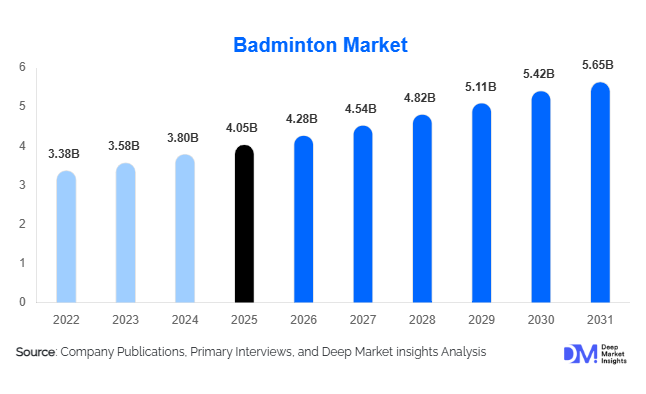
According to Deep Market Insights, the global badminton market size was valued at USD 4.05 billion in 2025 and is projected to grow from USD 4.28 billion in 2026 to reach USD 5.65 billion by 2031, expanding at a CAGR of 6.1% during the forecast period (2026–2031). The market growth is primarily driven by rising participation in recreational and professional badminton, increasing investments in sports infrastructure, growing health and fitness awareness, and continuous innovation in badminton equipment. The sport has evolved beyond traditional strongholds in Asia and is gaining popularity across North America, Europe, and the Middle East, supported by school sports programs, community recreation initiatives, and international tournaments.
Key Market Insights
- Asia-Pacific dominates the global badminton market, accounting for nearly 57% of total revenue, supported by strong participation rates in China, India, Indonesia, Malaysia, Japan, and South Korea.
- Racquets remain the largest product category, representing approximately 34% of global market value due to premiumization and frequent replacement cycles among active players.
- Online distribution channels are expanding rapidly, driven by increasing consumer preference for direct-to-consumer purchasing and wider product accessibility.
- Carbon-fiber and graphite-based equipment continue to gain market share, reflecting consumer demand for lightweight, high-performance products.
- Synthetic shuttlecock technology is emerging as a major industry trend, helping reduce dependence on feather-based supply chains while improving durability.
- Government investments in sports infrastructure and youth development programs are creating long-term opportunities for equipment manufacturers and sports facility operators.
Badminton Market Trends
Premiumization of Equipment Driving Consumer Spending
The badminton industry is witnessing significant premiumization as consumers increasingly invest in technologically advanced racquets, footwear, strings, and accessories. Manufacturers are focusing on lightweight carbon-fiber frames, improved aerodynamics, vibration reduction systems, and enhanced durability. Professional and competitive amateur players are upgrading equipment more frequently to improve performance, while recreational users are becoming increasingly willing to purchase branded products that offer superior comfort and playing experience. Premium racquets priced above USD 150 continue to gain market share across developed and emerging markets. The trend is particularly visible in China, Japan, India, South Korea, and Southeast Asia, where badminton enjoys strong cultural popularity and competitive participation.
Rise of Synthetic Shuttlecock Adoption
Advancements in synthetic shuttlecock technology are reshaping product demand across schools, sports clubs, recreational facilities, and training academies. Traditional feather shuttlecocks remain the preferred choice for professional competition; however, rising feather costs and supply chain volatility have encouraged institutions to explore synthetic alternatives. New-generation synthetic shuttlecocks offer improved flight consistency, longer durability, and lower operating costs. Manufacturers are investing heavily in research and development to narrow the performance gap between synthetic and feather variants. As sustainability concerns grow and institutions seek cost-effective solutions, synthetic shuttlecock adoption is expected to increase significantly over the next decade.
Badminton Market Drivers
Growing Global Participation in Recreational Sports
Badminton is increasingly recognized as an accessible and affordable fitness activity suitable for participants of all ages. Rising awareness regarding physical fitness, cardiovascular health, and active lifestyles is encouraging participation in recreational sports worldwide. Urban populations are particularly attracted to badminton because it requires limited playing space compared to several other sports and can be played indoors throughout the year. Governments, schools, and community organizations are actively promoting badminton as part of physical education and wellness programs, contributing to sustained demand for equipment and accessories.
Expansion of Professional Competitions and Sports Media Coverage
The growing popularity of international badminton tournaments, Olympic participation, and digital sports broadcasting has enhanced the sport’s visibility worldwide. Sponsorship agreements, athlete endorsements, and social media engagement are influencing equipment purchasing decisions among amateur and recreational players. Major badminton tournaments organized by international federations continue to attract millions of viewers globally, creating opportunities for equipment manufacturers to strengthen brand awareness and expand product sales. Increased exposure of elite athletes is also supporting demand for premium performance-oriented products.
Badminton Market Restraints
Volatility in Shuttlecock Raw Material Supply
Feather shuttlecocks continue to dominate competitive badminton; however, manufacturers remain vulnerable to fluctuations in feather availability and poultry industry supply dynamics. Changes in livestock production, trade regulations, and transportation costs can significantly impact shuttlecock pricing. Rising raw material costs often reduce profit margins and increase operating expenses for clubs, academies, and recreational facilities. Such volatility remains one of the most significant challenges facing the badminton equipment industry.
Limited Market Penetration in Emerging Regions
While badminton enjoys widespread popularity across Asia-Pacific region, participation rates remain relatively low in several regions including Latin America, parts of Africa, and some European countries. Limited infrastructure, lower awareness, and competition from other sports restrict market expansion. Manufacturers seeking global growth must invest in grassroots development, sports education programs, and localized marketing initiatives to increase participation and consumer engagement.
Badminton Market Opportunities
Expansion of Indoor Sports Infrastructure
Governments and private investors are increasingly funding indoor sports facilities, recreation centers, and community sports complexes. Countries such as India, Saudi Arabia, UAE, Indonesia, and Vietnam are witnessing significant investments in sports infrastructure aimed at promoting fitness and youth participation. Every new facility generates recurring demand for racquets, shuttlecocks, court equipment, flooring systems, and maintenance services. This trend creates substantial opportunities for both established manufacturers and new market entrants.
Growth of Direct-to-Consumer and Digital Commerce Channels
E-commerce platforms and brand-owned online stores are revolutionizing the purchasing experience for badminton equipment. Manufacturers can now directly engage with consumers, improve profit margins, and offer customized products. Online channels are particularly valuable in developing regions where specialty sports retail networks remain underdeveloped. Personalized equipment recommendations, subscription-based shuttlecock purchasing programs, and digital coaching integrations represent emerging revenue opportunities within the market.
Report Scope
| Report Metric | Details |
|---|---|
| Market Size in 2025 | USD 4.05 Billion |
| Market Size in 2026 | USD 4.28 Billion |
| Market Size in 2031 | USD 5.65 Billion |
| CAGR | 6.1% (2026-2031) |
| Base Year for Estimation | 2025 |
| Historical Data | 2022-2024 |
| Forecast Period | 2026-2031 |
| Report Coverage | Revenue Forecast, Competitive Landscape, Supply Chain Disruption, Growth Factors, Environment & Regulatory Landscape and Trends |
| Geographies Covered | North America, Europe, APAC, Middle East and Africa, LATAM |
| Countries Covered | U.S., Canada, U.K., Germany, France, Spain, Italy, Russia, Nordic, Benelux, Rest of Europe, China, Korea, Japan, India, Australia, Singapore, Taiwan, South East Asia, Rest of Asia-Pacific, UAE, Turky, Saudi Arabia, South Africa, Egypt, Nigeria, Rest of MEA, Brazil, Mexico, Argentina, Chile, Colombia, Rest of LATAM |
Explore more data points, trends and opportunities Download Free Sample Report
Product Type Insights
Rackets represent the largest product segment, accounting for approximately 34% of global market revenue in 2025. Frequent product upgrades, technological advancements, and premium pricing strategies support demand. Shuttlecocks constitute the second-largest segment, driven by recurring replacement requirements across clubs, schools, and tournaments. Footwear continues to gain traction as players increasingly prioritize injury prevention, comfort, and performance enhancement. Apparel, strings, and accessories collectively contribute a significant portion of market revenue, benefiting from growing participation rates and rising consumer preference for branded sports products. Premium and mid-range equipment categories remain particularly attractive as consumers seek a balance between performance and affordability.
Player Category Insights
Recreational players account for the largest share of the badminton market, representing approximately 52% of total demand. This segment benefits from widespread accessibility, relatively low participation costs, and growing fitness awareness. Competitive amateur players form a substantial secondary market, frequently investing in higher-performance equipment and specialized training accessories. Professional athletes, while smaller in volume, generate significant value through demand for premium racquets, footwear, and customized equipment. Junior players represent an important growth segment, supported by increasing participation in school sports programs and youth development initiatives worldwide.
Distribution Channel Insights
Specialty sports stores continue to represent a major distribution channel due to the technical nature of badminton equipment purchases and consumer preference for professional guidance. However, online retail has emerged as the fastest-growing channel, accounting for approximately one-third of global sales. Consumers increasingly rely on digital platforms to compare products, access reviews, and purchase equipment at competitive prices. Direct-to-consumer sales through manufacturer websites are also expanding, allowing brands to strengthen customer relationships and improve margins. Institutional procurement by clubs, academies, and educational institutions remains a stable channel supported by recurring equipment replacement requirements.
End User Insights
Individual consumers dominate the badminton market, accounting for approximately 58% of total demand in 2025. Growing recreational participation and fitness-focused lifestyles continue to support equipment purchases among this group. Sports clubs and academies represent the fastest-growing institutional segment due to increasing demand for structured training and competitive development programs. Educational institutions are also contributing significantly to market growth through badminton inclusion in physical education curricula. Professional federations and community recreation centers further support equipment consumption through tournament organization, coaching activities, and grassroots participation programs.
Explore more data points, trends and opportunities Download Free Sample Report
Badminton Market Segmentations
By Product Type
- Racquets
- Shuttlecocks
- Footwear
- Apparel
- Strings
- Accessories
By Player Category
- Professional Players
- Competitive Amateur Players
- Recreational Players
- Junior Players
By Material Type
- Carbon Fiber/Graphite
- Aluminum
- Steel
- Composite Materials
By Distribution Channel
- Specialty Sports Stores
- Multi-Sport Retail Chains
- Online/E-Commerce
- Direct-to-Consumer Brand Websites
- Club & Institutional Procurement
By End User
- Individual Consumers
- Sports Clubs & Academies
- Educational Institutions
- Professional Associations & Federations
- Corporate & Community Recreation Centers
Regional Insights
Asia-Pacific
Asia-Pacific remains the largest regional market, accounting for approximately 57% of global revenue in 2025. China leads global consumption and manufacturing, contributing nearly 22% of worldwide market demand. India is among the fastest-growing markets, supported by government sports initiatives, expanding badminton academies, and rising middle-class participation. Indonesia, Malaysia, Japan, South Korea, and Thailand continue to demonstrate strong demand due to deep-rooted badminton culture, professional competition success, and extensive grassroots participation.
North America
North America accounts for approximately 18% of global market revenue. The United States represents the dominant market within the region, driven by increasing recreational participation, growing badminton club memberships, and rising demand among multicultural communities. Canada is also witnessing steady growth supported by investments in community sports facilities and youth development programs. E-commerce channels are playing a crucial role in expanding product accessibility throughout the region.
Europe
Europe contributes approximately 15% of global badminton market revenue. Denmark remains one of the region’s strongest badminton nations, supported by high participation rates and international competitive success. Germany, the United Kingdom, France, and Spain are experiencing increasing recreational demand, particularly among younger demographics seeking indoor fitness activities. Investments in sports infrastructure and growing awareness of badminton as a health-oriented sport continue to support market expansion across Europe.
Latin America
Latin America currently represents a smaller but steadily growing market. Brazil and Mexico account for the majority of regional demand, supported by increasing interest in Olympic sports and grassroots sports development programs. While badminton participation remains relatively limited compared to traditional sports, rising urbanization and expanding recreational sports infrastructure are expected to support long-term growth opportunities.
Middle East & Africa
The Middle East & Africa region is emerging as one of the fastest-growing badminton markets globally. The UAE and Saudi Arabia are investing heavily in sports infrastructure and recreational facilities as part of broader economic diversification initiatives. South Africa remains a key market within Africa, while increasing participation across several Gulf Cooperation Council countries is creating new opportunities for equipment manufacturers. The region is expected to achieve the highest growth rate during the forecast period due to government-backed sports development initiatives.
Key Players in the Badminton Market
- Yonex Co., Ltd.
- Li-Ning Company Limited
- Victor Rackets Industrial Corp.
- Babolat
- Mizuno Corporation
- ASICS Corporation
- Gosen Co., Ltd.
- Apacs Sports
- Carlton Sports
- Forza
- RSL International
- Kawasaki Sports
- Kason
- Ashaway
- Wilson Sporting Goods