Baby Snacks Market Size
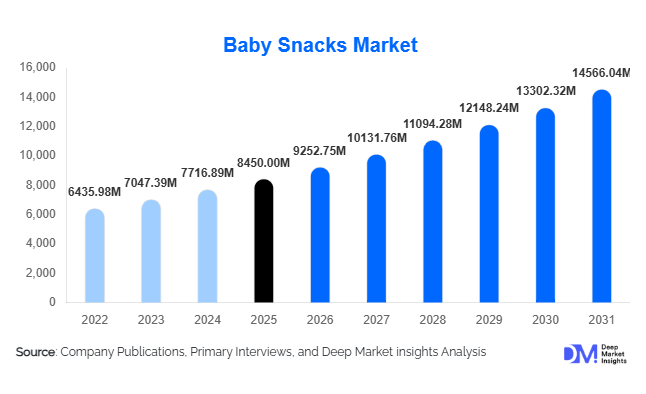
According to Deep Market Insights,the global baby snacks market size was valued at USD 8,450 million in 2025 and is projected to grow from USD 9,252.75 million in 2026 to reach USD 14,566.04 million by 2031, expanding at a CAGR of 9.5% during the forecast period (2026–2031). The baby snacks market growth is primarily driven by increasing awareness about infant nutrition, rising demand for convenient and ready-to-eat baby food products, and the growing popularity of organic and clean-label snack options designed for infants and toddlers.
Key Market Insights
- Baby snacks are increasingly formulated with clean-label ingredients, including organic fruits, vegetables, and whole grains to meet evolving parental preferences for natural nutrition.
- Convenience-driven consumption is accelerating, with parents seeking portable, easy-to-feed snack formats suitable for travel, daycare, and outdoor activities.
- North America dominates the global baby snacks market, supported by strong purchasing power, high awareness of infant nutrition, and established retail distribution networks.
- Asia-Pacific is the fastest-growing region, driven by rising birth rates, expanding middle-class populations, and increasing adoption of packaged baby foods.
- Premium organic and allergen-free snacks are gaining traction, particularly among urban consumers who prioritize ingredient transparency and product safety.
- E-commerce platforms are transforming baby food distribution, enabling direct-to-consumer sales, subscription models, and personalized product recommendations.
What are the latest trends in the baby snacks market?
Clean Label and Organic Product Innovation
The demand for clean-label baby snacks is increasing rapidly as parents prioritize natural, minimally processed foods for infants and toddlers. Manufacturers are responding by introducing products made with organic grains, fruits, and vegetables while eliminating artificial preservatives, synthetic flavors, and added sugars. Organic certifications and transparent labeling practices are becoming essential differentiators in the competitive baby snacks industry. Brands are also focusing on sustainable ingredient sourcing and environmentally friendly packaging to align with broader consumer expectations for ethical and responsible food production. This shift toward natural nutrition has led to a surge in organic puffed snacks, fruit bites, and whole grain biscuits specifically formulated for young children.
Functional and Nutrient-Fortified Baby Snacks
Functional nutrition is becoming a defining trend in the baby snacks market as companies develop products enriched with essential nutrients that support early childhood development. Snacks fortified with iron, calcium, DHA, probiotics, and plant-based proteins are increasingly being introduced to promote brain development, bone health, and digestive wellness. These products are designed to supplement daily dietary requirements while offering convenient snack formats that children enjoy. The integration of functional ingredients also enables manufacturers to differentiate their offerings and command premium pricing. As parents become more informed about early childhood nutrition, demand for scientifically formulated and developmentally supportive snacks is expected to grow significantly.
What are the key drivers in the baby snacks market?
Growing Awareness of Infant Nutrition
Rising awareness about early childhood nutrition is a major driver of the global baby snacks market. Parents are increasingly seeking foods that provide balanced nutrition and support healthy development during infancy and toddlerhood. Pediatricians and nutrition experts often recommend nutrient-rich snacks that encourage self-feeding while supplying essential vitamins and minerals. This trend has led to the development of fortified snacks containing iron, calcium, and vitamins that help meet dietary requirements for young children. As nutrition education becomes more accessible through digital platforms and healthcare professionals, parents are becoming more conscious about selecting high-quality snack products for their children.
Rising Number of Working Parents
The increasing participation of women in the workforce is significantly boosting demand for convenient baby food solutions. Busy lifestyles and time constraints are encouraging parents to choose ready-to-eat snacks that require minimal preparation while still meeting nutritional standards. Baby snacks provide a convenient feeding option during travel, daycare, or family outings. The availability of portion-controlled packs and resealable packaging further enhances product convenience. As dual-income households become more common globally, the demand for packaged baby snacks is expected to increase steadily.
What are the restraints for the global market?
Strict Food Safety Regulations
Baby food products are subject to stringent regulatory standards due to the vulnerability of infant consumers. Governments across major markets require rigorous testing and certification processes to ensure product safety, ingredient quality, and contamination control. Compliance with these regulations increases manufacturing costs and may slow product launches, particularly for smaller companies entering the market.
Concerns Regarding Processed Foods
Some parents remain cautious about feeding packaged snacks to infants due to concerns about processing levels, additives, and sugar content. In certain regions, traditional homemade foods are still preferred over packaged alternatives. These perceptions can limit market growth unless manufacturers focus on transparency, reduced processing, and natural ingredient formulations.
What are the key opportunities in the baby snacks industry?
Expansion in Emerging Markets
Emerging economies across Asia-Pacific, Latin America, and the Middle East present substantial growth opportunities for baby snack manufacturers. Countries such as China, India, Indonesia, and Brazil are experiencing rising birth rates, increasing disposable incomes, and rapid urbanization. These factors are encouraging greater adoption of packaged baby foods. Expanding retail infrastructure and growing penetration of online grocery platforms are further supporting market entry for global brands. Companies that introduce region-specific flavors and affordable product formats are likely to capture significant demand in these high-growth markets.
Innovation in Functional Nutrition
The increasing demand for development-focused nutrition is creating opportunities for companies to introduce functional baby snacks enriched with essential nutrients. Products containing probiotics for digestive health, DHA for cognitive development, and plant-based proteins for balanced nutrition are gaining popularity among health-conscious parents. Research-driven product innovation enables brands to differentiate their offerings and appeal to premium consumer segments. As nutritional science continues to advance, functional snacks designed to support immunity and developmental milestones are expected to gain widespread adoption.
Report Scope
| Report Metric | Details |
|---|---|
| Market Size in 2025 | USD 8450 Million |
| Market Size in 2026 | USD 9252.75 Million |
| Market Size in 2031 | USD 14566.04 Million |
| CAGR | 9.5% (2026-2031) |
| Base Year for Estimation | 2025 |
| Historical Data | 2022-2024 |
| Forecast Period | 2026-2031 |
| Report Coverage | Revenue Forecast, Competitive Landscape, Supply Chain Disruption, Growth Factors, Environment & Regulatory Landscape and Trends |
| Geographies Covered | North America, Europe, APAC, Middle East and Africa, LATAM |
| Countries Covered | U.S., Canada, U.K., Germany, France, Spain, Italy, Russia, Nordic, Benelux, Rest of Europe, China, Korea, Japan, India, Australia, Singapore, Taiwan, South East Asia, Rest of Asia-Pacific, UAE, Turky, Saudi Arabia, South Africa, Egypt, Nigeria, Rest of MEA, Brazil, Mexico, Argentina, Chile, Colombia, Rest of LATAM |
Explore more data points, trends and opportunities Download Free Sample Report
Product Type Insights
Puffed snacks represent the leading product category in the global baby snacks market, accounting for nearly 27% of total revenue. The segment’s dominance is primarily driven by their light texture and rapid dissolvability, which significantly reduces choking risks and makes them ideal for infants who are learning self-feeding skills. Parents widely prefer puffed snacks because they are easy for babies to grasp, safe to consume, and often fortified with essential vitamins and minerals. In addition, manufacturers frequently incorporate whole grains, fruits, and vegetable ingredients to improve nutritional value while maintaining appealing flavors.Biscuits and teething wafers also hold a significant share of the market due to their dual functionality as both snacks and teething aids. These products help soothe gum irritation during the teething phase while providing gentle nutrition and energy for infants. Their longer shelf life and portability further contribute to their popularity among parents seeking convenient snack options.
Fruit- and vegetable-based snacks are experiencing strong growth as parents increasingly prioritize natural ingredients and clean-label formulations. These snacks are often free from artificial preservatives, colors, and added sugars, aligning with the growing demand for organic and minimally processed baby foods.Soft baked snack bars and yogurt-based drops are emerging product categories that are gaining traction among health-conscious consumers. These snacks provide convenient finger-food formats while delivering balanced nutrition through ingredients such as dairy cultures, fruits, whole grains, and plant-based proteins. Continuous product innovation, including allergen-free formulations, organic certifications, and functional ingredients, is expanding consumer choices and contributing significantly to the growth of the global baby snacks market.
Application Insights
The primary application of baby snacks lies in infant and toddler nutrition, where these products serve as complementary foods alongside traditional baby food categories such as purees, cereals, and formula. Baby snacks are designed to provide additional nutrients between meals while supporting the developmental stages of infants and toddlers.The toddler segment, particularly children aged 12–24 months, represents the largest consumer base for baby snacks. During this developmental phase, children begin to explore a wider variety of textures and flavors while increasing their daily snacking frequency. As a result, parents often rely on packaged baby snacks to provide balanced nutrition in a convenient format.
Baby snacks also play an important role in encouraging self-feeding behaviors, which helps infants develop motor skills, hand-eye coordination, and independence during early childhood development. Products designed for this purpose are typically small, easy to hold, and formulated to dissolve quickly in the mouth.Beyond household consumption, demand is also increasing across institutional environments such as daycare centers, preschools, and early childhood education facilities. These institutions frequently provide packaged snacks as safe, portion-controlled meal supplements for young children. As global participation in childcare services continues to expand due to increasing workforce participation among parents, institutional demand for baby snacks is expected to rise steadily.
Distribution Channel Insights
Supermarkets and hypermarkets dominate the distribution landscape for baby snacks, accounting for the largest share of global sales. The leadership of this segment is primarily driven by the extensive product assortments offered by large retail chains, allowing parents to easily compare brands, ingredients, and nutritional labels before making purchasing decisions. These retail environments also provide promotional discounts, bundled offerings, and strong product visibility that encourage impulse purchases.Online retail platforms are rapidly gaining importance as digital commerce transforms consumer purchasing behavior. Many parents increasingly prefer the convenience of home delivery, particularly for frequently purchased baby products. E-commerce platforms provide access to a broader selection of specialty baby food products, including organic, allergen-free, and imported brands that may not be available in traditional retail outlets.
Additionally, online platforms enhance consumer engagement through detailed product descriptions, ingredient transparency, parenting blogs, customer reviews, and subscription-based purchasing models that allow parents to receive baby snacks regularly without repeated ordering.Pharmacies and specialty baby stores continue to play an important role in the distribution of premium and organic baby snacks. These outlets benefit from high consumer trust due to their healthcare-oriented positioning and are often preferred by parents seeking medically recommended or nutritionally specialized products.
Age Group Insights
Children aged 12–24 months account for the largest share of the baby snacks market. The dominance of this segment is largely attributed to the developmental stage during which toddlers transition from pureed foods to finger foods and begin consuming snacks more frequently throughout the day. Products targeting this age group are typically designed to be soft, easily digestible, and nutritionally balanced while offering appealing flavors that encourage healthy eating habits.The 6–8 months age group is experiencing steady growth as parents begin introducing early-stage snacks during the weaning phase. Snacks formulated for this segment are designed to dissolve quickly in the mouth, minimizing choking risks while supporting the development of chewing and swallowing skills.
Meanwhile, snacks designed for children aged 2–3 years are gaining popularity as toddlers begin transitioning toward regular snack foods. These products often resemble traditional snacks but are formulated specifically for young children with reduced sodium, lower sugar levels, and carefully selected ingredients to meet dietary guidelines for early childhood nutrition.Manufacturers are increasingly developing age-specific product formulations and packaging to address the nutritional needs and developmental milestones of each stage of early childhood, further supporting market growth.
Explore more data points, trends and opportunities Download Free Sample Report
Baby Snacks Market Segmentations
By Product Type
- Puffed Snacks
- Biscuits & Teething Wafers
- Fruit & Vegetable Snacks
- Soft Baked Bars
- Yogurt-Based Drops
By Application / Age Group
- 6–8 Months
- 9–12 Months
- 12–24 Months
- 2–3 Years
By Distribution Channel
- Supermarkets & Hypermarkets
- Online Retail / E-commerce
- Pharmacies & Drugstores
- Specialty Baby Stores
Regional Insights
North America
North America represents the largest regional market for baby snacks, accounting for approximately 32% of global demand. The United States dominates regional consumption due to high consumer awareness regarding infant nutrition, strong purchasing power, and the widespread availability of premium and organic baby food products. Parents in the region increasingly seek clean-label snacks made with natural ingredients and free from artificial additives.Canada also contributes significantly to regional growth, supported by rising demand for organic, allergen-free, and sustainably produced baby foods. The region benefits from a well-developed retail infrastructure, including large supermarket chains and advanced e-commerce platforms, which ensure broad product accessibility. Additionally, the strong presence of major baby food manufacturers and continuous product innovation further strengthen market expansion across North America.
Europe
Europe accounts for nearly 24% of the global baby snacks market, with strong demand originating from countries such as Germany, France, and the United Kingdom. European consumers place significant emphasis on product safety, organic certification, and sustainable sourcing practices, which has driven the growth of certified organic baby snack products across the region.Strict regulatory standards established by the European Union for infant nutrition and baby food safety enhance consumer trust in packaged baby snacks. Additionally, increasing parental awareness of balanced nutrition during early childhood and the growing popularity of plant-based and natural ingredient snacks are further supporting market growth across Europe.
Asia-Pacific
Asia-Pacific is the fastest-growing regional market, accounting for approximately 29% of the global baby snacks market. Rapid urbanization, rising disposable incomes, and expanding middle-class populations are major factors driving demand for convenient packaged baby foods across the region.China represents the largest market within Asia-Pacific, largely due to strong consumer demand for premium imported baby food products and heightened parental awareness regarding food safety and nutrition. India is also experiencing rapid growth, supported by increasing urbanization, improving retail infrastructure, and rising awareness of infant nutrition among young parents.Japan and South Korea maintain steady demand driven by busy lifestyles, high female workforce participation, and strong distribution networks for packaged baby food products. The expansion of e-commerce platforms and growing penetration of international baby food brands further contribute to regional market expansion.
Latin America
The baby snacks market in Latin America is expanding steadily, with Brazil and Mexico representing the largest markets. Increasing urbanization and the expansion of modern retail channels such as supermarkets and convenience stores are encouraging greater adoption of packaged baby foods.Rising middle-class populations and improving economic conditions are also increasing consumer spending on infant nutrition products. Furthermore, multinational baby food manufacturers are strengthening their presence in the region through new product launches and strategic partnerships with local distributors, which is expected to further enhance market penetration in Latin America.
Middle East & Africa
The Middle East and Africa region is witnessing moderate growth in the baby snacks market, supported by rising urbanization, increasing disposable incomes, and improving access to modern retail infrastructure. Countries such as Saudi Arabia, the United Arab Emirates, and South Africa are leading regional demand due to the growing presence of international baby food brands and expanding supermarket chains.In addition, high birth rates across several African countries create strong long-term demand for infant nutrition products. Increasing consumer awareness regarding packaged baby foods and the gradual expansion of e-commerce platforms are expected to further support market growth across the region in the coming years.
Key Players in the Baby Snacks Market
- Nestlé
- Danone
- Kraft Heinz
- Abbott Laboratories
- Hero Group
- Hain Celestial Group
- Campbell Soup Company
- Bellamy’s Organic
- HiPP GmbH
- Plum Organics
- Happy Family Organics
- Little Spoon
- Ella’s Kitchen
- Amara Organic Foods
- Once Upon a Farm