Global Baby Finger Foods Market Size
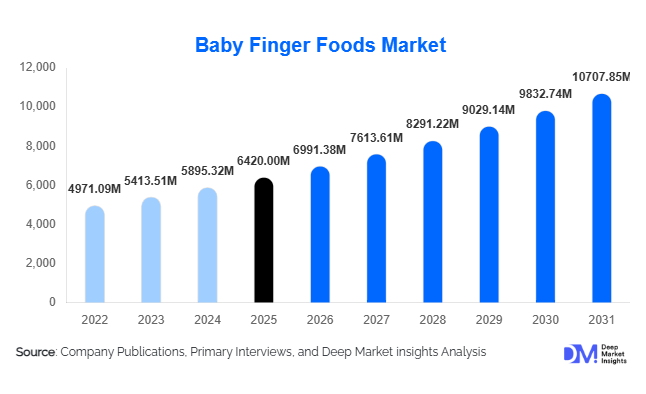
According to Deep Market Insights, the global baby finger foods market size was valued at USD 6,420 million in 2026 and is projected to grow from USD 6,991.38 million in 2027 to reach USD 10,707.85 million by 2031, expanding at a CAGR of 8.9% during the forecast period (2026–2031). The market growth is primarily driven by rising demand for convenient infant nutrition solutions, increasing adoption of clean-label and organic baby food products, and growing awareness of early childhood dietary development. Additionally, rapid urbanization, increasing participation of women in the workforce, and the expansion of e-commerce distribution channels are significantly accelerating global demand for baby finger foods.
Key Market Insights
- Puffed snacks dominate the global product landscape, accounting for the largest share due to their easy-to-consume texture, low choking risk, and fortified nutritional profiles suitable for early-stage weaning.
- Organic and clean-label baby finger foods are gaining strong momentum, especially in North America and Europe, as parents increasingly avoid artificial additives and preservatives.
- North America remains the largest regional market, supported by high disposable income, strong retail penetration, and high awareness of infant nutrition standards.
- Asia-Pacific is the fastest-growing region, driven by rising birth rates, expanding middle-class population, and increasing penetration of online retail channels.
- E-commerce and direct-to-consumer channels are reshaping distribution, enabling niche brands and subscription-based baby food services to scale rapidly across global markets.
- Functional baby finger foods enriched with DHA, probiotics, and iron are emerging as a major innovation trend, supporting cognitive and immune development in infants.
baby finger foods market latest trends
Rising Demand for Clean-Label and Organic Baby Snacks
The market is witnessing a strong shift toward clean-label, organic, and minimally processed baby finger foods. Parents are increasingly scrutinizing ingredient lists and avoiding artificial flavors, preservatives, and genetically modified ingredients. This trend is particularly strong in developed markets such as the United States, Germany, and the United Kingdom, where organic-certified baby snacks are becoming mainstream. Manufacturers are responding by investing in transparent sourcing, USDA/EU organic certifications, and allergen-free formulations. This shift is also encouraging premiumization, allowing brands to achieve higher margins while building long-term consumer trust.
Expansion of Functional and Nutrient-Enriched Finger Foods
Another major trend is the growing adoption of functional baby finger foods enriched with essential nutrients such as iron, calcium, DHA, and probiotics. Parents are increasingly prioritizing products that support brain development, immunity, and gut health in early childhood. As a result, manufacturers are innovating with fortified puffed snacks, protein-based bites, and freeze-dried fruit and vegetable formats. These innovations are also aligned with pediatric nutrition recommendations that emphasize developmental feeding stages, making functional foods one of the fastest-evolving segments in the market.
baby finger foods market drivers
Increasing Urbanization and Dual-Income Households
The rapid rise in urban populations and dual-income households is a key growth driver for the baby finger foods market. Working parents increasingly rely on convenient, ready-to-eat infant snacks that reduce preparation time while ensuring balanced nutrition. This lifestyle shift is particularly visible in urban centers across North America, Europe, and Asia-Pacific. Baby finger foods provide portability, portion control, and ease of feeding, making them a preferred choice for daycare, travel, and daily consumption routines.
Growing Awareness of Early Childhood Nutrition
Rising awareness regarding early childhood cognitive development and dietary habits is significantly influencing market demand. Parents are increasingly following pediatric guidance that encourages self-feeding and texture progression, both of which are supported by finger food products. Governments and health organizations are also promoting fortified infant nutrition to address micronutrient deficiencies, further supporting market expansion. This increased awareness is directly translating into higher adoption of nutrient-rich baby snacks globally.
baby finger foods market restraints
High Cost of Premium Baby Nutrition Products
One of the key restraints in the market is the high cost associated with organic, fortified, and premium baby finger foods. Strict regulatory requirements, certification costs, and high-quality raw material sourcing significantly increase production expenses. As a result, these products remain less accessible in price-sensitive regions such as parts of Latin America, Africa, and rural Asia. This pricing gap limits mass-market penetration despite growing awareness of infant nutrition.
Strict Regulatory and Safety Compliance Requirements
The baby food industry is heavily regulated, with stringent safety, labeling, and nutritional standards enforced by agencies such as the FDA, EFSA, and FSSAI. Compliance with these regulations increases operational complexity and extends product development timelines. Manufacturers must invest heavily in testing, certification, and quality assurance systems, which can slow down innovation and increase time-to-market for new product launches.
baby finger foods industry key opportunities
Growth of E-Commerce and Subscription-Based Models
The rapid expansion of online grocery platforms and direct-to-consumer subscription services presents a major opportunity for baby finger foods manufacturers. These models allow brands to deliver customized, age-specific nutrition packs directly to consumers while reducing dependence on traditional retail channels. Emerging markets such as India, Brazil, and Southeast Asia are experiencing rapid adoption of digital shopping, enabling niche baby food brands to scale quickly. Subscription models also improve customer retention and create predictable revenue streams for manufacturers.
Innovation in Plant-Based and Functional Nutrition Products
Increasing demand for plant-based diets and functional nutrition is creating new opportunities for innovation in baby finger foods. Manufacturers are developing allergen-free, plant-based protein snacks that cater to vegetarian and vegan consumer preferences. Additionally, fortified products targeting immunity, gut health, and cognitive development are gaining strong traction. This trend is opening new product categories and expanding the consumer base beyond traditional infant nutrition segments.
Report Scope
| Report Metric | Details |
|---|---|
| Market Size in 2025 | USD 6420.00 Million |
| Market Size in 2026 | USD 6991.38 Million |
| Market Size in 2031 | USD 10707.85 Million |
| CAGR | 8.9% (2026-2031) |
| Base Year for Estimation | 2025 |
| Historical Data | 2022-2024 |
| Forecast Period | 2026-2031 |
| Report Coverage | Revenue Forecast, Competitive Landscape, Supply Chain Disruption, Growth Factors, Environment & Regulatory Landscape and Trends |
| Geographies Covered | North America, Europe, APAC, Middle East and Africa, LATAM |
| Countries Covered | U.S., Canada, U.K., Germany, France, Spain, Italy, Russia, Nordic, Benelux, Rest of Europe, China, Korea, Japan, India, Australia, Singapore, Taiwan, South East Asia, Rest of Asia-Pacific, UAE, Turky, Saudi Arabia, South Africa, Egypt, Nigeria, Rest of MEA, Brazil, Mexico, Argentina, Chile, Colombia, Rest of LATAM |
Explore more data points, trends and opportunities Download Free Sample Report
Product Type Insights
Puffed snacks account for the largest share of the global baby finger foods market owing to their light texture, easy digestibility, low choking risk, and suitability for infants transitioning from purees to self-feeding. Their ability to dissolve quickly in the mouth, combined with widespread availability in multiple flavors and fortified formulations containing essential vitamins and minerals, has made them the preferred choice among parents and pediatric nutrition experts. Manufacturers continue to introduce organic, whole-grain, and clean-label puffed snacks enriched with iron, calcium, and probiotics to address the growing demand for functional infant nutrition, further strengthening the segment's market leadership. Soft biscuits and rusks continue to witness substantial demand due to their teething-friendly characteristics and fortified nutritional profiles that support early childhood development. These products remain popular among caregivers seeking convenient and mess-free feeding solutions. Freeze-dried fruit and vegetable snacks are emerging as one of the fastest-growing product categories as they preserve natural nutrients, colors, and flavors without the need for artificial preservatives, aligning with the increasing consumer preference for minimally processed and clean-label baby foods. Protein-based finger foods, including egg-, lentil-, chickpea-, and pea protein-based snacks, are gaining momentum as parents place greater emphasis on balanced nutrition and protein intake during infancy to support muscle and cognitive development. Additionally, toddler-focused cereal bars and snack bars are experiencing rising adoption, particularly in urban households where busy lifestyles and on-the-go consumption are increasing demand for portable, nutritious, and portion-controlled baby snack products.
Application Insights
Household consumption remains the dominant application segment in the global baby finger foods market, primarily driven by the increasing preference among parents for convenient, nutritionally balanced, and ready-to-eat snack options that support infants during the weaning process. Growing awareness regarding age-appropriate complementary feeding practices, combined with rising disposable incomes and the increasing participation of working parents in the workforce, continues to fuel household demand for packaged baby finger foods. Parents are increasingly seeking products that combine convenience with nutritional value, encouraging manufacturers to expand their portfolios with organic, fortified, allergen-free, and clean-label offerings. Daycare centers and childcare facilities represent a steadily growing application segment as institutional caregivers increasingly adopt standardized, portion-controlled, and allergen-safe food products that comply with nutritional guidelines and food safety regulations. Pediatric nutrition programs and government-supported maternal and child health initiatives also contribute significantly to market expansion, particularly across developing economies where child nutrition programs are improving access to fortified complementary foods. Furthermore, export-oriented demand continues to expand as premium baby finger foods manufactured in developed countries are increasingly distributed across emerging markets through modern retail channels, specialty stores, and rapidly growing e-commerce platforms, enabling global brands to expand their international footprint.
Distribution Channel Insights
Supermarkets and hypermarkets dominate the global baby finger foods market due to their extensive product assortment, strong consumer trust, attractive promotional activities, and the convenience of one-stop shopping. These retail formats allow parents to compare multiple brands, product formulations, and price points while benefiting from in-store promotions and product visibility, making them the preferred purchasing channel for baby nutrition products. Online retail represents the fastest-growing distribution channel, driven by increasing internet penetration, smartphone adoption, digital payment infrastructure, and the convenience of home delivery. Subscription-based purchasing models, personalized product recommendations, and wider availability of premium and imported baby food brands are encouraging consumers to shift toward online shopping. Specialty baby stores continue to maintain a significant presence by offering expert guidance, premium product selections, and exclusive organic and medically recommended baby foods that appeal to health-conscious parents. Pharmacies also remain important distribution channels due to their credibility and association with pediatric healthcare professionals. Meanwhile, direct-to-consumer sales through manufacturer-owned websites are expanding steadily, enabling companies to strengthen customer engagement, collect valuable consumer insights, introduce subscription services, and improve profit margins. Social media platforms and influencer marketing are further reshaping purchasing behavior by increasing product awareness, educating parents on infant nutrition, and driving brand loyalty among younger consumers.
End User Insights
Infants aged 12–24 months represent the largest end-user segment in the global baby finger foods market as this developmental stage marks the transition from spoon-fed purees to independent self-feeding, creating strong demand for safe, nutritious, and easy-to-handle finger foods. The growing emphasis on baby-led weaning practices, combined with increasing parental awareness regarding the importance of developing motor skills and healthy eating habits during early childhood, continues to drive the dominance of this segment. Manufacturers are introducing age-specific formulations, varied textures, and fortified products specifically designed for this age group, further supporting segment growth. Infants aged 6–12 months represent a rapidly expanding segment as pediatric recommendations increasingly encourage the gradual introduction of complementary foods alongside breastfeeding or formula feeding. Products developed for this age group focus on soft textures, high nutritional density, and allergen-conscious formulations to ensure safe early feeding experiences. Toddlers aged 24–36 months continue to generate strong repeat purchases as parents seek more diverse flavors, larger portion sizes, and snacks that support continued growth and active lifestyles. Additionally, the increasing enrollment of infants and toddlers in daycare centers and early childhood education facilities is strengthening institutional demand for standardized, nutritionally balanced, and food safety-compliant finger food products across multiple age categories.
Explore more data points, trends and opportunities Download Free Sample Report
Baby Finger Foods Market Segmentations
By Product Type
- Puffed Snacks
- Soft Biscuits & Rusks
- Freeze-Dried Finger Foods
- Soft Fruit & Vegetable Pieces
- Protein-Based Finger Foods
- Cereal & Snack Bars for Toddlers
By Ingredient Source
- Conventional Ingredients
- Organic Ingredients
- Clean-Label / Natural Formulations
- Fortified Functional Ingredients
By Packaging Type
- Resealable Pouches & Single-Serve Packs
- Jars & Containers
- Boxes & Cartons
- Sachets & Travel Packs
By Distribution Channel
- Supermarkets & Hypermarkets
- Specialty Baby Stores
- Pharmacies & Drug Stores
- Online Retail / E-commerce
- Direct-to-Consumer
By Age Group
- 6–12 Months
- 12–24 Months
- 24–36 Months
Regional Insights
North America
North America holds the largest share of the global baby finger foods market due to its well-established baby food industry, high consumer spending power, and strong awareness regarding infant nutrition and early childhood development. The region benefits from high adoption of premium, organic, fortified, and clean-label baby foods, supported by stringent food safety regulations and widespread availability across supermarkets, specialty stores, and online platforms. The United States remains the largest contributor, driven by rising demand for functional baby snacks, increasing participation of working parents, growing preference for convenient ready-to-eat products, and continuous product innovation by leading manufacturers. Canada also contributes significantly through increasing consumer preference for allergen-free, non-GMO, and sustainably produced baby foods, while strong retail infrastructure, expanding e-commerce penetration, and rising demand for environmentally friendly packaging continue to support regional market growth.
Europe
Europe represents a mature yet highly innovative market characterized by strong regulatory oversight, premium product offerings, and high consumer confidence in certified baby nutrition products. Germany, the United Kingdom, and France account for a significant share of regional demand due to well-developed retail networks and increasing preference for organic, minimally processed, and nutritionally balanced baby foods. Strict European food safety regulations encourage manufacturers to invest in high-quality ingredients, transparent labeling, and continuous product innovation. The regional market is further driven by rising demand for clean-label formulations, ethical sourcing, recyclable packaging, and environmentally sustainable production practices. Increasing parental awareness regarding infant nutrition, combined with growing demand for allergen-free and plant-based baby snacks, continues to stimulate product development and long-term market expansion across Europe.
Asia-Pacific
Asia-Pacific is the fastest-growing regional market for baby finger foods, supported by rising birth rates in several developing economies, rapid urbanization, increasing female workforce participation, expanding middle-class populations, and improving household incomes. China dominates regional demand through its strong preference for premium imported baby foods, growing health consciousness among parents, and continuous expansion of cross-border e-commerce platforms. India is witnessing rapid market growth due to increasing awareness of infant nutrition, expanding organized retail, improving healthcare access, and rising penetration of digital commerce into Tier II and Tier III cities. Japan and Australia remain mature markets characterized by strong demand for premium-quality, functional, and innovation-driven baby nutrition products. Additionally, increasing investments by multinational manufacturers, expanding local production capacities, improving distribution infrastructure, and favorable demographic trends continue to accelerate regional market growth.
Latin America
Latin America is emerging as an attractive growth market, led by Brazil and Mexico, where rapid urbanization, improving disposable incomes, changing lifestyles, and growing awareness of infant nutrition are increasing demand for packaged baby finger foods. Expanding modern retail infrastructure and rising e-commerce adoption are improving product accessibility across urban and semi-urban areas. Although price sensitivity continues to influence purchasing decisions, manufacturers are increasingly introducing affordable product variants alongside premium offerings to address diverse consumer segments. Growing participation of women in the workforce, increasing demand for convenient feeding solutions, expanding healthcare awareness campaigns, and continuous investments by international baby food manufacturers are collectively supporting sustained regional market growth.
Middle East & Africa
The Middle East & Africa baby finger foods market is experiencing steady growth, supported by increasing awareness of infant nutrition, rising healthcare investments, expanding modern retail networks, and improving household purchasing power across several countries. Gulf Cooperation Council countries, particularly Saudi Arabia and the UAE, lead regional demand due to high disposable incomes, strong preference for imported premium baby food products, and increasing consumer demand for organic and fortified nutrition. Across Africa, improving maternal and child healthcare initiatives, expanding urban populations, and rising awareness of complementary feeding practices are gradually increasing market adoption despite relatively limited domestic manufacturing capacity. Continued investments in retail infrastructure, growing penetration of international baby food brands, expanding e-commerce availability, and government efforts to improve child nutrition are expected to further support long-term regional market growth.
Key Players in the Baby Finger Foods Market
- Nestlé S.A.
- Danone S.A.
- Hero Group
- HiPP GmbH & Co. KG
- The Hain Celestial Group
- Kraft Heinz Company
- Abbott Laboratories
- Reckitt Benckiser Group
- Yili Group
- Arla Foods
- FrieslandCampina
- Campbell Soup Company
- Bubs Australia
- Baby Gourmet Foods Inc.
- Sprout Foods Inc.