Baby Cereals Market Size
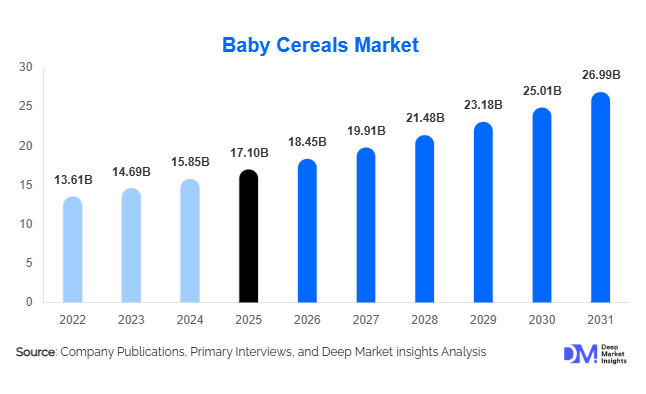
According to Deep Market Insights,the global baby cereals market size was valued at USD 17.1 billion in 2025 and is projected to grow from USD 18.45 billion in 2026 to reach USD 26.99 billion by 2031, expanding at a CAGR of 7.9% during the forecast period (2026–2031). The baby cereals market growth is primarily driven by rising awareness of infant nutrition, increasing demand for convenient complementary foods, and the expansion of fortified and organic infant cereal products. As infants transition from breast milk or formula to solid foods, baby cereals remain one of the most widely recommended first foods due to their digestibility and high nutritional value.
Manufacturers are focusing on innovation through iron-fortified formulations, probiotic enrichment, and clean-label ingredient sourcing to address evolving consumer expectations. The growing preference for organic and allergen-free cereals has encouraged companies to expand premium product lines that cater to health-conscious parents. In addition, increasing urbanization, higher female workforce participation, and busy lifestyles are boosting demand for ready-to-prepare infant foods. The rapid expansion of e-commerce platforms and specialty baby food stores is further improving product accessibility worldwide. Emerging markets in Asia-Pacific and Latin America are witnessing strong growth due to rising birth rates and growing middle-class purchasing power, while North America and Europe continue to lead in product innovation and premium organic baby cereal adoption.
Key Market Insights
- Iron-fortified cereals remain the most widely consumed baby cereal category, as healthcare guidelines emphasize iron intake during early infancy.
- Organic and clean-label baby cereals are gaining significant traction, driven by parental concerns regarding pesticide residues and artificial additives.
- Asia-Pacific dominates global demand, supported by high birth rates and increasing disposable income across China and India.
- North America continues to lead innovation, with strong growth in functional baby cereals enriched with probiotics, DHA, and plant-based proteins.
- E-commerce platforms are rapidly transforming distribution channels, enabling direct-to-consumer sales and subscription-based baby food deliveries.
- Product diversification with ancient grains such as quinoa, millet, and oats is expanding nutritional options for infants globally.
What are the latest trends in the baby cereals market?
Growing Demand for Organic and Clean-Label Infant Foods
Parents are increasingly prioritizing food safety and ingredient transparency when selecting infant nutrition products. This shift has accelerated demand for organic baby cereals made from pesticide-free grains such as oats, quinoa, and brown rice. Organic certification and non-GMO labeling have become important purchase drivers in markets across North America and Europe. Many manufacturers are reformulating products to remove artificial preservatives, refined sugars, and synthetic additives while emphasizing natural ingredient sourcing. The clean-label movement is also encouraging brands to highlight simplified ingredient lists and traceable supply chains. As a result, organic baby cereals are emerging as one of the fastest-growing segments within the infant nutrition industry.
Functional and Nutrient-Enriched Baby Cereals
Product innovation in the baby cereals market is increasingly centered around functional nutrition. Manufacturers are introducing cereals enriched with probiotics, omega-3 fatty acids, DHA, and plant-based proteins to support infant cognitive development, digestive health, and immune function. Advances in microencapsulation technology allow sensitive nutrients to remain stable throughout the manufacturing process. These fortified formulations address common micronutrient deficiencies among infants while offering additional health benefits. Functional cereals are also gaining popularity among pediatricians and nutritionists, who recommend them as part of balanced complementary feeding programs. This trend is expected to drive premium product growth across both developed and emerging markets.
What are the key drivers in the baby cereals market?
Rising Awareness of Infant Nutrition and Health
Global awareness regarding infant nutrition has increased significantly in recent years. Healthcare professionals and pediatric organizations emphasize the importance of introducing iron-rich complementary foods at around six months of age to prevent nutritional deficiencies. Baby cereals are widely recommended because they provide essential vitamins, minerals, and dietary fiber required for healthy infant growth. Public health campaigns and nutritional guidelines have strengthened consumer trust in fortified cereals, making them one of the most common first solid foods introduced to infants worldwide.
Increasing Urbanization and Working Parents
Urban lifestyles and the rise of dual-income households are driving demand for convenient infant feeding solutions. Many working parents prefer ready-to-prepare foods that require minimal cooking time while still meeting nutritional requirements. Instant baby cereals that can be prepared by simply mixing with milk or water offer a practical solution for busy families. The convenience factor, combined with long shelf life and easy storage, has made baby cereals a staple product in urban households across both developed and developing economies.
What are the restraints for the global market?
Growing Preference for Homemade Baby Food
In several developed markets, health-conscious parents increasingly prefer homemade baby foods prepared from fresh ingredients. Some consumers believe freshly cooked foods provide better nutritional value compared to packaged alternatives. This perception has created challenges for packaged baby cereal manufacturers, particularly in markets where parents have access to organic ingredients and are willing to spend time preparing infant meals at home.
Stringent Regulations for Infant Food Safety
Infant food products are subject to strict safety regulations and quality standards across many countries. Manufacturers must comply with rigorous testing procedures, labeling requirements, and ingredient safety regulations before introducing new products to the market. These regulatory barriers can increase production costs and delay product launches, especially for smaller companies entering the infant nutrition industry.
What are the key opportunities in the baby cereals industry?
Expansion of E-Commerce and Direct-to-Consumer Sales
The rapid growth of online grocery platforms and specialty baby product marketplaces is creating significant opportunities for baby cereal manufacturers. E-commerce channels allow brands to directly reach consumers without relying solely on traditional retail networks. Subscription-based delivery models for infant foods are gaining popularity among urban parents who prefer automated replenishment of frequently used products. Digital marketing and personalized product recommendations are further improving brand engagement and customer loyalty.
Growth of Premium and Organic Infant Nutrition
The premium baby food segment continues to expand as consumers increasingly prioritize quality and safety in infant nutrition products. Organic cereals made from certified grains and natural ingredients command higher price points compared to conventional cereals. Companies investing in organic farming partnerships and transparent sourcing practices are well positioned to capture a larger share of the premium infant nutrition market.
Report Scope
| Report Metric | Details |
|---|---|
| Market Size in 2025 | USD 17.10 Billion |
| Market Size in 2026 | USD 18.45 Billion |
| Market Size in 2031 | USD 26.99 Billion |
| CAGR | 7.9% (2026-2031) |
| Base Year for Estimation | 2025 |
| Historical Data | 2022-2024 |
| Forecast Period | 2026-2031 |
| Report Coverage | Revenue Forecast, Competitive Landscape, Supply Chain Disruption, Growth Factors, Environment & Regulatory Landscape and Trends |
| Geographies Covered | North America, Europe, APAC, Middle East and Africa, LATAM |
| Countries Covered | U.S., Canada, U.K., Germany, France, Spain, Italy, Russia, Nordic, Benelux, Rest of Europe, China, Korea, Japan, India, Australia, Singapore, Taiwan, South East Asia, Rest of Asia-Pacific, UAE, Turky, Saudi Arabia, South Africa, Egypt, Nigeria, Rest of MEA, Brazil, Mexico, Argentina, Chile, Colombia, Rest of LATAM |
Explore more data points, trends and opportunities Download Free Sample Report
Product Type Insights
Rice-based baby cereals dominate the global baby cereals market, accounting for nearly 32% of total demand. The segment’s leadership is primarily driven by the grain’s easy digestibility, low allergenic potential, and long-standing recommendation by pediatricians as one of the first complementary foods introduced during infancy. Rice cereals are widely preferred by parents because they are gentle on developing digestive systems and are often fortified with essential nutrients such as iron, zinc, and vitamins that support early childhood development.Wheat- and oat-based cereals represent other significant product segments, particularly in developed markets such as Europe and North America where diversified grain consumption is common. These cereals provide additional nutritional benefits, including higher fiber and protein content, making them suitable for infants progressing to more complex diets.
Multigrain and ancient grain cereals containing ingredients such as quinoa, millet, barley, and amaranth are rapidly gaining popularity worldwide. Growing parental awareness regarding balanced infant nutrition and the increasing preference for nutrient-dense foods are driving demand for these formulations. Manufacturers are increasingly developing cereals that combine multiple grains to enhance nutritional profiles, improve taste variety, and appeal to evolving consumer preferences for natural, organic, and minimally processed ingredients. Continuous product innovation, including organic formulations and fortified variants, is further strengthening product diversification within the baby cereals market.
Application Insights
Household infant feeding represents the dominant application segment, accounting for the majority of global baby cereal consumption. The leading position of this segment is driven by the widespread adoption of complementary feeding practices as infants transition from exclusive milk consumption to solid foods. Baby cereals are often introduced during early feeding stages because they are easy to prepare, nutritionally balanced, and highly adaptable to infants' dietary requirements.Hospitals and pediatric clinics also play an important role in the market by recommending fortified cereal formulations, particularly for infants requiring additional iron, vitamins, or nutritional support. Healthcare professionals frequently advise parents on appropriate infant nutrition products, which contributes to the adoption of scientifically formulated cereals.
Institutional childcare facilities and daycare centers are emerging as additional application areas, supported by rising female workforce participation and increasing reliance on organized childcare services. Structured feeding programs in these institutions often include baby cereals due to their convenience, standardized portion sizes, and balanced nutritional composition. As childcare infrastructure expands globally, institutional demand for packaged infant foods is expected to increase further.
Distribution Channel Insights
Supermarkets and hypermarkets remain the leading distribution channels for baby cereals, accounting for a substantial share of global retail sales. The dominance of this segment is driven by their extensive product assortments, competitive pricing, and the convenience of one-stop shopping. Parents prefer these outlets because they allow easy comparison of multiple brands, formulations, and nutritional attributes in a single location.Pharmacies and specialty baby stores also represent important retail channels due to the high level of consumer trust associated with healthcare-related product recommendations. These outlets often carry premium, organic, and medically recommended baby food products, making them a preferred option for health-conscious parents seeking high-quality infant nutrition.
Online retail platforms are witnessing the fastest growth among distribution channels. The rapid expansion of e-commerce, combined with increasing smartphone penetration and digital payment adoption, has significantly transformed consumer purchasing behavior. Online marketplaces provide parents with convenient home delivery, subscription services for recurring purchases, access to international brands, and the ability to compare product reviews and nutritional information. As digital retail ecosystems continue to expand globally, e-commerce is expected to play an increasingly important role in baby cereal distribution.
Age Group Insights
Infants aged 6–12 months represent the largest consumer segment within the global baby cereals market. The dominance of this age group is primarily driven by the developmental stage during which infants transition from exclusive milk feeding to complementary solid foods. Baby cereals provide a convenient and nutritionally balanced option during this critical phase, offering essential nutrients such as iron, calcium, and vitamins that support cognitive and physical development.Products designed for infants aged 4–6 months typically consist of single-grain cereals formulated to minimize allergen exposure and ensure easy digestion. These cereals are usually introduced gradually under pediatric guidance as infants begin their transition to solid foods.
For infants aged 12–24 months, baby cereals often incorporate more complex grain blends, fruits, vegetables, and additional nutrients to support continued growth and developmental needs. These products may also feature thicker textures and diverse flavors to accommodate the evolving eating habits of toddlers. Manufacturers continue to innovate formulations and textures across age segments to align with pediatric nutrition guidelines and the changing dietary needs of growing infants.
Explore more data points, trends and opportunities Download Free Sample Report
Baby Cereals Market Segmentations
By Product Type
- Rice-Based Baby Cereals
- Wheat-Based Baby Cereals
- Oat-Based Baby Cereals
- Multigrain & Ancient Grain Cereals
- Organic & Fortified Baby Cereals
By Application
- Household Infant Feeding
- Hospitals & Pediatric Clinics
- Daycare & Institutional Feeding Programs
By Distribution Channel
- Supermarkets & Hypermarkets
- Pharmacies & Specialty Baby Stores
- Online Retail / E-Commerce Platforms
Regional Insights
North America
North America accounts for approximately 24% of the global baby cereals market, with the United States representing the largest regional consumer. Market growth in the region is supported by high awareness of infant nutrition, strong purchasing power, and widespread availability of fortified baby food products. Parents in North America increasingly prioritize scientifically formulated infant foods that provide balanced nutrition and developmental benefits.
The growing demand for organic, non-GMO, and clean-label baby foods is further driving product innovation across the region. Consumers are showing greater interest in transparent ingredient sourcing and minimally processed formulations, encouraging manufacturers to expand premium and organic cereal offerings. In addition, the well-established retail infrastructure, including supermarkets, specialty baby stores, and online platforms, ensures widespread product accessibility.Canada also demonstrates strong demand for organic infant foods, supported by high living standards, increasing health consciousness among parents, and strict regulatory standards governing infant nutrition products.
Europe
Europe holds nearly 21% of the global baby cereals market share, with countries such as Germany, France, the United Kingdom, and Italy driving regional demand. European consumers place strong emphasis on organic certification, clean-label ingredients, and sustainably sourced food products. These preferences have encouraged manufacturers to develop baby cereals with natural ingredients, minimal additives, and environmentally responsible packaging.
Government initiatives promoting early childhood nutrition and strict food safety regulations also contribute significantly to consumer confidence in packaged infant foods. The region's well-developed healthcare systems and pediatric guidance programs further support the adoption of fortified infant cereals.Additionally, Europe’s growing focus on sustainability is influencing product development strategies. Many companies are adopting eco-friendly packaging solutions, reducing carbon footprints in supply chains, and investing in responsibly sourced grains to align with evolving environmental expectations among consumers.
Asia-Pacific
Asia-Pacific represents the largest and fastest-growing regional market, accounting for approximately 42% of global demand. The region’s dominance is largely attributed to its large infant population, rising disposable incomes, and increasing urbanization across major economies.China is the dominant market within the region, driven by heightened awareness of infant food safety following previous food safety concerns and increasing demand for high-quality packaged infant nutrition products. Parents increasingly prefer trusted brands and fortified cereals that meet international safety standards.
India is also witnessing strong growth due to its large birth population, expanding middle-class population, and improving awareness of infant nutrition. Rapid expansion of modern retail channels and e-commerce platforms is improving product accessibility across urban and semi-urban areas.Japan and South Korea represent mature markets characterized by high adoption of premium fortified cereals, advanced product innovation, and strong demand for convenient and nutritionally optimized infant foods.
Latin America
Latin America represents an emerging market for baby cereals, with Brazil and Mexico accounting for the largest consumer bases. Market growth in the region is supported by rising awareness of infant nutrition, increasing disposable incomes, and improving retail distribution networks.Urbanization and the rapid expansion of supermarket chains and hypermarkets are enhancing product accessibility across major metropolitan areas. Additionally, government initiatives aimed at improving maternal and infant health are contributing to greater adoption of fortified baby food products.Manufacturers are also introducing affordable cereal formulations tailored to price-sensitive consumers in developing markets, which is helping expand product penetration across a broader demographic base.
Middle East & Africa
The Middle East and Africa region is gradually expanding within the global baby cereals market. Countries such as Saudi Arabia, the United Arab Emirates, and South Africa are witnessing increasing demand for packaged infant nutrition products due to rising urbanization and growing awareness of early childhood nutrition.High birth rates in several African countries and improving healthcare infrastructure are expected to support long-term market growth. In the Middle East, strong demand for premium imported baby food brands and increasing participation of women in the workforce are driving consumption of convenient infant nutrition products.Expanding retail networks, including supermarkets, pharmacies, and online marketplaces, are further improving product availability across the region, supporting the gradual expansion of the baby cereals market.
Key Players in the Baby Cereals Market
- Nestlé S.A.
- Danone S.A.
- Abbott Laboratories
- Kraft Heinz Company
- HiPP GmbH & Co. Vertrieb KG
- Hero Group
- Bellamy’s Organic
- Hain Celestial Group
- Inner Mongolia Yili Industrial Group
- China Feihe Limited