Baby Bottles Market Size
According to Deep Market Insights, the global baby bottles market size was valued at USD 3,950 million in 2025 and is projected to grow from USD 4,250.20 million in 2026 to reach USD 6,130.14 million by 2031, expanding at a CAGR of 7.6% during the forecast period (2026–2031). The baby bottles market growth is primarily driven by increasing awareness of infant health and nutrition, rising participation of women in the workforce, and growing demand for safe, BPA-free, and ergonomically designed feeding products. Rapid urbanization, expanding e-commerce penetration, and premiumization trends are further contributing to the steady expansion of this market globally.
Key Market Insights
- Demand is shifting toward BPA-free, eco-friendly, and non-toxic materials, including glass and silicone baby bottles.
- Anti-colic baby bottles dominate the product landscape, driven by parental focus on infant comfort and digestion.
- Asia-Pacific dominates the global market, supported by high birth rates and large population bases in India and China.
- Online retail channels are witnessing the fastest growth, driven by convenience and wider product availability.
- Premiumization is a key trend in developed markets, with consumers preferring technologically advanced and durable products.
- Technological innovations, including smart baby bottles with temperature sensors and feeding trackers, are gaining traction.
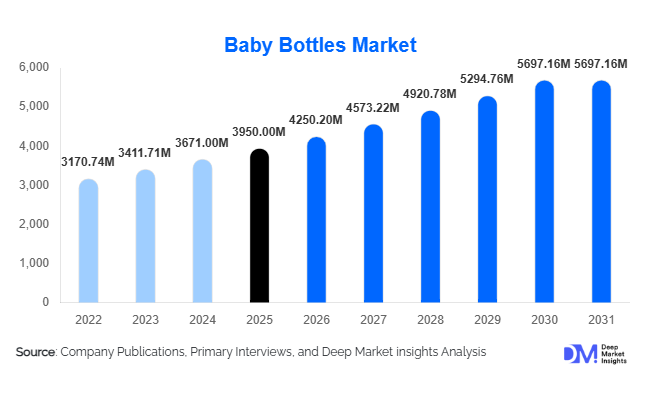
What are the latest trends in the baby bottles market?
Shift Toward Sustainable and Eco-Friendly Materials
The baby bottles market is experiencing a strong shift toward environmentally sustainable products. Parents are increasingly opting for glass and silicone bottles due to concerns regarding plastic safety and environmental impact. Manufacturers are responding by introducing recyclable materials, biodegradable packaging, and toxin-free production processes. This trend is particularly prominent in North America and Europe, where regulatory frameworks and consumer awareness around sustainability are well established. Companies are also investing in lifecycle assessments and eco-label certifications to strengthen their brand positioning and appeal to environmentally conscious consumers.
Integration of Smart and Connected Feeding Solutions
Technological advancements are transforming traditional baby feeding products into smart solutions. Smart baby bottles equipped with temperature monitoring, feeding volume tracking, and app connectivity are gaining popularity among tech-savvy parents. These innovations enable real-time monitoring of infant feeding patterns, improving convenience and safety. The adoption of IoT-enabled baby care devices is expected to grow rapidly, particularly in developed markets where digital ecosystems are well integrated into daily life. This trend is opening new premium product categories and enhancing user engagement.
What are the key drivers in the baby bottles market?
Rising Awareness of Infant Health and Safety
Growing awareness among parents regarding infant health and safety is a major driver of the baby bottles market. Consumers are increasingly prioritizing products made from BPA-free, non-toxic, and medically approved materials. Regulatory bans on harmful chemicals have further accelerated the adoption of safer alternatives. This has encouraged manufacturers to innovate and comply with stringent safety standards, boosting consumer confidence and driving market growth.
Increasing Participation of Women in the Workforce
The rising number of working mothers globally has significantly increased reliance on bottle feeding. Busy lifestyles and time constraints have made baby bottles an essential product for infant care. Urbanization and changing family structures are further supporting this trend, particularly in emerging economies. The demand for convenient, easy-to-use, and portable feeding solutions continues to grow, strengthening market expansion.
What are the restraints for the global market?
Declining Birth Rates in Developed Economies
One of the primary challenges for the baby bottles market is the declining birth rate in developed regions such as Europe and North America. This demographic shift reduces the potential customer base, impacting overall demand growth. Companies are increasingly focusing on emerging markets to offset this slowdown.
High Price Sensitivity and Intense Competition
The presence of low-cost, unbranded products in developing markets creates pricing pressure for established brands. Consumers in price-sensitive regions often prioritize affordability over premium features, which can limit profit margins. Additionally, intense competition among global and local players poses challenges in maintaining brand differentiation.
What are the key opportunities in the baby bottles industry?
Expansion in Emerging Markets
Emerging economies in Asia-Pacific, Latin America, and Africa present significant growth opportunities due to rising birth rates, increasing disposable incomes, and improving healthcare infrastructure. Countries such as India and Indonesia are witnessing strong demand for infant care products, supported by government initiatives in maternal and child health. Companies that focus on localized manufacturing and affordable product offerings can capitalize on these high-growth markets.
Adoption of Smart Feeding Technologies
The integration of smart technology into baby bottles is creating new revenue streams for manufacturers. Features such as temperature control, feeding analytics, and mobile app integration are appealing to modern parents. This segment is expected to grow rapidly, offering opportunities for product differentiation and premium pricing strategies.
Growth in Sustainable Product Lines
The increasing preference for eco-friendly products provides an opportunity for manufacturers to expand their sustainable product portfolios. Glass and silicone bottles are gaining popularity due to their durability and safety. Companies investing in green manufacturing processes and sustainable packaging can strengthen their market positioning and attract environmentally conscious consumers.
Report Scope
| Report Metric | Details |
|---|---|
| Market Size in 2025 | USD 3950 Million |
| Market Size in 2026 | USD 4250.20 Million |
| Market Size in 2031 | USD 6130.14 Million |
| CAGR | 7.6% (2026-2031) |
| Base Year for Estimation | 2025 |
| Historical Data | 2022-2024 |
| Forecast Period | 2026-2031 |
| Report Coverage | Revenue Forecast, Competitive Landscape, Supply Chain Disruption, Growth Factors, Environment & Regulatory Landscape and Trends |
| Geographies Covered | North America, Europe, APAC, Middle East and Africa, LATAM |
| Countries Covered | U.S., Canada, U.K., Germany, France, Spain, Italy, Russia, Nordic, Benelux, Rest of Europe, China, Korea, Japan, India, Australia, Singapore, Taiwan, South East Asia, Rest of Asia-Pacific, UAE, Turky, Saudi Arabia, South Africa, Egypt, Nigeria, Rest of MEA, Brazil, Mexico, Argentina, Chile, Colombia, Rest of LATAM |
Explore more data points, trends and opportunities Download Free Sample Report
Product Type Insights
Plastic baby bottles continue to dominate the global market, accounting for approximately 58% of the total share in 2025. This leadership is primarily driven by their affordability, lightweight nature, durability, and widespread availability across both developed and emerging markets. Polypropylene-based bottles, in particular, remain highly preferred due to their cost-effectiveness and compliance with BPA-free regulations. However, shifting consumer preferences toward safety and sustainability are gradually reshaping the segment landscape. Glass and silicone bottles are witnessing accelerated adoption, especially in North America and Europe, where parents prioritize non-toxic, heat-resistant, and environmentally friendly materials. Silicone bottles, though premium-priced, are gaining traction due to their flexibility, durability, and resistance to breakage.
From a capacity perspective, medium-capacity bottles (150–300 ml) lead with around 46% market share, as they align with the most common feeding volumes required across infant stages, offering versatility and convenience. In terms of design, wide-neck bottles hold nearly 52% share, driven by their ease of cleaning, compatibility with modern breast pumps, and convenience in formula preparation. Additionally, anti-colic bottles dominate the functional segment with approximately 64% share, reflecting strong parental demand for products that reduce air intake, minimize infant discomfort, and improve feeding efficiency. The continued innovation in venting systems and ergonomic designs is expected to further strengthen the dominance of these leading segments.
Application Insights
The household segment represents the largest application area, accounting for over 80% of total demand, driven by consistent purchases from parents and caregivers. This dominance is supported by rising awareness of infant nutrition, increasing disposable incomes, and the growing adoption of branded and premium baby care products. The shift toward nuclear families and the increasing participation of women in the workforce are further reinforcing household demand for convenient feeding solutions.
Hospitals and maternity clinics are emerging as the fastest-growing segment, driven by the adoption of standardized feeding protocols, strict hygiene requirements, and the need for medically approved feeding products. Institutional demand is also supported by rising birth rates in developing regions and improvements in healthcare infrastructure. Daycare centers are gaining importance, particularly in urban areas, where dual-income households rely on professional childcare services. These facilities require durable, easy-to-clean, and hygienic baby bottles, leading to bulk procurement and repeat purchasing patterns. This diversification of application areas is contributing to stable and sustained market growth.
Distribution Channel Insights
Offline retail channels continue to dominate the baby bottles market, accounting for approximately 62% of total sales in 2025. Supermarkets, hypermarkets, specialty baby stores, and pharmacies remain key distribution points, offering consumers the advantage of product inspection, brand comparison, and immediate purchase. In many developing regions, offline retail remains the primary channel due to limited digital penetration and strong reliance on traditional shopping habits.
However, online retail is the fastest-growing distribution channel, driven by increasing internet penetration, smartphone usage, and the convenience of home delivery. E-commerce platforms and brand-owned websites are enabling direct-to-consumer engagement, offering a wide range of products, competitive pricing, and access to customer reviews. Digital marketing strategies, influencer endorsements, and subscription-based purchasing models are further accelerating online sales. The integration of omnichannel strategies by leading brands is enhancing customer experience and expanding market reach globally.
Age Group Insights
The 0–6 months age group dominates the baby bottles market, accounting for approximately 48% of the total share in 2025. This segment leads due to the high dependency on bottle feeding during early infancy, particularly among working mothers and in cases where breastfeeding supplementation is required. The demand for smaller, ergonomically designed bottles with anti-colic features is highest in this age group, driving innovation and product development.
The 6–12 months segment follows, supported by the introduction of complementary feeding and increasing feeding frequency. Parents in this stage often transition to medium-capacity bottles with enhanced durability. The 12–24 months segment, while smaller in share, is experiencing steady growth as toddlers require larger capacity bottles and more robust designs. This segment is also witnessing innovation in spill-proof and training bottle solutions, supporting long-term product usage.
Explore more data points, trends and opportunities Download Free Sample Report
Baby Bottles Market Segmentations
By Product Type
- Plastic Baby Bottles
- Glass Baby Bottles
- Silicone Baby Bottles
- Stainless Steel Baby Bottles
By Application
- Household/Individual Consumers
- Hospitals & Maternity Clinics
- Daycare Centers
By Distribution Channel
- Online Retail
- Supermarkets/Hypermarkets
- Specialty Baby Stores
- Pharmacies & Drug Stores
By Capacity
- Below 150 ml
- 150–300 ml
- Above 300 ml
By Age Group
- 0–6 Months
- 6–12 Months
- 12–24 Months
Regional Insights
North America
North America accounts for approximately 26% of the global baby bottles market, with the United States being the largest contributor. Growth in this region is driven by high disposable incomes, strong consumer awareness regarding infant health, and a preference for premium, technologically advanced products. The increasing demand for BPA-free, anti-colic, and smart baby bottles is significantly influencing market dynamics. Additionally, the widespread presence of established brands, advanced retail infrastructure, and strong e-commerce penetration are supporting market expansion. Rising trends in sustainable parenting and eco-friendly products are also encouraging the adoption of glass and silicone bottles, contributing to higher average selling prices.
Europe
Europe holds around 22% of the global market share, led by countries such as Germany, the United Kingdom, and France. The region’s growth is primarily driven by stringent regulatory standards related to infant safety and product quality, which have accelerated the adoption of BPA-free and sustainable materials. Increasing environmental awareness among consumers is further boosting demand for glass and silicone baby bottles. Additionally, well-established healthcare systems, high urbanization rates, and strong purchasing power are supporting consistent demand. The trend toward premiumization and eco-conscious consumption is particularly prominent in Western Europe, driving innovation and product differentiation.
Asia-Pacific
Asia-Pacific dominates the global baby bottles market with approximately 38% share in 2025 and is also the fastest-growing region, with a CAGR exceeding 8.5%. Countries such as China and India are key contributors, driven by high birth rates, large population bases, and increasing urbanization. Rising disposable incomes and expanding middle-class populations are enabling greater spending on infant care products. Government initiatives focused on maternal and child healthcare, along with improving healthcare infrastructure, are further supporting market growth. Additionally, the rapid expansion of e-commerce platforms and retail networks is enhancing product accessibility. The growing awareness of infant nutrition and safety is also driving the adoption of branded and premium baby bottles in the region.
Latin America
Latin America is witnessing steady growth, with Brazil and Mexico emerging as key markets. The region’s expansion is driven by improving economic conditions, rising awareness of infant health, and increasing penetration of organized retail. Urbanization and the growing number of working mothers are contributing to higher demand for convenient feeding solutions. Additionally, the expansion of international brands and the development of local manufacturing capabilities are improving product availability and affordability. Government healthcare initiatives and rising investments in maternal care are further supporting market growth.
Middle East & Africa
The Middle East & Africa region is gradually expanding, with growth concentrated in countries such as the United Arab Emirates and South Africa. Key growth drivers include improving healthcare infrastructure, increasing awareness of infant nutrition, and rising disposable incomes in urban areas. The growing expatriate population in the Middle East is also contributing to demand for premium baby care products. In Africa, high birth rates and government efforts to improve maternal and child health services are supporting market expansion. However, price sensitivity remains a challenge, encouraging demand for affordable product options. The gradual development of retail and distribution networks is expected to further enhance market penetration in the region.
Key Players in the Baby Bottles Market
- Philips Avent
- Pigeon Corporation
- Tommee Tippee
- Comotomo
- MAM Baby
- Chicco
- Dr. Brown’s
- NUK
- Medela
- Evenflo Feeding
- Lansinoh
- Mayborn Group
- Richell Corporation
- Nanobébé
- Playtex Baby