Asian Cuisine Market Size
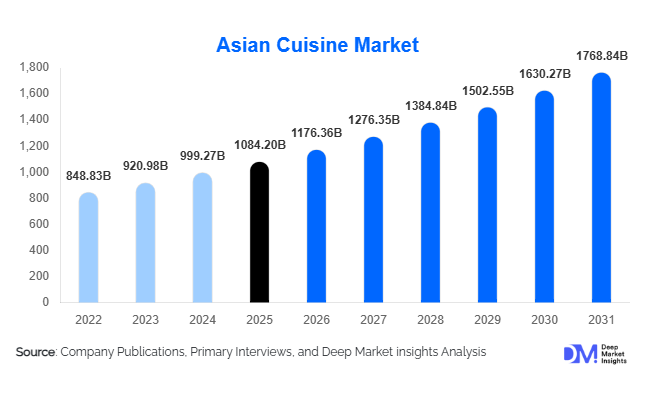
According to Deep Market Insights, the global Asian cuisine market size was valued at USD 1,084.2 billion in 2025 and is projected to grow from USD 1,176.36 billion in 2026 to reach USD 1,768.84 billion by 2031, expanding at a CAGR of 8.5% during the forecast period (2026–2031). The market growth is driven by increasing globalization of food culture, rapid expansion of Asian restaurant chains across Western economies, rising consumer preference for flavorful and healthier meal options, and the acceleration of digital food delivery ecosystems. Asian cuisine—including Chinese, Japanese, Indian, Thai, Korean, and Southeast Asian food categories—has transitioned from ethnic niche offerings to mainstream global dining formats.
Key Market Insights
- Asian cuisine has become a mainstream global food category, supported by urbanization and multicultural consumption patterns.
- Quick-service Asian restaurant chains are expanding aggressively across North America and Europe through franchising models.
- Asia-Pacific dominates global consumption, supported by strong domestic demand in China, India, Japan, and Southeast Asia.
- Korean and Japanese cuisines are among the fastest-growing segments due to pop-culture influence and premium dining appeal.
- Food delivery platforms and cloud kitchens are reshaping distribution and improving accessibility of Asian meals worldwide.
- Health-oriented menu innovation, including plant-based and low-oil cooking styles, is expanding consumer adoption.
What are the latest trends in the Asian cuisine market?
Globalization of Regional Asian Flavors
Regional Asian cuisines are increasingly gaining global recognition beyond traditional Chinese and Indian offerings. Korean cuisine, Japanese ramen concepts, Thai street food, and Vietnamese pho formats are expanding internationally through franchise-led restaurant models. Consumers are showing growing interest in authenticity, encouraging restaurants to preserve traditional cooking techniques while adapting spice levels and ingredient sourcing to local tastes. Fusion cuisine is also emerging, blending Asian flavors with Western formats such as Asian tacos, sushi burritos, and curry-based fast casual meals. This trend is enabling brands to attract younger consumers seeking culinary novelty while maintaining operational scalability.
Digital Ordering and Delivery-First Asian Food Brands
The rise of delivery-first restaurant models has significantly benefited Asian cuisine due to its portability and strong flavor retention during transport. Cloud kitchens specializing in noodles, rice bowls, dumplings, and stir-fried meals are expanding rapidly in urban markets. AI-based menu optimization, dynamic pricing, and predictive demand analytics are improving operational efficiency. Digital-native Asian brands increasingly rely on aggregator platforms and direct mobile apps, allowing rapid geographic expansion without heavy real estate investments. The growth of late-night food delivery and office meal subscriptions further strengthens demand for Asian cuisine formats.
What are the key drivers in the Asian cuisine market?
Rising Demand for Convenient Yet Flavor-Rich Meals
Consumers globally are seeking meals that combine convenience with strong taste profiles, positioning Asian cuisine as a preferred option. Rice-based meals, noodle bowls, and stir-fry dishes provide fast preparation times and adaptability across dietary preferences. Urban lifestyles and dual-income households are accelerating demand for ready-to-eat Asian meals through restaurants and packaged food channels.
Health Perception and Nutritional Diversity
Many Asian cuisines emphasize vegetables, fermented foods, lean proteins, and balanced portioning. Japanese and Korean diets, in particular, are associated with wellness benefits, driving adoption among health-conscious consumers. The growing popularity of plant-based diets has also supported tofu, tempeh, and vegetable-forward Asian dishes globally.
Expansion of International Restaurant Chains
Major Asian restaurant brands are expanding through franchising and strategic partnerships across developed and emerging economies. Standardized menus, scalable supply chains, and digital ordering systems allow consistent customer experiences. International tourism recovery and cultural exposure through media and entertainment further reinforce adoption.
What are the restraints for the global market?
Supply Chain Complexity and Ingredient Standardization
Authentic Asian cuisine often relies on specialized ingredients such as sauces, spices, seafood varieties, and fermented products. Supply disruptions and import dependency can increase operational costs and affect menu consistency, particularly in Western markets.
Cultural Adaptation Challenges
Balancing authenticity with localization remains challenging. Excessive adaptation risks diluting brand identity, while strict authenticity may limit acceptance among new consumers unfamiliar with traditional flavors. Regulatory compliance related to food safety and labeling standards across regions also adds operational complexity.
What are the key opportunities in the Asian cuisine industry?
Expansion into Emerging Urban Markets
Rapid urbanization across Africa, Latin America, and Southeast Asia is creating strong demand for affordable and scalable dining formats. Asian cuisine concepts—particularly noodles, rice meals, and street-food-inspired menus—are highly adaptable to price-sensitive markets. New entrants can leverage franchising and localized sourcing strategies to capture early market share in growing cities.
Plant-Based and Functional Asian Foods
Asian culinary traditions naturally align with plant-forward diets, presenting significant opportunities for innovation. Vegan ramen, plant-based dumplings, and fermented probiotic foods such as kimchi and miso are gaining popularity among wellness-focused consumers. Functional foods incorporating immunity-boosting ingredients are expected to expand premium product categories.
Retail and Packaged Asian Meal Solutions
Supermarkets and e-commerce platforms are increasingly offering ready-to-cook Asian meal kits, frozen dumplings, instant noodles, and sauce kits. This retail expansion allows restaurant brands to diversify revenue streams beyond dine-in operations. Private-label Asian products from global retailers are also increasing accessibility and driving household consumption growth.
Report Scope
| Report Metric | Details |
|---|---|
| Market Size in 2025 | USD 1084.20 Billion |
| Market Size in 2026 | USD 1176.36 Billion |
| Market Size in 2031 | USD 1768.84 Billion |
| CAGR | 8.5% (2026-2031) |
| Base Year for Estimation | 2025 |
| Historical Data | 2022-2024 |
| Forecast Period | 2026-2031 |
| Report Coverage | Revenue Forecast, Competitive Landscape, Supply Chain Disruption, Growth Factors, Environment & Regulatory Landscape and Trends |
| Geographies Covered | North America, Europe, APAC, Middle East and Africa, LATAM |
| Countries Covered | U.S., Canada, U.K., Germany, France, Spain, Italy, Russia, Nordic, Benelux, Rest of Europe, China, Korea, Japan, India, Australia, Singapore, Taiwan, South East Asia, Rest of Asia-Pacific, UAE, Turky, Saudi Arabia, South Africa, Egypt, Nigeria, Rest of MEA, Brazil, Mexico, Argentina, Chile, Colombia, Rest of LATAM |
Explore more data points, trends and opportunities Download Free Sample Report
Cuisine Type Insights
Chinese cuisine remains the leading segment, accounting for approximately 28% of the global market in 2025. Its dominance is fueled by widespread international adoption, adaptability to local tastes, and the scalability of popular dishes such as noodles, fried rice, dumplings, and dim sum. Japanese cuisine retains a strong premium positioning, driven by global sushi and ramen trends, culinary innovation, and experiential dining concepts that attract high-spending consumers. Indian cuisine continues to expand due to its vegetarian diversity, rich spice profiles, and growing international recognition in both casual and fine-dining segments. Korean cuisine is the fastest-growing category, propelled by global cultural influence, the rise of K-pop and K-drama inspired food trends, and increasing popularity of Korean BBQ, kimchi, and fermented foods. Thai and Vietnamese cuisines are seeing steady growth, particularly through street-food-inspired fast-casual concepts that emphasize authenticity, freshness, and bold flavor profiles, appealing to younger and health-conscious consumers worldwide.
Service Type Insights
Quick-service restaurants (QSR) dominate the market with nearly 41% share in 2025, driven by affordability, standardized menu offerings, convenience, and compatibility with delivery platforms. Full-service restaurants continue to maintain a strong presence, especially in urban and premium markets, where experiential dining and high-quality service for Japanese, Korean, and fusion cuisines attract affluent consumers. Cloud kitchens represent the fastest-growing service segment, supported by low initial investment, operational flexibility, and the rapid expansion of online delivery ecosystems. This model is particularly appealing in densely populated urban areas and regions with high digital penetration.
Distribution Channel Insights
Dine-in consumption continues to contribute significant revenue globally; however, online delivery channels account for nearly 34% of total Asian cuisine sales, driven by convenience, mobile app penetration, and busy urban lifestyles. Aggregator platforms and direct-ordering apps allow restaurants to reach wider customer bases and tap into new regions without heavy infrastructure investment. Retail packaged foods and ready-to-eat meals are witnessing strong growth, especially in North America and Europe, as consumers increasingly prefer recreating authentic Asian dishes at home, supported by the availability of frozen, frozen-prepared, and shelf-stable Asian products.
End-Use Insights
Individual consumers represent the largest demand base for Asian cuisine, motivated by a desire for international flavors, convenience, and diverse dining experiences. Institutional consumption, however, is rising steadily, driven by corporate catering, office meal subscriptions, and hospitality integration into tourism and event segments. The global foodservice industry, valued above USD 4 trillion, acts as a key driver, with Asian cuisine representing one of the fastest-growing menu categories. Export-driven demand is also robust, particularly for sauces, noodles, frozen foods, and ready-to-cook products from China, Thailand, Vietnam, and South Korea, which increasingly cater to Western markets seeking authentic flavors and high-quality ingredients.
Explore more data points, trends and opportunities Download Free Sample Report
Asian Cuisine Market Segmentations
By Cuisine Type
- Chinese Cuisine
- Japanese Cuisine
- Indian Cuisine
- Thai Cuisine
- Korean Cuisine
- Vietnamese Cuisine
- Pan-Asian Fusion Cuisine
By Service Type
- Full-Service Restaurants
- Quick Service Restaurants
- Cloud Kitchens & Delivery-Only Kitchens
- Street Food & Casual Dining
- Packaged & Ready-to-Eat Asian Foods
By Distribution Channel
- Dine-In Services
- Online Food Delivery Platforms
- Takeaway & Quick Pickup
- Retail & Supermarkets
By End Use
- Household Consumption
- Foodservice & Restaurants
- Hospitality & Tourism
- Corporate & Institutional Catering
By Price Category
- Premium Asian Dining
- Mid-Range Dining
- Economy & Street Food Segment
Regional Insights
Asia-Pacific
Asia-Pacific dominates the market with approximately 47% share in 2025. China accounts for nearly 21% of global consumption, fueled by a large domestic foodservice sector, rapid urbanization, and strong cultural preference for Chinese culinary staples. India is among the fastest-growing markets, driven by rising urban middle-class income, increasing dining-out frequency, and the expansion of organized restaurant chains and QSR networks. Japan and South Korea contribute significantly to premium dining demand and culinary exports, with global recognition for sushi, ramen, and Korean BBQ concepts. Southeast Asian countries, including Thailand and Vietnam, are expanding exports of sauces, seafood, and packaged meals, supported by government initiatives promoting food export and growing interest from international retailers. Overall, regional growth is propelled by population density, rising disposable income, increasing international travel, and a surge in e-commerce-enabled food delivery.
North America
North America holds nearly 22% market share, led by the United States, where Asian cuisine is among the most consumed international food categories. Demand is driven by multicultural demographics, high adoption of delivery services, and the rapid expansion of fast-casual Asian concepts. Premium Japanese and Korean dining experiences are growing in metropolitan areas, while innovative fusion concepts attract younger consumers. Canada is also witnessing strong growth, particularly in Japanese and Korean cuisine adoption, supported by urbanization and rising interest in health-conscious and globally inspired menus. Regional growth drivers include strong digital infrastructure, a high preference for convenience, and an increasing number of cross-cultural culinary events that promote awareness and accessibility of Asian cuisine.
Europe
Europe accounts for roughly 18% of global demand, with the U.K., Germany, and France leading consumption. The market is characterized by growing consumer interest in Thai, Indian, and Japanese cuisines, driven by health-conscious trends, international travel exposure, and curiosity for exotic flavors. Takeaway and delivery services are growing rapidly, supported by advanced online ordering systems and food aggregators. Culinary education, influencer culture, and fusion dining experiences are also accelerating market growth. Overall, Europe’s adoption is fueled by high urbanization, disposable income growth, evolving food trends, and the popularity of dining experiences that combine convenience with authenticity.
Middle East & Africa
The Middle East & Africa region sees strong demand in the UAE and Saudi Arabia, largely driven by expatriate populations and robust hospitality sectors. Premium dining and buffet-style Asian concepts are popular in urban centers and tourist hotspots. African markets, including South Africa and Kenya, are experiencing growth through urban restaurant expansion, increasing tourism, and rising middle-class consumption. Regional growth is supported by improving foodservice infrastructure, increasing international investment, and cultural openness to global cuisines, which allows Asian dishes to gain traction beyond traditional urban hubs.
Latin America
Latin America is witnessing steady growth, led by Brazil and Mexico, where Asian fusion concepts are gaining popularity in metropolitan areas. Japanese cuisine maintains historical influence in Brazil due to cultural ties, supporting consistent market expansion. Urbanization, increasing disposable incomes, and rising awareness of health-conscious eating patterns are further driving market adoption. The proliferation of modern retail formats and online delivery platforms also accelerates access to authentic and fusion Asian food experiences, making Latin America an increasingly attractive market for Asian cuisine brands.
Key Players in the Asian Cuisine Market
- Yum! China Holdings, Inc.
- Ajinomoto Co., Inc.
- Nissin Foods Holdings Co., Ltd.
- Tingyi (Cayman Islands) Holding Corp.
- Maruha Nichiro Corporation
- Skylark Holdings Co., Ltd.
- Haidilao International Holding Ltd.
- Jollibee Foods Corporation
- Yoshinoya Holdings Co., Ltd.
- Genki Sushi Co., Ltd.
- McCormick & Company (Asian sauces segment)
- Thai Union Group PCL
- DaChan Food (Asia) Limited
- Haidilao Hot Pot Group
- Ajisen (China) Holdings Limited