Artisan Bakery Market Size
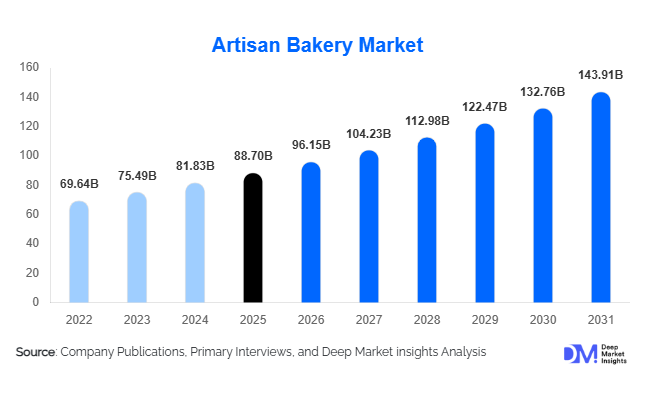
According to Deep Market Insights, the global artisan bakery market size was valued at USD 88.7 billion in 2025 and is projected to grow from USD 96.15 billion in 2026 to reach USD 143.91 billion by 2031, expanding at a CAGR of 8.4% during the forecast period (2026–2031). The artisan bakery market growth is primarily driven by rising consumer preference for clean-label baked goods, increasing demand for premium and freshly prepared food products, and expanding café culture worldwide. Consumers are increasingly shifting away from mass-produced bakery items toward handcrafted products made using traditional fermentation techniques, natural ingredients, and minimal processing. The expansion of in-store bakery concepts across supermarkets, alongside technological advancements in frozen artisan dough production, is further enabling scalability while maintaining craftsmanship quality. Emerging markets are witnessing strong adoption as premium food consumption rises among urban middle-class populations, positioning artisan bakery products as both lifestyle and health-oriented purchases.
Key Market Insights
- Consumer demand is rapidly shifting toward clean-label and naturally fermented bakery products, particularly sourdough and multigrain bread varieties.
- Supermarkets and retail chains are expanding in-store artisan baking concepts to replicate traditional bakery experiences and increase footfall.
- Europe dominates global demand due to strong baking traditions and daily fresh bread consumption habits.
- Asia-Pacific is the fastest-growing region, supported by westernized diets and expanding café culture.
- Frozen artisan dough technology is enabling global distribution while preserving product authenticity and freshness.
- Premiumization trends allow artisan bakery products to command price premiums of 30–80% over industrial baked goods.
What are the latest trends in the artisan bakery market?
Clean-Label and Natural Ingredient Adoption
Consumers increasingly prioritize transparency in food ingredients, driving strong demand for artisan bakery products made without artificial preservatives or additives. Clean-label positioning has become a defining feature of artisan bakeries, with brands emphasizing traditional fermentation, organic flour sourcing, and minimal ingredient lists. Sourdough bread has gained exceptional popularity due to perceived digestive benefits and natural fermentation processes. Retailers are highlighting ingredient traceability and local sourcing practices to strengthen consumer trust. This shift toward authenticity is reshaping product innovation, encouraging bakeries to experiment with ancient grains, plant-based inclusions, and nutrient-dense recipes aligned with health-conscious lifestyles.
Technology-Enabled Artisan Production
Modern bakery technologies are transforming artisan production without compromising craftsmanship. Controlled fermentation chambers, automated dough handling systems, and frozen par-baked logistics allow producers to scale operations efficiently. Supermarkets and café chains increasingly adopt centralized production facilities supplying fresh or partially baked goods to multiple locations. Digital demand forecasting tools are also helping reduce waste, a critical challenge for fresh bakery products with short shelf life. These innovations enable artisan bakeries to expand geographically while maintaining consistent product quality and freshness standards.
What are the key drivers in the artisan bakery market?
Growing Premium Food Consumption
Rising disposable incomes and evolving food preferences are encouraging consumers to trade up from packaged bread toward premium bakery products. Artisan bakery items offer perceived superior taste, authenticity, and health benefits, making them attractive to urban consumers seeking high-quality daily food options. Premium bakery consumption is particularly strong among millennials and younger professionals who associate handcrafted food with lifestyle value and wellness.
Expansion of Café and Coffee Culture
The global growth of café chains and specialty coffee outlets significantly drives artisan bakery demand. Bakery products such as croissants, brioche, and specialty pastries enhance beverage sales and increase average customer spending. Hybrid work patterns and social dining trends have increased café visitation frequency, positioning artisan bakery offerings as essential complementary products within foodservice environments.
Health and Digestibility Awareness
Consumers increasingly perceive naturally fermented bakery products as healthier alternatives to industrial bread. Long fermentation processes improve texture and digestibility, while whole-grain and gluten-conscious offerings appeal to wellness-focused buyers. This health positioning strengthens long-term demand across both developed and emerging markets.
What are the restraints for the global market?
High Production and Labor Costs
Artisan bakery production relies heavily on skilled labor, extended fermentation times, and premium ingredients, resulting in higher operational costs compared to industrial baking. Smaller bakeries face challenges scaling production while maintaining profitability, particularly in price-sensitive markets.
Limited Shelf Life and Supply Chain Complexity
Because artisan products avoid preservatives, they typically have shorter shelf lives, increasing wastage risks and distribution challenges. Maintaining freshness across long supply chains requires investment in cold storage and optimized logistics, which may limit expansion in developing regions.
What are the key opportunities in the artisan bakery industry?
Health-Focused Product Innovation
Opportunities exist in developing functional bakery products enriched with seeds, protein blends, and ancient grains. Producers introducing low-glycemic, organic, or allergen-free artisan lines can attract health-conscious consumers and expand premium product portfolios. Regulatory encouragement toward clean labeling further strengthens long-term innovation opportunities.
Expansion in Emerging Markets
Rapid urbanization and income growth across Asia-Pacific, the Middle East, and Latin America are creating new demand pools. Western-style cafés and premium retail formats are introducing artisan bakery consumption to new demographics. Local adaptation of flavors and formats enables brands to capture regional preferences while maintaining artisan positioning.
Report Scope
| Report Metric | Details |
|---|---|
| Market Size in 2025 | USD 88.70 Billion |
| Market Size in 2026 | USD 96.15 Billion |
| Market Size in 2031 | USD 143.91 Billion |
| CAGR | 8.4% (2026-2031) |
| Base Year for Estimation | 2025 |
| Historical Data | 2022-2024 |
| Forecast Period | 2026-2031 |
| Report Coverage | Revenue Forecast, Competitive Landscape, Supply Chain Disruption, Growth Factors, Environment & Regulatory Landscape and Trends |
| Geographies Covered | North America, Europe, APAC, Middle East and Africa, LATAM |
| Countries Covered | U.S., Canada, U.K., Germany, France, Spain, Italy, Russia, Nordic, Benelux, Rest of Europe, China, Korea, Japan, India, Australia, Singapore, Taiwan, South East Asia, Rest of Asia-Pacific, UAE, Turky, Saudi Arabia, South Africa, Egypt, Nigeria, Rest of MEA, Brazil, Mexico, Argentina, Chile, Colombia, Rest of LATAM |
Explore more data points, trends and opportunities Download Free Sample Report
Product Type Insights
The artisan bakery market demonstrates strong diversification across product categories, with artisan bread emerging as the dominant segment, accounting for nearly 38% of global market share in 2025. The leadership of artisan bread is primarily driven by increasing consumer preference for traditional baking methods, natural fermentation processes, and perceived digestive health benefits associated with sourdough and long-fermentation products. Sourdough, multigrain, and whole-wheat varieties have gained widespread popularity as consumers increasingly prioritize gut health, nutritional density, and minimally processed foods. The growing rejection of mass-produced packaged bread has further accelerated demand for handcrafted alternatives that emphasize authenticity and craftsmanship.Viennoiserie products, including croissants, brioche, and laminated pastries, continue to expand rapidly through café chains and premium quick-service formats, where consumers seek indulgent yet high-quality bakery experiences. Artisan cakes and pastries are also witnessing notable growth, particularly within premium retail environments and celebration-driven consumption occasions such as birthdays, weddings, and seasonal festivities. Additionally, specialty regional bakery products are achieving international penetration as globalization and culinary exploration encourage consumers to experiment with European, Asian, and Mediterranean baking traditions. This growing appreciation for artisanal techniques, combined with premiumization trends in food consumption, continues to reinforce product innovation and category expansion across global markets.
Production Model Insights
Production models within the artisan bakery industry are evolving to balance authenticity with scalability, with in-store scratch baking accounting for approximately 34% market share. This segment leads primarily because consumers strongly associate visible baking environments with freshness, transparency, and product quality. Supermarkets and premium grocery retailers increasingly invest in open-kitchen bakery formats that allow customers to observe preparation processes, strengthening trust and enhancing perceived product value. The sensory appeal created by aroma, visual presentation, and real-time baking significantly influences purchase decisions and repeat consumption.At the same time, centralized artisan production facilities are gaining traction among large bakery chains and retail groups seeking operational efficiency, standardized quality, and cost optimization. These facilities enable consistent production while maintaining artisanal characteristics through controlled fermentation and skilled craftsmanship. Frozen artisan dough solutions are also expanding globally, acting as a key enabler for international scalability. These solutions allow retailers and foodservice operators to deliver freshly baked products without requiring full-scale bakery infrastructure, thereby accelerating market penetration in emerging regions and supporting rapid outlet expansion while preserving authentic taste and texture profiles.
Ingredient Positioning Insights
Ingredient positioning plays a critical role in shaping consumer purchasing behavior, with clean-label and natural ingredient bakery products representing nearly 41% of the overall market, making this the leading segment. Growth in this category is driven by heightened consumer awareness surrounding food processing, additives, and artificial preservatives. Shoppers increasingly scrutinize ingredient lists and favor bakery products formulated with recognizable components such as flour, water, salt, and natural starters. Transparency in sourcing and production methods has become a defining competitive advantage for artisan bakeries.The expansion of organic, gluten-free, and specialty dietary offerings further supports this segment’s dominance. Health-conscious consumers and individuals with dietary sensitivities are actively seeking bakery products that align with wellness-focused lifestyles without compromising taste or texture. North America and Europe remain key adoption centers due to mature organic food ecosystems and regulatory support for labeling standards, while emerging markets are gradually embracing clean-label positioning as awareness of nutrition and food quality continues to increase. Manufacturers are investing in alternative grains, ancient cereals, and fermentation-based solutions to enhance both nutritional value and product differentiation.
Distribution Channel Insights
Distribution dynamics within the artisan bakery market reflect a shift toward experiential retail, with independent artisan bakeries maintaining leadership at roughly 29% market share. The leading position of this segment is supported by strong community engagement, localized branding, and consumer perception of superior craftsmanship. Customers often associate independent bakeries with authenticity, personalized service, and premium product quality, which fosters long-term loyalty and repeat purchases.However, supermarket artisan sections and café chains are rapidly narrowing the gap as retailers invest heavily in premium bakery concepts, live baking stations, and curated product assortments designed to replicate boutique bakery experiences. Large retail chains leverage scale advantages, strategic pricing, and accessibility to attract broader consumer demographics. Meanwhile, digital transformation is reshaping distribution through online bakery ordering platforms, direct-to-consumer delivery, and subscription-based bakery models. Urban consumers increasingly value convenience combined with premium quality, driving growth in e-commerce bakery channels, particularly in metropolitan areas with high smartphone penetration and advanced logistics infrastructure.
End-Use Insights
Household consumption dominates the artisan bakery market, accounting for approximately 52% share, supported by daily bread consumption habits and rising demand for premium food experiences at home. The leading position of this segment is driven by changing lifestyle patterns, including increased home dining, growing interest in gourmet foods, and consumer willingness to trade up from conventional bakery products to higher-quality artisanal alternatives. The perception of artisan bakery items as both healthier and more flavorful reinforces consistent household demand across developed and emerging economies.Foodservice applications represent one of the fastest-growing end-use segments, expanding at nearly 9–10% annually as cafés, hotels, and quick-service restaurants integrate artisan bakery offerings to enhance menu differentiation and customer experience. Premium sandwiches, brunch menus, and specialty breakfast formats increasingly rely on artisan bread varieties to elevate perceived value. Institutional buyers such as airlines, luxury catering providers, and hospitality groups are also adopting artisan bakery products to improve service quality and brand positioning. Additionally, frozen artisan dough exports are enabling cross-border supply expansion, allowing producers to serve international markets while maintaining product authenticity and freshness standards.
Explore more data points, trends and opportunities Download Free Sample Report
Artisan Bakery Market Segmentations
By Product Type
- Artisan Bread
- Viennoiserie
- Artisan Cakes & Pastries
- Cookies & Biscuits
- Regional & Specialty Bakery Products
By Production Model
- In-Store Scratch Baking
- Centralized Artisan Production Facilities
- Frozen Artisan Dough & Par-Baked Products
By Ingredient Positioning
- Clean-Label / Natural Ingredient Products
- Organic Artisan Bakery Products
- Whole Grain & Functional Bakery Products
- Gluten-Free & Specialty Diet Bakery
By Distribution Channel
- Independent Artisan Bakeries
- Supermarkets & Hypermarkets
- Café Chains & Foodservice Outlets
- Online Bakery Platforms & Direct-to-Consumer
- Specialty Gourmet Retail Stores
By End Use
- Household Consumption
- Foodservice & Hospitality
- Institutional Buyers
- Export & Frozen Dough Supply
Regional Insights
North America
North America accounts for approximately 27% of global market share, led primarily by the United States, where strong café culture, premium grocery retail expansion, and consumer willingness to pay for quality food products drive sustained demand. Regional growth is supported by rising clean-label awareness, increasing adoption of sourdough and whole-grain bakery products, and growing interest in functional nutrition. Consumers increasingly prioritize transparency, locally sourced ingredients, and small-batch production, encouraging retailers to expand artisan bakery assortments. The expansion of specialty coffee chains and brunch-oriented dining culture further fuels demand for premium baked goods. In Canada, market growth is reinforced by multicultural culinary influences, urbanization, and the rapid development of specialty bakery retail formats that emphasize handcrafted and organic offerings.
Europe
Europe remains the largest regional market with nearly 34% share in 2025, supported by deeply rooted bread consumption traditions and strong cultural dependence on freshly baked products. Countries such as France, Germany, Italy, and the United Kingdom benefit from long-established artisanal baking heritage, skilled craftsmanship, and regulatory frameworks that protect traditional production methods. Regional growth is further driven by premium product innovation, including organic breads, ancient grain formulations, and specialty fermented products. Consumers demonstrate high frequency purchasing behavior due to daily bread consumption habits, while tourism and café culture continue to sustain bakery demand. Additionally, sustainability initiatives, including reduced food waste and locally sourced ingredients, are increasingly influencing purchasing decisions across European markets.
Asia-Pacific
Asia-Pacific represents the fastest-growing regional market, expanding at a CAGR exceeding 10%, fueled by rapid urbanization, rising disposable income, and westernization of dietary patterns. Countries such as China, Japan, South Korea, and India are witnessing significant expansion of café chains, premium retail outlets, and modern bakery formats. Growth drivers include a young consumer population seeking premium lifestyle experiences, increasing exposure to global cuisines through travel and digital media, and growing demand for convenient yet high-quality food products. The region also benefits from rising middle-class populations and evolving breakfast habits that increasingly incorporate bread-based meals. Localization strategies, including adaptation of artisan products to regional flavors and textures, further accelerate adoption across diverse consumer groups.
Latin America
Latin America is experiencing steady market expansion led by Brazil and Mexico, where urban consumers are gradually shifting toward premium bakery consumption. Regional growth is driven by increasing café culture, modernization of retail infrastructure, and growing middle-class spending on premium food experiences. Artisan bakery concepts are being introduced through specialty bakery chains and upscale cafés, often incorporating local ingredients and traditional flavors to enhance cultural relevance. Rising tourism activity and the influence of European baking traditions also contribute to growing consumer familiarity with artisan products, supporting long-term market development.
Middle East & Africa
The Middle East & Africa region is witnessing consistent growth supported by expanding tourism, luxury hospitality development, and increasing demand for premium dining experiences. Countries such as the UAE and Saudi Arabia drive regional demand through high-end hotels, international café chains, and upscale retail environments that emphasize premium bakery offerings. Rapid urban development and a growing expatriate population further stimulate consumption of European-style artisan products. In Africa, South Africa is emerging as a developing artisan bakery hub, supported by rising urbanization, evolving consumer tastes, and the gradual expansion of premium retail and foodservice infrastructure. Increasing exposure to global culinary trends and rising disposable income levels are expected to further strengthen regional adoption in the coming years.
Key Players in the Artisan Bakery Market
- Grupo Bimbo, S.A.B. de C.V.
- Aryzta AG
- Europastry S.A.
- Flowers Foods Inc.
- Yamazaki Baking Co., Ltd.
- Rich Products Corporation
- La Lorraine Bakery Group
- Lantmännen Unibake
- Dawn Foods
- Bridor (Le Duff Group)
- Vandemoortele NV
- Harry-Brot GmbH
- Warburtons Ltd.
- Panera Bread Company
- Premier Foods plc