Amaranth Oil Market Size
According to Deep Market Insights, the global amaranth oil market size was valued at USD 0.89 billion in 2025 and is projected to grow from USD 1.00 billion in 2026 to reach USD 1.79 billion by 2031, expanding at a CAGR of 12.4% during the forecast period (2026–2031). Market growth is primarily driven by rising demand for plant-based bioactive ingredients, increasing adoption of natural oils in premium cosmetics and nutraceuticals, and expanding consumer preference for clean-label functional products. The growing recognition of amaranth oil’s high squalene content and antioxidant properties is accelerating its integration into skincare formulations, dietary supplements, and functional food applications worldwide.
Key Market Insights
- Demand for botanical and clean-label ingredients is reshaping specialty oil markets, positioning amaranth oil as a premium functional ingredient across cosmetics and nutrition sectors.
- Cosmetics and personal care applications dominate global consumption, supported by increasing adoption of plant-derived emollients in anti-aging and dermaceutical products.
- North America leads global demand due to strong nutraceutical consumption and premium skincare product penetration.
- Asia-Pacific is the fastest-growing regional market, driven by expanding middle-class income and rapid beauty industry growth.
- Supply remains constrained by limited amaranth cultivation, supporting premium pricing and high manufacturer margins.
- Advanced extraction technologies, including cold-pressing and supercritical CO₂ extraction, are improving product purity and commercial scalability.
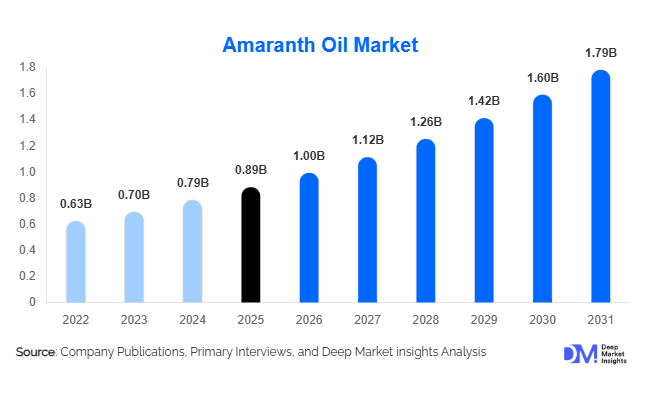
What are the latest trends in the amaranth oil market?
Shift Toward Functional and Bioactive Oils
The global specialty oils industry is witnessing a strong transition toward functional oils enriched with naturally occurring bioactive compounds. Amaranth oil, recognized for its high concentration of squalene, tocopherols, and phytosterols, is gaining popularity as consumers increasingly prioritize preventive health solutions. Nutraceutical brands are incorporating amaranth oil into capsules, blends, and fortified formulations targeting cardiovascular health and immune support. This shift reflects broader consumer demand for ingredients that combine nutrition with measurable wellness benefits, transforming amaranth oil from a niche product into a commercially scalable functional ingredient.
Premium Clean Beauty Formulations
Clean beauty trends are significantly influencing market expansion. Cosmetic manufacturers are replacing synthetic emollients with plant-derived oils to meet sustainability and transparency expectations. Amaranth oil is widely used in anti-aging serums, moisturizers, and sensitive-skin formulations due to its lightweight texture and skin barrier repair properties. Premium skincare brands are increasingly marketing formulations featuring rare botanical oils, elevating product positioning and enabling higher price realization. Organic certification and traceability are becoming key differentiators as consumers demand ethically sourced ingredients.
What are the key drivers in the amaranth oil market?
Expansion of Nutraceutical Consumption
The rapid growth of the global nutraceutical industry is a major driver supporting amaranth oil demand. Increasing awareness regarding lifestyle diseases has encouraged consumers to adopt functional supplements enriched with antioxidants and healthy lipids. Amaranth oil’s nutritional composition allows supplement manufacturers to develop differentiated products focused on heart health, inflammation reduction, and metabolic wellness, accelerating adoption across developed and emerging markets.
Rising Demand for Natural Cosmetic Ingredients
Global cosmetic brands are actively reformulating products using botanical ingredients to meet evolving consumer expectations. Amaranth oil enhances hydration, improves elasticity, and supports skin regeneration, making it particularly attractive in premium skincare categories. Growth in luxury beauty markets and dermaceutical innovation is expanding industrial demand, with manufacturers entering long-term sourcing agreements to secure supply stability.
What are the restraints for the global market?
Limited Agricultural Production Capacity
Amaranth cultivation remains relatively limited compared to conventional oilseed crops, creating supply-side constraints. Fragmented farming structures and inconsistent yields restrict large-scale industrial adoption. Seasonal fluctuations in crop availability also influence price volatility, posing challenges for manufacturers dependent on stable raw material sourcing.
High Processing and Extraction Costs
Production of high-quality amaranth oil requires specialized extraction technologies such as cold pressing or supercritical CO₂ extraction. These processes increase operational expenses, resulting in premium product pricing. While beneficial for high-end applications, elevated costs limit penetration into mass-market food applications and restrict adoption primarily to premium product segments.
What are the key opportunities in the amaranth oil industry?
Integration into Dermaceutical and Wellness Products
The convergence of cosmetics and healthcare presents strong opportunities for amaranth oil suppliers. Dermaceutical products combining therapeutic and cosmetic benefits are expanding rapidly, and amaranth oil’s antioxidant profile aligns well with formulations targeting aging skin, inflammation, and barrier repair. Companies investing in clinical validation and formulation innovation are likely to capture significant premium market share.
Expansion of Cultivation and Vertical Integration
Growing demand is encouraging investments in contract farming and agricultural diversification programs across Asia and Latin America. Vertical integration strategies—from seed cultivation to oil extraction—enable manufacturers to reduce supply risk, improve traceability, and enhance profitability. Government initiatives supporting alternative crops and sustainable agriculture further strengthen expansion prospects.
Report Scope
| Report Metric | Details |
|---|---|
| Market Size in 2025 | USD 0.89 Billion |
| Market Size in 2026 | USD 1.00 Billion |
| Market Size in 2031 | USD 1.79 Billion |
| CAGR | 12.4% (2026-2031) |
| Base Year for Estimation | 2025 |
| Historical Data | 2022-2024 |
| Forecast Period | 2026-2031 |
| Report Coverage | Revenue Forecast, Competitive Landscape, Supply Chain Disruption, Growth Factors, Environment & Regulatory Landscape and Trends |
| Geographies Covered | North America, Europe, APAC, Middle East and Africa, LATAM |
| Countries Covered | U.S., Canada, U.K., Germany, France, Spain, Italy, Russia, Nordic, Benelux, Rest of Europe, China, Korea, Japan, India, Australia, Singapore, Taiwan, South East Asia, Rest of Asia-Pacific, UAE, Turky, Saudi Arabia, South Africa, Egypt, Nigeria, Rest of MEA, Brazil, Mexico, Argentina, Chile, Colombia, Rest of LATAM |
Explore more data points, trends and opportunities Download Free Sample Report
Extraction Method Insights
The extraction method landscape plays a critical role in defining product quality, bioactive preservation, pricing structure, and end-use suitability within the global amaranth oil market. Cold-pressed amaranth oil continues to dominate the global market, accounting for nearly 46% of total revenue share, primarily due to its ability to retain naturally occurring nutrients such as squalene, tocopherols, and essential fatty acids. Growing consumer preference for minimally processed, clean-label, and chemical-free products has strengthened demand for cold-pressed variants across nutraceutical, cosmetic, and premium food applications. Manufacturers are increasingly positioning cold-pressed oils as high-value functional ingredients, aligning with broader health and sustainability trends.Supercritical CO₂ extraction is gaining significant traction, particularly within pharmaceutical-grade formulations and premium cosmetic applications, as the technology enables superior purity, solvent-free processing, and enhanced oxidation stability. This method supports precise extraction of bioactive compounds while maintaining molecular integrity, making it highly suitable for anti-aging skincare, dermatological formulations, and lipid-based drug delivery systems. Rising investments in advanced extraction technologies and automation are gradually reducing operational costs, enabling wider commercial adoption.Solvent-extracted amaranth oil continues to maintain relevance in industrial and large-scale food processing applications where cost efficiency and high-volume output remain key priorities. Although this method results in relatively lower nutrient preservation compared to mechanical or CO₂ extraction, it provides scalability advantages for bulk ingredient manufacturers. Increasing technological advancements aimed at improving solvent recovery and reducing environmental impact are further supporting this segment. Overall, expanding investments in extraction infrastructure, process optimization, and yield enhancement technologies are improving supply consistency while enabling large-scale commercialization of amaranth oil across diverse industries.
Application Insights
Dietary supplements and functional foods represent the leading application segment, contributing approximately 34% of global market demand, driven primarily by increasing consumer focus on preventive healthcare and nutritional supplementation. The leading segment growth is supported by rising awareness of cardiovascular health, immune system support, and metabolic wellness benefits associated with plant-derived oils rich in unsaturated fatty acids and antioxidants. Capsules, soft gels, fortified edible oils, and functional blends incorporating amaranth oil are gaining widespread acceptance among health-conscious consumers and aging populations seeking natural alternatives to synthetic supplements.The cosmetics and personal care application segment closely follows, supported by accelerating demand for natural and plant-based skincare ingredients. Amaranth oil’s high squalene content enhances skin hydration, elasticity, and barrier repair, making it particularly attractive for anti-aging, sensitive skin, and premium dermatological formulations. Increasing adoption by clean beauty brands and the shift toward sustainable ingredient sourcing are reinforcing long-term growth within this segment.
Pharmaceutical applications are emerging steadily as research into lipid-based delivery systems expands. Amaranth oil is being explored as a carrier oil capable of improving bioavailability and absorption efficiency of active pharmaceutical ingredients. The growing focus on nutraceutical-pharmaceutical convergence is expected to create new innovation opportunities in therapeutic formulations.Aromatherapy and wellness applications are also expanding as holistic health practices gain global popularity. The incorporation of amaranth oil into massage oils, therapeutic blends, and wellness products reflects rising consumer interest in stress management, mindfulness, and natural self-care solutions, further diversifying application potential across lifestyle-oriented markets.
Distribution Channel Insights
B2B direct sales dominate global distribution channels, accounting for over half of total market revenue, as ingredient manufacturers primarily supply cosmetic, nutraceutical, and food brands through long-term procurement agreements. The leading channel growth is driven by increasing demand for stable supply partnerships, quality traceability, and customized formulations required by large-scale manufacturers. Contract-based sourcing enables consistent pricing structures and supports product standardization across global production networks.Specialty ingredient distributors play a crucial intermediary role by enabling market access for small and mid-sized brands lacking direct sourcing capabilities. These distributors facilitate regulatory compliance, logistics management, and formulation support, thereby accelerating innovation among emerging wellness and beauty companies.Online retail channels are expanding rapidly, particularly for consumer-packaged amaranth oil products targeting wellness-focused and digitally engaged consumers. The growth of e-commerce platforms, direct-to-consumer brand strategies, and health-focused digital marketplaces is increasing product accessibility while enabling brands to educate consumers about functional benefits through content-driven marketing.Health stores, organic retailers, and premium retail outlets continue to maintain importance in developed markets, where consumers often prefer experiential purchasing and expert recommendations. These channels strengthen brand positioning for high-quality and specialty-grade oils while supporting niche market visibility.
End-Use Industry Insights
The cosmetics and personal care industry remains the largest end-use segment, contributing approximately 36% of global consumption. The leading segment driver is the rapid expansion of premium skincare and clean beauty formulations that prioritize bio-based, sustainable ingredients with clinically supported benefits. Amaranth oil’s compatibility with sensitive skin formulations and multifunctional cosmetic properties support its increasing integration into serums, moisturizers, and dermatological treatments.The nutraceutical industry represents the fastest-growing end-use segment, supported by rising global supplement consumption, preventive health awareness, and aging demographic trends. Increasing consumer adoption of plant-derived functional ingredients is encouraging manufacturers to incorporate amaranth oil into advanced nutritional formulations targeting heart health, inflammation management, and overall wellness optimization.Food and beverage applications are gradually increasing as manufacturers explore functional fortification opportunities within edible oils, health snacks, and specialty food products. Growing demand for nutrient-dense plant-based ingredients is supporting innovation in functional food categories, particularly within health-conscious urban populations.Pharmaceutical and wellness industries are also emerging as important growth avenues as scientific research continues to evaluate the therapeutic potential of lipid-based delivery systems. Collaboration between ingredient suppliers and research institutions is expected to accelerate clinical validation and expand commercial adoption across medical and therapeutic applications.
Explore more data points, trends and opportunities Download Free Sample Report
Amaranth Oil Market Segmentations
By Type
- Pharmaceutical Grade
- Food Grade
- Others
By Application
- Cosmetics
- Food Supplements
- Pharmaceutical
- Others
Regional Insights
North America
North America accounted for nearly 32% of global market share in 2025, led by strong demand across the United States and Canada. Regional growth is primarily driven by high consumer awareness regarding functional nutrition, preventive healthcare adoption, and strong demand for premium skincare solutions. The presence of a well-established nutraceutical manufacturing ecosystem, advanced research capabilities, and widespread availability of clean-label products across retail and e-commerce platforms supports sustained expansion. Increasing investment in plant-based innovation, rising vegan and organic product penetration, and strong purchasing power further reinforce market maturity in the region.
Europe
Europe holds approximately 28% market share, supported by consistent demand across Germany, France, Italy, and the United Kingdom. Regional growth is driven by stringent regulatory frameworks promoting natural ingredients, sustainability certifications, and organic product standards that encourage adoption of plant-derived oils. Consumer preference for ethically sourced and environmentally responsible products continues to accelerate market penetration. Eastern Europe contributes significantly as a cultivation and processing hub, improving regional supply chain resilience and reducing dependency on imports while strengthening export competitiveness.
Asia-Pacific
Asia-Pacific represents the fastest-growing regional market, with China, India, Japan, and South Korea driving consumption growth. Rapid urbanization, expanding middle-class populations, and rising disposable incomes are increasing spending on health, beauty, and wellness products. The region’s booming cosmetics industry, particularly K-beauty and J-beauty innovation ecosystems, is accelerating ingredient adoption. Growing awareness of plant-based nutrition, expanding e-commerce penetration, and supportive agricultural conditions are strengthening regional supply capabilities. India is emerging as a key cultivation and processing center due to favorable agro-climatic conditions, improving domestic production capacity and export potential.
Latin America
Latin America accounts for around 8% of global demand, led by Peru and Mexico. Regional growth is supported by strong agricultural heritage associated with amaranth cultivation and increasing global demand for naturally sourced ingredients. The region plays a dual role as both a production base and an export-oriented supplier supporting North American and European markets. Rising investments in value-added processing, organic farming practices, and fair-trade supply chains are enhancing regional competitiveness while improving farmer participation in global value chains.
Middle East & Africa
The Middle East & Africa region is gradually expanding, supported by increasing premium skincare consumption in countries such as the UAE and South Africa. Regional growth is driven by rising disposable incomes, expanding luxury beauty retail sectors, and growing awareness of natural wellness products among younger consumer demographics. Increasing demand for halal-certified and plant-based cosmetic ingredients is also contributing to adoption. Improvements in retail infrastructure, cross-border trade expansion, and growing health and wellness tourism are expected to support long-term market development across the region.
Key Players in the Amaranth Oil Market
- Flavex Naturextrakte GmbH
- AOT Organic Products
- RusOliva Pvt. Ltd.
- AMR Amaranth A.S.
- Proderna Biotech Pvt. Ltd.
- Gustav Heess GmbH
- Naturex S.A.
- BioOrganic Concepts
- Aromex Industry
- Botanical Beauty LLC
- Hunan Nutramax Inc.
- Spack International
- Jedwards International
- Green Source Organics
- Organicway Inc.