Almond Milk Market Size
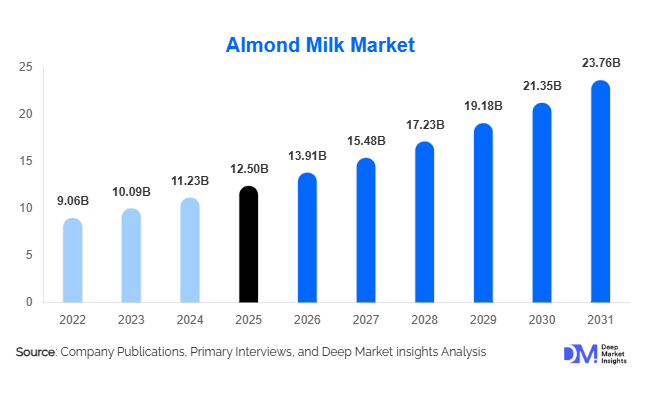
According to Deep Market Insights,the global almond milk market size was valued at USD 12.5 billion in 2025 and is projected to grow from USD 13.91 billion in 2026 to reach USD 23.76 billion by 2031, expanding at a CAGR of 11.3% during the forecast period (2026–2031). The almond milk market growth is primarily driven by the increasing global shift toward plant-based diets, rising lactose intolerance among consumers, and growing awareness regarding the health benefits of dairy alternatives.
Almond milk has become one of the most widely consumed plant-based milk alternatives due to its low calorie content, lactose-free composition, and versatility across beverages and food applications. Consumers increasingly prefer almond milk as a healthier substitute for traditional dairy milk, especially in breakfast cereals, smoothies, coffee beverages, and baking applications. The growing popularity of vegan and flexitarian diets has significantly contributed to the expansion of the almond milk market worldwide.
Manufacturers are also introducing fortified almond milk products enriched with vitamins, minerals, and protein to replicate the nutritional profile of dairy milk. In addition, innovations in flavors such as vanilla, chocolate, and barista-grade almond milk formulations have broadened the product appeal across diverse consumer groups. Expanding distribution channels including supermarkets, specialty health stores, and online retail platforms have further enhanced product accessibility and market penetration.
Key Market Insights
- The almond milk market is witnessing rapid growth due to rising demand for plant-based dairy alternatives, driven by increasing lactose intolerance and vegan dietary preferences worldwide.
- Fortified almond milk products are gaining popularity as manufacturers enhance formulations with calcium, vitamin D, and vitamin B12 to match the nutritional profile of dairy milk.
- North America dominates the global almond milk market, supported by high consumer awareness, strong retail infrastructure, and widespread adoption of plant-based beverages.
- Asia-Pacific is the fastest-growing region, driven by rising disposable incomes, increasing urbanization, and growing health-conscious consumer behavior.
- The foodservice sector is expanding almond milk demand, particularly in cafés and coffee chains offering dairy-free beverage alternatives.
- Sustainable packaging and eco-friendly sourcing practices are becoming key differentiators for leading almond milk manufacturers.
What are the latest trends in the almond milk market?
Rising Demand for Functional and Fortified Plant-Based Beverages
Consumers increasingly prefer beverages that deliver additional health benefits beyond basic nutrition. This has encouraged manufacturers to develop fortified almond milk products enriched with calcium, vitamin D, protein, and probiotics. Functional almond milk variants are gaining strong traction among health-conscious consumers seeking beverages that support bone health, digestive health, and overall wellness. Additionally, the growing popularity of fitness-oriented diets has boosted demand for protein-enriched almond milk products used in smoothies and meal replacement beverages.
Expansion of Barista-Grade Almond Milk in Coffee Culture
The rapid expansion of specialty coffee culture globally has created significant demand for barista-grade almond milk designed for frothing and steaming. Coffee chains and independent cafés are increasingly offering almond milk as a standard dairy alternative in lattes, cappuccinos, and iced beverages. This trend has encouraged manufacturers to introduce formulations specifically tailored for coffee beverages, with improved texture, foam stability, and taste profiles. As coffee consumption continues to rise globally, the foodservice channel is expected to remain a key growth driver for the almond milk market.
What are the key drivers in the almond milk market?
Growing Prevalence of Lactose Intolerance
Lactose intolerance affects a large portion of the global population, particularly in Asia and Africa. Almond milk provides a lactose-free alternative that closely mimics the functionality of dairy milk in beverages and food preparation. As awareness of lactose intolerance continues to increase, more consumers are switching to plant-based dairy substitutes such as almond milk, driving sustained market growth.
Expansion of the Global Plant-Based Food Industry
The global plant-based food industry has experienced rapid expansion in recent years as consumers seek healthier and more sustainable dietary options. Almond milk has emerged as one of the most widely accepted plant-based milk alternatives due to its mild taste, nutritional benefits, and versatility across various food and beverage applications. The growing popularity of vegan, vegetarian, and flexitarian diets is further accelerating demand for almond milk products worldwide.
What are the restraints for the global market?
High Production and Retail Costs
Almond milk products typically carry higher retail prices compared to conventional dairy milk due to the costs associated with almond cultivation, processing, and packaging. This price difference can limit adoption among price-sensitive consumers, particularly in emerging economies where dairy milk remains significantly cheaper.
Environmental Concerns Associated with Almond Farming
Almond cultivation requires substantial water resources, particularly in major production regions such as California. Growing environmental concerns regarding water consumption and sustainable agriculture have raised scrutiny over almond farming practices. These concerns may create supply chain challenges for manufacturers and potentially influence consumer perceptions of almond-based products.
What are the key opportunities in the almond milk industry?
Growth of Emerging Markets
Emerging economies in Asia-Pacific and Latin America present substantial growth opportunities for almond milk manufacturers. Rising disposable income, urbanization, and increasing awareness of plant-based nutrition are encouraging consumers in countries such as China, India, and Brazil to adopt dairy alternatives. Expanding retail networks and e-commerce platforms are further facilitating market entry for almond milk products in these regions.
Innovation in Functional and Premium Almond Milk Products
Product innovation represents another significant opportunity in the almond milk market. Manufacturers are developing premium formulations including organic almond milk, protein-enriched beverages, and probiotic-infused variants. These products target niche consumer segments such as athletes, children, and elderly populations seeking specialized nutritional solutions. As consumer demand for functional beverages continues to rise, companies focusing on innovative formulations are expected to gain competitive advantages.
Report Scope
| Report Metric | Details |
|---|---|
| Market Size in 2025 | USD 12.50 Billion |
| Market Size in 2026 | USD 13.91 Billion |
| Market Size in 2031 | USD 23.76 Billion |
| CAGR | 11.3% (2026-2031) |
| Base Year for Estimation | 2025 |
| Historical Data | 2022-2024 |
| Forecast Period | 2026-2031 |
| Report Coverage | Revenue Forecast, Competitive Landscape, Supply Chain Disruption, Growth Factors, Environment & Regulatory Landscape and Trends |
| Geographies Covered | North America, Europe, APAC, Middle East and Africa, LATAM |
| Countries Covered | U.S., Canada, U.K., Germany, France, Spain, Italy, Russia, Nordic, Benelux, Rest of Europe, China, Korea, Japan, India, Australia, Singapore, Taiwan, South East Asia, Rest of Asia-Pacific, UAE, Turky, Saudi Arabia, South Africa, Egypt, Nigeria, Rest of MEA, Brazil, Mexico, Argentina, Chile, Colombia, Rest of LATAM |
Explore more data points, trends and opportunities Download Free Sample Report
Product Type Insights
Unsweetened almond milk represents the leading product segment in the global almond milk market, accounting for nearly 38% of total market share in 2025. The dominance of this segment is primarily driven by the growing global shift toward healthier beverage choices and increasing consumer awareness regarding sugar intake. Consumers are increasingly seeking beverages with minimal additives and lower calorie content, which has significantly increased the demand for unsweetened almond milk varieties. The rising prevalence of lifestyle-related health concerns such as obesity, diabetes, and cardiovascular diseases has further encouraged consumers to adopt low-sugar alternatives, positioning unsweetened almond milk as a preferred dairy-free beverage option. In addition, the growing popularity of plant-based and vegan diets has strengthened the demand for naturally flavored and clean-label beverage products, supporting the continued expansion of the unsweetened segment. Sweetened and flavored almond milk variants, including vanilla, chocolate, and other innovative flavors, continue to attract younger demographics and consumers seeking enhanced taste profiles in dairy alternatives. These flavored products are commonly used in smoothies, desserts, and specialty beverages. Meanwhile, plain or original almond milk remains a widely consumed option due to its versatility in daily food preparation and beverage applications, including cereal consumption, baking, and cooking.
Application Insights
The beverage segment dominates the application landscape of the almond milk market, accounting for more than 51% of global demand. The leadership of this segment is largely attributed to the rapid adoption of almond milk as a direct replacement for traditional dairy milk in everyday beverage consumption. Almond milk has gained significant popularity among consumers due to its lactose-free composition, lower calorie content, and compatibility with plant-based diets. The increasing consumption of specialty coffee beverages, smoothies, protein shakes, and breakfast cereals prepared with plant-based milk alternatives has significantly contributed to the growth of this segment. Coffee shops and café chains have increasingly integrated almond milk into their beverage menus, further strengthening its role in the beverage industry. In addition to beverage applications, the food processing industry has emerged as an important growth area for almond milk utilization. Food manufacturers are incorporating almond milk into a wide range of dairy-free products, including plant-based ice creams, bakery products, desserts, and ready-to-drink beverages. The growing demand for vegan and lactose-free food products has also encouraged the development of almond milk-based yogurt, sauces, and nutritional beverages, thereby expanding its application scope across the broader food manufacturing sector.
Distribution Channel Insights
Supermarkets and hypermarkets constitute the largest distribution channel for almond milk products, capturing nearly 47% of global sales in 2025. The strong performance of this segment is primarily driven by the extensive retail presence of large grocery chains that provide consumers with convenient access to a broad range of plant-based dairy alternatives. These retail outlets offer a diverse product assortment, including organic, flavored, fortified, and private-label almond milk products, allowing consumers to compare brands and select products based on nutritional value, pricing, and flavor preferences. Additionally, in-store promotions, product visibility, and organized shelf placement contribute significantly to consumer purchasing decisions. Specialty health food stores also play an important role in the distribution landscape, particularly for premium, organic, and functional almond milk products targeted at health-conscious consumers. Meanwhile, online retail platforms are emerging as one of the fastest-growing distribution channels in the almond milk market. The increasing adoption of digital grocery shopping, the convenience of home delivery, and the growing presence of e-commerce platforms offering plant-based food products are significantly accelerating the growth of online almond milk sales worldwide.
End-Use Insights
Household consumption represents the largest end-use segment in the global almond milk market, primarily driven by the widespread integration of plant-based beverages into daily diets. Consumers increasingly use almond milk as a dairy substitute in cooking, baking, breakfast cereals, smoothies, and nutritional drinks. The rising adoption of vegan, lactose-free, and flexitarian diets has significantly contributed to the expansion of household consumption, as consumers actively seek plant-based alternatives that align with health-conscious and environmentally sustainable lifestyles. In addition to residential consumption, the foodservice industry is emerging as one of the fastest-growing end-use sectors for almond milk. Cafés, coffee chains, restaurants, and bakeries are increasingly incorporating almond milk into specialty beverages such as lattes, cappuccinos, and plant-based desserts to meet the rising demand for dairy-free menu options. Furthermore, the nutraceutical and functional beverage industries are increasingly utilizing almond milk as a base ingredient in fortified beverages, protein drinks, meal replacement products, and nutritional supplements. The presence of naturally occurring vitamins, minerals, and healthy fats in almonds makes almond milk an attractive ingredient for manufacturers developing functional and wellness-oriented beverage formulations.
Explore more data points, trends and opportunities Download Free Sample Report
Almond Milk Market Segmentations
By Product Type
- Plain / Original Almond Milk
- Sweetened Almond Milk
- Unsweetened Almond Milk
- Flavored Almond Milk
By Application
- Beverage Consumption
- Bakery & Confectionery
- Cereals & Breakfast Products
- Smoothies & Ready-to-Drink Beverages
- Ice Cream & Frozen Desserts
By Distribution Channel
- Supermarkets & Hypermarkets
- Convenience Stores
- Online Retail / E-Commerce
- Specialty Health Food Stores
- Foodservice & HoReCa Supply
Regional Insights
North America
North America holds the largest share of the global almond milk market, accounting for approximately 42% of global revenue in 2025. The strong regional leadership is driven by high consumer awareness of plant-based nutrition, strong adoption of vegan and flexitarian diets, and the well-established presence of leading almond milk manufacturers across the region. The United States dominates the North American market due to widespread consumer acceptance of dairy alternatives and the strong expansion of plant-based beverage brands in retail and foodservice channels. California plays a particularly important role in the regional market as it serves as the global hub for almond cultivation and processing, ensuring stable raw material supply and large-scale production of almond-based beverages. The growing prevalence of lactose intolerance, increasing demand for clean-label food products, and strong innovation in plant-based beverage formulations are further supporting regional market expansion. Canada is also experiencing increasing demand for almond milk as consumers shift toward healthier beverage alternatives and retailers continue to expand plant-based product offerings.
Europe
Europe represents the second-largest almond milk market globally, supported by strong consumer demand for sustainable, organic, and plant-based food products. Countries such as Germany, the United Kingdom, France, Italy, and the Netherlands play a significant role in driving regional demand for almond milk. European consumers demonstrate a strong preference for environmentally sustainable food products, which has encouraged manufacturers to introduce organic almond milk variants and adopt eco-friendly packaging solutions. Government initiatives promoting plant-based diets and sustainable food consumption are also contributing to market expansion. In addition, the region benefits from a highly developed retail infrastructure that enables widespread distribution of plant-based dairy alternatives through supermarkets, hypermarkets, and specialty health food stores. The rapid growth of vegan populations and increasing awareness of lactose intolerance across European countries are further supporting the long-term growth of the almond milk market.
Asia-Pacific
Asia-Pacific is projected to be the fastest-growing regional market for almond milk, with an expected growth rate exceeding 13% CAGR during the forecast period. The region's rapid expansion is driven by increasing health awareness, rising disposable incomes, and the growing adoption of plant-based dietary habits among urban populations. Countries such as China, Japan, South Korea, and India are emerging as key markets due to expanding middle-class populations and increasing interest in functional and dairy-free beverages. The growing prevalence of lactose intolerance across many Asian populations has also encouraged consumers to adopt plant-based milk alternatives such as almond milk. Rapid urbanization, changing dietary patterns, and the expansion of modern retail infrastructure—including supermarkets, convenience stores, and e-commerce platforms—are further supporting product accessibility and market growth throughout the region.
Latin America
Latin America is gradually emerging as a promising market for almond milk products, supported by increasing consumer awareness of plant-based nutrition and improving retail distribution networks. Brazil and Mexico represent the largest markets in the region due to their expanding urban populations and rising demand for healthier beverage alternatives. Consumers in major metropolitan areas are increasingly adopting lactose-free and plant-based diets, which has created favorable conditions for almond milk consumption. The expansion of modern supermarkets, health food stores, and e-commerce platforms is also improving product accessibility and brand visibility across the region. In addition, growing exposure to global health and wellness trends is encouraging consumers to explore plant-based beverages as part of a balanced and sustainable diet.
Middle East & Africa
The Middle East and Africa region is witnessing steady growth in almond milk consumption, driven by increasing demand for premium health beverages and the gradual expansion of plant-based food categories. Countries such as the United Arab Emirates, Saudi Arabia, and South Africa represent key markets due to their growing urban populations and rising awareness of health-oriented food products. Increasing rates of lactose intolerance and dairy sensitivity in the region are also encouraging consumers to adopt plant-based milk alternatives. Furthermore, the rapid expansion of organized retail outlets, supermarkets, and specialty health stores is improving the availability of almond milk products across major cities. The influence of international foodservice chains and the growing popularity of specialty coffee beverages are further contributing to the adoption of almond milk in cafés and restaurants throughout the region.
Key Players in the Almond Milk Market
- Blue Diamond Growers
- Danone
- Califia Farms
- Hain Celestial Group
- SunOpta
- Pacific Foods
- Nestlé
- Ripple Foods
- Oatly Group
- Elmhurst 1925
- Pureharvest
- Earth’s Own Food Company
- Freedom Foods Group
- Malk Organics
- Silk