Algae Market Size
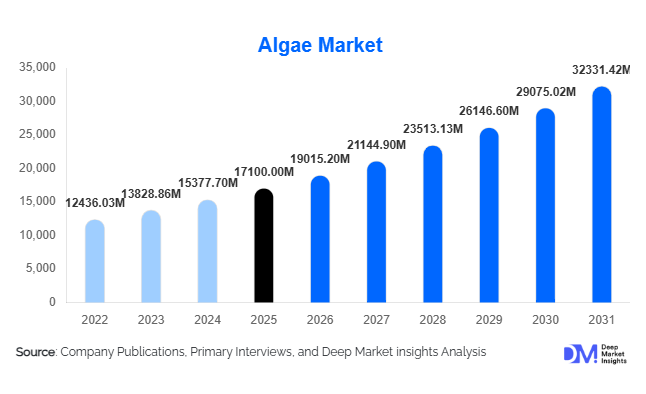
According to Deep Market Insights, the global algae market size was valued at USD 17,100 million in 2025 and is projected to grow from USD 19,015.20 million in 2026 to reach USD 32,331.42 million by 2031, expanding at a CAGR of 11.2% during the forecast period (2026–2031). The algae market growth is primarily driven by rising demand for plant-based nutrition, increasing applications in biofuels and pharmaceuticals, and growing adoption of sustainable raw materials across industrial sectors.
Key Market Insights
- Algae is increasingly being adopted as a sustainable and high-nutrient raw material, supporting demand in food, healthcare, and industrial applications.
- Microalgae dominates the market, particularly spirulina and chlorella, due to their high protein content and widespread nutraceutical use.
- Asia-Pacific leads the global market, supported by large-scale production in China and growing demand in India and Japan.
- North America remains a key innovation hub, driven by strong R&D investments and advanced cultivation technologies.
- Food & beverage applications account for the largest share, fueled by the rise of functional foods and natural additives.
- Technological advancements, including photobioreactors and genetic optimization, are improving production efficiency and scalability.
What are the latest trends in the algae market?
Rising Adoption of Algae-Based Functional Foods
The global shift toward healthier diets is driving demand for algae-based functional foods. Products such as spirulina powders, chlorella tablets, and algae-derived protein ingredients are gaining popularity among health-conscious consumers. These products offer high nutritional value, including proteins, vitamins, antioxidants, and omega fatty acids. Food manufacturers are increasingly incorporating algae into beverages, snacks, and plant-based alternatives, positioning it as a key ingredient in the evolving health and wellness ecosystem. This trend is particularly strong in North America and Europe, where consumers are actively seeking clean-label and plant-based products.
Expansion of Algae in Biofuel and Environmental Applications
Algae is gaining traction as a viable feedstock for biofuel production due to its high yield and low environmental impact. Governments and energy companies are investing in algae-based biodiesel and bioethanol projects to reduce dependence on fossil fuels. Additionally, algae is being used in wastewater treatment and carbon capture applications due to its ability to absorb pollutants and CO₂ efficiently. These environmental benefits are positioning algae as a critical component in sustainability initiatives, particularly in regions with stringent environmental regulations.
What are the key drivers in the algae market?
Growing Demand for Plant-Based and Sustainable Nutrition
The increasing global shift toward plant-based diets is a major driver of the algae market. Algae offers a highly sustainable protein source with minimal land and water requirements, making it an attractive alternative to traditional agriculture. Rising awareness about environmental sustainability and health benefits is further accelerating demand, particularly in developed economies.
Advancements in Cultivation Technologies
Technological innovations such as closed photobioreactors and hybrid cultivation systems are enhancing production efficiency and scalability. These technologies reduce contamination risks, improve yield, and lower operational costs over time. As a result, algae production is becoming more commercially viable, encouraging investments and market expansion.
What are the restraints for the global market?
High Initial Capital Investment
The setup of algae cultivation systems, particularly advanced photobioreactors, requires significant capital investment. This acts as a barrier for small and medium-sized enterprises, limiting market entry and expansion in certain regions.
Regulatory and Standardization Challenges
The lack of uniform regulatory frameworks for algae-based products, especially in food and pharmaceuticals, creates challenges for manufacturers. Compliance with varying international standards can increase costs and delay product approvals, impacting market growth.
What are the key opportunities in the algae industry?
Growth in Biofuel Integration
The increasing focus on renewable energy presents a significant opportunity for algae-based biofuels. Governments worldwide are supporting alternative energy initiatives, creating favorable conditions for algae producers to expand into the energy sector. The high productivity and non-competition with food crops make algae a promising feedstock for sustainable fuel production.
Expansion of Nutraceutical and Functional Food Markets
The rising demand for preventive healthcare and immunity-boosting products is creating opportunities for algae-based nutraceuticals. Emerging markets are witnessing increased consumption of dietary supplements, driven by growing health awareness and disposable incomes. This trend is expected to drive long-term market growth.
Report Scope
| Report Metric | Details |
|---|---|
| Market Size in 2025 | USD 17100 Million |
| Market Size in 2026 | USD 19015.20 Million |
| Market Size in 2031 | USD 32331.42 Million |
| CAGR | 11.2% (2026-2031) |
| Base Year for Estimation | 2025 |
| Historical Data | 2022-2024 |
| Forecast Period | 2026-2031 |
| Report Coverage | Revenue Forecast, Competitive Landscape, Supply Chain Disruption, Growth Factors, Environment & Regulatory Landscape and Trends |
| Geographies Covered | North America, Europe, APAC, Middle East and Africa, LATAM |
| Countries Covered | U.S., Canada, U.K., Germany, France, Spain, Italy, Russia, Nordic, Benelux, Rest of Europe, China, Korea, Japan, India, Australia, Singapore, Taiwan, South East Asia, Rest of Asia-Pacific, UAE, Turky, Saudi Arabia, South Africa, Egypt, Nigeria, Rest of MEA, Brazil, Mexico, Argentina, Chile, Colombia, Rest of LATAM |
Explore more data points, trends and opportunities Download Free Sample Report
Type Insights
The global algae market is structurally led by the microalgae segment, which accounts for approximately 62% of the total market share in 2025, reflecting its widespread commercial viability and multifunctional application profile. Microalgae, particularly widely recognized species such as spirulina and chlorella, have achieved significant penetration across nutraceutical, pharmaceutical, and functional food markets due to their superior nutritional density, including high protein content, essential amino acids, vitamins, and antioxidants. The segment’s dominance is further reinforced by its scalability in controlled cultivation systems, including photobioreactors and open pond systems, which enable consistent quality and high-yield production. In addition, increasing global consumer awareness regarding preventive healthcare, immunity enhancement, and plant-based dietary trends has accelerated the integration of microalgae into dietary supplements, protein powders, and fortified food products. The leading driver for this segment remains the rising demand for high-protein, plant-based, and sustainable nutritional ingredients, which positions microalgae as a critical alternative to traditional protein sources such as soy and animal-based proteins.On the other hand, macroalgae, which includes brown, red, and green algae varieties such as kelp, nori, and seaweed, continues to maintain a substantial yet secondary share within the global market. Macroalgae finds extensive application in food processing, hydrocolloid extraction (such as agar, carrageenan, and alginate), and industrial uses including fertilizers and animal feed. While its growth trajectory remains positive, the segment is comparatively constrained by geographic cultivation limitations and relatively lower protein concentration compared to microalgae. Nevertheless, the macroalgae segment is increasingly benefiting from the global shift toward clean-label ingredients and natural additives, particularly in the food processing and cosmetic industries, thereby ensuring its steady contribution to overall market expansion.
Form Insights
In terms of form, dry algae products dominate the global market landscape, accounting for nearly 55% of the total market share, owing to their logistical, economic, and functional advantages. Dry forms, including powders, flakes, granules, and capsules, offer extended shelf life, reduced transportation costs, and ease of incorporation into a wide range of applications, from dietary supplements to packaged food products. These attributes make them particularly attractive for large-scale commercial distribution and international trade. The leading driver for this segment is the increasing consumer preference for convenient, shelf-stable, and easy-to-use nutritional formats, especially within the rapidly growing dietary supplement industry. Furthermore, the compatibility of dry algae with encapsulation technologies and functional food formulations enhances its appeal among manufacturers seeking versatile ingredients.Liquid and paste forms of algae, while currently representing a smaller share of the market, are witnessing accelerated adoption in specialized applications such as cosmetics, pharmaceuticals, and biotechnology. These forms are particularly valued for their higher bioavailability and ease of extraction of bioactive compounds, including pigments, lipids, and antioxidants. As innovation in processing technologies advances and industrial applications expand, the liquid and paste segments are expected to gain incremental traction, especially in high-value, niche markets such as skincare and biopharmaceuticals.
Application Insights
The food and beverage sector continues to dominate the application landscape of the algae market, accounting for approximately 34% of the total market share in 2025. This leadership position is primarily driven by the growing demand for functional foods, natural colorants, and plant-based ingredients that align with evolving consumer preferences for health and sustainability. Algae-derived ingredients are increasingly being incorporated into a wide range of food products, including snacks, beverages, dairy alternatives, and bakery items, due to their nutritional benefits and natural origin. The leading driver for this segment is the rapid expansion of the global functional food industry, supported by rising health consciousness, increasing disposable incomes, and a shift toward preventive nutrition.Pharmaceutical and nutraceutical applications represent one of the fastest-growing segments within the algae market, fueled by ongoing research and development into algae-derived bioactive compounds. These include omega-3 fatty acids, polysaccharides, peptides, and pigments such as astaxanthin and phycocyanin, which have demonstrated significant therapeutic potential. The increasing prevalence of chronic diseases, coupled with a growing emphasis on natural and plant-based therapeutic solutions, is driving the adoption of algae in drug development and dietary supplementation. Additionally, algae is gaining prominence in animal feed and agriculture, where it is used to enhance nutritional value and improve sustainability, further diversifying its application scope.
End-Use Industry Insights
The food industry remains the largest end-use sector for algae products, accounting for approximately 36% of total demand, as manufacturers increasingly incorporate algae-based ingredients into mainstream and specialty food offerings. The integration of algae into food formulations is driven by its nutritional profile, natural origin, and ability to enhance product functionality, making it a preferred choice among food processors and manufacturers. The leading driver for this segment is the sustained growth of the global food processing industry, combined with increasing demand for clean-label, plant-based, and fortified food products.The healthcare and pharmaceutical sector is emerging as the fastest-growing end-use industry, driven by the expanding use of algae in nutraceuticals, dietary supplements, and drug development. Advances in biotechnology and extraction techniques have enabled the identification and commercialization of novel algae-derived compounds with therapeutic benefits, thereby accelerating market growth in this segment. Meanwhile, the energy sector, although currently at a nascent stage, presents substantial long-term growth potential. Increasing investments in renewable energy and biofuel technologies are positioning algae as a promising feedstock for biofuel production, particularly due to its high lipid content and rapid growth rate. As global efforts to reduce carbon emissions intensify, the role of algae in sustainable energy solutions is expected to expand significantly.
Distribution Channel Insights
Direct sales channels dominate the distribution landscape, accounting for approximately 51% of the market share, as manufacturers primarily engage in bulk supply agreements with food processing companies, pharmaceutical firms, and industrial users. This distribution model ensures cost efficiency, supply chain stability, and long-term business relationships, making it the preferred channel for large-scale transactions. The leading driver for this segment is the increasing demand for bulk procurement by industrial buyers, which necessitates direct engagement with producers to ensure consistent quality and supply.At the same time, distributor networks and online retail channels are gaining prominence, particularly for consumer-oriented products such as dietary supplements and functional foods. The rapid growth of e-commerce platforms and digital marketing strategies has enabled manufacturers to reach a broader consumer base, thereby enhancing market accessibility and brand visibility. As consumer purchasing behavior continues to shift toward online channels, the role of digital distribution is expected to become increasingly significant in shaping the future of the algae market.
Explore more data points, trends and opportunities Download Free Sample Report
Algae Market Segmentations
Type
- Microalgae
- Macroalgae
Form
- Dry
- Liquid
- Paste/Gel
Application
- Food & Beverages
- Pharmaceuticals & Nutraceuticals
- Cosmetics & Personal Care
- Biofuels
- Animal Feed & Aquaculture
- Agriculture
- Industrial Applications
Distribution Channel
- Direct Sales (B2B)
- Distributors & Wholesalers
- Online Retail
Regional Insights
Asia-Pacific
Asia-Pacific leads the global algae market, accounting for approximately 42% of the total market share in 2025, making it the most dominant regional contributor. The region’s leadership is underpinned by a combination of favorable climatic conditions, extensive coastlines, and well-established aquaculture practices that support large-scale algae cultivation. China plays a pivotal role as the largest producer and exporter of algae products, leveraging cost-efficient production systems and significant government support. India is rapidly emerging as a high-growth market, driven by increasing investments in algae-based startups, supportive policy frameworks, and rising awareness of sustainable and plant-based nutrition. Japan, as a mature market, continues to exhibit strong demand for algae-based food products, particularly traditional seaweed varieties integrated into daily diets. The primary growth drivers for the Asia-Pacific region include expanding aquaculture infrastructure, rising consumer awareness regarding health and nutrition, government initiatives promoting sustainable agriculture, and increasing export demand for algae-based products.
North America
North America holds approximately 24% of the global market share, characterized by advanced technological capabilities, robust research and development activities, and a highly developed consumer market. The United States dominates the regional landscape, supported by strong demand for dietary supplements, functional foods, and plant-based alternatives. The presence of leading biotechnology firms and research institutions has facilitated innovation in algae cultivation, processing, and product development. Additionally, increasing consumer awareness regarding the health benefits of algae, coupled with the growing popularity of vegan and plant-based diets, is driving market expansion. Key growth drivers in North America include technological innovation, high consumer purchasing power, increasing investment in sustainable food systems, and a well-established nutraceutical industry.
Europe
Europe accounts for nearly 21% of the global algae market, with countries such as Germany, France, and the United Kingdom serving as major contributors to regional demand. The region’s strong emphasis on sustainability, environmental protection, and circular economy principles has significantly accelerated the adoption of algae-based products across various industries. Stringent environmental regulations and policies aimed at reducing carbon emissions are encouraging the use of algae in applications such as biofuels, wastewater treatment, and biodegradable materials. Furthermore, the growing demand for organic and clean-label food products is driving the incorporation of algae into food and beverage formulations. The primary drivers for regional growth include regulatory support for sustainable practices, increasing consumer preference for eco-friendly products, and ongoing investments in green technologies.
Latin America
Latin America represents approximately 7% of the global market, with Brazil emerging as a key growth hub due to its expanding biofuel industry and favorable environmental conditions for algae cultivation. The region is increasingly recognizing the potential of algae as a sustainable resource for energy, agriculture, and food applications. Growing awareness of environmental sustainability and the need to diversify energy sources are driving investments in algae-based biofuel production. Additionally, the agricultural sector is adopting algae-based fertilizers and animal feed to improve productivity and sustainability. Key growth drivers in Latin America include the expansion of the biofuel industry, increasing investment in sustainable agriculture, and rising awareness of the environmental benefits of algae-based solutions.
Middle East & Africa
The Middle East & Africa region accounts for approximately 6% of the global algae market, supported by increasing investments in sustainable technologies and environmental management solutions. The region’s arid climate and water scarcity challenges have prompted governments and private sector players to explore algae-based solutions for water treatment, carbon capture, and renewable energy. Countries in the Middle East are investing in large-scale algae cultivation projects to address environmental concerns and reduce dependence on fossil fuels. In Africa, the growing need for affordable nutrition and sustainable agricultural practices is driving the adoption of algae-based products. The primary growth drivers for this region include increasing investment in environmental sustainability, rising demand for water treatment solutions, and the development of innovative algae-based technologies tailored to local conditions.
Key Players in the Algae Market
- Cyanotech Corporation
- DIC Corporation
- Corbion NV
- BASF SE
- DSM-Firmenich
- Fuji Chemical Industries Co., Ltd.
- Roquette Frères
- Algenol Biotech LLC
- Cellana Inc.
- TerraVia Holdings Inc.
- Algatech Ltd.
- EID Parry (India) Ltd.
- Qualitas Health Inc.
- Heliae Development LLC
- Solazyme Inc.