Alcoholic Beverages Market Size
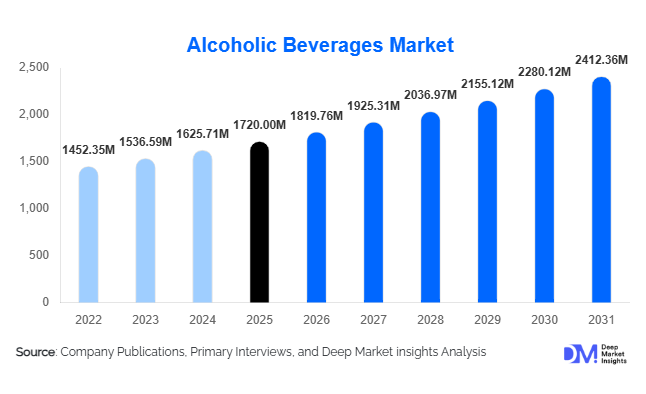
According to Deep Market Insights, the global alcoholic beverages market size was valued at USD 1,720.0 billion in 2025 and is projected to grow from USD 1,819.76 billion in 2026 to reach USD 2,412.36 billion by 2031, expanding at a CAGR of 5.8% during the forecast period (2026–2031). The alcoholic beverages market growth is primarily driven by premiumization trends, rising disposable incomes in emerging economies, and the rapid expansion of ready-to-drink (RTD) and flavored alcoholic beverages. Increasing urbanization, evolving social drinking patterns, and the growing influence of digital retail channels are further supporting global demand across beer, wine, and spirits categories.
Key Market Insights
- Premium and super-premium alcoholic beverages are gaining traction globally, with consumers increasingly opting for high-quality, craft, and artisanal products.
- Spirits and RTD beverages are the fastest-growing segments, driven by innovation in flavors, convenience, and evolving consumption preferences among millennials and Gen Z.
- Europe dominates the global market, supported by strong cultural consumption and export leadership in wine and spirits.
- Asia-Pacific is the fastest-growing region, fueled by rising disposable incomes and changing social norms in countries like China and India.
- Off-trade channels account for the majority of sales, led by supermarkets, liquor stores, and rapidly expanding online platforms.
- Technological integration and e-commerce growth are transforming distribution, enabling direct-to-consumer engagement and personalized marketing strategies.
What are the latest trends in the alcoholic beverages market?
Premiumization and Craft Beverage Expansion
The alcoholic beverages market is witnessing a strong shift toward premiumization, with consumers increasingly favoring high-quality and differentiated products. Craft beer, small-batch spirits, and premium wines are gaining popularity, supported by rising disposable incomes and evolving taste preferences. This trend is particularly prominent in urban markets, where consumers are willing to pay a premium for authenticity, unique flavors, and brand storytelling. Manufacturers are responding by launching limited-edition products, region-specific variants, and sustainably produced beverages, enhancing brand value and profit margins.
Rise of Ready-to-Drink (RTD) and Low-Alcohol Beverages
Ready-to-drink (RTD) beverages, including hard seltzers and pre-mixed cocktails, are rapidly gaining market share due to their convenience and appeal to younger consumers. Additionally, the growing focus on health and wellness is driving demand for low-alcohol and low-calorie beverages. Companies are innovating with natural ingredients, botanical infusions, and reduced sugar formulations to attract health-conscious consumers. This trend is expanding the consumer base and creating new growth avenues within the market.
What are the key drivers in the alcoholic beverages market?
Rising Disposable Incomes and Urbanization
Increasing urbanization and rising middle-class incomes, particularly in emerging economies such as India and China, are significantly driving the demand for alcoholic beverages. As consumers gain higher purchasing power, they are exploring a wider variety of products, including premium and imported brands. Urban lifestyles also promote social drinking culture, boosting overall consumption levels across different product categories.
Expansion of Distribution Channels
The rapid expansion of organized retail and e-commerce platforms is enhancing product accessibility and availability. Online alcohol sales have witnessed significant growth, supported by regulatory relaxations and improved logistics. Consumers benefit from wider product selections, competitive pricing, and convenient home delivery, making digital channels a key growth driver for the industry.
What are the restraints for the global market?
Stringent Regulations and High Taxation
The alcoholic beverages market faces strict regulations and high excise duties across multiple regions. Governments impose restrictions on advertising, distribution, and consumption, which can limit market growth. Regulatory variations across countries also create challenges for global players in terms of compliance and market entry strategies.
Growing Health Awareness and Shift to Alternatives
Increasing awareness of health risks associated with alcohol consumption is leading to a shift toward non-alcoholic and low-alcohol alternatives. This trend may reduce consumption levels in certain demographics, particularly among younger and health-conscious consumers, posing a challenge for traditional high-alcohol product segments.
What are the key opportunities in the alcoholic beverages industry?
Growth in Emerging Markets
Emerging economies in Asia-Pacific, Latin America, and Africa present significant growth opportunities due to rising disposable incomes, urbanization, and changing consumption patterns. Companies investing in localized production, distribution networks, and culturally relevant branding can capture substantial market share in these regions.
Digital Transformation and Direct-to-Consumer Models
The growth of e-commerce and digital platforms is enabling direct-to-consumer (D2C) sales, allowing brands to enhance customer engagement and gather valuable consumer insights. Personalized marketing, subscription models, and digital promotions are creating new revenue streams and improving customer loyalty.
Report Scope
| Report Metric | Details |
|---|---|
| Market Size in 2025 | USD 1720 Million |
| Market Size in 2026 | USD 1819.76 Million |
| Market Size in 2031 | USD 2412.36 Million |
| CAGR | 5.8% (2026-2031) |
| Base Year for Estimation | 2025 |
| Historical Data | 2022-2024 |
| Forecast Period | 2026-2031 |
| Report Coverage | Revenue Forecast, Competitive Landscape, Supply Chain Disruption, Growth Factors, Environment & Regulatory Landscape and Trends |
| Geographies Covered | North America, Europe, APAC, Middle East and Africa, LATAM |
| Countries Covered | U.S., Canada, U.K., Germany, France, Spain, Italy, Russia, Nordic, Benelux, Rest of Europe, China, Korea, Japan, India, Australia, Singapore, Taiwan, South East Asia, Rest of Asia-Pacific, UAE, Turky, Saudi Arabia, South Africa, Egypt, Nigeria, Rest of MEA, Brazil, Mexico, Argentina, Chile, Colombia, Rest of LATAM |
Explore more data points, trends and opportunities Download Free Sample Report
Product Type Insights
The global alcoholic beverages market continues to exhibit a highly diversified product landscape, with beer maintaining its position as the dominant segment, accounting for approximately 42% of the global market share in 2025. This leadership is primarily attributed to beer’s affordability, accessibility, and deep-rooted cultural acceptance across both developed and emerging economies. Mass-market lagers remain widely consumed due to their price competitiveness, while the premium and craft beer segments are witnessing accelerated growth driven by consumer preference for unique flavors, artisanal production methods, and local sourcing. Craft breweries, microbreweries, and experimental brewing techniques are reshaping the competitive landscape, particularly in urban centers where consumers are increasingly seeking differentiated experiences.Ready-to-drink (RTD) beverages have emerged as the fastest-growing segment within the alcoholic beverages market, propelled by convenience, portability, and continuous product innovation. These beverages, which include pre-mixed cocktails, hard seltzers, and flavored alcoholic drinks, are particularly appealing to younger consumers seeking low-alcohol, easy-to-consume options. Manufacturers are investing heavily in new flavor profiles, packaging innovations, and branding strategies to capture this dynamic segment. The rapid growth of RTDs reflects a broader shift toward casual and experiential drinking habits, where convenience and novelty play a central role.Cider and perry, while representing a smaller share of the market, are steadily gaining traction as niche alternatives to traditional alcoholic beverages. Their natural ingredients, perceived health benefits, and refreshing taste profiles are resonating with consumers seeking lighter and fruit-based options. This segment is particularly popular in regions with strong apple and pear cultivation, and its growth is supported by increasing experimentation and premiumization within the category.
Application Insights
In terms of application, individual consumption through retail channels continues to dominate the alcoholic beverages market, accounting for the majority of global sales. This dominance is largely driven by changing consumer lifestyles, where at-home consumption has become increasingly prevalent due to convenience, cost savings, and evolving social norms. The availability of a wide variety of products across different price points in retail outlets further supports this trend, enabling consumers to explore new categories and brands without the need for on-premise experiences.The hospitality sector, encompassing bars, restaurants, hotels, and nightlife venues, is experiencing a strong resurgence and growth trajectory. This recovery is supported by the revival of tourism, increasing disposable incomes, and a renewed interest in social experiences. On-premise consumption plays a crucial role in shaping consumer preferences, particularly for premium and experimental products, as it allows consumers to engage with curated experiences, professional mixology, and brand storytelling. The hospitality sector also serves as a key platform for product launches and brand positioning, making it an essential component of the overall market ecosystem.Emerging applications such as alcohol-infused culinary experiences and experiential events are further expanding the scope of alcoholic beverage consumption. From alcohol-paired dining experiences to themed tasting events and festivals, these innovative applications are redefining how consumers interact with alcoholic products. Such experiences are particularly popular among millennials and urban consumers who value uniqueness, social engagement, and memorable experiences. This trend is encouraging producers and retailers to collaborate with chefs, event organizers, and influencers to create immersive consumption environments that go beyond traditional drinking occasions.
Distribution Channel Insights
Distribution channels play a critical role in shaping market dynamics, with off-trade channels accounting for approximately 65% of total market share. Supermarkets, hypermarkets, and specialized liquor stores dominate this segment by offering extensive product assortments, competitive pricing, and convenient access. These channels are particularly effective in driving volume sales and catering to everyday consumption needs. The presence of private labels and promotional activities further enhances consumer engagement and purchasing behavior within off-trade environments.Online retail has emerged as the fastest-growing distribution channel, driven by increasing digital adoption, changing consumer preferences, and advancements in logistics and delivery infrastructure. E-commerce platforms provide consumers with unparalleled convenience, enabling them to browse, compare, and purchase products from the comfort of their homes. The integration of personalized recommendations, subscription models, and direct-to-consumer strategies is further enhancing the online shopping experience. Regulatory changes in several markets have also facilitated the growth of online alcohol sales, making it a critical channel for future expansion.On-trade channels, including bars, restaurants, and entertainment venues, remain essential for premium product sales and brand visibility. Despite challenges in recent years, these channels are recovering steadily and continue to play a vital role in influencing consumer perceptions and preferences. The experiential nature of on-trade consumption allows brands to showcase their products in curated settings, fostering brand loyalty and encouraging repeat purchases. As consumer confidence returns and social activities increase, on-trade channels are expected to regain their prominence, particularly in urban and tourist-heavy regions.
Consumer Demographics Insights
Consumer demographics are a key determinant of market trends, with millennials representing the largest consumer segment in the global alcoholic beverages market. This generation is characterized by its preference for premium, craft, and experiential products, as well as its willingness to explore new flavors and categories. Millennials are also highly influenced by branding, storytelling, and social media, making them a critical target audience for marketing and innovation strategies. Their emphasis on quality over quantity is driving the premiumization trend across multiple product categories.Gen Z consumers are emerging as a significant force in shaping future market dynamics, particularly through their preference for ready-to-drink beverages and low-alcohol or alcohol-free alternatives. This demographic values convenience, health consciousness, and sustainability, leading to increased demand for products that align with these priorities. The rise of functional and wellness-oriented beverages within the alcoholic category reflects the evolving expectations of Gen Z consumers, who seek balance and moderation in their consumption habits.Older demographics continue to play a vital role in sustaining traditional segments such as wine and spirits. These consumers often exhibit strong brand loyalty and a preference for established products, contributing to the stability of these categories. However, they are also gradually embracing premium and innovative offerings, particularly as disposable incomes increase and lifestyle preferences evolve. The growing diversity in consumer demographics is encouraging manufacturers to adopt more segmented and targeted approaches, ensuring that product offerings and marketing strategies resonate with different age groups and cultural contexts.
Explore more data points, trends and opportunities Download Free Sample Report
Alcoholic Beverages Market Segmentations
By Product Type
- Beer
- Wine
- Spirits
- Ready-to-Drink (RTD) Beverages
- Cider & Perry
By Application
- Individual Consumption
- Hospitality & On-Trade
- Events & Entertainment
- Culinary & Experiential Applications
By Distribution Channel
- Supermarkets & Hypermarkets
- Convenience Stores
- Specialty Liquor Stores
- Online Retail
- Bars & Pubs
Regional Insights
North America
North America holds approximately 28% of the global market share, with the United States serving as the primary driver of regional growth. The region is characterized by a highly developed and mature market, where innovation, premiumization, and consumer experimentation are key growth drivers. The strong demand for premium spirits, craft beer, and ready-to-drink beverages reflects the evolving preferences of consumers who prioritize quality, authenticity, and convenience. Additionally, the presence of a well-established distribution network, coupled with advanced marketing and branding strategies, supports sustained market expansion.Another critical driver of growth in North America is the increasing popularity of experiential consumption, including craft distillery tours, brewery visits, and curated tasting events. These experiences enhance consumer engagement and foster brand loyalty, contributing to long-term market growth. Furthermore, the region’s robust e-commerce infrastructure and regulatory advancements in online alcohol sales are facilitating the rapid expansion of digital distribution channels, enabling brands to reach a broader audience.
Europe
Europe dominates the global alcoholic beverages market with around 30% share, supported by deeply rooted consumption traditions, strong production capabilities, and extensive export networks. Countries such as Germany, France, Italy, and the United Kingdom play a pivotal role in driving regional demand, particularly in the wine and beer segments. The region’s rich cultural heritage and emphasis on quality and authenticity contribute to its leadership position in the global market.Growth in Europe is driven by several factors, including the increasing demand for premium and organic products, the expansion of tourism, and the rising popularity of craft and artisanal beverages. The region’s strong regulatory framework and emphasis on geographical indications further enhance product differentiation and brand value. Additionally, European producers are активно expanding their presence in international markets, leveraging their reputation for quality and tradition to capture global demand.
Asia-Pacific
Asia-Pacific accounts for approximately 25% of the global market and is the fastest-growing region, driven by rapid urbanization, rising disposable incomes, and changing consumer lifestyles. Countries such as China and India are at the forefront of this growth, supported by large populations and increasing acceptance of alcoholic beverages in social and cultural contexts. The expansion of the middle class and the influence of Western consumption patterns are further accelerating market development in the region.Key growth drivers in Asia-Pacific include the growing popularity of premium and imported products, the expansion of modern retail and e-commerce channels, and the increasing influence of younger consumers. The region is also witnessing significant investments in local production and innovation, as both domestic and international players seek to capitalize on the growing demand. Additionally, the rise of social media and digital marketing is playing a crucial role in shaping consumer preferences and driving brand awareness.
Latin America
Latin America holds around 10% of the global market share, with Brazil and Mexico serving as major contributors to regional growth. The region is characterized by strong cultural associations with alcoholic beverages, particularly beer and tequila, which are deeply embedded in social and celebratory occasions. The affordability and widespread availability of beer make it the dominant product category, while tequila and other spirits continue to gain popularity both domestically and internationally.Growth in Latin America is driven by increasing urbanization, rising disposable incomes, and the expansion of retail and distribution networks. The region is also experiencing a growing interest in premium and craft products, particularly among younger consumers seeking unique and high-quality experiences. Additionally, the tourism industry plays a significant role in driving demand, as visitors are introduced to local beverages and cultural traditions.
Middle East & Africa
The Middle East & Africa region accounts for approximately 7% of the global market share, with growth concentrated in countries such as South Africa and select Middle Eastern markets where regulations permit alcohol consumption. The region presents a diverse and complex market landscape, characterized by varying cultural norms, regulatory environments, and consumer preferences.Key growth drivers in this region include the expansion of urban centers, increasing disposable incomes, and the development of tourism and hospitality sectors. In South Africa, the presence of a well-established wine and beer industry supports domestic consumption and export growth. Meanwhile, in select Middle Eastern markets, the growth of expatriate populations and the expansion of luxury hospitality offerings are contributing to increased demand for premium alcoholic beverages. Despite regulatory challenges, the region offers significant growth potential, particularly as economic development and globalization continue to reshape consumption patterns.
Key Players in the Alcoholic Beverages Market
- Anheuser-Busch InBev
- Diageo
- Heineken
- Pernod Ricard
- Carlsberg Group
- Molson Coors Beverage Company
- Brown-Forman
- Constellation Brands
- Asahi Group Holdings
- Kirin Holdings
- Bacardi Limited
- Thai Beverage
- Suntory Holdings
- Rémy Cointreau
- Davide Campari-Milano