Agave Syrup Market Size
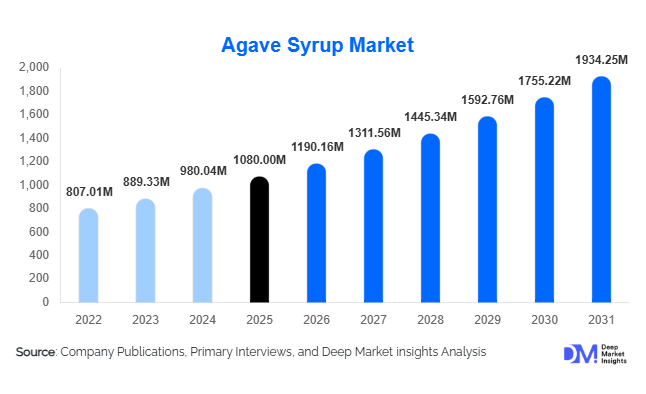
According to Deep Market Insights, the global agave syrup market size was valued at USD 1,080 million in 2025 and is projected to grow from USD 1,190.16 million in 2026 to reach USD 1,934.25 million by 2031, expanding at a CAGR of 10.2% during the forecast period (2026–2031). The agave syrup market growth is primarily driven by increasing global demand for natural sweeteners, rising adoption of plant-based diets, and expanding reformulation initiatives by food and beverage manufacturers seeking sugar alternatives aligned with clean-label trends.
Key Market Insights
- Natural and plant-based sweeteners are replacing refined sugar, positioning agave syrup as a preferred ingredient in clean-label and vegan food formulations.
- Food and beverage manufacturers account for the largest demand share, driven by reformulation strategies aimed at sugar reduction and healthier product positioning.
- North America dominates global consumption due to strong organic food adoption and widespread health-conscious consumer behavior.
- Asia-Pacific is the fastest-growing region, supported by rising disposable income and growing demand for premium imported food ingredients.
- Organic-certified agave syrup is expanding rapidly, attracting premium pricing and strong retail penetration.
- Supply chain integration in Mexico, the primary agave-producing region, is becoming critical for pricing stability and long-term sourcing security.
What are the latest trends in the agave syrup market?
Clean-Label and Natural Sweetener Adoption Accelerating
Food manufacturers globally are transitioning toward natural ingredients as consumers increasingly avoid artificial sweeteners and refined sugar. Agave syrup’s plant-based origin and mild flavor profile make it highly suitable for clean-label product reformulations. Brands are highlighting ingredient transparency and natural sourcing on packaging, reinforcing agave syrup’s premium positioning. The trend is particularly visible across snack bars, breakfast cereals, dairy alternatives, and ready-to-drink beverages. Retailers are also expanding shelf space dedicated to organic and natural sweeteners, enabling broader consumer accessibility and strengthening market penetration.
Functional Beverage Innovation Driving Demand
The rapid growth of functional beverages is reshaping demand patterns for agave syrup. Manufacturers of kombucha, energy drinks, herbal beverages, and plant-based protein drinks increasingly use agave syrup due to its high solubility and balanced sweetness. Unlike traditional sugar, agave syrup blends effectively in cold-processing applications, supporting innovation in health-focused beverages. Digital-first beverage startups are particularly driving adoption, integrating agave syrup into low-calorie and wellness-oriented formulations designed for younger consumers seeking healthier alternatives.
What are the key drivers in the agave syrup market?
Growing Demand for Natural Sugar Alternatives
Rising awareness regarding obesity, diabetes, and excessive sugar consumption is encouraging consumers to shift toward natural sweeteners. Governments introducing sugar taxes and labeling regulations are accelerating reformulation across packaged foods and beverages. Agave syrup provides manufacturers with a viable solution to maintain sweetness while improving product perception, making it a major growth driver for the industry.
Expansion of Vegan and Plant-Based Food Markets
The global rise in vegan and flexitarian lifestyles is significantly boosting agave syrup demand. As a plant-derived substitute for honey, agave syrup is widely adopted in vegan bakery products, confectionery, and beverages. Plant-based dairy alternatives, including oat and almond drinks, increasingly incorporate agave syrup for flavor enhancement and texture balance, reinforcing its role within the expanding plant-based ecosystem.
What are the restraints for the global market?
Raw Material Supply Volatility
Agave cultivation requires multi-year growth cycles, making supply sensitive to climatic conditions and agricultural disruptions. Production concentration in Mexico creates dependency risks, leading to price fluctuations that impact manufacturer margins and long-term contract pricing.
Health Concerns Related to Fructose Content
Despite being marketed as natural, agave syrup contains relatively high fructose levels. Increasing scientific debate and consumer awareness regarding fructose intake may influence purchasing decisions, particularly among highly health-conscious consumers, creating a restraint for broader adoption.
What are the key opportunities in the agave syrup industry?
Functional and Nutritional Food Applications
The expansion of functional foods and sports nutrition presents strong opportunities for agave syrup suppliers. Its low glycemic characteristics and natural positioning make it attractive for protein bars, energy gels, and nutraceutical products. Companies entering this segment can benefit from premium pricing and long-term demand growth tied to wellness trends.
Emerging Market Expansion in Asia-Pacific
Rapid urbanization and increasing health awareness across Asia-Pacific countries such as India, China, and South Korea are creating new demand centers. E-commerce penetration and exposure to Western dietary trends are accelerating adoption of natural sweeteners. Manufacturers investing in localized branding and distribution partnerships are expected to capture early-mover advantages.
Report Scope
| Report Metric | Details |
|---|---|
| Market Size in 2025 | USD 1080 Million |
| Market Size in 2026 | USD 1190.16 Million |
| Market Size in 2031 | USD 1934.25 Million |
| CAGR | 10.2% (2026-2031) |
| Base Year for Estimation | 2025 |
| Historical Data | 2022-2024 |
| Forecast Period | 2026-2031 |
| Report Coverage | Revenue Forecast, Competitive Landscape, Supply Chain Disruption, Growth Factors, Environment & Regulatory Landscape and Trends |
| Geographies Covered | North America, Europe, APAC, Middle East and Africa, LATAM |
| Countries Covered | U.S., Canada, U.K., Germany, France, Spain, Italy, Russia, Nordic, Benelux, Rest of Europe, China, Korea, Japan, India, Australia, Singapore, Taiwan, South East Asia, Rest of Asia-Pacific, UAE, Turky, Saudi Arabia, South Africa, Egypt, Nigeria, Rest of MEA, Brazil, Mexico, Argentina, Chile, Colombia, Rest of LATAM |
Explore more data points, trends and opportunities Download Free Sample Report
Product Type Insights
The global agave syrup market demonstrates strong segmentation across product types, with light agave syrup maintaining a dominant position and accounting for nearly 38% of total market demand. The leadership of this segment is primarily driven by its mild flavor profile, light color, and high solubility, which make it highly adaptable across a wide range of food and beverage formulations. Manufacturers increasingly prefer light agave syrup as a sugar substitute in beverages, dairy alternatives, breakfast cereals, and ready-to-eat foods due to its ability to enhance sweetness without altering product taste or appearance. The growing global shift toward clean-label formulations and reduced refined sugar consumption further strengthens demand for this segment, particularly among beverage innovators and health-oriented packaged food producers.Amber agave syrup represents the second-largest segment and continues to experience stable growth owing to its richer flavor characteristics and caramel-like notes. This variant is widely used in bakery, confectionery, and dessert applications where flavor enhancement is a critical product attribute. Food manufacturers leverage amber agave syrup to deliver natural sweetness alongside depth of flavor, allowing premium positioning in artisanal and gourmet product categories. The rising demand for natural baking ingredients and minimally processed sweeteners supports sustained expansion of this segment across developed markets.Dark agave syrup occupies a smaller yet high-value niche within the market, primarily catering to specialty culinary applications and premium foodservice environments. Its strong flavor intensity makes it suitable for sauces, marinades, and specialty beverages, particularly within gourmet and organic food segments. Although volume demand remains comparatively limited, higher pricing and specialty positioning contribute positively to overall market profitability.Organic-certified agave syrup variants are emerging as one of the fastest-growing product categories, supported by increasing consumer awareness regarding sustainability, traceability, and chemical-free production practices. Certification standards and environmentally responsible farming practices enable producers to command premium pricing while strengthening brand differentiation. Growing adoption of organic ingredients by multinational food companies and private-label health brands continues to accelerate the expansion of certified agave syrup products worldwide.
Application Insights
Food and beverage applications dominate the global agave syrup market, accounting for approximately 72% of total consumption. The leading position of this segment is driven by the increasing replacement of refined sugar and artificial sweeteners with plant-based alternatives across beverages, bakery goods, dairy substitutes, breakfast foods, and snack products. Beverage manufacturers, in particular, are adopting agave syrup due to its high fructose content, superior solubility, and lower glycemic index compared to traditional sweeteners, enabling formulation of reduced-sugar and functional beverages aligned with evolving consumer health preferences.The nutraceutical application segment is expanding rapidly as agave syrup gains acceptance as a natural binding and sweetening ingredient in dietary supplements, protein bars, and functional snacks. Growth in preventive healthcare awareness and demand for functional nutrition products supports wider integration of agave-derived ingredients within wellness-focused product portfolios. Manufacturers are increasingly incorporating agave syrup into energy supplements and plant-based nutrition solutions to improve taste profiles while maintaining natural ingredient claims.Personal care applications are gradually emerging as an innovation-driven segment within the market. Agave-derived ingredients are utilized in natural skincare and cosmetic formulations due to their humectant properties and compatibility with clean beauty trends. Rising consumer preference for botanical and plant-based personal care products is encouraging cosmetic manufacturers to explore agave-based formulations, contributing to long-term diversification of market demand.Foodservice applications are also gaining momentum as restaurants, cafés, and premium beverage chains adopt agave syrup as a natural sweetener alternative for specialty beverages and health-focused menu offerings. The expansion of café culture and premium dining experiences globally continues to enhance institutional demand, particularly in urban markets emphasizing wellness-oriented consumption.
Distribution Channel Insights
B2B industrial sales dominate the distribution landscape, contributing nearly 64% of global revenue. The leadership of this channel is primarily driven by large-scale procurement by food and beverage manufacturers that require consistent ingredient supply for mass production. Long-term supply agreements between agave processors and multinational food companies ensure stable demand flows, reinforcing the importance of industrial distribution networks. Bulk purchasing efficiencies and cost optimization strategies further strengthen the dominance of this segment.Traditional retail channels, including supermarkets, hypermarkets, and specialty health stores, remain essential for consumer accessibility and brand visibility. Premium grocery retailers play a significant role in promoting organic and natural sweeteners, enabling consumer education and product differentiation through in-store positioning. Increasing shelf space dedicated to health-oriented products continues to support retail expansion across developed economies.E-commerce platforms represent the fastest-growing distribution channel as digital retail enables direct-to-consumer engagement and global market penetration for niche and emerging brands. Online platforms allow smaller organic producers to scale internationally without heavy investment in physical distribution infrastructure. Subscription-based purchasing models, digital marketing strategies, and cross-border online trade are reshaping distribution dynamics, making online channels increasingly influential in market growth.
End-Use Industry Insights
The packaged food industry represents the largest end-use segment, accounting for approximately 41% of total agave syrup demand. The segment’s leadership is driven by growing reformulation initiatives among food manufacturers seeking to reduce refined sugar content while maintaining flavor quality. Clean-label product development, rising demand for natural ingredients, and increasing consumer scrutiny of ingredient lists are encouraging widespread adoption of agave syrup across packaged snacks, cereals, sauces, and ready-to-eat meals.Beverage manufacturers represent the fastest-growing end-use industry, supported by rapid innovation in functional drinks, plant-based beverages, flavored waters, and low-calorie refreshment products. Agave syrup’s high solubility and stable sweetness profile make it particularly suitable for beverage applications, enabling manufacturers to develop differentiated health-focused offerings.Plant-based dairy alternatives and nutritional snack producers are emerging as high-growth users as vegan and flexitarian dietary trends expand globally. Agave syrup enhances taste and texture in plant-based yogurts, protein bars, and dairy-free desserts, supporting product innovation within alternative nutrition marketsExport-driven demand continues to play a crucial role in shaping industry dynamics, with Mexico serving as the primary global production hub supplying major importing markets such as the United States, Germany, and Japan. Expanding international trade networks and increasing global acceptance of agave-based sweeteners further strengthen demand across multiple end-use industries
Explore more data points, trends and opportunities Download Free Sample Report
Agave Syrup Market Segmentations
By Product Type
- Light Agave Syrup
- Amber Agave Syrup
- Dark Agave Syrup
- Raw Organic Agave Syrup
By Application
- Food Beverages
- Nutraceuticals Dietary Supplements
- Personal Care Cosmetics
- Foodservice Hospitality
By Distribution Channel
- B2B Industrial Sales
- Supermarkets Hypermarkets
- Specialty Health Organic Stores
- Online Retail E-Commerce
- Foodservice Distributors
By End-Use Industry
- Packaged Food Manufacturers
- Beverage Manufacturers
- Plant-Based Vegan Food Producers
- HoReCa (Hotels, Restaurants
- Health Wellness Brands
Regional Insights
North America
North America holds approximately 34% of the global agave syrup market share, led by strong consumption patterns in the United States. Regional growth is driven by advanced sugar-reduction initiatives, rising adoption of plant-based diets, and widespread consumer awareness regarding natural sweeteners. Regulatory support for transparent food labeling and growing demand for clean-label ingredients encourage food manufacturers to incorporate agave syrup into reformulated products. The rapid expansion of functional beverages, organic packaged foods, and vegan product categories further accelerates regional demand. Canada contributes steady growth through expanding premium grocery retail networks and increasing penetration of health-focused private-label brands, while strong distribution infrastructure supports consistent product availability.
Europe
Europe accounts for nearly 26% of global demand, with Germany, the United Kingdom, France, and the Netherlands serving as key consumption centers. Regional growth is strongly supported by stringent food labeling regulations that promote transparency and discourage excessive refined sugar usage. Increasing consumer preference for organic-certified and sustainably sourced ingredients continues to drive adoption across bakery, dairy alternatives, and functional food categories. The region’s mature organic food market, combined with rising vegan and flexitarian populations, creates favorable conditions for agave syrup expansion. Additionally, innovation within premium confectionery and artisanal food manufacturing strengthens long-term market penetration.
Asia-Pacific
Asia-Pacific represents the fastest-growing regional market, expanding at an estimated CAGR of nearly 12.8%. Growth is fueled by rapid urbanization, rising disposable incomes, and expanding middle-class populations across China and India, where consumers are increasingly exploring healthier dietary alternatives. Growing awareness of lifestyle-related health concerns such as obesity and diabetes encourages adoption of natural sweeteners in beverages and packaged foods. Japan and South Korea serve as premium innovation hubs emphasizing functional foods, nutraceutical beverages, and clean-label product development. The rapid expansion of modern retail channels and e-commerce ecosystems across the region further accelerates market accessibility and consumer adoption.
Latin America
Latin America contributes roughly 22% of global market share, primarily driven by Mexico’s dominant position in agave cultivation and syrup production. Favorable climatic conditions, established agricultural expertise, and vertically integrated supply chains enable large-scale production and export competitiveness. Regional growth is supported by increasing investments in processing infrastructure aimed at meeting rising international demand. Export-oriented manufacturing and trade partnerships with North America and Europe continue to strengthen the region’s strategic importance within the global agave syrup value chain. Domestic consumption is also gradually increasing as health awareness expands among urban populations.
Middle East & Africa
The Middle East and Africa region is experiencing gradual but consistent market growth, led by the United Arab Emirates and South Africa. Rising disposable incomes, expanding premium retail environments, and increasing demand for imported health foods contribute to growing adoption of natural sweeteners. Wellness-oriented consumption trends and the popularity of functional beverages within urban populations are supporting gradual market penetration. Growth is further reinforced by expanding hospitality and foodservice sectors, where agave syrup is increasingly used in premium beverage preparation and specialty culinary applications. Improving distribution networks and increasing awareness of clean-label ingredients are expected to sustain long-term regional expansion.
Key Players in the Agave Syrup Market
- Madhava Ltd.
- Wholesome Sweeteners Inc.
- The iidea Company
- Nekutli S.A. de C.V.
- Colibree Company Inc.
- Groovy Food Company Ltd.
- Dandy Lions Ltd.
- NOW Health Group Inc.
- NaturaleBio
- Ciranda Inc.
- Global Goods Inc.
- Best Ground International
- Earth Circle Organics
- SunOpta Inc.
- Tradin Organic Agriculture B.V.