Acerola Fruit Extract Market Size
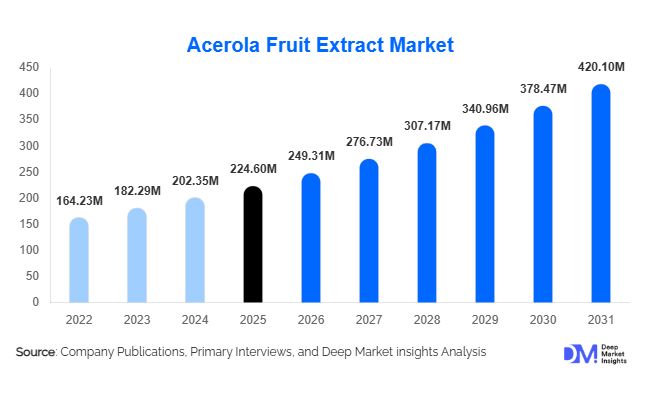
According to Deep Market Insights,the global acerola fruit extract market size was valued at USD 224.6 million in 2025 and is projected to grow from USD 249.31 million in 2026 to reach USD 420.10 million by 2031, expanding at a CAGR of 11.0% during the forecast period (2026–2031). The market growth is primarily driven by increasing demand for natural vitamin C ingredients, rapid expansion of nutraceutical and functional food industries, and growing consumer preference for clean-label, plant-derived antioxidants. Rising awareness of preventive healthcare and immunity-focused nutrition continues to position acerola fruit extract as a premium alternative to synthetic ascorbic acid across supplements, beverages, and personal care applications.
Key Market Insights
- Natural vitamin C adoption is accelerating globally, with manufacturers replacing synthetic ascorbic acid to meet clean-label product positioning.
- Nutraceutical applications dominate demand, supported by rising consumption of immune-support supplements and functional nutrition products.
- Latin America leads global production, particularly Brazil, serving as the primary export hub for acerola raw materials.
- Asia-Pacific is the fastest-growing regional market, driven by expanding middle-class populations and rising supplement penetration.
- Organic-certified acerola extracts are gaining premium positioning, supported by sustainability and transparency trends.
- Technological advancements in extraction and microencapsulation are improving stability, bioavailability, and application versatility.
What are the latest trends in the acerola fruit extract market?
Clean-Label Reformulation Driving Ingredient Substitution
Food and supplement manufacturers are increasingly reformulating products using natural ingredients to comply with evolving consumer expectations and regulatory standards. Acerola fruit extract has emerged as a preferred natural vitamin C source due to its recognizable botanical origin and antioxidant properties. Brands are highlighting “fruit-derived vitamin C” labeling to differentiate premium products. This trend is particularly strong in Europe and North America, where regulatory scrutiny and consumer awareness surrounding synthetic additives are reshaping formulation strategies. Companies are investing in standardized extracts that deliver consistent potency while maintaining natural claims, enabling broader adoption across mainstream food applications.
Expansion of Functional Beverages and Gummies
Functional beverages, immunity shots, and nutraceutical gummies are rapidly becoming key growth platforms for acerola extract usage. Beverage manufacturers favor acerola extract because of its solubility and compatibility with citrus flavor systems. Wellness drinks combining probiotics, botanicals, and vitamins increasingly incorporate acerola as a natural fortification ingredient. Similarly, gummy supplements targeting younger consumers rely on acerola extract to deliver natural antioxidant benefits while supporting clean-label positioning. These evolving delivery formats are expanding acerola demand beyond traditional capsules and powders into mainstream consumer products.
What are the key drivers in the acerola fruit extract market?
Growing Preventive Healthcare Awareness
Consumers worldwide are prioritizing immunity and long-term health maintenance, driving demand for antioxidant-rich nutritional ingredients. Acerola fruit extract contains exceptionally high natural vitamin C concentrations, making it highly suitable for immune-support formulations. Increased supplement consumption across North America, Europe, and Asia-Pacific continues to accelerate ingredient demand as consumers adopt daily wellness routines.
Rapid Expansion of the Nutraceutical Industry
The global nutraceutical sector is expanding steadily, supported by aging populations, rising disposable income, and increasing health consciousness. Acerola extract is widely incorporated into tablets, powders, chewables, and liquid supplements due to its natural origin and bioavailability advantages. Manufacturers increasingly use botanical blends combining acerola with herbal extracts, further strengthening market penetration.
What are the restraints for the global market?
High Production and Processing Costs
Compared to synthetic vitamin C, acerola fruit extract requires complex cultivation, harvesting, and stabilization processes. Extraction technologies and quality standardization increase production costs, limiting adoption in price-sensitive mass-market products. Manufacturers must balance cost efficiency with natural ingredient positioning to maintain competitiveness.
Raw Material Supply Volatility
Acerola cultivation depends heavily on tropical climate conditions, making supply vulnerable to seasonal variations and weather disruptions. Yield fluctuations impact pricing stability and create procurement challenges for ingredient manufacturers relying on consistent raw material availability.
What are the key opportunities in the acerola fruit extract industry?
Natural Ingredient Premiumization
Premium food, beverage, and supplement brands increasingly emphasize transparency and sustainability, creating opportunities for acerola extract suppliers to position products as high-value natural ingredients. Organic-certified and traceable supply chains enable companies to command higher margins while meeting consumer expectations for authenticity and environmental responsibility.
Technological Innovation in Extraction and Delivery Systems
Advancements such as microencapsulation and low-temperature drying technologies are improving shelf life and nutrient stability. These innovations allow acerola extract to be incorporated into heat-sensitive applications including bakery products, dairy alternatives, and skincare formulations. Pharmaceutical-grade formulations also represent a growing opportunity as natural antioxidants gain clinical relevance.
Report Scope
| Report Metric | Details |
|---|---|
| Market Size in 2025 | USD 224.60 Million |
| Market Size in 2026 | USD 249.31 Million |
| Market Size in 2031 | USD 420.10 Million |
| CAGR | 11% (2026-2031) |
| Base Year for Estimation | 2025 |
| Historical Data | 2022-2024 |
| Forecast Period | 2026-2031 |
| Report Coverage | Revenue Forecast, Competitive Landscape, Supply Chain Disruption, Growth Factors, Environment & Regulatory Landscape and Trends |
| Geographies Covered | North America, Europe, APAC, Middle East and Africa, LATAM |
| Countries Covered | U.S., Canada, U.K., Germany, France, Spain, Italy, Russia, Nordic, Benelux, Rest of Europe, China, Korea, Japan, India, Australia, Singapore, Taiwan, South East Asia, Rest of Asia-Pacific, UAE, Turky, Saudi Arabia, South Africa, Egypt, Nigeria, Rest of MEA, Brazil, Mexico, Argentina, Chile, Colombia, Rest of LATAM |
Explore more data points, trends and opportunities Download Free Sample Report
Product Type Insights
The powdered acerola fruit extract segment holds the leading share of the global market, primarily driven by its superior stability, extended shelf life, and ease of incorporation into dry formulations across nutraceutical, food, and pharmaceutical applications. Manufacturers increasingly prefer powdered formats because they enable precise dosage control, cost-efficient storage, and simplified global transportation logistics. Spray-dried acerola powders are extensively utilized in large-scale nutraceutical production due to consistent quality and scalability, while freeze-dried variants are gaining traction in premium formulations where maximum preservation of vitamin C and phytonutrients is essential. Liquid acerola extracts are witnessing steady adoption, particularly within functional beverages, wellness tonics, and fortified syrups, as brands prioritize rapid solubility and improved bioavailability. Encapsulated acerola extracts represent a developing but high-potential segment, supported by advancements in microencapsulation technologies that enhance nutrient protection, controlled release, and product stability in complex formulations.
Application Insights
Dietary supplements constitute the leading application segment, supported by the rising global focus on preventive healthcare and immune system support. Increasing consumer preference for natural sources of vitamin C over synthetic alternatives continues to drive strong demand for acerola extract within capsules, tablets, and powdered supplement blends. Functional foods and beverages are emerging as one of the fastest-expanding applications, as manufacturers increasingly fortify juices, plant-based beverages, snack bars, and wellness shots with naturally derived antioxidants to meet clean-label expectations. Pharmaceutical applications leverage acerola extract for antioxidant and immunity-focused formulations, particularly in natural therapeutic products and recovery supplements. In cosmetics and personal care, acerola extract is gaining popularity due to its high vitamin C concentration, supporting skin-brightening, collagen stimulation, and anti-aging product claims. Animal nutrition applications, although currently niche, are expanding steadily as premium pet food and livestock supplement producers adopt natural immune-support ingredients to enhance product differentiation.
Distribution Channel Insights
Direct business-to-business (B2B) ingredient supply remains the dominant distribution channel, driven by long-term procurement contracts between acerola extract producers and nutraceutical, pharmaceutical, and food manufacturers seeking consistent raw material quality and pricing stability. Ingredient distributors play a critical role in expanding regional accessibility, particularly for small and mid-sized manufacturers lacking direct sourcing capabilities. The rapid growth of online B2B ingredient marketplaces is transforming procurement dynamics by improving transparency, shortening sourcing timelines, and enabling emerging brands to access specialized botanical ingredients. Additionally, contract manufacturing organizations are becoming increasingly important within the value chain, allowing consumer brands to efficiently integrate acerola extract into finished products while reducing capital investment and accelerating product commercialization timelines.
End-Use Industry Insights
Nutraceutical manufacturers represent the largest end-use industry, primarily driven by increasing consumer adoption of preventive health solutions and demand for naturally sourced antioxidants. Acerola extract aligns strongly with immune health, energy support, and wellness positioning, making it a preferred ingredient in modern supplement formulations. The food and beverage industry is rapidly increasing adoption as companies reformulate products to meet clean-label standards and replace synthetic ascorbic acid with plant-based vitamin C sources. Pharmaceutical companies utilize standardized acerola extracts in natural therapeutic and adjunct health formulations, benefiting from growing acceptance of botanical ingredients in evidence-based healthcare products. Cosmetic and personal care brands continue integrating acerola extract into skincare formulations due to its antioxidant activity and effectiveness in promoting skin radiance and anti-aging benefits. Meanwhile, animal nutrition producers are gradually incorporating acerola extract into premium feed additives and pet supplements, supported by rising demand for functional nutrition solutions targeting immunity and overall animal wellness.
Explore more data points, trends and opportunities Download Free Sample Report
Acerola Fruit Extract Market Segmentations
By Product Type
- Powdered Acerola Extract
- Liquid Acerola Extract
- Freeze-Dried Acerola Extract
- Encapsulated & Standardized Extracts
By Application
- Dietary Supplements & Nutraceuticals
- Food & Beverage Fortification
- Pharmaceutical Preparations
- Cosmetics & Personal Care Products
- Animal Nutrition & Feed Additives
By Distribution Channel
- Direct B2B Ingredient Supply
- Ingredient Distributors & Traders
- Online B2B Platforms
- Contract Manufacturing & Private Label Supply
By End-Use Industry
- Nutraceutical Manufacturers
- Food & Beverage Companies
- Pharmaceutical Industry
- Cosmetics & Personal Care Industry
- Animal Health Industry
Regional Insights
North America
North America represents a significant share of the global acerola fruit extract market, supported by strong consumer spending on dietary supplements and widespread adoption of functional nutrition products across the United States and Canada. Regional growth is primarily driven by high awareness of natural health ingredients, increasing demand for clean-label foods, and the rapid expansion of plant-based and functional beverage categories. Regulatory clarity surrounding natural ingredients and the presence of established nutraceutical manufacturers further strengthen market penetration. Additionally, growing interest in preventive healthcare, immunity-focused formulations, and premium wellness products continues to accelerate acerola extract adoption across multiple end-use industries.
Europe
Europe remains a mature yet steadily expanding market, led by countries such as Germany, France, and the United Kingdom. Regional growth is driven by stringent food safety regulations that encourage replacement of synthetic additives with natural botanical alternatives, supporting strong demand for acerola-derived vitamin C. Increasing consumer preference for organic, sustainably sourced, and clean-label ingredients further accelerates adoption across food, supplement, and cosmetic sectors. The region’s well-established natural cosmetics industry and rising vegan product innovation also contribute significantly to market expansion, as manufacturers seek multifunctional plant-based ingredients aligned with sustainability objectives.
Asia-Pacific
Asia-Pacific is the fastest-growing regional market, fueled by expanding middle-class populations, rising disposable incomes, and rapidly increasing awareness of preventive healthcare in countries including China, India, Japan, and South Korea. Growth is strongly supported by the expansion of e-commerce platforms that enhance accessibility to dietary supplements and functional foods. Urbanization, changing dietary habits, and growing demand for immunity-support products following heightened health consciousness are accelerating acerola extract consumption. Additionally, regional manufacturers are increasingly incorporating natural antioxidants into beverages, nutraceuticals, and beauty products, while India and China continue emerging as major import markets for acerola-based ingredients due to limited domestic cultivation.
Latin America
Latin America plays a strategic dual role as both a production hub and an expanding consumption market. Brazil dominates global acerola cultivation, benefiting from favorable climatic conditions and established agricultural infrastructure that support large-scale production and export activities. Regional growth is driven by investments in agricultural processing technologies, value-added extraction capabilities, and export-oriented supply chains. Increasing domestic awareness of natural health products and rising functional food consumption are also contributing to regional demand growth, positioning Latin America as a critical supplier within the global acerola extract value chain.
Middle East & Africa
The Middle East & Africa region is experiencing gradual but consistent market growth, led by countries such as the United Arab Emirates and South Africa. Expansion is supported by increasing consumer health awareness, rising demand for premium imported supplements, and the development of modern retail and e-commerce distribution channels. Growing urban populations and higher disposable incomes are encouraging adoption of functional nutrition and wellness products containing natural ingredients. Furthermore, expanding beauty and personal care markets within the region are contributing to increased utilization of acerola extract in skincare formulations emphasizing antioxidant and skin-brightening benefits.
Key Players in the Acerola Fruit Extract Market
- Givaudan (Naturex)
- Nexira
- Symrise (Diana Food)
- Duas Rodas Industrial
- Martin Bauer Group
- ADM (Archer Daniels Midland)
- Döhler Group
- BGG World
- The Green Labs LLC
- Ingredient Solutions Inc.
- Herbal Creations
- Xi’an Lyphar Biotech
- Nutra Green Biotechnology
- Foodchem International Corporation
- Alvinesa Natural Ingredients