Top 6 Companies in Food Truck Industry Market | Competitive Insights
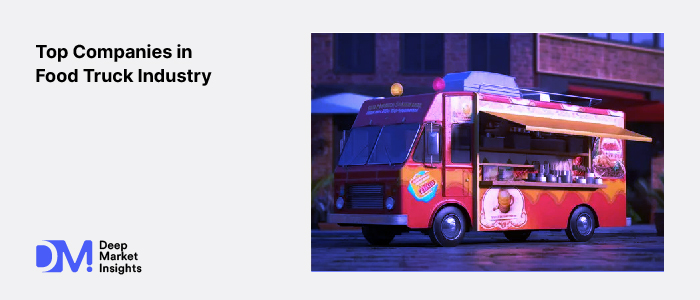
The Top Companies in Food Truck Industry Market reflects a rapidly evolving segment within the global foodservice ecosystem, driven by urbanization, mobile consumption trends, and low entry barriers.Food trucks have transitioned from niche street vendors to structured micro-enterprises with scalable business models.Globally, over 4.5 million mobile food service units operate, contributing significantly to informal and semi-organized food retail.
The market is characterized by relatively low capital investment, with initial setup costs ranging between USD 30,000 and USD 150,000 per truck, making it attractive for entrepreneurs and small-scale operators.Increasing consumer demand for convenience, diverse cuisines, and quick-service formats continues to fuel competition among leading manufacturers, franchise operators, and food truck solution providers.
Top Companies in Food Truck Industry Market Overview with Data
The Top Companies in Food Truck Industry Market spans multiple value chains including vehicle manufacturing, kitchen equipment integration, food franchise operations, and fleet management services.
Key market data points include:
-
Average daily sales per food truck range between USD 300 and USD 1,500, depending on location and menu type
-
Urban regions account for approximately 65% of total food truck operations, with dense clusters in North America, Europe, and Asia-Pacific
-
Standard food truck build costs range from USD 50,000 to USD 120,000, while premium customized units exceed USD 200,000
-
Equipment costs contribute 30-40% of total setup investment
-
Food trucks typically achieve gross margins between 20% and 35%, driven by lower overhead compared to brick-and-mortar restaurants
Pricing benchmarks vary significantly:
-
Street food items: USD 5-15 per serving
-
Gourmet offerings: USD 12-25 per serving
-
Event-based catering packages: USD 1,000-5,000 per day per truck
Regionally, North America holds an estimated 40% market share, followed by Europe at 25%, and Asia-Pacific at approximately 20%, with emerging growth in urban India and Southeast Asia.
Top Companies in Food Truck Industry Market
Prestige Food Trucks
Prestige Food Trucks operates as a leading manufacturer and custom builder of mobile kitchens, serving both independent operators and franchise brands.The company delivers over 250-300 customized trucks annually, catering to clients across North America and select international markets.Its product portfolio includes fully equipped trucks, trailers, and carts, with pricing ranging from USD 60,000 to USD 180,000 depending on customization levels.Prestige focuses on turnkey solutions, integrating cooking equipment, refrigeration, and branding within a single unit.The company positions itself in the premium customization segment, targeting professional chefs and scalable food businesses.Its strategy emphasizes design innovation, compliance with food safety regulations, and durability, ensuring operational efficiency and lower maintenance costs for fleet operators.
VS Veicoli Speciali

VS Veicoli Speciali, based in Europe, specializes in high-end mobile catering vehicles and luxury food trucks.The company produces approximately 150-200 units per year, with a strong presence in Italy, Germany, and France.Its offerings include gourmet food trucks, coffee vans, and event catering vehicles, with prices ranging between EUR 70,000 and EUR 200,000.The company differentiates itself through premium aesthetics, advanced kitchen layouts, and energy-efficient systems.VS Veicoli Speciali targets high-end clients, including hospitality brands and corporate event organizers.Its strategy focuses on design excellence and technological integration, such as smart kitchen systems and modular interiors, enabling flexibility in menu offerings and operational scalability.
M&R Specialty Trailers and Trucks

M&R Specialty Trailers and Trucks is a U.S.-based manufacturer known for producing durable and cost-effective food trucks and concession trailers.The company manufactures approximately 200+ units annually, catering primarily to small and mid-sized operators.Its product range includes basic food trucks priced from USD 50,000 to fully customized units exceeding USD 120,000. M&R emphasizes affordability and compliance with local health regulations, making it a preferred choice for first-time entrepreneurs.The company’s market positioning centers on value-driven solutions, balancing cost efficiency with essential functionality.Its strategy includes expanding dealer networks and offering financing options, which lowers entry barriers for new operators and drives volume sales.
Roaming Hunger

Roaming Hunger operates as a digital platform and fleet management service provider, connecting food truck operators with event organizers and corporate clients.The platform supports over 18,000 food trucks across 25+ markets, making it one of the largest aggregators globally.The company generates revenue through booking commissions, event management services, and marketing solutions.Average booking values range from USD 1,500 to USD 4,000 per event, depending on scale and location.Roaming Hunger’s strategy focuses on digital enablement, streamlining demand-supply matching, and improving utilization rates for food truck operators. Its strong network effect and data-driven approach enhance operational efficiency and revenue predictability for vendors.
The Food Truck Group
The Food Truck Group specializes in building and operating standardized food truck fleets for franchise brands and corporate clients.The company manages fleets of 50-100 trucks per major contract, primarily in North America.Its services include truck manufacturing, branding, staffing, and route optimization.Fleet deployment costs typically range from USD 80,000 to USD 150,000 per unit, depending on specifications.The company positions itself as a B2B solutions provider, targeting large-scale clients such as retail chains and event organizers.Its strategy emphasizes scalability, standardized operations, and centralized procurement, enabling consistent quality and cost efficiencies across multiple locations.
Legion Food Trucks
Legion Food Trucks focuses on mid-range and high-performance mobile kitchens, producing approximately 100-150 units annually. The company serves both independent operators and regional food chains.Its product portfolio includes compact trucks, trailers, and specialty vehicles, with pricing between USD 55,000 and USD 140,000.Legion emphasizes durability, ergonomic kitchen layouts, and compliance with stringent safety standards.The company’s competitive positioning lies in delivering reliable, mid-tier solutions that balance cost and performance. Its strategy includes expanding into emerging markets and offering modular designs that reduce production time by 15-20%, improving delivery timelines.
Competitive Landscape Insights
The Top Companies in Food Truck Industry Market exhibits a fragmented yet competitive structure:
-
Top manufacturers and service providers collectively hold approximately 35-40% market share, while small independent builders dominate the remaining segment
-
Pricing segmentation is divided into three tiers:
-
Entry-level: USD 30,000-60,000
-
Mid-range: USD 60,000-120,000
-
Premium: USD 120,000-200,000+
-
Fleet operators and aggregators contribute nearly 20% of total market revenue, driven by event-based demand and corporate partnerships
Supply chain dynamics are influenced by:
-
Rising costs of steel and automotive components, increasing production costs by 8-12% annually
-
Dependence on commercial kitchen equipment suppliers, which account for 30-40% of build costs
-
Increasing adoption of modular and pre-fabricated units, reducing manufacturing time by 10-25%
Digital platforms are reshaping the market by improving utilization rates and enabling dynamic pricing, particularly for event-based operations.
The Top Companies in Food Truck Industry Market demonstrate a diverse mix of manufacturers, service providers, and digital platforms, each addressing different segments of the value chain.From premium custom builders to scalable fleet operators, the market offers varied entry points for stakeholders.Key differentiators include pricing flexibility, production capacity, customization capabilities, and digital integration.With setup costs ranging from USD 30,000 to USD 200,000+ and daily revenue potential reaching USD 1,500, the sector continues to attract entrepreneurs and institutional investors alike.For procurement professionals and decision-makers, selecting the right partner depends on balancing cost, scalability, and operational efficiency.Companies that integrate design innovation, supply chain optimization, and digital enablement are best positioned to capture long-term value in this competitive landscape.