Japan Plant Based Meat Market Size & Outlook, 2026-2034
Last Updated : 31 July, 2026 |
Study Period : 2022-2034 |
Format : PDF, Excel |
Author : Hannah Blake
Japan Plant Based Meat Market Insights
- Based on Deep Market Insights findings, the Japan Plant Based Meat Market reached USD 288.07 Million in 2025 and is estimated to attain USD 1433.13 Million by 2034.
- From 2026 to 2034, the Japan market is expected to grow at a steady CAGR of 19.56%.
- Within the Source category, Soy-based dominated in 2025 in terms of market size contribution.
- Over the forecast period, Pea-based is forecasted to deliver the fastest growth, positioning it as the most lucrative Source segment.
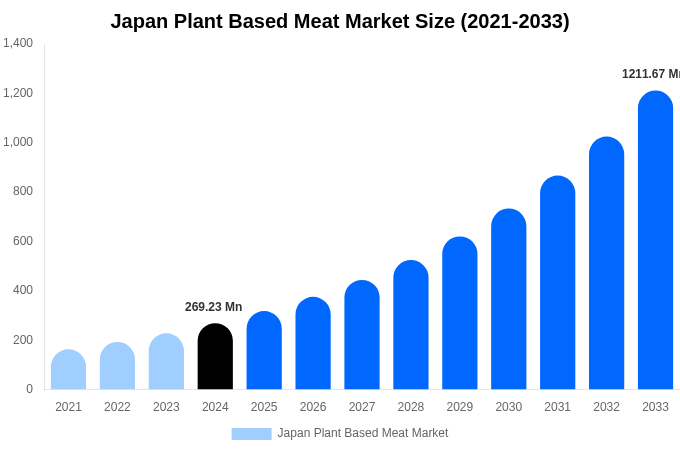
Source: DMI Analysis Company Publications, Primary Interviews.

Other Key Findings
- Japan accounted for 2.71% of the global Plant Based Meat Market size in 2025.
- By 2034, United States is expected to remain the top global market in terms of size.
- Within Asia Pacific, China is forecasted to dominate the regional Plant Based Meat Market size by 2034.
- India will be the fastest-growing market in Asia Pacific, projected to achieve USD 2446.3 Million by 2034.
Japan Plant-Based Meat Market Dynamics
- Japan's plant-based meat market is driven by increasing consumer interest in sustainable food products, growing health-conscious lifestyles, rising demand for alternative protein sources, and expanding flexitarian dietary habits. Consumers increasingly adopt plant-based burgers, sausages, nuggets, mince, meatballs, and ready-to-cook meat alternatives made from soy, pea, wheat, mushroom, and other plant proteins.
- Plant-based meat manufacturers, supermarkets, convenience stores, specialty health retailers, restaurants, foodservice operators, online grocery platforms, and direct-to-consumer brands strengthen market accessibility through diversified retail and foodservice channels. Companies increasingly improve product taste, texture, nutritional value, clean-label formulations, and localized flavor profiles.
- Manufacturers invest in protein extraction technologies, extrusion processing, fermentation technologies, ingredient innovation, sustainable manufacturing, and product formulation research to strengthen competitive differentiation. Innovation increasingly emphasizes high-protein products, soy-free alternatives, clean-label ingredients, fortified nutrition, and premium gourmet offerings.
- Market participants collaborate with food manufacturers, ingredient suppliers, restaurant chains, retailers, research institutions, and food technology companies to strengthen innovation and commercial expansion. Continued investment in sustainable proteins, alternative meat technologies, premium product development, and environmental sustainability reinforces competitiveness across Japan's plant-based meat industry.
Key Market Insights
- Sustainable foods strengthen demand.
- Alternative proteins expand adoption.
- Product innovation improves competitiveness.
- Flexitarian lifestyles support growth.
Japan Plant Based Meat Market Source 2026-2034 (USD Million)
| Source | 2022 | 2023 | 2024 | 2025 | 2026 | 2027 | 2028 | 2029 | 2030 | 2031 | 2032 | 2033 | 2034 |
|---|---|---|---|---|---|---|---|---|---|---|---|---|---|
| Soy-based | XX.x | XX.x | XX.x | 116.18 | XX.x | XX.x | XX.x | XX.x | XX.x | XX.x | XX.x | XX.x | XX.x |
| Wheat-based | XX.x | XX.x | XX.x | XX.x | XX.x | XX.x | XX.x | XX.x | XX.x | XX.x | XX.x | XX.x | XX.x |
| Pea-based | XX.x | XX.x | XX.x | XX.x | XX.x | XX.x | XX.x | XX.x | XX.x | XX.x | XX.x | XX.x | XX.x |
| Other plant proteins | XX.x | XX.x | XX.x | XX.x | XX.x | XX.x | XX.x | XX.x | XX.x | XX.x | XX.x | XX.x | XX.x |
| Total | XX.x | XX.x | XX.x | 288.07 | XX.x | XX.x | XX.x | XX.x | XX.x | XX.x | XX.x | XX.x | XX.x |
Source: DMI Analysis Company Publications, Primary Interviews.
Japan Plant Based Meat Market Product 2026-2034 (USD Million)
| Product | 2022 | 2023 | 2024 | 2025 | 2026 | 2027 | 2028 | 2029 | 2030 | 2031 | 2032 | 2033 | 2034 |
|---|---|---|---|---|---|---|---|---|---|---|---|---|---|
| Burgers | XX.x | XX.x | XX.x | 86.45 | XX.x | XX.x | XX.x | XX.x | XX.x | XX.x | XX.x | XX.x | XX.x |
| Sausages | XX.x | XX.x | XX.x | XX.x | XX.x | XX.x | XX.x | XX.x | XX.x | XX.x | XX.x | XX.x | XX.x |
| Nuggets | XX.x | XX.x | XX.x | XX.x | XX.x | XX.x | XX.x | XX.x | XX.x | XX.x | XX.x | XX.x | XX.x |
| Meatballs | XX.x | XX.x | XX.x | XX.x | XX.x | XX.x | XX.x | XX.x | XX.x | XX.x | XX.x | XX.x | XX.x |
| Mince | XX.x | XX.x | XX.x | XX.x | XX.x | XX.x | XX.x | XX.x | XX.x | XX.x | XX.x | XX.x | XX.x |
| Others | XX.x | XX.x | XX.x | XX.x | XX.x | XX.x | XX.x | XX.x | XX.x | XX.x | XX.x | XX.x | XX.x |
| Total | XX.x | XX.x | XX.x | 288.09 | XX.x | XX.x | XX.x | XX.x | XX.x | XX.x | XX.x | XX.x | XX.x |
Source: DMI Analysis Company Publications, Primary Interviews.
Japan Plant Based Meat Market End use 2026-2034 (USD Million)
| End use | 2022 | 2023 | 2024 | 2025 | 2026 | 2027 | 2028 | 2029 | 2030 | 2031 | 2032 | 2033 | 2034 |
|---|---|---|---|---|---|---|---|---|---|---|---|---|---|
| Retail and household | XX.x | XX.x | XX.x | 156.92 | XX.x | XX.x | XX.x | XX.x | XX.x | XX.x | XX.x | XX.x | XX.x |
| Foodservice | XX.x | XX.x | XX.x | XX.x | XX.x | XX.x | XX.x | XX.x | XX.x | XX.x | XX.x | XX.x | XX.x |
| Institutional | XX.x | XX.x | XX.x | XX.x | XX.x | XX.x | XX.x | XX.x | XX.x | XX.x | XX.x | XX.x | XX.x |
| Total | XX.x | XX.x | XX.x | 288.08 | XX.x | XX.x | XX.x | XX.x | XX.x | XX.x | XX.x | XX.x | XX.x |
Source: DMI Analysis Company Publications, Primary Interviews.
Japan Plant Based Meat Market Distribution channel 2026-2034 (USD Million)
| Distribution channel | 2022 | 2023 | 2024 | 2025 | 2026 | 2027 | 2028 | 2029 | 2030 | 2031 | 2032 | 2033 | 2034 |
|---|---|---|---|---|---|---|---|---|---|---|---|---|---|
| Supermarkets and hypermarkets | XX.x | XX.x | XX.x | 129.66 | XX.x | XX.x | XX.x | XX.x | XX.x | XX.x | XX.x | XX.x | XX.x |
| Specialty and health stores | XX.x | XX.x | XX.x | XX.x | XX.x | XX.x | XX.x | XX.x | XX.x | XX.x | XX.x | XX.x | XX.x |
| Online retail | XX.x | XX.x | XX.x | XX.x | XX.x | XX.x | XX.x | XX.x | XX.x | XX.x | XX.x | XX.x | XX.x |
| Total | XX.x | XX.x | XX.x | 288.07 | XX.x | XX.x | XX.x | XX.x | XX.x | XX.x | XX.x | XX.x | XX.x |
Source: DMI Analysis Company Publications, Primary Interviews.
Inside This Report
This section examines Japan's plant-based meat market through consumer trends, protein innovation, sustainability, and competitive developments.
- Country market landscape: Reviews Japan's plant-based meat ecosystem.
- Consumer and food trends: Explores flexitarian diets, health awareness, and sustainability.
- Product innovation and applications: Covers burgers, sausages, nuggets, mince, meatballs, and ready meals.
- Competitive and industry developments: Highlights innovation, partnerships, and retail expansion.
Report Summary
| Report Scope | Details |
|---|---|
| Base Year for Study | 2025 |
| Study Period | 2022-2034 |
| Historical Period | 2022-2024 |
| Forecast Period | 2026-2034 |
| Market Size In 2025 | USD 288.07 Million |
| Market Size In 2034 | USD 1433.13 Million |
| Largest segment | Soy-based |
| Units | Revenue in USD Million |
| CAGR | 19.56% (2026-2034) |
| Report Coverage | Revenue Forecast, Competitive Landscape, Growth Factors, Environment & Regulatory Landscape and Trends |