Zipper Market Size
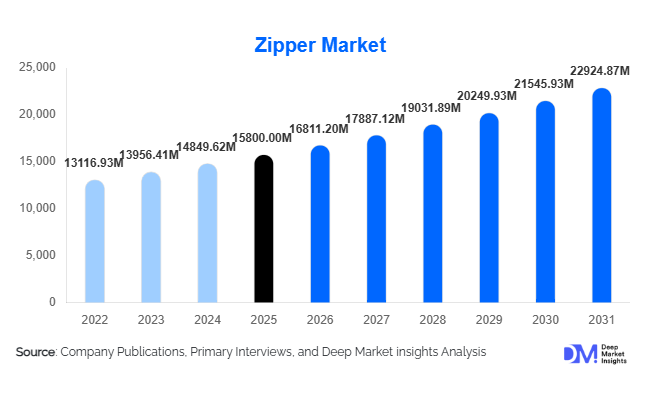
According to Deep Market Insights, the global zipper market size was valued at USD 15,800 million in 2025 and is projected to grow from USD 16,811.20 million in 2026 to reach USD 22,924.87 million by 2031, expanding at a CAGR of 6.4% during the forecast period (2026–2031). The zipper market growth is primarily driven by the expansion of the global apparel and textile industry, increasing demand for travel and luggage products, and rising adoption of functional and high-performance fastening solutions across industrial applications.
Key Market Insights
- Apparel remains the dominant application segment, accounting for over 55% of total zipper demand globally.
- Asia-Pacific leads the global market, driven by large-scale textile manufacturing in China, India, and Southeast Asia.
- Sustainable and recycled material-based zippers are gaining traction, supported by environmental regulations and brand commitments.
- OEM/direct supply channels dominate, contributing nearly 65% of total market distribution.
- High-performance zippers, including waterproof and flame-resistant variants, are expanding in industrial and outdoor applications.
- Automation and smart manufacturing technologies are improving production efficiency and enabling customization.
What are the latest trends in the zipper market?
Sustainability and Eco-Friendly Materials
The zipper market is witnessing a significant shift toward environmentally sustainable products. Manufacturers are increasingly adopting recycled polyester, biodegradable plastics, and low-impact metal processing techniques to meet sustainability targets set by global apparel brands. Eco-conscious consumers are influencing purchasing decisions, prompting brands to integrate sustainable components, including zippers, into their products. Certifications related to environmental compliance are becoming critical for suppliers to remain competitive. Additionally, innovations in bio-based materials and closed-loop recycling systems are emerging as key differentiators, helping manufacturers reduce carbon footprints and align with circular economy principles.
Growth of Functional and Performance Zippers
Demand for specialized zippers is rising across industries such as outdoor gear, defense, and protective clothing. Waterproof, airtight, anti-microbial, and fire-resistant zippers are increasingly used in applications requiring durability and performance. This trend is driven by the growing popularity of adventure sports, increased defense spending, and rising demand for industrial safety equipment. Manufacturers are investing in R&D to enhance product functionality, improve durability, and offer customized solutions tailored to specific end-use requirements. High-performance zippers also command higher margins, making them an attractive segment for market players.
What are the key drivers in the zipper market?
Expansion of the Global Apparel Industry
The growth of the apparel sector remains the primary driver of the zipper market. Fast fashion trends, increasing clothing consumption, and rising disposable incomes are boosting garment production worldwide. Countries in the Asia-Pacific, particularly China, Bangladesh, and Vietnam, are leading global apparel exports, creating sustained demand for zippers. The shift toward affordable and mass-produced clothing further amplifies zipper consumption, as garments require cost-effective and durable fastening solutions.
Rising Demand from the Travel and Luggage Industry
The increasing popularity of global tourism and business travel is driving demand for luggage and travel accessories. Products such as suitcases, backpacks, and duffel bags rely heavily on durable zipper systems. With travel recovering strongly post-pandemic and urban mobility trends on the rise, the luggage segment is witnessing robust growth. This, in turn, is contributing significantly to the expansion of the zipper market.
What are the restraints for the global market?
Volatility in Raw Material Prices
The zipper market is highly sensitive to fluctuations in raw material costs, particularly metals and petrochemical-based plastics. Price volatility impacts production costs and profit margins, making it challenging for manufacturers to maintain stable pricing strategies. This issue is especially critical for small and medium-sized manufacturers operating with limited financial flexibility.
Competition from Alternative Fastening Solutions
Alternative fastening solutions such as Velcro, buttons, and magnetic closures are gaining traction in certain applications. These alternatives offer advantages such as ease of use and lower cost in specific use cases, particularly in children’s wear and adaptive clothing. While zippers remain dominant, increasing adoption of substitutes poses a competitive challenge.
What are the key opportunities in the zipper industry?
Adoption of Sustainable Manufacturing Practices
The transition toward sustainable production presents a major opportunity for zipper manufacturers. Companies investing in eco-friendly materials, energy-efficient processes, and recycling technologies can gain a competitive edge. Global brands are increasingly prioritizing suppliers that align with sustainability goals, creating long-term growth opportunities for environmentally responsible manufacturers.
Expansion in Emerging Markets
Emerging economies in Asia, Africa, and Latin America offer significant growth potential due to rapid urbanization, rising incomes, and expanding textile industries. Countries such as India, Vietnam, and Bangladesh are becoming key manufacturing hubs, generating consistent demand for zippers. Additionally, increasing domestic consumption in these regions further supports market growth.
Report Scope
| Report Metric | Details |
|---|---|
| Market Size in 2025 | USD 15800 Million |
| Market Size in 2026 | USD 16811.20 Million |
| Market Size in 2031 | USD 22924.87 Million |
| CAGR | 6.4% (2026-2031) |
| Base Year for Estimation | 2025 |
| Historical Data | 2022-2024 |
| Forecast Period | 2026-2031 |
| Report Coverage | Revenue Forecast, Competitive Landscape, Supply Chain Disruption, Growth Factors, Environment & Regulatory Landscape and Trends |
| Geographies Covered | North America, Europe, APAC, Middle East and Africa, LATAM |
| Countries Covered | U.S., Canada, U.K., Germany, France, Spain, Italy, Russia, Nordic, Benelux, Rest of Europe, China, Korea, Japan, India, Australia, Singapore, Taiwan, South East Asia, Rest of Asia-Pacific, UAE, Turky, Saudi Arabia, South Africa, Egypt, Nigeria, Rest of MEA, Brazil, Mexico, Argentina, Chile, Colombia, Rest of LATAM |
Explore more data points, trends and opportunities Download Free Sample Report
Material Type Insights
Nylon zippers dominate the market, accounting for approximately 42% of global demand in 2025. Their flexibility, lightweight nature, and cost-effectiveness make them ideal for apparel and bag applications. Plastic zippers are also widely used due to their corrosion resistance and versatility, particularly in luggage and outdoor gear. Metal zippers, while more expensive, are preferred in premium apparel and heavy-duty applications due to their durability and aesthetic appeal. Specialty materials, including waterproof and fire-resistant variants, are gaining traction in industrial and high-performance applications.
Product Type Insights
Closed-end zippers continue to lead the global zipper market, accounting for approximately 38% of total market share in 2025. Their dominance is primarily driven by their extensive usage in mass-produced garments such as jeans, trousers, skirts, and casual wear, where durability, cost-efficiency, and ease of integration into high-speed manufacturing lines are critical. The leading driver for this segment is the sustained expansion of the global apparel manufacturing industry, particularly in Asia-Pacific, where large-scale production demands standardized and reliable fastening solutions. Open-end zippers follow closely, widely used in jackets, hoodies, and outerwear, benefiting from seasonal fashion demand and rising consumption of winter wear in developed regions. Two-way zippers are gaining traction in luggage, sportswear, and industrial applications due to their functional flexibility, especially in premium and utility-driven products. Invisible zippers are increasingly preferred in high-end fashion and designer apparel, where aesthetics and seamless finishing are key purchasing factors. Meanwhile, waterproof and sealed zippers represent a high-growth niche, driven by increasing demand in outdoor gear, defense equipment, and protective clothing, where performance and resistance to environmental conditions are essential.
Application Insights
The apparel segment dominates the zipper market, contributing nearly 55% of total global demand in 2025. The primary growth driver for this segment is the rapid expansion of fast fashion and increasing global clothing consumption, supported by e-commerce penetration and shorter fashion cycles. High-volume production of garments requires cost-effective and scalable zipper solutions, reinforcing the segment’s leadership. The luggage and bags segment represents the second-largest application, driven by the resurgence of global travel, urban mobility trends, and increasing demand for durable travel accessories. Footwear applications are steadily growing, particularly in boots and sports shoes, where zippers enhance functionality and design. The automotive segment is also expanding, with zippers used in seat covers, upholstery, and interior components, supported by rising vehicle production and customization trends. Industrial and protective gear applications are emerging as high-growth areas, fueled by increased demand for safety equipment, military gear, and outdoor performance products, where specialized zippers provide durability and resistance to harsh conditions.
End-Use Industry Insights
The fashion and textile industry remains the largest end-use segment, accounting for over 58% of the global zipper market. The key driver for this segment is the continuous growth in global garment exports, particularly from manufacturing hubs such as China, Bangladesh, and Vietnam, combined with rising consumer demand for affordable and trendy clothing. The travel and luggage industry is among the fastest-growing segments, supported by increasing international tourism, business travel, and demand for premium travel goods, with growth rates exceeding 7% CAGR. The automotive sector is an emerging end-user, driven by rising vehicle production and the integration of comfort and aesthetic features in vehicle interiors. Additionally, the industrial and defense sectors are contributing to market expansion, as demand for high-performance zippers in protective clothing, military gear, and safety equipment continues to rise. These segments are characterized by higher margins due to the specialized nature of the products.
Distribution Channel Insights
OEM/direct supply dominates the zipper market, accounting for approximately 65% of total distribution in 2025. The primary driver for this dominance is the need for consistent quality, cost control, and large-volume procurement by apparel and luggage manufacturers. Direct sourcing enables manufacturers to integrate zippers seamlessly into production processes while maintaining supply chain efficiency. The aftermarket segment plays a crucial role in replacement demand, particularly in the repair and maintenance of garments, bags, and industrial equipment. Retail channels, including offline stores, cater to small-scale manufacturers and individual consumers, while e-commerce platforms are witnessing rapid growth. The rise of DIY culture, small fashion startups, and independent designers is driving online sales, enabling easier access to a wide variety of zipper types and customization options.
Explore more data points, trends and opportunities Download Free Sample Report
Zipper Market Segmentations
By Material Type
- Metal Zippers
- Plastic Zippers
- Nylon (Coil) Zippers
- Specialty Zippers
By Product Type
- Closed-End Zippers
- Open-End Zippers
- Two-Way Zippers
- Invisible Zippers
- Waterproof/Sealed Zippers
- Custom/Decorative Zippers
By Application
- Apparel
- Luggage & Bags
- Footwear
- Automotive
- Home Furnishing
- Industrial & Protective Gear
By End-Use Industry
- Fashion & Textile Industry
- Travel & Luggage Industry
- Automotive Industry
- Furniture & Home Décor
- Defense & Industrial Sector
By Distribution Channel
- OEM/Direct Supply
- Aftermarket
- Retail (Offline)
- E-commerce
Regional Insights
Asia-Pacific
Asia-Pacific dominates the global zipper market with approximately 52% market share in 2025, making it the largest and fastest-growing region. China leads the market, contributing over 30% of global production, followed by India, Bangladesh, and Vietnam. The key drivers for regional growth include the presence of large-scale textile manufacturing hubs, low labor costs, and strong export-oriented economies. Government initiatives such as “Make in India” and similar manufacturing incentives in Southeast Asia are further boosting domestic production. Additionally, rising disposable incomes and expanding middle-class populations are driving domestic consumption of apparel and travel goods. The region’s well-established supply chain infrastructure and increasing investments in automation are also enhancing production efficiency and competitiveness.
North America
North America accounts for around 18% of the global zipper market, with the United States being the primary contributor. Growth in this region is driven by strong demand for premium and specialized zippers, particularly in outdoor gear, sportswear, and automotive applications. The increasing popularity of adventure tourism and performance apparel is fueling demand for high-quality, durable, and functional zippers. Additionally, the region’s focus on sustainability and innovation is encouraging the adoption of eco-friendly materials and advanced manufacturing technologies. High consumer purchasing power and preference for branded and high-performance products further support market growth.
Europe
Europe holds approximately 16% of the global market share, with key countries including Germany, Italy, France, and the United Kingdom. The primary growth driver in this region is the strong demand for premium, high-quality, and sustainable zipper products, supported by stringent environmental regulations. The presence of luxury fashion brands and designer apparel manufacturers significantly contributes to demand for aesthetically superior and durable zippers. Additionally, increasing consumer awareness regarding sustainability is driving the adoption of recycled and eco-friendly materials. Technological innovation and advanced manufacturing capabilities also play a crucial role in maintaining Europe’s competitive position in the global market.
Latin America
Latin America represents a smaller but steadily growing market, led by Brazil and Mexico. The key drivers for growth include increasing urbanization, rising disposable incomes, and expanding middle-class populations, which are boosting demand for apparel and travel goods. The region is also witnessing gradual development in local textile manufacturing, reducing dependency on imports. Growth in the retail and e-commerce sectors is further supporting zipper demand, particularly among small and medium-sized enterprises. Additionally, improving economic conditions and regional trade agreements are facilitating market expansion.
Middle East & Africa
The Middle East and Africa region is experiencing steady growth in the zipper market, driven by expanding retail sectors, increasing tourism, and rising demand for travel and lifestyle products. Key markets include the UAE, Saudi Arabia, and South Africa. The growth drivers in this region include increasing urbanization, rising disposable incomes, and the expansion of organized retail and fashion industries. Additionally, the growth of the tourism sector is boosting demand for luggage and travel accessories. Infrastructure development and government initiatives aimed at diversifying economies away from oil are also supporting industrial and manufacturing growth, contributing to increased zipper demand across various applications.
Key Players in the Zipper Market
- YKK Corporation
- SBS Zipper
- Riri Group
- IDEAL Fastener Corporation
- YBS Zipper
- Coats Group
- KCC Zipper
- Fujian SBS Zipper Science & Technology
- UCAN Zippers
- Max Zipper
- Sanli Zipper
- 3F Zipper
- Jinjiang Fuxing Zipper
- Zhejiang Weixing Industrial Development
- HSD Zipper