Yoga Tourism Market Size
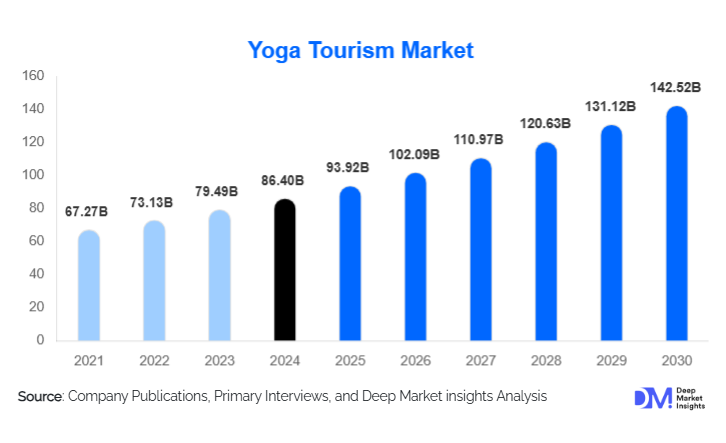
According to Deep Market Insights, the global yoga tourism market size was valued at USD 86.4 billion in 2025 and is projected to grow from USD 93.92 billion in 2026 to reach USD 142.52 billion by 2031, expanding at a CAGR of 8.7% during the forecast period (2026–2031). The yoga tourism market growth is primarily driven by the rising global focus on mental well-being, increasing preference for experiential travel, and rapid expansion of wellness-focused hospitality ecosystems across Asia-Pacific, Europe, and the Americas. The market’s evolution is closely tied to stress-driven lifestyle changes, the influence of wellness influencers, and the global shift toward immersive, nature-centric, and transformational travel experiences.
Key Market Insights
- Yoga tourism is increasingly shifting toward holistic, mindfulness-driven travel experiences, with retreats integrating meditation, Ayurveda, nature therapy, and detox programs.
- Luxury and premium yoga retreats are expanding globally, fueled by affluent travelers seeking personalized and immersive wellness journeys.
- Asia-Pacific dominates the yoga tourism landscape, led by India, Bali (Indonesia), and Thailand as global hubs for immersive yoga retreats and teacher training programs.
- North America remains the strongest outbound region, with U.S. and Canadian travelers forming one of the largest participant bases for international yoga retreats.
- Europe is the fastest-growing outbound region, driven by experiential travel preferences, corporate wellness programs, and cross-border mobility.
- Technology integration, including biometric wellness tracking, AI-personalized itineraries, and VR meditation previews, is reshaping traveler engagement and retreat differentiation.
Yoga Tourism Market Trends
Holistic & Multi-Dimensional Wellness Retreats Rising
Yoga tourism is evolving beyond traditional asana-based programs into comprehensive mind–body healing experiences. Retreats increasingly incorporate Ayurveda, sound healing, breathwork, naturopathy, Reiki, and nature immersion therapies to create holistic transformation journeys. The integration of nutrition counseling, plant-based cuisine, and mindfulness coaching is becoming mainstream. Travelers now seek deeper therapeutic benefits such as stress detoxification, burnout recovery, and emotional rejuvenation. Wellness resorts in India, Bali, Thailand, Mexico, and Costa Rica are pioneering structured healing itineraries that combine yoga with mental reset pathways, elevating the market toward a premium health-oriented travel segment.
Technology-Enhanced Wellness Experiences
Retreat operators are embracing emerging technologies to improve personalization, engagement, and measurable wellness outcomes. VR meditation previews help travelers explore retreat environments before booking, while AI-based wellness assessments curate individualized itineraries based on stress levels, sleep patterns, and biometric feedback. Wearable devices are being integrated into yoga sessions to track breathing efficiency, heart rate variability, and posture correction. Booking platforms now feature sustainability filters, instructor credibility ratings, and real-time program comparisons, boosting trust and transparency in the selection process. Digital communities and app-based post-retreat coaching further strengthen customer retention.
Yoga Tourism Market Drivers
Rising Global Focus on Mental Health & Stress Reduction
Escalating levels of burnout, anxiety, and mental fatigue are pushing travelers toward restorative and wellness-centered experiences. Yoga retreats are perceived as safe, structured environments that offer emotional balance, mindfulness, and therapeutic rejuvenation. Corporate burnout recovery programs and remote-work-induced stress are accelerating this trend, making yoga tourism a mainstream solution for mental well-being.
Shift Toward Experiential & Purpose-Driven Travel
Travelers increasingly seek meaningful experiences that offer lasting value. Yoga tourism aligns perfectly with experiential travel trends—offering immersion, community, self-discovery, and personal renewal. The “experience over material goods” paradigm, particularly strong among millennials and Gen Z, is fueling demand for transformational retreats, meditation camps, and teacher-training journeys.
Influence of Social Media & Wellness Influencers
Instagram, YouTube, and wellness influencers significantly impact travel decisions. Visual storytelling around Bali beaches, Indian ashrams, and Costa Rican jungle retreats inspires millions of travelers to participate in structured yoga programs. Over 70% of yoga travelers report social media as a key decision driver. Influencer-led retreats and branded wellness collaborations are expanding the market’s aspirational appeal and premiumization.
Yoga Tourism Market Restraints
High Seasonality & Weather-Dependent Operations
Yoga tourism relies heavily on seasonal climate patterns. Monsoons in India, extreme heat in the Middle East, and unpredictable weather conditions in tropical destinations restrict year-round activity. This seasonality impacts revenue stability, retreat occupancy, and operational planning for hospitality providers.
Lack of Global Standards & Regulatory Complexity
The absence of uniform global standards for yoga training, retreat accreditation, and safety norms creates inconsistency and trust issues. Visa restrictions for foreign instructors, local licensing hurdles, and regulatory variations across destinations complicate operations for international retreat providers. These challenges can slow expansion and reduce consumer confidence in emerging markets.
Yoga Tourism Market Opportunities
Technology-Integrated Personalized Wellness Journeys
The integration of AI diagnostics, VR meditation rooms, biometric tracking, and digital wellness pathways offers powerful differentiation for retreat operators. Personalized stress-mapping, sleep optimization, and post-retreat coaching programs can attract premium travelers and corporate clients seeking measurable improvements in well-being. Technology-enhanced retreats are likely to become a core competitive advantage.
Corporate Wellness & Stress-Resilience Retreats
As organizations expand mental health budgets, yoga tourism providers can tap into strong demand for corporate offsite retreats, team-building mindfulness sessions, and leadership-focused resilience programs. With corporate wellness investments growing globally, structured yoga-based programs offer scalable opportunities for retreat centers, hotels, and instructors.
Emerging Yoga Destinations in the Middle East, Europe & Latin America
Countries such as Japan, South Korea, the UAE, Saudi Arabia, Portugal, Mexico, and Chile are investing heavily in wellness tourism infrastructure. These regions provide untapped landscapes for new retreat centers, desert yoga escapes, mountain-healing circuits, and wellness resorts. Government incentives, improved air connectivity, and early-mover advantages make expansion into emerging markets a major long-term opportunity.
Report Scope
| Report Metric | Details |
|---|---|
| Market Size in 2025 | USD 86.4 Billion |
| Market Size in 2026 | USD 93.92 Billion |
| Market Size in 2031 | USD 142.52 Billion |
| CAGR | 8.7% (2026-2031) |
| Base Year for Estimation | 2025 |
| Historical Data | 2022-2024 |
| Forecast Period | 2026-2031 |
| Report Coverage | Revenue Forecast, Competitive Landscape, Supply Chain Disruption, Growth Factors, Environment & Regulatory Landscape and Trends |
| Geographies Covered | North America, Europe, APAC, Middle East and Africa, LATAM |
| Countries Covered | U.S., Canada, U.K., Germany, France, Spain, Italy, Russia, Nordic, Benelux, Rest of Europe, China, Korea, Japan, India, Australia, Singapore, Taiwan, South East Asia, Rest of Asia-Pacific, UAE, Turky, Saudi Arabia, South Africa, Egypt, Nigeria, Rest of MEA, Brazil, Mexico, Argentina, Chile, Colombia, Rest of LATAM |
Explore more data points, trends and opportunities Download Free Sample Report
Tourism Type Insights
Yoga retreat tourism dominates the market, accounting for nearly 38% of the global share in 2025. These retreats provide immersive multi-day experiences combining yoga, meditation, nutrition, and nature therapy, making them one of the most commercially viable formats. Mid-range retreats offering 7–14-day programs remain most popular due to affordability and schedule compatibility with global travelers. Luxury yoga retreats are rapidly expanding, offering premium itineraries, boutique accommodations, and wellness concierge services. Hybrid models such as adventure+yoga (surf/yoga, trekking/yoga) and spiritual+yoga programs are gaining traction as travelers seek variety and deeper self-exploration.
Booking Channel Insights
Direct bookings account for 46% of the total market share in 2025, supported by travelers’ preference for personalized communication, instructor interaction, and detailed program information. Enhanced digital presence, interactive websites, and influencer-led marketing further boost direct conversions. OTAs and specialized yoga-travel platforms continue to grow, particularly among first-time travelers, offering curated packages and transparent pricing.
Consumer Segment Insights
Solo female travelers represent the largest consumer group, contributing nearly 34% of total participation. Safety, community, emotional healing, and self-growth are major motivators for this demographic. Millennials and Gen Z travelers are driving demand for adventure-infused yoga retreats and digital detox experiences. Senior travelers (50+) increasingly participate in restorative and therapeutic yoga programs, contributing to steady growth in the premium wellness segment.
Duration Insights
Retreats lasting 8–15 days hold 40% market share, offering the ideal balance between immersive experience and vacation length. Extended stays of 30+ days, particularly for teacher training and deep-learning programs, are rising steadily, driven by spiritual tourism and professional certification demand.
Price Tier Insights
Mid-range retreats (USD 600–2,000 per trip) account for 48% of global market share and appeal to mainstream wellness travelers. Luxury retreats are expanding at the fastest pace, with premium resorts in Bali, India, Mexico, and Thailand offering high-end programs featuring gourmet wellness cuisine, personalized therapists, and concierge meditation planning.
Explore more data points, trends and opportunities Download Free Sample Report
Yoga Tourism Market Segmentations
By Tourism Type
- Yoga Retreat Tourism (Immersive Retreats, Detox Programs)
- Yoga Wellness Tourism (Spa & Wellness + Yoga Packages)
- Yoga Meditation Tourism (Mindfulness, Silence Retreats)
- Adventure + Yoga Tourism (Surf + Yoga, Trek + Yoga)
- Yoga Teacher Training Tourism (200-Hour, 300–500 Hour YTTC)
- Luxury Yoga Tourism (Premium Resort-Based Programs)
By Booking Channel
- Direct Retreat/Resort Bookings
- Online Travel Agencies (OTAs)
- Specialized Yoga Travel Platforms
- Offline Travel Agents
By Consumer Group
- Solo Female Travelers
- Corporate/Group Wellness Travelers
- Millennial Wellness Travelers
- Senior Wellness Travelers (50+)
By Duration Type
- Short Retreats (3–7 Days)
- Medium Retreats (8–15 Days)
- Long Duration Retreats (16–30 Days)
- Extended Yoga Programs (30+ Days)
By Price Tier
- Budget (USD 200–600)
- Mid-Range (USD 600–2,000)
- Premium (USD 2,000–5,000)
- Luxury (USD 5,000+)
Regional Insights
North America
North America represents 26% of the global yoga tourism market, with the U.S. and Canada serving as major outbound contributors. Growing awareness of mental health, corporate burnout solutions, and enthusiasm for experiential travel fuel demand. Domestic retreats in California, Hawaii, Arizona, and Mexico also attract strong participation from wellness-driven travelers.
Europe
Europe holds 24% market share and is one of the fastest-growing outbound segments. The U.K., Germany, France, Italy, and Spain lead participation. European travelers show a strong preference for sustainable retreats, Mediterranean wellness escapes, and long-stay programs in India, Bali, and Greece.
Asia-Pacific
Asia-Pacific dominates the global landscape with a 31% market share and the fastest CAGR of 9.8%. India, Thailand, Indonesia, Sri Lanka, and Vietnam are world-leading yoga hubs offering authentic, cost-effective, and spiritually rooted programs. Bali alone contributes nearly 7% of global yoga traveler volume. Japan and South Korea are emerging with strong domestic interest in mindfulness and wellness escapes.
Latin America
Latin America accounts for 10% market share, led by Costa Rica, Mexico, Peru, and Chile. Costa Rica is the second-largest global yoga tourism destination after India, offering premium eco-retreats and nature-immersive yoga programs. Adventure+yoga hybrids are particularly popular across the region.
Middle East & Africa
The Middle East & Africa hold approximately 9% of the global share. The UAE and Saudi Arabia are investing in high-end wellness tourism diversification, creating opportunities for luxury yoga retreats and desert-wellness circuits. Africa is emerging with safari+yoga hybrids in Kenya, South Africa, and Morocco.
Key Players in the Yoga Tourism Market
- YogaWorks Retreats
- Shambhala Retreats
- Art of Living Retreat Center
- Parmarth Niketan
- Ananda in the Himalayas
- BaliSpirit Retreat
- Yoga Barn Ubud
- Vikasa Yoga Retreat Thailand
- Blue Spirit Costa Rica
- Samahita Retreat
- Gaia Retreat & Spa
- Esalen Institute
- Sivananda Yoga Retreats
- Zen Resort Bali
- Wanderlust Wellness Travel
Recent Developments
- In March 2025, Ananda in the Himalayas launched a biofeedback-driven meditation program integrating wearable technology with Ayurvedic therapies for enhanced personalization.
- In January 2025, Yoga Barn Ubud introduced eco-conscious long-stay packages combining forest therapy, detox programs, and community farming experiences.
- In April 2025, Blue Spirit Costa Rica expanded its luxury oceanfront retreat facilities with new wellness villas and immersive healing circuits.