Yoga and Pilates Socks Market Size
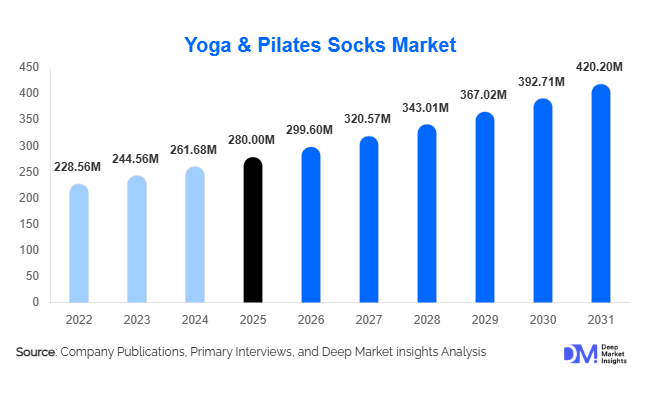
According to Deep Market Insights, the global yoga and Pilates socks market size was valued at USD 280 million in 2025 and is projected to grow from USD 299.60 million in 2026 to reach USD 420.20 million by 2031, expanding at a CAGR of 7% during the forecast period (2026–2031). The market growth is primarily driven by increasing participation in yoga and Pilates activities, rising consumer preference for performance-focused and hygienic footwear, and growing adoption of eco-friendly and technologically enhanced socks for fitness enthusiasts worldwide.
Key Market Insights
- Grip and performance socks are dominating the market, as consumers increasingly seek anti-slip features, ergonomic support, and comfort during studio and home workouts.
- Sustainability and ethical materials are shaping product design, with demand for bamboo, organic cotton, and recycled textiles growing rapidly, especially in North America and Europe.
- Women account for the largest end-user segment, reflecting higher participation in yoga and Pilates and willingness to invest in specialized socks.
- Online retail channels are emerging as the fastest-growing distribution platform, enabling brands to reach consumers directly and support personalized offerings.
- Asia-Pacific is the fastest-growing region, driven by rising urban fitness participation in China, India, and Southeast Asia.
- Technological innovations, including antimicrobial coatings, compression zones, and performance-oriented grips, are differentiating products and attracting premium consumers.
What are the latest trends in the yoga and Pilates socks market?
Performance and Grip-Oriented Socks Leading Demand
Grip socks, featuring anti-slip dots, tread patterns, and toe separation, remain the most popular product type globally. These socks are preferred in Pilates, yoga, and barre studios due to the need for stability and safety during exercises on smooth surfaces. Enhanced cushioning, targeted compression, and ergonomic designs further reinforce their appeal. Trends indicate a shift from simple non-slip socks to premium performance-oriented designs with aesthetic and functional upgrades, driving repeat purchases and loyalty among studio-goers and home practitioners alike.
Sustainable and Eco-Friendly Materials Driving Premiumization
Consumer demand for eco-conscious products is growing, leading to increased use of bamboo fibers, organic cotton, and recycled textiles. Brands are marketing certifications such as GOTS and OEKO-TEX to demonstrate sustainable sourcing. This trend is strongest in North America and Europe, where environmental awareness is high, and is creating opportunities for higher-margin products that combine comfort, performance, and ethical sourcing. Sustainability has become a key differentiator, with eco-friendly socks commanding premium pricing and loyalty from conscious consumers.
What are the key drivers in the yoga and Pilates socks market?
Increasing Participation in Wellness Activities
The global rise in yoga and Pilates participation is a key driver. Urbanization, work-from-home trends, and increasing awareness of mental and physical health are boosting demand for wellness activities. Consumers prefer performance socks that improve balance, provide comfort, and maintain hygiene, especially in shared studio settings. Boutique and chain studio expansions worldwide have reinforced this trend, creating consistent demand for specialized yoga and Pilates socks.
Digital Transformation and E-Commerce Growth
E-commerce platforms have revolutionized the accessibility and purchasing of yoga and Pilates socks. Online retail offers consumers convenience, customization, and direct access to brands. Social media marketing, influencer promotions, and user reviews further encourage online adoption. This digital-first approach has allowed small and niche brands to compete globally, expanding overall market penetration and enabling rapid experimentation with new materials, colors, and designs.
Product Innovation and Functional Features
Advances in materials, grip technology, compression zones, and ergonomic design have positioned yoga and Pilates socks as essential performance accessories. Antimicrobial coatings, breathable mesh, and toe-separation designs improve hygiene and comfort. Technological integration enhances differentiation, enabling brands to offer value beyond basic hosiery. Continuous product innovation is supporting higher adoption rates, particularly in premium segments.
What are the restraints for the global market?
Price Sensitivity in Emerging Markets
Yoga and Pilates socks are often priced at a premium due to specialized materials and grip technology. In developing markets, cost-conscious consumers prefer standard socks over performance options. This price sensitivity can limit market growth in regions with lower per-capita income, slowing adoption despite rising fitness awareness.
Market Fragmentation and Brand Differentiation Challenges
The market is highly fragmented, with numerous small and regional players competing on price. Many products are undifferentiated, creating challenges for new entrants and limiting economies of scale. Without strong brand positioning or technological advantages, small players struggle to compete, which can hinder sustained growth in competitive markets.
What are the key opportunities in the yoga and Pilates socks industry?
Boutique Fitness and Home Exercise Expansion
The proliferation of boutique studios and home fitness platforms provides substantial opportunities. Partnerships between sock brands and studios for branded merchandise, subscriptions, or personalized packs can create recurring revenue streams. Consumers adopting hybrid workout routines increasingly seek performance socks for both studio and home use, expanding total addressable market potential.
Eco-Friendly and Sustainable Products
Brands can leverage sustainability as a key differentiator. The demand for organic cotton, bamboo, and recycled fibers is increasing globally. Certifications, traceability, and marketing around environmental responsibility can attract premium consumers and support higher-margin product lines, particularly in North America and Europe. Sustainability initiatives also align with wellness-conscious audiences, creating stronger brand loyalty.
Tech-Enhanced Socks and Performance Innovation
Integration of smart textiles, compression zones, biomechanical support, and adaptive grips presents high-margin growth opportunities. Such innovations can expand use cases beyond yoga and Pilates, including physical therapy, rehabilitation, and athletic training. Early adoption of these features enables brands to differentiate from competitors and target health-conscious, performance-oriented consumers.
Report Scope
| Report Metric | Details |
|---|---|
| Market Size in 2025 | USD 280 Million |
| Market Size in 2026 | USD 299.60 Million |
| Market Size in 2031 | USD 420.20 Million |
| CAGR | 7% (2026-2031) |
| Base Year for Estimation | 2025 |
| Historical Data | 2022-2024 |
| Forecast Period | 2026-2031 |
| Report Coverage | Revenue Forecast, Competitive Landscape, Supply Chain Disruption, Growth Factors, Environment & Regulatory Landscape and Trends |
| Geographies Covered | North America, Europe, APAC, Middle East and Africa, LATAM |
| Countries Covered | U.S., Canada, U.K., Germany, France, Spain, Italy, Russia, Nordic, Benelux, Rest of Europe, China, Korea, Japan, India, Australia, Singapore, Taiwan, South East Asia, Rest of Asia-Pacific, UAE, Turky, Saudi Arabia, South Africa, Egypt, Nigeria, Rest of MEA, Brazil, Mexico, Argentina, Chile, Colombia, Rest of LATAM |
Explore more data points, trends and opportunities Download Free Sample Report
Product Type Insights
Grip socks dominate the global yoga and Pilates socks market, accounting for approximately 45–50% of total market revenue in 2025. Their leadership is driven by the growing emphasis on stability and injury prevention during workouts performed on smooth studio floors, yoga mats, or reformer machines used in Pilates sessions. Grip socks are equipped with silicone or rubberized anti-slip patterns that enhance traction, making them particularly popular in Pilates studios, barre classes, and hot yoga environments where balance and safety are critical. The rising popularity of boutique fitness studios and instructor-led group sessions has significantly accelerated the demand for grip socks, as many studios recommend or require them for hygiene and safety purposes.
Closed-toe grip socks remain the most widely used format due to their versatility and ability to provide full-foot coverage and comfort. However, open-toe and toe-separation designs are gaining popularity among experienced practitioners who prefer enhanced toe flexibility and improved alignment during yoga poses. Compression and therapeutic yoga socks are also emerging as niche but rapidly expanding segments, especially among consumers engaged in rehabilitation, physiotherapy, and recovery-focused wellness activities. These variants offer targeted arch support, improved circulation, and muscle stabilization, appealing to aging fitness populations and individuals recovering from injuries. Increasing product innovation in grip technology, ergonomic cushioning, and breathable materials is expected to further reinforce the dominance of grip socks within the product type segment.
Material Insights
Cotton and sustainable fiber blends represent the leading material segment, accounting for approximately around 40% of the global market share in 2025. Their leadership is primarily attributed to superior breathability, softness, moisture absorption, and comfort during extended yoga or Pilates sessions. Cotton-based socks are particularly favored in studios where long-duration classes require materials that minimize sweating and skin irritation. Additionally, the increasing consumer preference for eco-friendly and skin-safe fabrics has further strengthened the demand for organic cotton and sustainably sourced blends.
Synthetic fibers such as nylon, spandex, and polyester remain critical for performance-focused socks, as they provide durability, elasticity, and structural integrity required for grip patterns and compression zones. Hybrid material blends combining cotton, elastane, and synthetic fibers are becoming increasingly common, enabling manufacturers to balance comfort, stretchability, and durability while meeting the evolving functional expectations of fitness consumers.
Distribution Channel Insights
Online retail channels dominate the distribution landscape, accounting for approximately 55–60% of total global sales. The rapid expansion of e-commerce platforms, direct-to-consumer brand websites, and online marketplaces has transformed how consumers discover and purchase yoga and Pilates socks. Online platforms allow brands to showcase product features such as grip technology, sustainability credentials, and ergonomic designs through detailed product descriptions, video demonstrations, and user reviews. This digital accessibility has enabled niche and emerging brands to compete effectively with established sportswear companies.
Despite the dominance of online channels, specialty fitness stores and boutique studio retail outlets remain important sales channels. Many yoga and Pilates studios sell branded grip socks directly to customers, often as part of membership packages or class requirements. These locations provide an experiential purchasing environment where consumers can physically assess product comfort and fit. Mass retail chains and sporting goods stores continue to serve the mid-range and entry-level market segments by offering accessible price points and wider geographic reach.
End User Insights
Women represent the largest end-user segment, accounting for approximately 65–70% of global demand. This dominance reflects the historically strong participation of women in yoga, Pilates, barre, and related wellness activities. Female consumers also tend to demonstrate higher spending on specialized fitness apparel and accessories, including grip socks designed for comfort, hygiene, and style. Product aesthetics such as color variety, patterns, and fashion-oriented designs further encourage repeat purchases among this demographic. The men’s segment is gradually expanding, particularly in urban fitness markets where strength-based Pilates, mobility training, and hybrid fitness routines are gaining popularity. Fitness-conscious male consumers are increasingly adopting grip socks for Pilates reformer workouts and functional training sessions that require enhanced traction and stability.
Another emerging segment includes children and youth participants, driven by the growing incorporation of yoga and mindfulness practices in schools, sports academies, and family wellness programs. Parents increasingly view yoga as a beneficial activity for improving flexibility, focus, and overall physical development in children. As a result, youth-oriented product lines featuring comfortable, colorful, and durable socks are gradually expanding. Export-driven demand from countries with well-established studio networks, particularly the United States, Canada, and the United Kingdom, continues to influence global market dynamics, with many specialized brands supplying international fitness studios and online consumers.
Explore more data points, trends and opportunities Download Free Sample Report
Yoga & Pilates Socks Market Segmentations
By Product Type
- Grip Yoga Socks
- Toe Yoga Socks
- Full Toe Grip Socks
- Half Toe Grip Socks
- Compression Yoga & Pilates Socks
By Application
- Yoga
- Pilates
- Barre Workouts
- Dance & Studio Fitness
- Home Fitness & Rehabilitation
By Distribution Channel
- Online Retail
- Sports & Fitness Stores
- Department Stores
- Yoga & Pilates Studios
- Specialty Apparel Stores
Regional Insights
North America
North America remains the largest regional market, accounting for approximately 35–40% of global revenue in 2025. The United States represents the dominant contributor, supported by a highly developed fitness industry, widespread adoption of yoga and Pilates, and strong consumer spending on wellness-related products. The presence of thousands of boutique fitness studios, Pilates reformer centers, and yoga schools across major metropolitan areas has created sustained demand for specialized grip socks.
High awareness of hygiene standards in shared workout environments has further accelerated adoption, as many studios encourage or mandate the use of grip socks for Pilates and barre classes. Additionally, the strong presence of leading athletic apparel brands and premium wellness retailers has helped expand product availability and innovation in the region. Canada also contributes significantly to regional demand, supported by rising interest in holistic wellness, mindfulness practices, and sustainable athletic apparel. The rapid growth of e-commerce and direct-to-consumer fitness brands continues to reinforce North America's market leadership.
Europe
Europe holds approximately 20–25% of the global market share, with key demand centers located in the United Kingdom, Germany, France, Italy, and the Netherlands. The region’s growth is strongly influenced by rising health awareness, the expansion of boutique fitness studios, and increasing interest in mindfulness-based wellness practices. Yoga and Pilates have become integral components of urban fitness lifestyles across European cities.
European consumers place strong emphasis on sustainability and ethical sourcing, which has encouraged the adoption of eco-friendly materials such as organic cotton, bamboo fibers, and recycled textiles. Regulatory frameworks promoting environmentally responsible manufacturing have also encouraged brands to develop sustainable product lines. Furthermore, the growing popularity of hybrid wellness experiences, including yoga retreats, wellness tourism, and corporate mindfulness programs, continues to stimulate demand for specialized yoga accessories, including performance socks.
Asia-Pacific
Asia-Pacific represents the fastest-growing regional market, expanding at an estimated CAGR of 6–7%. Major demand centers include China, India, Japan, South Korea, and Australia. Rapid urbanization, rising disposable income, and increasing awareness of mental and physical health are encouraging more consumers to adopt yoga and Pilates as part of their daily fitness routines.
China has witnessed substantial growth in boutique fitness studios and wellness-focused gyms across major cities such as Beijing, Shanghai, and Shenzhen. Meanwhile, India benefits from its cultural association with yoga, supported by government initiatives promoting yoga globally and domestically. Japan and South Korea are experiencing growing demand for Pilates reformer studios, which often require grip socks for hygiene and safety reasons.
The widespread adoption of digital fitness platforms and online wellness communities in the Asia-Pacific has also contributed to higher product visibility and consumer engagement. E-commerce platforms and mobile shopping applications are making premium yoga accessories more accessible to younger consumers, further accelerating regional market expansion.
Latin America
Latin America accounts for approximately 5–8% of the global market, with Brazil and Mexico representing the largest demand centers. Growing urban populations, rising awareness of fitness and wellness, and the gradual expansion of boutique yoga studios are supporting market growth in the region. Brazil’s vibrant fitness culture and widespread participation in group exercise activities have encouraged the adoption of specialized workout accessories, including grip socks. In Mexico, rising middle-class income levels and increasing exposure to global fitness trends through social media are driving demand for premium yoga products. However, price sensitivity remains a key challenge, which has encouraged the availability of mid-range and affordable product options.
Middle East & Africa
The Middle East & Africa region currently accounts for approximately 3–6% of global demand, but it is gradually emerging as a promising market due to increasing health awareness and government-led wellness initiatives. The United Arab Emirates and Saudi Arabia are among the fastest-growing markets in the region, driven by luxury fitness studios, wellness tourism, and rising interest in yoga and Pilates among expatriate and local populations.
In Africa, South Africa represents the primary market for yoga and Pilates socks, supported by the growing popularity of wellness activities in urban centers such as Johannesburg and Cape Town. Rising demand for breathable and high-performance athletic accessories suited to warm climates is encouraging adoption in the region. Additionally, the gradual expansion of international fitness brands and online retail channels is improving product availability and awareness.
Key Players in the Yoga and Pilates Socks Market
- Adidas AG
- Nike Inc.
- Lululemon Athletica Inc.
- Gaiam Inc.
- Manduka LLC
- ToeSox Inc.
- Bombas LLC
- Great Soles LLC
- Hylaea Inc.
- LA Active LLC
- Tavi Noir LLC
- Pembrook LLC
- Shashi Inc.
- Under Armour Inc.
- YogaPaws Inc.