Writing Instruments Market Size
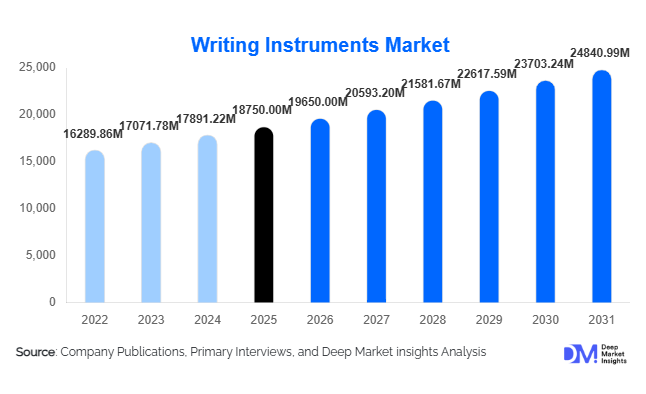
According to Deep Market Insights, the global writing instruments market size was valued at USD 18,750 million in 2025 and is projected to grow from USD 19,650.00 million in 2026 to reach USD 24,840.99 million by 2031, expanding at a CAGR of 4.8% during the forecast period (2026–2031). The market growth is primarily driven by rising global literacy rates, expanding education infrastructure, and consistent demand from corporate and personal use segments. Despite increasing digitalization, writing instruments continue to hold relevance due to their affordability, accessibility, and essential role in academic and professional environments.
Key Market Insights
- Pens dominate the market, accounting for over 60% of global demand, driven by affordability and versatility across end users.
- Asia-Pacific leads the global market, supported by a large student population and a strong manufacturing base.
- Eco-friendly writing instruments are gaining traction, driven by sustainability regulations and consumer awareness.
- Premium and luxury segments are expanding, particularly in developed markets, due to gifting and branding trends.
- Offline retail continues to dominate, although e-commerce channels are steadily gaining share.
- Hybrid digital writing tools such as stylus pens are emerging as a key innovation area.
What are the latest trends in the writing instruments market?
Shift Toward Sustainable Writing Solutions
The market is witnessing a growing shift toward environmentally sustainable products. Manufacturers are increasingly adopting biodegradable materials, recycled plastics, and refillable designs to reduce environmental impact. Regulatory pressure in regions such as Europe is accelerating this trend, pushing companies to innovate in eco-friendly product lines. Consumers, especially younger demographics, are favoring brands that align with sustainability goals, prompting companies to invest in green certifications and sustainable packaging. This trend is expected to reshape product development strategies and influence purchasing decisions globally.
Premiumization and Lifestyle Positioning
Writing instruments are increasingly being positioned as lifestyle and gifting products, particularly in developed markets. Premium pens, including luxury fountain pens and designer collections, are gaining popularity among professionals and collectors. Brands are focusing on aesthetics, craftsmanship, and brand heritage to differentiate their offerings. Corporate gifting and executive branding are also contributing to demand in this segment, allowing manufacturers to achieve higher margins compared to mass-market products.
What are the key drivers in the writing instruments market?
Expansion of Global Education Infrastructure
The steady growth of the global student population and increasing investments in education infrastructure are major drivers of market demand. Governments in emerging economies are prioritizing literacy and school enrollment, leading to sustained consumption of basic writing tools such as pens and pencils. This demand is particularly strong in Asia-Pacific and Africa, where population growth and policy support are driving educational expansion.
Growth in Corporate and Office Activities
The expansion of office-based work environments, especially in emerging markets, continues to drive demand for writing instruments. Despite digital transformation, writing tools remain essential for documentation, note-taking, and administrative functions. The rise of small and medium enterprises further contributes to consistent demand across corporate sectors.
What are the restraints for the global market?
Increasing Digital Substitution
The growing adoption of digital devices such as tablets, laptops, and smartphones is reducing reliance on traditional writing tools. Digital note-taking applications and cloud-based documentation systems are replacing paper-based processes, particularly in developed economies. This trend poses a long-term challenge to volume growth in the market.
Volatility in Raw Material Prices
Fluctuations in the prices of key raw materials such as plastics and metals impact manufacturing costs and profit margins. Price sensitivity in the economy segment limits the ability of manufacturers to pass on cost increases to consumers, creating margin pressures across the industry.
What are the key opportunities in the writing instruments industry?
Growth in Eco-Friendly Product Segments
The increasing focus on sustainability presents a significant opportunity for manufacturers to develop eco-friendly writing instruments. Products made from recycled materials, bamboo, and biodegradable plastics are gaining acceptance, particularly in environmentally conscious markets. Companies that invest in sustainable innovation are likely to gain a competitive edge.
Expansion in Emerging Markets
Emerging economies such as India, Indonesia, and Brazil offer strong growth potential due to rising literacy rates and expanding middle-class populations. Increasing school enrollment and government investments in education infrastructure are driving demand for affordable writing tools. Local manufacturing and distribution strategies can help companies tap into these high-growth regions effectively.
Report Scope
| Report Metric | Details |
|---|---|
| Market Size in 2025 | USD 18750 Million |
| Market Size in 2026 | USD 19650 Million |
| Market Size in 2031 | USD 24840.99 Million |
| CAGR | 4.8% (2026-2031) |
| Base Year for Estimation | 2025 |
| Historical Data | 2022-2024 |
| Forecast Period | 2026-2031 |
| Report Coverage | Revenue Forecast, Competitive Landscape, Supply Chain Disruption, Growth Factors, Environment & Regulatory Landscape and Trends |
| Geographies Covered | North America, Europe, APAC, Middle East and Africa, LATAM |
| Countries Covered | U.S., Canada, U.K., Germany, France, Spain, Italy, Russia, Nordic, Benelux, Rest of Europe, China, Korea, Japan, India, Australia, Singapore, Taiwan, South East Asia, Rest of Asia-Pacific, UAE, Turky, Saudi Arabia, South Africa, Egypt, Nigeria, Rest of MEA, Brazil, Mexico, Argentina, Chile, Colombia, Rest of LATAM |
Explore more data points, trends and opportunities Download Free Sample Report
Product Type Insights
Pens continue to dominate the global writing instruments market, accounting for approximately 62% of total revenue in 2025. This dominance is largely driven by the affordability, durability, and widespread accessibility of ballpoint pens, making them a staple across educational, corporate, and personal use segments. Gel and rollerball pens are experiencing rising adoption due to their smooth writing experience and ergonomic designs, appealing particularly to students, professionals, and creative users seeking enhanced writing comfort. Pencils, including wooden and mechanical variants, remain essential in educational and artistic applications, supported by government initiatives promoting literacy and creative programs in schools. Markers, highlighters, and specialty pens are witnessing steady growth in offices, design studios, and art industries, driven by increasing professional and creative use cases. Overall, product innovation, ergonomic designs, and hybrid pen formats like stylus-integrated pens are key drivers sustaining growth in the pens segment globally.
Application Insights
The education sector is the largest end-use segment in the writing instruments market, contributing nearly 48% of global demand. Growth in this segment is propelled by rising literacy rates, expanding school enrollment, and governmental investments in education infrastructure across developing regions. The corporate sector is another significant contributor, with demand driven by office usage, branding initiatives, and premium gifting practices. Household and personal use remains stable, supported by everyday writing needs and a growing preference for designer pens in urban markets. The art and design segment is emerging as a high-growth niche, fueled by increasing adoption of specialized writing tools such as colored pencils, markers, and drawing pens. Additionally, digital stylus pens are gaining traction as hybrid tools, bridging traditional writing with digital applications, particularly in professional and creative domains. Overall, education continues to drive volume, while corporate and creative applications support higher-value segments and premiumization trends.
Distribution Channel Insights
Offline retail remains the dominant distribution channel, accounting for around 68% of global sales. Accessibility of stationery stores, bulk purchasing for schools, and established supply chains contribute to the continued strength of this channel. However, online retail is rapidly expanding due to increasing consumer preference for convenience, competitive pricing, and the ability to access a broader product assortment. E-commerce platforms, brand-owned websites, and online marketplaces are becoming essential channels, particularly in urban and digitally connected regions. Hybrid models combining online and offline strategies, such as click-and-collect and subscription-based pen clubs, are further enhancing distribution reach and customer engagement.
Explore more data points, trends and opportunities Download Free Sample Report
Writing Instruments Market Segmentations
By Product Type
- Pens
- Pencils
- Other Writing Tools
By Application
- Education
- Corporate & Office Use
- Household / Personal Use
- Art & Design Professionals
By Distribution Channel
- Offline Retail
- Online Retail
By End-User
- Educational Institutions
- Corporate & Office Use
- Household/Personal Use
- Art & Design Professionals
By Material Type
- Plastic-based Writing Instruments
- Metal-based Writing Instruments
- Sustainable/Eco-friendly Materials
Regional Insights
Asia-Pacific
Asia-Pacific holds the largest share of the writing instruments market at approximately 42% in 2025. Key countries such as China and India drive demand, supported by large student populations, growing literacy initiatives, and a robust manufacturing ecosystem. Government programs to improve education access, including school infrastructure expansion and the supply of writing tools, act as strong demand catalysts. Urbanization and rising middle-class income levels are increasing household and corporate consumption of premium and eco-friendly products. The region’s manufacturing dominance also supports export-driven growth, making Asia-Pacific both a leading consumption and production hub. Additionally, the rising popularity of hybrid digital writing tools in urban centers is driving adoption in professional and creative applications.
North America
North America accounts for around 21% of the global market, with the United States contributing the largest share. Market growth is driven by strong demand for premium and eco-friendly writing instruments, with consumers willing to pay higher prices for sustainable, designer, or technologically integrated products. Corporate and office use is a major driver, alongside educational institutions and homeschooling initiatives. Technological adoption, including stylus-integrated pens for digital learning, supports demand. High disposable incomes, preference for branded and ergonomic products, and increasing awareness of sustainability in office and educational supplies are the main drivers of growth in this region.
Europe
Europe represents approximately 19% of the market, led by Germany, France, and the UK. Regional growth is strongly driven by the adoption of sustainable writing instruments and premium products. Environmental regulations encouraging the reduction of single-use plastics, along with consumer preference for eco-friendly and refillable products, support market expansion. High literacy rates, long-standing educational frameworks, and a culture of premium gifting contribute to steady growth. Corporate adoption of designer pens and emphasis on office ergonomics also fuel demand in Western Europe, while innovation in pen design and hybrid digital tools drives adoption among professionals and students.
Latin America
Latin America accounts for around 9% of global demand, with Brazil and Mexico as key markets. Market growth is driven by increasing literacy rates, expanding access to education, and government programs supplying schools with writing instruments. Urbanization and rising middle-class income levels are supporting demand for mid-range and premium pens. Corporate usage, particularly in office supplies and branding programs, is growing steadily. Additionally, the younger demographic is driving the adoption of specialized markers and art tools, contributing to incremental growth in niche categories within the region.
Middle East & Africa
The Middle East & Africa region holds approximately 9% share, with Africa representing the fastest-growing sub-region, exhibiting growth exceeding 6% CAGR. Demand is driven by rising literacy rates, expanding school enrollment, and government initiatives to improve educational infrastructure. Population growth, urbanization, and increasing disposable incomes support higher consumption of both economy and premium writing instruments. In the Middle East, countries like the UAE, Saudi Arabia, and Qatar are contributing to growth through strong demand for premium, designer, and eco-friendly products in corporate, educational, and household segments. Government incentives for local manufacturing and educational supply programs further reinforce growth, while regional professional and creative sectors are driving demand for specialized markers, highlighters, and stylus pens.
Key Players in the Writing Instruments Market
- BIC Group
- Pilot Corporation
- Newell Brands
- Faber-Castell
- STAEDTLER
- Mitsubishi Pencil Co.
- Zebra Co., Ltd.
- Lamy GmbH
- Montblanc
- Luxor Writing Instruments
- Cello Pens
- Monami Co., Ltd.
- Maped Group
- Kokuyo Co., Ltd.
- Reynolds Pens