Wrist Watch Market Size
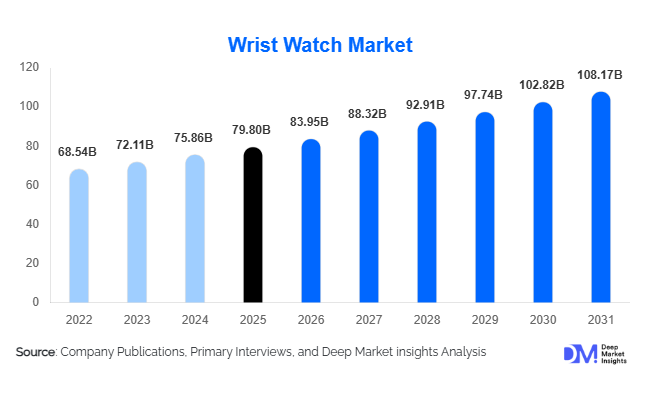
According to Deep Market Insights, the global wrist watch market size was valued at USD 79.8 billion in 2025 and is projected to grow from USD 83.95 billion in 2026 to reach USD 108.17 billion by 2031, expanding at a CAGR of 5.2% during the forecast period (2026–2031). The wrist watch market growth is primarily driven by rising global demand for luxury timepieces, increasing penetration of smartwatches and connected wearables, growing disposable incomes in emerging economies, and the expanding role of watches as fashion accessories, health-monitoring devices, and investment assets.
The industry is undergoing a significant transformation as traditional watchmakers and technology companies compete across evolving consumer preferences. Luxury Swiss watch manufacturers continue to dominate premium mechanical categories through craftsmanship, exclusivity, and heritage branding, while smart wearable manufacturers are accelerating innovation through AI-enabled health tracking, ECG monitoring, GPS integration, and contactless payment technologies. Consumers are increasingly seeking multifunctional devices that combine fashion, personalization, connectivity, and wellness capabilities.
Asia-Pacific remains the largest regional market due to strong demand from China, Japan, India, and South Korea, while North America leads smartwatch adoption globally. Europe continues to dominate luxury mechanical watch exports led by Switzerland, Germany, and France. The growing popularity of certified pre-owned luxury watches, omnichannel retailing, sustainable manufacturing, and direct-to-consumer business models is reshaping the competitive landscape. Furthermore, the integration of AI analytics, advanced sensors, sustainable materials, and premium customization options is expected to continue supporting long-term wrist watch market expansion globally.
Key Market Insights
- Smartwatches are increasingly transforming the wrist watch industry, with consumers prioritizing health monitoring, connectivity, AI integration, and multifunctional wearable ecosystems.
- Luxury mechanical watches continue experiencing strong demand globally, driven by affluent consumers, collector culture, and rising interest in watches as investment assets.
- Asia-Pacific dominates the global wrist watch market, led by China, Japan, India, and South Korea due to expanding middle-class spending and rapid digital adoption.
- North America leads smartwatch adoption globally, supported by high consumer spending, strong wearable technology penetration, and integrated digital ecosystems.
- Europe remains the center of luxury mechanical watch manufacturing, with Switzerland continuing to dominate premium exports and heritage craftsmanship.
- Online retail and omnichannel distribution are reshaping consumer purchasing behavior, particularly among younger demographics seeking convenience, customization, and direct-to-consumer experiences.
- Sustainability and ethical sourcing initiatives are becoming critical differentiators, encouraging brands to adopt recyclable materials, solar-powered movements, and carbon-neutral production practices.
Wrist Watch Market Trends
Growing Demand for Smart Health Monitoring Watches
The wrist watch market is witnessing rapid adoption of smartwatches integrated with advanced health-monitoring technologies. Consumers increasingly demand wearable devices capable of monitoring heart rate variability, ECG, blood oxygen levels, sleep quality, stress indicators, and fitness performance. Smartwatches are evolving from communication accessories into personalized wellness ecosystems that support preventive healthcare and remote monitoring. Technology companies are investing heavily in AI-enabled biometric analytics and cloud-based health integration to enhance user engagement and recurring ecosystem revenue.
Healthcare providers and insurers are also beginning to integrate wearable health data into wellness programs and digital healthcare initiatives. This trend is especially strong in North America, China, Japan, and Western Europe where healthcare digitization is advancing rapidly. Continuous improvements in battery life, sensor accuracy, and miniaturized electronics are expected to further accelerate smartwatch adoption globally.
Luxury Watch Premiumization and Collectible Culture
The luxury watch segment is increasingly benefiting from premiumization and collectible investment trends. High-net-worth individuals and younger affluent consumers are purchasing luxury mechanical watches not only as status symbols but also as appreciating alternative assets. Limited-edition launches, heritage craftsmanship, and scarcity-driven pricing strategies are enabling luxury brands to maintain strong pricing power despite macroeconomic volatility.
The expansion of certified pre-owned luxury watch platforms is also reshaping industry dynamics by increasing secondary market liquidity and accessibility. Consumers are increasingly participating in watch trading, auctions, and collectible investment markets, particularly for premium Swiss brands. Social media influence, celebrity endorsements, and digital luxury communities are further fueling demand for ultra-premium and limited-production watches globally.
Wrist Watch Market Drivers
Expansion of Connected Wearable Ecosystems
The rapid growth of connected wearable ecosystems is a major driver for the wrist watch market. Smartwatches are increasingly integrated with smartphones, healthcare platforms, fitness applications, payment systems, and AI-powered virtual assistants. Consumers are demanding multifunctional devices capable of delivering productivity, communication, navigation, entertainment, and wellness capabilities within a single wearable device.
Technology leaders are continuously enhancing smartwatch functionality through software updates, advanced chipsets, AI integration, and cloud synchronization. Rising smartphone penetration and increasing consumer dependence on connected devices continue supporting long-term smartwatch demand globally.
Rising Global Luxury Consumption
The growing population of affluent consumers and high-net-worth individuals is accelerating luxury watch demand globally. Luxury watches remain powerful symbols of prestige, craftsmanship, and exclusivity. Swiss watch exports continue to perform strongly due to rising premium demand across China, India, the Middle East, and Southeast Asia.
Younger consumers are increasingly entering the luxury market earlier through aspirational purchases and investment-oriented buying behavior. The expansion of luxury retail boutiques, personalized shopping experiences, and limited-edition product launches is further strengthening demand for premium timepieces.
E-Commerce and Omnichannel Retail Expansion
The rapid growth of e-commerce and omnichannel retailing is significantly supporting wrist watch market expansion. Consumers increasingly prefer online purchasing due to pricing transparency, wider product availability, virtual try-on technologies, and direct brand engagement. Luxury brands are also strengthening direct-to-consumer strategies to improve margins and customer retention.
Social media marketing, influencer collaborations, and digital advertising campaigns are reshaping consumer purchasing decisions, particularly among Millennials and Gen Z consumers. Online platforms are additionally improving access to certified pre-owned luxury watches, broadening the overall addressable market.
Wrist Watch Market Restraints
Counterfeit and Grey Market Challenges
The global wrist watch industry continues to face significant challenges from counterfeit products and unauthorized grey market distribution channels. Counterfeit luxury watches negatively impact brand reputation, pricing integrity, and consumer trust, particularly across online retail platforms and emerging markets. Premium brands continue investing heavily in blockchain authentication, serialized tracking, and digital certification technologies to combat counterfeiting.
Grey market distribution also creates pricing inconsistencies that weaken authorized retailer networks and reduce profit margins for luxury manufacturers. Maintaining exclusivity and brand control remains a major operational challenge across premium categories.
Raw Material and Semiconductor Price Volatility
Fluctuations in raw material prices continue creating cost pressures across the wrist watch supply chain. Gold, platinum, titanium, sapphire crystal, lithium batteries, and semiconductor components have experienced pricing volatility due to geopolitical tensions, supply chain disruptions, and inflationary pressures.
Smartwatch manufacturers are additionally exposed to semiconductor shortages and rising electronic component costs, while luxury watchmakers face increasing precious metal procurement expenses. These factors can pressure manufacturing margins and limit pricing flexibility, particularly within mid-range product categories.
Wrist Watch Market Opportunities
AI-Integrated Smartwatch Innovation
The growing adoption of AI-powered wearable devices presents substantial opportunities for smartwatch manufacturers and technology companies. AI-enabled smartwatches capable of predictive health analytics, personalized fitness coaching, voice interaction, and contextual recommendations are expected to become mainstream over the next decade.
Integration with telemedicine, insurance wellness programs, and digital healthcare ecosystems could significantly expand smartwatch applications beyond consumer electronics. Companies investing in advanced sensors, machine learning, and healthcare partnerships are likely to gain competitive advantages within the wearable segment.
Emerging Market Expansion
Rapid urbanization and rising disposable incomes across India, Indonesia, Vietnam, Brazil, Mexico, and the Middle East present major growth opportunities for the wrist watch industry. Expanding middle-class populations are increasingly purchasing branded watches, luxury accessories, and connected wearables.
Government initiatives such as “Make in India” and regional electronics manufacturing incentives are encouraging local assembly and production investments. E-commerce growth in emerging markets is also enabling international watch brands to scale distribution efficiently without relying entirely on physical retail infrastructure.
Sustainable and Ethical Watch Manufacturing
Sustainability-focused product innovation is emerging as a key opportunity across both luxury and smartwatch categories. Consumers increasingly prefer watches manufactured using recycled materials, ethical sourcing practices, carbon-neutral production, and renewable energy-powered manufacturing facilities.
Solar-powered watches, biodegradable packaging, vegan leather straps, and recycled stainless steel are becoming increasingly popular among environmentally conscious consumers. Brands that successfully integrate sustainability into product positioning and supply chain transparency are expected to strengthen long-term customer loyalty.
Report Scope
| Report Metric | Details |
|---|---|
| Market Size in 2025 | USD 79.8 Billion |
| Market Size in 2026 | USD 83.95 Billion |
| Market Size in 2031 | USD 108.17 Billion |
| CAGR | 5.2% (2026-2031) |
| Base Year for Estimation | 2025 |
| Historical Data | 2022-2024 |
| Forecast Period | 2026-2031 |
| Report Coverage | Revenue Forecast, Competitive Landscape, Supply Chain Disruption, Growth Factors, Environment & Regulatory Landscape and Trends |
| Geographies Covered | North America, Europe, APAC, Middle East and Africa, LATAM |
| Countries Covered | U.S., Canada, U.K., Germany, France, Spain, Italy, Russia, Nordic, Benelux, Rest of Europe, China, Korea, Japan, India, Australia, Singapore, Taiwan, South East Asia, Rest of Asia-Pacific, UAE, Turky, Saudi Arabia, South Africa, Egypt, Nigeria, Rest of MEA, Brazil, Mexico, Argentina, Chile, Colombia, Rest of LATAM |
Explore more data points, trends and opportunities Download Free Sample Report
Product Type Insights
Analog watches continue dominating the global wrist watch market, accounting for nearly 52% of total revenue in 2025 due to their timeless design appeal, luxury positioning, and strong consumer preference for traditional craftsmanship. Mechanical luxury watches remain particularly popular among collectors and affluent consumers seeking exclusivity and long-term investment value. Smartwatches represent the fastest-growing product category, supported by increasing demand for health monitoring, connectivity, and wearable digital ecosystems. Sports watches and rugged outdoor watches are also experiencing strong growth due to rising participation in fitness, adventure tourism, and outdoor recreational activities globally. Hybrid watches that combine traditional analog aesthetics with smart functionalities are emerging as a niche category appealing to consumers seeking both classic styling and connected features.
Movement Type Insights
Quartz movement watches account for approximately 65% of global unit sales due to affordability, durability, accuracy, and low maintenance requirements. These watches remain highly popular in mass-market and fashion-oriented categories across Asia-Pacific and Latin America. Mechanical watches continue dominating premium and luxury segments where craftsmanship, heritage, and exclusivity are critical purchasing factors. Automatic watches are experiencing increasing demand among collectors and high-income consumers due to their engineering sophistication and investment appeal. Solar-powered and kinetic movement watches are also gaining traction as sustainability and energy efficiency become increasingly important purchasing considerations among environmentally conscious consumers.
Distribution Channel Insights
Offline retail channels continue accounting for the majority of wrist watch sales globally, contributing nearly 62% of total market revenue in 2025. Brand boutiques, department stores, specialty watch retailers, and luxury shopping destinations remain critical for experiential purchasing, particularly within premium and luxury categories. Consumers purchasing high-value watches often prefer in-store consultations, personalized services, and physical product authentication before purchase.
Online retail channels, however, are the fastest-growing distribution segment due to rising e-commerce adoption and changing consumer purchasing behavior. Brand-owned websites, e-commerce marketplaces, and certified pre-owned luxury watch platforms are expanding rapidly. Virtual try-on technologies, AI-based personalization, and direct-to-consumer digital marketing strategies are significantly improving online conversion rates globally.
End User Insights
Men’s watches continue representing the largest end-user segment, accounting for nearly 58% of global market revenue in 2025. Demand is primarily driven by luxury mechanical watches, sports watches, and collectible timepieces targeted toward affluent male consumers. Men’s luxury watch ownership continues benefiting from strong gifting culture, corporate purchasing, and status-driven consumption patterns.
Women’s watches are witnessing strong growth globally, particularly within fashion-oriented luxury categories and jewelry-inspired designs. Smartwatches targeted toward women are also expanding rapidly due to increasing adoption of health and wellness tracking features. The unisex category is growing steadily as minimalist designs and lifestyle-oriented wearable devices become increasingly mainstream among younger consumers.
Application Insights
Luxury and status-symbol applications account for nearly 34% of total wrist watch market revenue globally, particularly within Swiss luxury mechanical segments. Consumers increasingly view luxury watches as symbols of success, personal identity, and collectible investment assets. Premium gifting demand also remains a significant contributor to luxury watch sales across Asia-Pacific and the Middle East.
Sports and fitness applications are among the fastest-growing segments due to rising smartwatch penetration and increasing health awareness globally. GPS-enabled sports watches, diving watches, and rugged outdoor smartwatches are gaining popularity among athletes, adventure travelers, and fitness enthusiasts. Medical and healthcare applications are also emerging rapidly as smartwatches increasingly support remote patient monitoring, wellness tracking, and preventive healthcare initiatives.
Explore more data points, trends and opportunities Download Free Sample Report
Wrist Watch Market Segmentations
By Product Type
- Traditional Analog Watches
- Mechanical Watches
- Digital Watches
- Smartwatches
- Hybrid Watches
- Luxury Watches
- Sports & Adventure Watches
By Movement Type
- Quartz Movement Watches
- Mechanical Movement Watches
- Electronic/Digital Movement
- Solar-Powered Watches
- Kinetic Energy Watches
- Smart OS-Based Movement Watches
By Distribution Channel
- Offline Retail
- Online Retail
- Omnichannel Retail
By End User
- Men
- Women
- Unisex
- Kids
By Application
- Fashion & Lifestyle
- Luxury & Status Symbol
- Fitness & Sports Tracking
- Healthcare & Medical Monitoring
- Outdoor & Adventure Use
- Professional & Industrial Use
- Collectibles & Investment
Regional Insights
North America
North America accounted for approximately 23% of the global wrist watch market in 2025, led primarily by the United States. The region dominates smartwatch adoption globally due to strong consumer purchasing power, advanced digital infrastructure, and high penetration of connected wearable ecosystems. American consumers increasingly prefer multifunctional smartwatches offering fitness tracking, mobile payments, AI integration, and healthcare applications. Luxury watch demand also remains strong across the U.S. and Canada, supported by affluent consumers and established luxury retail infrastructure.
Europe
Europe represented nearly 29% of global market revenue in 2025 and remains the global center for luxury mechanical watch manufacturing. Switzerland dominates premium watch exports globally through internationally recognized luxury brands and heritage craftsmanship. Germany continues gaining traction within precision-engineered luxury segments, while France and Italy contribute strongly through fashion luxury watch demand. European consumers increasingly prioritize sustainability, craftsmanship, and exclusivity, supporting premium mechanical watch growth across the region.
Asia-Pacific
Asia-Pacific remains the largest regional market, accounting for nearly 38% of global wrist watch revenue in 2025. China continues dominating regional demand due to rising luxury consumption, expanding middle-class spending, and increasing smartwatch penetration. India is among the fastest-growing markets globally, supported by rising urbanization, growing digital retail infrastructure, and increasing consumer interest in branded watches. Japan remains a major manufacturing hub for quartz and premium electronic watches, while South Korea contributes strongly through smartwatch innovation and wearable technology adoption.
Latin America
Latin America is experiencing gradual growth in wrist watch demand, led by Brazil and Mexico. Rising middle-class populations, increasing smartphone adoption, and expanding e-commerce penetration are supporting smartwatch and fashion watch sales across the region. Luxury watch demand is also increasing among affluent consumers in major urban centers. Brazil remains one of the fastest-growing luxury watch markets in Latin America due to growing premium consumer spending and expanding luxury retail networks.
Middle East & Africa
The Middle East & Africa region is witnessing increasing demand for premium and luxury watches, particularly across UAE and Saudi Arabia. High-income consumers, tourism-driven retail, and luxury shopping destinations continue supporting strong watch imports across the Gulf region. Dubai remains a major global hub for luxury watch retail and re-export activity. South Africa additionally contributes to regional demand through growing luxury retail infrastructure and increasing smartwatch adoption among urban consumers.
Key Players in the Wrist Watch Market
- Apple Inc.
- Rolex SA
- The Swatch Group Ltd.
- Compagnie Financière Richemont SA
- Seiko Group Corporation
- Citizen Watch Co., Ltd.
- Casio Computer Co., Ltd.
- Fossil Group Inc.
- LVMH Moët Hennessy Louis Vuitton
- Samsung Electronics Co., Ltd.
- Garmin Ltd.
- Huawei Technologies Co., Ltd.
- Titan Company Limited
- Movado Group Inc.
- Audemars Piguet Holding SA