Wood Pellet Stoves Market Size
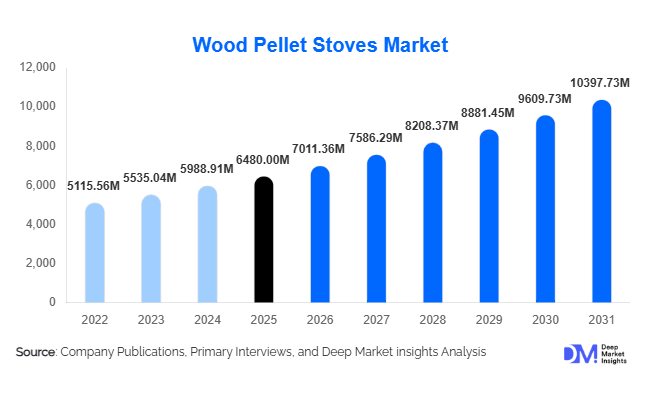
According to Deep Market Insights, the global wood pellet stoves market size was valued at USD 6,480 million in 2025 and is projected to grow from USD 7,011.36 million in 2026 to reach USD 10,397.73 million by 2031, expanding at a CAGR of 8.2% during the forecast period (2026–2031). The market growth is primarily driven by rising demand for low-emission residential heating systems, increasing adoption of renewable biomass energy, and growing government incentives promoting carbon-neutral heating alternatives across Europe and North America.
Wood pellet stoves are increasingly being adopted as an efficient and sustainable alternative to conventional fossil-fuel-based heating systems. These systems utilize compressed biomass pellets derived from wood waste and forestry residues, offering high thermal efficiency and reduced greenhouse gas emissions. The market is witnessing strong momentum due to energy price volatility, stricter environmental regulations, and rising consumer preference for smart and automated heating solutions. Europe continues to dominate global demand, supported by stringent emission norms and strong subsidy frameworks, while North America maintains steady growth driven by residential retrofitting and off-grid heating needs. Meanwhile, Asia-Pacific is emerging as the fastest-growing region due to increasing renewable energy adoption and expanding rural heating requirements. Technological advancements such as IoT-enabled pellet stoves, automated fuel feeding systems, and low-emission combustion technologies are further enhancing market penetration across both residential and commercial sectors.
Key Market Insights
- Freestanding pellet stoves dominate global demand, driven by easy installation and strong residential adoption across developed markets.
- Fully automatic and smart-connected stoves are the fastest-growing segment, supported by rising smart home integration.
- Europe leads global consumption due to strong environmental regulations and biomass heating incentives.
- Residential applications account for the majority share, with increasing adoption in single-family homes and off-grid properties.
- Low-emission certified systems are gaining traction due to tightening government emission standards globally.
- Specialty heating retailers and HVAC installers remain key distribution channels due to the technical nature of installations.
Wood Pellet Stoves Market Trends
Smart Heating and Digital Integration
The integration of IoT and smart home technologies is transforming the wood pellet stoves market. Consumers are increasingly adopting Wi-Fi-enabled stoves with remote monitoring, programmable thermostats, and automated combustion control systems. These features enhance convenience, improve energy efficiency, and reduce maintenance requirements. Manufacturers are also integrating predictive maintenance systems and mobile app-based controls, allowing users to optimize fuel consumption and heating performance in real time.
Shift Toward Low-Emission and Certified Systems
Strict environmental regulations in Europe and North America are accelerating demand for certified low-emission pellet stoves. Governments are implementing stringent air quality standards, pushing manufacturers to develop advanced combustion technologies that minimize particulate emissions. This trend is also encouraging innovation in catalytic combustion systems and high-efficiency burners, improving overall sustainability performance across the industry.
Wood Pellet Stoves Market Drivers
Rising Demand for Energy-Efficient Heating
Increasing energy costs and volatility in fossil fuel prices are driving consumers toward cost-efficient heating alternatives. Wood pellet stoves offer lower long-term operating costs compared to traditional electric and gas heating systems, making them an attractive option for residential users. Growing energy independence concerns, particularly in Europe, further strengthen adoption rates.
Government Incentives and Environmental Regulations
Supportive government policies promoting renewable heating systems are a major growth driver. Subsidies, tax credits, and clean energy grants are encouraging households and businesses to adopt biomass-based heating solutions. Regulatory pressure to reduce carbon emissions is also pushing the replacement of conventional heating systems with pellet-based technologies.
Technological Advancements in Heating Systems
Continuous innovation in combustion efficiency, automation, and smart controls is significantly improving product performance. Modern pellet stoves now offer higher efficiency levels, automated fuel feeding, and integrated digital controls, making them more user-friendly and cost-effective. These advancements are expanding adoption in both urban and rural markets.
Wood Pellet Stoves Market Restraints
High Initial Installation and Equipment Costs
The relatively high upfront cost of pellet stove systems remains a key barrier to adoption. Advanced models with smart features and hydro integration require significant investment, making them less accessible to price-sensitive consumers. Installation complexity and maintenance requirements further add to total ownership costs.
Dependence on Pellet Fuel Supply Chain
The market is highly dependent on stable pellet fuel availability. Disruptions in supply chains, seasonal demand fluctuations, and raw material shortages can lead to price volatility, impacting consumer confidence. In regions with underdeveloped biomass infrastructure, adoption remains limited due to inconsistent fuel accessibility.
Wood Pellet Stoves Market Opportunities
Expansion in Emerging Economies
Emerging markets in Asia-Pacific, Latin America, and Eastern Europe present significant growth opportunities. Rising energy demand, increasing rural electrification challenges, and growing awareness of renewable heating solutions are driving adoption. Governments in these regions are also investing in biomass energy infrastructure, creating favorable market conditions.
Growth in Commercial and Institutional Heating
The adoption of pellet stoves in commercial spaces such as hotels, schools, warehouses, and healthcare facilities is expanding. Organizations are increasingly focused on reducing operational energy costs and achieving sustainability targets. Hydro pellet systems and centralized heating solutions are gaining traction in these applications.
Integration with Green Building Initiatives
The rise of sustainable construction and green building certifications is creating long-term opportunities for pellet stove manufacturers. Developers are integrating renewable heating systems into eco-friendly residential and commercial projects, increasing demand for energy-efficient and low-emission heating technologies.
Report Scope
| Report Metric | Details |
|---|---|
| Market Size in 2025 | USD 6480 Million |
| Market Size in 2026 | USD 7011.36 Million |
| Market Size in 2031 | USD 10397.73 Million |
| CAGR | 8.2% (2026-2031) |
| Base Year for Estimation | 2025 |
| Historical Data | 2022-2024 |
| Forecast Period | 2026-2031 |
| Report Coverage | Revenue Forecast, Competitive Landscape, Supply Chain Disruption, Growth Factors, Environment & Regulatory Landscape and Trends |
| Geographies Covered | North America, Europe, APAC, Middle East and Africa, LATAM |
| Countries Covered | U.S., Canada, U.K., Germany, France, Spain, Italy, Russia, Nordic, Benelux, Rest of Europe, China, Korea, Japan, India, Australia, Singapore, Taiwan, South East Asia, Rest of Asia-Pacific, UAE, Turky, Saudi Arabia, South Africa, Egypt, Nigeria, Rest of MEA, Brazil, Mexico, Argentina, Chile, Colombia, Rest of LATAM |
Explore more data points, trends and opportunities Download Free Sample Report
Product Type Insights
Freestanding pellet stoves continue to dominate the global market, accounting for approximately 41% of total revenue in 2025. Their leadership is primarily driven by ease of installation, lower upfront complexity compared to integrated heating systems, and strong suitability for residential retrofitting across both urban and rural households. These systems require minimal structural modification, making them highly attractive in mature housing markets such as North America and Europe, where renovation-driven heating upgrades are common. Additionally, rising demand for compact, aesthetically designed heating appliances that complement modern interiors has further strengthened adoption in this category.
Fully automatic pellet stoves represent the fastest-growing product segment, supported by increasing integration with smart home ecosystems, rising consumer preference for convenience, and advancements in automated combustion control technologies. These systems reduce manual intervention through self-ignition, programmable thermostats, and IoT-based remote monitoring, making them particularly appealing to urban consumers in developed markets. The growth of energy-efficient smart homes and rising willingness to pay for premium automation features continue to accelerate this segment’s expansion globally.
Insert pellet stoves are witnessing steady demand, especially in Europe, where renovation of existing fireplaces is a major trend. Their growth is driven by homeowners seeking to modernize traditional heating systems without altering architectural structures, particularly in older residential buildings. Hydro pellet stoves are expanding in commercial, institutional, and centralized heating applications due to their ability to integrate domestic hot water supply systems and support larger heating networks. Their adoption is strongly influenced by district heating modernization projects and rising demand for multi-functional heating solutions.
Application Insights
Residential applications dominate the wood pellet stoves market, accounting for nearly 72% of global demand. This dominance is driven by rising household energy costs, increasing environmental awareness, and growing preference for decentralized heating solutions in single-family homes, cabins, and off-grid residences. Government incentives for residential renewable heating adoption further strengthen this segment, particularly in Europe and North America. Additionally, rising demand for energy independence and fuel cost stability continues to support residential uptake.
Commercial applications, including hotels, restaurants, educational institutions, and retail facilities, are experiencing rapid growth as organizations prioritize sustainability and operational cost optimization. The hospitality sector, in particular, is increasingly adopting pellet-based heating systems to meet ESG commitments and reduce carbon footprints. Industrial and agricultural applications are also expanding steadily, especially in warehouses, workshops, and rural processing facilities where biomass heating provides a cost-effective alternative to fossil fuels. Growth in agro-based economies is further enhancing adoption in agricultural drying and heating operations.
Distribution Channel Insights
Specialty heating equipment retailers and HVAC installer networks remain the dominant distribution channels due to the technical complexity of pellet stove installation and the need for professional consultation. These channels provide value-added services such as system sizing, installation, maintenance, and after-sales support, which are critical for consumer confidence and long-term product performance.
Online channels are expanding steadily, driven by increased digital adoption, improved product transparency, and consumer preference for price comparison and product research before purchase. Direct sales from manufacturers are also gaining traction, supported by digital transformation initiatives, brand-owned e-commerce platforms, and personalized customer engagement strategies. This shift toward hybrid distribution models is improving market accessibility and expanding global reach for manufacturers.
Explore more data points, trends and opportunities Download Free Sample Report
Wood Pellet Stoves Market Segmentations
By Product Type
- Freestanding Pellet Stoves
- Insert Pellet Stoves
- Hydro Pellet Stoves
- Fully Automatic / Smart Pellet Stoves
- Multi-Fuel Pellet Stoves
- Outdoor Pellet Heating Systems
By Application
- Residential Heating
- Commercial Heating
- Industrial Heating
- Agricultural Heating & Drying Applications
- Off-Grid & Rural Heating Solutions
By Distribution Channel
- Specialty Heating Equipment Retailers
- HVAC Installers & Dealer Networks
- Online/E-commerce Platforms
- Direct Manufacturer Sales
- Home Improvement Stores
By Installation Type
- Freestanding Units
- Fireplace Insert Systems
- Wall-Mounted Systems
- Floor-Mounted Systems
- Centralized Heating Systems
Regional Insights
Europe
Europe holds the largest share of the global wood pellet stoves market at approximately 46% in 2025. Market leadership is driven by stringent environmental regulations, aggressive decarbonization targets, and widespread adoption of biomass-based heating systems. Countries such as Italy, Germany, Austria, and France are major contributors due to strong residential retrofit demand and established pellet fuel infrastructure.
strict EU emission regulations, high fossil fuel replacement rates, government subsidies for renewable heating, and strong consumer preference for low-emission home heating solutions. Additionally, energy security concerns following geopolitical instability have accelerated the shift toward domestic biomass-based heating alternatives.
North America
North America accounts for nearly 29% of the global market, with the United States and Canada leading regional demand. Growth is primarily driven by colder climatic conditions, strong demand for residential heating in suburban and rural areas, and increasing adoption of off-grid energy solutions. Rising electricity and gas prices are also encouraging consumers to explore cost-effective biomass heating alternatives. energy price volatility, rising interest in energy independence, availability of forestry resources for pellet production, and government incentives promoting renewable heating systems. In Canada and northern U.S. states, pellet stoves are increasingly used as primary or supplementary heating systems in residential properties.
Asia-Pacific
Asia-Pacific is the fastest-growing regional market, led by China, India, Japan, and Australia. Rising energy demand, increasing environmental awareness, and government-led renewable energy initiatives are driving adoption. Expanding biomass supply chains and improved awareness of sustainable heating technologies are further strengthening regional growth momentum. rural heating modernization programs in China, growing middle-class demand for modern home heating solutions in India, decarbonization policies in Japan, and strong eco-living trends in Australia. Additionally, increasing utilization of agricultural waste for biomass fuel production is enhancing supply-side availability across the region.
Latin America
Latin America is an emerging market, with demand concentrated in Chile, Argentina, and Brazil. Adoption is gradually increasing due to colder southern climates and rising interest in renewable energy solutions. Residential applications dominate regional usage, with growing awareness of biomass heating benefits among middle- and high-income households. expanding renewable energy policies, rising fuel import costs, increasing adoption of sustainable residential heating systems, and availability of forestry and agricultural residues for pellet production. Chile, in particular, is witnessing stronger penetration due to winter heating demand and environmental concerns related to traditional wood burning.
Middle East & Africa
This region is still in the early stages of adoption but presents long-term growth potential. Turkey and South Africa are the most active markets, while GCC countries are gradually exploring biomass-based heating solutions as part of broader sustainability and energy diversification strategies. increasing investment in sustainable infrastructure, diversification away from fossil fuel dependency in select countries, growing hospitality sector demand for eco-friendly heating solutions, and rising awareness of renewable energy technologies. In South Africa and Turkey, colder regional zones are also contributing to localized demand for pellet heating systems.
Key Players in the Wood Pellet Stoves Market
- MCZ Group
- Ravelli Group
- Palazzetti Lelio S.p.A.
- Piazzetta
- Jøtul Group
- Harman Stoves
- RIKA Innovative Ofentechnik GmbH
- Hearth & Home Technologies
- La Nordica-Extraflame
- Edilkamin S.p.A.