Wet Wipes for Babies Market Size
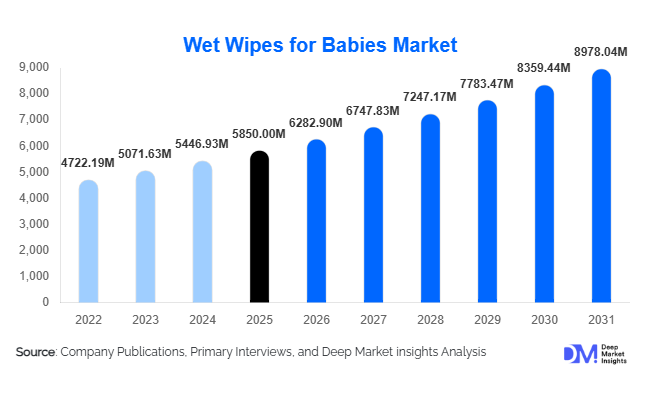
According to Deep Market Insights, the global wet wipes for babies market size was valued at USD 5,850 million in 2025 and is projected to grow from USD 6,282.90 million in 2026 to reach USD 8,978.04 million by 2031, expanding at a CAGR of 7.4% during the forecast period (2026–2031). The market growth is primarily driven by increasing awareness of infant hygiene, rising demand for convenient baby care products, and the growing adoption of premium, skin-friendly formulations among modern parents.
Key Market Insights
- Eco-friendly and biodegradable wipes are gaining strong traction, driven by environmental concerns and regulatory pressures on plastic usage.
- Premium and organic baby wipes segments are expanding rapidly, supported by consumer preference for chemical-free and dermatologically tested products.
- Asia-Pacific dominates the market, fueled by high birth rates, urbanization, and rising disposable incomes in countries such as China and India.
- North America remains a key premium market, with strong demand for high-quality and hypoallergenic baby wipes.
- E-commerce is emerging as the fastest-growing distribution channel, supported by subscription models and convenience-driven purchasing behavior.
- Technological advancements in materials and packaging, such as moisture-lock systems and plant-based fibers, are reshaping product innovation.
What are the latest trends in the wet wipes for babies market?
Shift Toward Sustainable and Biodegradable Products
The market is witnessing a strong shift toward environmentally sustainable products. Manufacturers are increasingly replacing synthetic fibers with biodegradable materials such as bamboo, organic cotton, and wood pulp. This transition is driven by growing consumer awareness regarding environmental impact and stricter regulations on non-biodegradable waste. Companies are also introducing compostable packaging and reducing chemical content, aligning with global sustainability goals. This trend is particularly prominent in Europe and North America, where eco-conscious parenting is influencing purchasing decisions.
Rising Demand for Skin-Friendly and Functional Wipes
Parents are prioritizing baby products that offer additional skincare benefits beyond basic cleaning. As a result, wipes with hypoallergenic, alcohol-free, and pH-balanced formulations are gaining popularity. Innovations such as probiotic-infused wipes, moisturizing variants, and wipes designed for sensitive skin are expanding product differentiation. Dermatological testing and certifications are becoming key selling points, especially in premium segments. This trend is supported by increasing concerns about infant skin sensitivity and allergic reactions.
What are the key drivers in the wet wipes for babies market?
Growing Awareness of Infant Hygiene
Increasing awareness about the importance of maintaining proper hygiene for infants is a primary driver of market growth. Baby wipes offer a convenient and effective solution for cleaning, reducing the risk of infections and skin irritations. Healthcare campaigns and improved access to pediatric care are further reinforcing this trend globally.
Rising Urbanization and Working Parent Population
The rise in urban populations and dual-income households has significantly boosted demand for convenient baby care products. Working parents prefer disposable, easy-to-use solutions such as wet wipes, which save time and effort. This shift in lifestyle patterns is particularly evident in emerging economies, where urbanization is accelerating product adoption.
Premiumization and Product Innovation
Consumers are increasingly willing to pay higher prices for premium baby wipes that ensure safety and quality. Products featuring organic ingredients, fragrance-free formulations, and advanced packaging are driving value growth. Continuous innovation by manufacturers is enhancing product appeal and expanding the consumer base.
What are the restraints for the global market?
Environmental Concerns and Regulatory Pressure
Traditional baby wipes, often made from synthetic materials, contribute to environmental pollution and sewer blockages. Governments and environmental organizations are imposing stricter regulations on disposable hygiene products, which may limit the growth of conventional wipes. Compliance with these regulations increases production costs for manufacturers.
Price Sensitivity in Emerging Markets
In developing regions, baby wipes are often considered a non-essential product compared to traditional cleaning methods such as cloth and water. High product costs can limit adoption among low-income households, posing a challenge for market expansion in price-sensitive markets.
What are the key opportunities in the wet wipes for babies market?
Expansion in Emerging Economies
Emerging markets such as India, Indonesia, and Brazil offer significant growth opportunities due to increasing birth rates, rising disposable incomes, and improving awareness of infant hygiene. Local manufacturing and cost-effective product offerings can help companies penetrate these markets more effectively.
Innovation in Eco-Friendly Materials
The development of biodegradable and plant-based wipes presents a major opportunity for manufacturers. Companies investing in sustainable raw materials and eco-friendly packaging can capture premium segments and comply with evolving environmental regulations. This also enhances brand reputation among environmentally conscious consumers.
Technological Advancements in Product Formulation
Advancements in dermatological science and material engineering are enabling the development of advanced baby wipes with enhanced functionality. Products offering antibacterial protection, skin nourishment, and improved durability are gaining traction. Smart packaging innovations further improve user convenience and product shelf life.
Report Scope
| Report Metric | Details |
|---|---|
| Market Size in 2025 | USD 5850 Million |
| Market Size in 2026 | USD 6282.90 Million |
| Market Size in 2031 | USD 8978.04 Million |
| CAGR | 7.4% (2026-2031) |
| Base Year for Estimation | 2025 |
| Historical Data | 2022-2024 |
| Forecast Period | 2026-2031 |
| Report Coverage | Revenue Forecast, Competitive Landscape, Supply Chain Disruption, Growth Factors, Environment & Regulatory Landscape and Trends |
| Geographies Covered | North America, Europe, APAC, Middle East and Africa, LATAM |
| Countries Covered | U.S., Canada, U.K., Germany, France, Spain, Italy, Russia, Nordic, Benelux, Rest of Europe, China, Korea, Japan, India, Australia, Singapore, Taiwan, South East Asia, Rest of Asia-Pacific, UAE, Turky, Saudi Arabia, South Africa, Egypt, Nigeria, Rest of MEA, Brazil, Mexico, Argentina, Chile, Colombia, Rest of LATAM |
Explore more data points, trends and opportunities Download Free Sample Report
Product Type Insights
Pre-moistened baby wipes continue to dominate the global market, accounting for approximately 82% of the total market share in 2025. This dominance is primarily driven by their superior convenience, ready-to-use nature, and ability to provide quick and hygienic cleaning solutions for infants. The increasing pace of urban lifestyles and the growing number of working parents have further reinforced demand for pre-moistened variants, as they eliminate the need for additional water or cleaning agents. Within this category, unscented and hypoallergenic wipes are emerging as the leading sub-segments, supported by rising concerns over infant skin sensitivity and allergies. Parents are increasingly opting for products free from alcohol, parabens, and artificial fragrances, especially for newborns. Meanwhile, dry wipes, although accounting for a smaller share, are gaining traction in niche segments, particularly among environmentally conscious consumers and in emerging markets where affordability and customization (adding water or natural solutions) are key purchasing factors.
Material Type Insights
Natural fiber-based wipes hold a substantial share of approximately 46% of the global market, reflecting a strong shift toward sustainable and skin-friendly materials. The leading position of this segment is driven by increasing consumer awareness of environmental issues and the harmful impact of synthetic materials on ecosystems. Materials such as cotton, bamboo, and wood pulp are widely preferred due to their biodegradability, softness, and reduced risk of skin irritation. Bamboo-based wipes, in particular, are gaining popularity due to their antimicrobial properties and rapid renewability. In contrast, synthetic materials such as polyester and polypropylene continue to maintain a notable presence due to their cost efficiency, durability, and large-scale manufacturing feasibility. However, their growth is gradually slowing as regulatory pressures and consumer preferences shift toward eco-friendly alternatives. The transition toward blended materials is also notable, as manufacturers attempt to balance cost, performance, and sustainability.
Packaging Type Insights
Soft pack packaging leads the global market with an estimated 68% share in 2025, primarily due to its affordability, lightweight design, and convenience in handling. This packaging format is widely adopted across both developed and emerging markets, as it offers flexibility in storage and ease of use for daily baby care routines. The widespread availability of refill packs further strengthens its dominance by reducing overall costs for consumers. Rigid plastic containers, while accounting for a smaller share, remain popular for home use due to their superior moisture retention capabilities and durability, ensuring product longevity. These are particularly preferred in premium segments where maintaining product quality is critical. Additionally, travel-sized packs are witnessing increasing demand, driven by rising mobility among parents and the need for compact, portable hygiene solutions during travel and outdoor activities. Innovations such as resealable lids and moisture-lock technologies are further enhancing the functionality of packaging formats.
Distribution Channel Insights
Offline retail channels continue to dominate the market, contributing approximately 61% of the total market share in 2025. Supermarkets, hypermarkets, pharmacies, and specialty baby stores remain key distribution points due to strong consumer trust, immediate product availability, and the ability to physically assess product quality before purchase. In many developing regions, offline retail remains the primary sales channel due to limited digital penetration. However, online retail is emerging as the fastest-growing segment, driven by increasing internet penetration, smartphone usage, and evolving consumer purchasing behavior. E-commerce platforms and brand-owned websites are offering competitive pricing, wider product assortments, and subscription-based models that ensure regular supply. The convenience of home delivery and access to customer reviews are further accelerating the shift toward digital channels, particularly among urban consumers and younger parents.
End-Use Insights
Household use dominates the wet wipes for babies market, accounting for nearly 88% of total demand in 2025. This segment’s leadership is driven by the daily hygiene requirements of infants, making baby wipes an essential product in modern childcare routines. The increasing awareness of infant health, coupled with rising disposable incomes, has significantly boosted household consumption. Institutional use, including hospitals, maternity clinics, and daycare centers, is growing at a faster rate, supported by stricter hygiene protocols and professional childcare services. Hospitals, in particular, are major consumers due to the need for maintaining sterile environments and ensuring newborn safety. The expansion of organized daycare services and early childcare facilities across urban areas is further contributing to the growth of institutional demand.
Explore more data points, trends and opportunities Download Free Sample Report
Wet Wipes for Babies Market Segmentations
By Product Type
- Pre-moistened Baby Wipes
- Dry Baby Wipes
By Material Type
- Natural Fibers
- Synthetic Fibers
- Blended Materials
By Packaging Type
- Soft Packs
- Rigid Plastic Containers
- Travel Packs
By Distribution Channel
- Offline Retail
- Online Retail
By End-Use
- Household Use
- Institutional Use
Regional Insights
Asia-Pacific
Asia-Pacific holds the largest share of approximately 32% of the global market in 2025 and is also the fastest-growing region, with a CAGR exceeding 8.5%. China and India are the primary contributors, driven by their large infant populations and rising middle-class income levels. Rapid urbanization, increasing female workforce participation, and improving awareness of infant hygiene are key drivers supporting regional growth. Additionally, expanding retail infrastructure and the penetration of e-commerce platforms are making baby wipes more accessible across both urban and semi-urban areas. Government initiatives aimed at improving maternal and child healthcare are also playing a significant role in boosting demand.
North America
North America accounts for around 28% of the global market share, with the United States dominating regional demand. Growth in this region is driven by high consumer awareness, strong preference for premium and organic products, and stringent regulatory standards governing baby care products. The presence of established market players and continuous product innovation further supports market expansion. Additionally, the increasing demand for eco-friendly and biodegradable wipes, coupled with high purchasing power and well-developed retail and e-commerce infrastructure, continues to drive growth in North America.
Europe
Europe holds approximately 25% of the market share, led by countries such as Germany, the United Kingdom, and France. The region’s growth is primarily driven by strict environmental regulations and strong consumer preference for sustainable and chemical-free products. European consumers are highly inclined toward biodegradable wipes and products with certified organic ingredients. Government policies promoting sustainability and reducing plastic waste are compelling manufacturers to innovate and introduce eco-friendly alternatives. Additionally, high awareness of infant health and well-established healthcare systems further contribute to steady market demand.
Latin America
Latin America contributes around 8% of the global market, with Brazil and Mexico being the leading countries. The region is experiencing steady growth due to increasing urbanization, rising disposable incomes, and expanding retail networks. Improved access to modern retail formats and growing awareness of infant hygiene are key factors driving demand. Additionally, the entry of international brands and the expansion of e-commerce platforms are enhancing product availability and affordability, further supporting market growth.
Middle East & Africa
The Middle East & Africa region accounts for approximately 7% of the global market, with key markets including the UAE and South Africa. Growth in this region is driven by improving healthcare infrastructure, rising awareness of infant hygiene, and increasing disposable incomes, particularly in urban areas. The growing number of hospitals and maternity centers, along with government initiatives to improve maternal and child health, are supporting market expansion. Additionally, the rising expatriate population and increasing adoption of Western lifestyle products are contributing to the growing demand for baby wipes in the region.
Key Players in the Wet Wipes for Babies Market
- Procter & Gamble
- Kimberly-Clark
- Johnson & Johnson
- Unicharm Corporation
- Essity AB
- Hengan International
- Nice-Pak Products
- Edgewell Personal Care
- Pigeon Corporation
- Kao Corporation
- Ontex Group
- Seventh Generation
- Himalaya Wellness
- Farlin Corporation
- Beiersdorf AG