Wedding Decorations Market Size
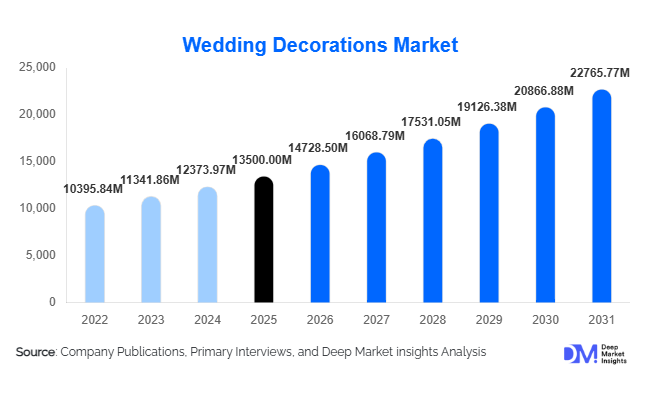
According to Deep Market Insights, the global wedding decorations market size was valued at USD 13,500 million in 2025 and is projected to grow from USD 14,728.50 million in 2026 to reach USD 22,765.77 million by 2031, expanding at a CAGR of 9.1% during the forecast period (2026–2031). The wedding decorations market growth is primarily driven by increasing consumer spending on experiential celebrations, the rising influence of social media aesthetics, and the growing popularity of destination and luxury weddings. The market is evolving rapidly with strong demand for personalized, theme-based, and visually immersive décor solutions across global regions.
Key Market Insights
- Floral decorations remain the largest segment, accounting for nearly 28% of the total market, driven by universal cultural relevance and visual appeal.
- Full-service decoration offerings dominate, contributing around 45% share as consumers increasingly prefer end-to-end event solutions.
- Asia-Pacific leads the global market with approximately 38% share, supported by high wedding volumes and cultural spending patterns.
- Luxury and premium-themed weddings are expanding rapidly, particularly in North America, the Middle East, and India.
- Sustainability is emerging as a key trend, with increasing demand for eco-friendly and reusable décor materials.
- Technology integration, including LED installations, projection mapping, and 3D visualization tools, is transforming decoration planning and execution.
What are the latest trends in the wedding decorations market?
Rise of Sustainable and Eco-Friendly Wedding Décor
Sustainability is becoming a defining trend in the wedding decorations market, driven by environmentally conscious consumers, particularly millennials and Gen Z couples. Demand for biodegradable materials, reusable décor elements, and locally sourced flowers is increasing significantly. Vendors are shifting toward rental-based models, fabric reuse, and eco-friendly installations to reduce waste. Governments and regulatory bodies are also promoting sustainable event practices, encouraging vendors to adopt greener alternatives. This shift is not only helping reduce environmental impact but also enabling businesses to differentiate themselves in a competitive market.
Technology-Driven and Immersive Décor Experiences
Technological advancements are reshaping the wedding decoration landscape, with increasing adoption of digital tools and immersive installations. Projection mapping, LED walls, and interactive lighting systems are being widely used to create visually captivating environments. Additionally, 3D visualization and augmented reality tools allow clients to preview décor concepts before execution, improving decision-making and customization. These innovations are particularly popular in urban and high-income markets, where clients seek unique, memorable experiences that stand out on digital platforms.
What are the key drivers in the wedding decorations market?
Rising Wedding Expenditure Globally
Increasing disposable incomes, particularly in emerging economies such as India and China, are driving higher spending on weddings. Decoration accounts for a substantial portion of total wedding budgets, often ranging between 20–30%. The growing middle class and rising aspirations for grand celebrations are significantly boosting demand for premium decoration services.
Influence of Social Media and Visual Culture
Social media platforms such as Instagram and Pinterest have transformed weddings into highly visual events. Couples are increasingly investing in unique, photogenic décor setups to create shareable experiences. This trend has accelerated demand for customized themes, elaborate floral installations, and innovative lighting solutions, driving market growth.
Growth of Professional Wedding Planning Services
The increasing reliance on event planners and professional decorators is another major growth driver. Event management companies are integrating decoration services into comprehensive packages, offering convenience and expertise. This has led to higher adoption of full-service decoration solutions and increased market consolidation.
What are the restraints for the global market?
High Cost of Premium Decoration Services
Luxury wedding decorations can significantly increase overall wedding expenses, limiting adoption in price-sensitive markets. High costs associated with imported flowers, advanced lighting systems, and customized installations create affordability challenges for a large segment of consumers.
Seasonal Demand Fluctuations
The wedding decorations market is highly seasonal, with demand concentrated in specific months depending on cultural and climatic factors. This leads to inconsistent revenue streams for vendors and challenges in workforce and inventory management during off-peak periods.
What are the key opportunities in the wedding decorations industry?
Expansion of Destination Weddings
The growing popularity of destination weddings presents a significant opportunity for market players. Countries such as India, Thailand, Italy, and the UAE are witnessing increasing demand from international clients seeking unique venues and cultural experiences. This trend is driving demand for large-scale, high-value decoration services and creating opportunities for vendors to expand globally through partnerships with hospitality providers.
Integration of Advanced Visualization Technologies
The adoption of 3D rendering, augmented reality, and digital mock-ups is enabling customers to visualize décor concepts before execution. Companies investing in these technologies can enhance customer experience, reduce design errors, and command premium pricing. This opportunity is particularly relevant in urban markets where clients demand high levels of customization.
Report Scope
| Report Metric | Details |
|---|---|
| Market Size in 2025 | USD 13500 Million |
| Market Size in 2026 | USD 14728.50 Million |
| Market Size in 2031 | USD 22765.77 Million |
| CAGR | 9.1% (2026-2031) |
| Base Year for Estimation | 2025 |
| Historical Data | 2022-2024 |
| Forecast Period | 2026-2031 |
| Report Coverage | Revenue Forecast, Competitive Landscape, Supply Chain Disruption, Growth Factors, Environment & Regulatory Landscape and Trends |
| Geographies Covered | North America, Europe, APAC, Middle East and Africa, LATAM |
| Countries Covered | U.S., Canada, U.K., Germany, France, Spain, Italy, Russia, Nordic, Benelux, Rest of Europe, China, Korea, Japan, India, Australia, Singapore, Taiwan, South East Asia, Rest of Asia-Pacific, UAE, Turky, Saudi Arabia, South Africa, Egypt, Nigeria, Rest of MEA, Brazil, Mexico, Argentina, Chile, Colombia, Rest of LATAM |
Explore more data points, trends and opportunities Download Free Sample Report
Product Type Insights
Floral decorations dominate the wedding decorations market, accounting for approximately 28% of the total market share in 2025. Their leadership is primarily driven by deep-rooted cultural significance across regions such as Asia-Pacific, the Middle East, and Europe, where flowers symbolize prosperity, purity, and celebration. Additionally, floral décor offers unmatched visual appeal, versatility, and adaptability across traditional, contemporary, and luxury wedding themes. The segment has further benefited from the rising trend of large-scale floral installations, including hanging gardens, floral tunnels, and stage backdrops, which enhance the experiential value of weddings. Artificial and preserved flowers are also gaining traction, particularly in large-scale and destination weddings, due to their cost efficiency, durability, and ease of logistics. The shift toward sustainable practices is encouraging the use of locally sourced and reusable floral elements, further strengthening the segment’s growth trajectory globally.
Application Insights
Luxury and premium-themed weddings represent the leading application segment, contributing around 32% of the global market. This segment is driven by increasing disposable incomes, rising aspirations for high-end celebrations, and the growing influence of social media, where visually striking weddings gain significant attention. Premium weddings emphasize bespoke décor, intricate installations, designer elements, and advanced lighting technologies, which significantly increase average spending per event. The rapid expansion of destination weddings in regions such as Southeast Asia, Southern Europe, and the Middle East is further fueling this segment, as these events typically involve higher décor budgets and demand for customized experiences. Additionally, affluent consumers are increasingly seeking exclusivity and personalization, prompting decorators to innovate with unique themes, immersive environments, and technology-driven décor solutions such as projection mapping and LED installations.
Distribution Channel Insights
Event management companies dominate the distribution channel segment with approximately 40% market share, supported by their ability to provide integrated, end-to-end wedding solutions. These companies combine planning, decoration, logistics, and vendor coordination into a single offering, making them highly attractive for large-scale and complex weddings. Their expertise in executing high-budget events, managing multiple vendors, and ensuring seamless coordination has positioned them as the preferred choice, particularly in urban and premium segments. Additionally, the growing complexity of modern weddings—featuring multi-day events, themed functions, and destination logistics—has increased reliance on professional planners. While direct vendor services continue to cater to localized and budget-conscious consumers, online platforms and marketplaces are emerging as fast-growing channels, especially for DIY décor solutions, rental-based products, and smaller-scale celebrations. Digitalization is also enabling decorators to reach a wider audience and streamline customer engagement.
End-Use Insights
Individual weddings account for nearly 65% of total market demand, driven by direct consumer spending and the cultural importance of weddings across major regions. This segment benefits from increasing household incomes, rising urbanization, and the growing trend of personalized celebrations. However, the hospitality sector is the fastest-growing end-use segment, fueled by the rapid rise of destination weddings and resort-based events. Hotels and resorts are increasingly investing in in-house decoration capabilities, dedicated wedding venues, and strategic partnerships with décor companies to attract high-value clients. This shift is particularly evident in regions such as the Middle East, Southeast Asia, and Southern Europe, where luxury resorts are positioning themselves as premium wedding destinations. Additionally, the integration of decoration services into hospitality offerings enhances revenue streams and improves customer experience, making this segment a key growth driver for the market.
Explore more data points, trends and opportunities Download Free Sample Report
Wedding Decorations Market Segmentations
By Product Type
- Floral Decorations
- Fabric & Drapery Decorations
- Lighting Decorations
- Furniture & Props
- Table Décor
- Signage & Stationery Décor
- Balloon & Inflatable Decorations
- Digital & Projection Décor
By Application
- Traditional Weddings
- Destination Weddings
- Luxury & Premium Themed Weddings
- Minimalist / Contemporary Weddings
- Eco-friendly / Sustainable Weddings
By Distribution Channel
- Event Management Companies
- Direct Vendors / Decorators
- Online Platforms / Marketplaces
- Specialty Décor Retail Stores
By End-Use
- Individual Weddings
- Wedding Planners & Event Agencies
- Hospitality Sector
Regional Insights
Asia-Pacific
Asia-Pacific leads the wedding decorations market with approximately 38% share in 2025, driven by high wedding volumes, strong cultural traditions, and increasing consumer spending in countries such as India and China. India remains the largest contributor due to its vast number of annual weddings and the cultural emphasis on elaborate, multi-day celebrations. The region’s growth is further supported by rising middle-class incomes, urbanization, and the increasing adoption of premium and theme-based weddings. Additionally, the expansion of destination weddings within countries like Thailand and Indonesia is boosting demand for high-value decoration services. The availability of cost-effective labor and materials also enables large-scale décor execution, making the Asia-Pacific a dominant and cost-efficient market.
North America
North America accounts for around 25% of the global market, with the United States being the primary contributor. The region’s growth is driven by high disposable incomes, strong demand for personalized and experiential weddings, and the widespread presence of professional wedding planners and decorators. Consumers in North America prioritize customization, leading to increased spending on unique themes, luxury décor, and technology-driven installations. Additionally, the influence of social media and celebrity weddings is encouraging higher expenditure on aesthetics. The region also benefits from advanced infrastructure, well-established event management ecosystems, and a growing trend of outdoor and destination weddings within domestic locations.
Europe
Europe holds approximately 20% market share, with countries such as Italy, France, and Spain leading in destination weddings. The region’s growth is primarily driven by its global appeal as a wedding destination, offering scenic venues, historic architecture, and premium hospitality services. European consumers also exhibit a strong preference for luxury and minimalist décor styles, which drives demand for high-quality materials and bespoke designs. Additionally, sustainability trends are particularly strong in Europe, encouraging the adoption of eco-friendly décor solutions. The presence of established tourism infrastructure and cross-border wedding demand further supports steady market growth in this region.
Middle East & Africa
The Middle East & Africa region is witnessing rapid growth, with the UAE emerging as a key hub for luxury destination weddings. The region’s expansion is driven by high spending capacity, a strong preference for opulent celebrations, and the presence of world-class hospitality infrastructure. Countries such as the UAE and Saudi Arabia are investing heavily in tourism and event infrastructure, attracting international weddings. In Africa, growing urbanization and increasing disposable incomes in countries like South Africa and Nigeria are contributing to market growth. The region’s focus on luxury, large-scale events, and premium décor solutions positions it as one of the fastest-growing markets globally.
Latin America
Latin America accounts for about 7% of the market, with Brazil and Mexico as key contributors. Growth in this region is driven by strong cultural emphasis on celebrations, increasing urbanization, and rising middle-class incomes. Weddings in Latin America are often vibrant and elaborate, creating steady demand for decorative elements. Additionally, the region is witnessing gradual growth in destination weddings, particularly in Mexico and the Caribbean, which is boosting demand for premium decoration services. Improving economic conditions and expanding hospitality infrastructure are further supporting the market’s development in this region.
Key Players in the Wedding Decorations Market
- Preston Bailey Designs
- Colin Cowie Lifestyle
- The Wedding Design Company
- David Tutera Inc.
- DesignLab Experience
- Rani Pink Love
- Elegant Affairs
- Kehoe Designs
- Mindy Weiss Party Consultants
- Revelry Event Designers
- Blue Lavender Events
- Birch Event Design
- Ace of Events
- Eventures
- Frosted Petticoat