Water Sports Products Market Size
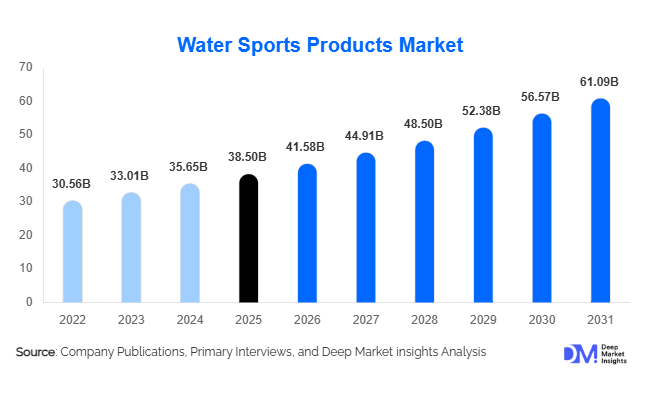
According to Deep Market Insights, the global water sports products market size was valued at USD 38.5 billion in 2025 and is projected to grow from USD 41.58 billion in 2026 to reach USD 61.09 billion by 2031, expanding at a CAGR of 8.0% during the forecast period (2026–2031). The market growth is primarily driven by the increasing popularity of recreational and adventure water sports, rising disposable incomes, expanding marine tourism infrastructure, and growing technological innovations in water sports equipment, including electric and smart watercraft.
Key Market Insights
- Personal watercraft and accessories dominate the market, driven by high-value equipment such as jet skis, wakeboards, and water skis, particularly in commercial rental and resort operations.
- Online retail channels are increasingly shaping the market, providing consumers with direct-to-consumer access, easier comparisons, and global reach for specialized water sports products.
- North America leads the global market, with the U.S. and Canada accounting for a significant share due to high disposable income and strong recreational participation in water sports.
- Asia-Pacific is the fastest-growing region, fueled by rising middle-class wealth, expanding tourism infrastructure, and growing adoption of recreational and adventure water activities in China, Australia, and Southeast Asia.
- Europe remains a major market, with sustainability-focused trends driving the adoption of eco-friendly water sports equipment and premium recreational gear.
- Technological adoption, including lightweight materials, wearable safety devices, and battery-powered watercraft, is reshaping product offerings and user experiences globally.
What are the latest trends in the water sports products market?
Sustainable and Eco-Friendly Equipment
Environmental awareness is driving demand for sustainable products across water sports categories. Biodegradable surfboards, recycled neoprene wetsuits, and low-emission personal watercraft are gaining traction globally. Consumers are increasingly selecting products aligned with green manufacturing processes. Regulatory pressures in Europe and North America further reinforce this trend, compelling manufacturers to adopt eco-conscious materials and production methods. Partnerships with environmental organizations and the incorporation of carbon-offset programs are becoming key differentiators for premium and mid-range brands.
Technological Integration in Water Sports
Technology is transforming both the product design and user experience in water sports. Innovations include electric-powered surfboards, GPS-enabled safety devices, and smart wearable gear that track performance metrics. Additionally, lightweight composite materials are improving durability and maneuverability. Integration with mobile applications allows consumers to monitor activities, share experiences on social media, and access interactive training content. Technology-enhanced experiences are attracting younger, tech-savvy consumers and expanding participation in both recreational and competitive water sports.
What are the key drivers in the water sports products market?
Rising Recreational and Adventure Tourism
The expansion of coastal and marine tourism infrastructure is a primary growth driver. Countries in the Asia-Pacific, the Middle East, and North America are investing in beaches, marinas, and adventure hubs, facilitating access to water sports. Resorts and adventure tourism operators are upgrading fleets and offering integrated water sports experiences, boosting demand for personal watercraft, diving gear, and paddleboards.
Technological Advancements
Innovations in product design and materials are driving adoption. Lightweight, durable boards, advanced diving equipment, and smart safety gear make participation more accessible to beginners while enhancing performance for experienced users. Battery-powered and electric watercraft are creating new product segments, appealing to environmentally conscious and premium customers.
Shift Toward Lifestyle and Fitness Activities
Consumers are increasingly prioritizing outdoor recreation and fitness, with water sports gaining popularity as both leisure and exercise activities. Social media trends and influencer-led marketing have amplified interest in water sports, particularly among millennials and Gen Z, expanding the consumer base for mid-range and premium equipment.
What are the restraints for the global market?
High Equipment Costs
Premium water sports products, particularly personal watercraft and high-performance diving gear, remain expensive. High upfront costs limit adoption in price-sensitive markets, restraining overall market growth despite increasing interest in recreational activities.
Seasonality and Geographic Dependence
Water sports activities are largely seasonal and depend on geographic and climatic conditions. Regions with short summers or limited coastal access see fluctuating demand, creating challenges for manufacturers and retailers in maintaining stable revenues year-round.
What are the key opportunities in the water sports products industry?
Expansion of Marine Tourism in Emerging Economies
Emerging economies in Southeast Asia, the Middle East, and Latin America are investing heavily in marine tourism infrastructure. Governments are promoting water-based recreational activities, creating strong demand for snorkeling, paddleboarding, and personal watercraft equipment. This presents an opportunity for global manufacturers and regional players to establish strategic distribution networks, partnerships with resorts, and rental services.
Integration of Sustainable and Eco-Friendly Products
Consumer awareness regarding environmental impact is creating demand for biodegradable, recyclable, and low-emission water sports equipment. Companies that adopt sustainable manufacturing processes, including circular economy models, can differentiate themselves and capture premium market segments. Regulatory compliance in regions such as Europe is further driving this opportunity.
Technological Advancements in Electric and Smart Equipment
Battery-powered watercraft, GPS-enabled safety devices, and smart wearables represent a significant growth avenue. These innovations enhance safety, accessibility, and user experience, particularly for premium segments. Integration with mobile apps allows performance tracking, community engagement, and social sharing, attracting younger consumers and encouraging repeat participation.
Report Scope
| Report Metric | Details |
|---|---|
| Market Size in 2025 | USD 38.5 Billion |
| Market Size in 2026 | USD 41.58 Billion |
| Market Size in 2031 | USD 61.09 Billion |
| CAGR | 8.0% (2026-2031) |
| Base Year for Estimation | 2025 |
| Historical Data | 2022-2024 |
| Forecast Period | 2026-2031 |
| Report Coverage | Revenue Forecast, Competitive Landscape, Supply Chain Disruption, Growth Factors, Environment & Regulatory Landscape and Trends |
| Geographies Covered | North America, Europe, APAC, Middle East and Africa, LATAM |
| Countries Covered | U.S., Canada, U.K., Germany, France, Spain, Italy, Russia, Nordic, Benelux, Rest of Europe, China, Korea, Japan, India, Australia, Singapore, Taiwan, South East Asia, Rest of Asia-Pacific, UAE, Turky, Saudi Arabia, South Africa, Egypt, Nigeria, Rest of MEA, Brazil, Mexico, Argentina, Chile, Colombia, Rest of LATAM |
Explore more data points, trends and opportunities Download Free Sample Report
Product Type Insights
Personal watercraft & accessories dominate the product segment, accounting for approximately 28% of the global market share in 2025. This leadership is primarily driven by the high unit value and recurring demand from commercial operators such as resorts, marine tourism companies, and rental service providers. Jet skis, wakeboards, and water skis generate significantly higher revenue per unit compared to other categories, making them a core revenue contributor. Additionally, the increasing popularity of experiential tourism and water-based adventure packages has led to large-scale fleet purchases by operators, further strengthening this segment. Technological advancements, including electric-powered personal watercraft and improved safety features, are also expanding adoption among premium consumers.
Surfing equipment and diving gear collectively account for a substantial volume share, driven by widespread participation in activities such as snorkeling and recreational surfing. These segments benefit from lower price points and higher repeat purchases, especially in coastal tourism markets. Meanwhile, safety and protective gear, including life jackets and helmets, is witnessing steady growth as regulatory requirements tighten and operators bundle safety equipment with water sports packages, ensuring consistent demand across both individual and commercial users.
Application Insights
Recreational water sports dominate the application segment, accounting for over 50% of the global market share in 2025. The segment’s leadership is driven by the global shift toward leisure, wellness, and outdoor lifestyle activities. Increasing disposable incomes, coupled with rising interest in experiential travel, have significantly boosted participation in activities such as kayaking, paddleboarding, snorkeling, and jet skiing. Social media influence and the growing trend of “experience-driven consumption” have further accelerated demand, particularly among millennials and Gen Z consumers.
Professional and competitive water sports represent a smaller but stable segment, supported by organized sporting events and institutional investments. Meanwhile, adventure tourism applications are expanding rapidly, particularly in emerging economies where governments are promoting marine tourism. Training and instructional applications are also gaining traction, driven by sports academies, schools, and certification programs for diving and water safety, creating a steady pipeline of new participants entering the market.
Distribution Channel Insights
Online retail channels account for approximately 26% of global sales, making them one of the fastest-growing distribution segments. This growth is driven by increasing digital penetration, the rise of direct-to-consumer (D2C) business models, and the ability for consumers to access a wide range of specialized products globally. Online platforms enable price transparency, product comparisons, and customer reviews, influencing purchasing decisions, particularly in mid-range and premium segments.
Specialty sports stores continue to play a critical role in high-value purchases, where consumers require expert guidance and product trials. Multi-brand retail chains cater to mass-market demand, especially for entry-level and mid-range products. Additionally, rental and resort-based distribution channels are emerging as a key growth driver, particularly in tourism-heavy regions. These channels not only generate recurring revenue streams but also act as a gateway for first-time users, often converting rental users into future buyers.
End-User Insights
Individual consumers account for approximately 55% of the market, driven by increasing participation in recreational and fitness-oriented water activities. The growing availability of affordable and portable equipment, such as inflatable paddleboards and compact snorkeling kits, has made personal ownership more accessible. Consumer preference is also shifting toward multi-functional and easy-to-use products, supporting sustained demand in this segment.
Commercial operators, including resorts, water sports rental companies, and tourism service providers, represent the fastest-growing segment, with a CAGR exceeding 9%. Growth in this segment is strongly linked to the global recovery and expansion of the tourism industry. Operators are continuously upgrading equipment fleets to enhance customer experience and safety, driving bulk purchases. Additionally, niche applications such as military and rescue operations are contributing to demand for specialized equipment, including high-performance watercraft and advanced safety gear, further diversifying the market.
Explore more data points, trends and opportunities Download Free Sample Report
Water Sports Products Market Segmentations
By Product Type
- Surfing Equipment
- Diving & Snorkeling Equipment
- Personal Watercraft & Accessories
- Sailing & Boating Equipment
- Safety & Protective Gear
- Apparel & Footwear
- Accessories & Ancillary Equipment
By Application
- Recreational Water Sports
- Professional/Competitive Water Sports
- Adventure Tourism Activities
- Training & Instructional Use
By Distribution Channel
- Online Retail
- Specialty Sports Stores
- Multi-brand Retail Chains
- Rental & Resort-based Sales
By End-User
- Individual Consumers
- Commercial Operators
- Sports Clubs & Institutions
- Military & Rescue Agencies
Regional Insights
North America
North America accounts for approximately 34% of the global market share in 2025, making it the largest regional market. The United States dominates regional demand, supported by high disposable incomes, a well-established recreational boating culture, and extensive coastal and inland water infrastructure. Canada also contributes significantly through kayaking, canoeing, and seasonal water sports activities. Key growth drivers include strong consumer spending on leisure activities, widespread adoption of premium and technologically advanced equipment, and a mature rental ecosystem. Additionally, the presence of leading manufacturers and continuous product innovation further strengthens the region’s market position.
Europe
Europe holds around 27% of the global market share, with major contributions from countries such as France, Spain, Italy, and the United Kingdom. The region’s growth is driven by a strong emphasis on sustainable tourism and eco-friendly products, with consumers increasingly opting for environmentally responsible equipment. Coastal tourism across the Mediterranean and Atlantic regions supports consistent demand for surfing, sailing, and diving equipment. Regulatory frameworks promoting safety and environmental standards are also influencing product innovation. Furthermore, increasing participation in recreational water sports and the expansion of mid-range and premium segments are key drivers of regional growth.
Asia-Pacific
Asia-Pacific is the fastest-growing region, with a CAGR exceeding 9% during the forecast period. China, Australia, Japan, and Southeast Asian countries such as Thailand and Indonesia are major contributors. Growth is driven by rising middle-class incomes, rapid urbanization, and increasing government investments in tourism infrastructure. The expansion of coastal tourism hubs and water sports facilities is significantly boosting demand for equipment such as paddleboards, snorkeling gear, and personal watercraft. Additionally, growing awareness of fitness and outdoor recreation, coupled with strong social media influence, is accelerating adoption among younger populations.
Middle East & Africa
The Middle East & Africa region is experiencing steady to high growth, led by countries such as the UAE, Saudi Arabia, and South Africa. In the Middle East, growth is driven by high disposable incomes, luxury tourism development, and government initiatives to diversify economies through tourism. Large-scale coastal projects and artificial waterfront developments are creating new opportunities for water sports activities. In Africa, established diving and adventure tourism destinations such as Egypt and South Africa continue to attract international tourists, supporting demand for snorkeling and diving equipment. Increasing investments in tourism infrastructure and international visitor inflows are key drivers for the region.
Latin America
Latin America is witnessing gradual growth, with Brazil and Mexico leading regional demand. Favorable coastlines, increasing tourism activities, and rising interest in adventure sports are supporting market expansion. Growth drivers include government efforts to promote tourism, improving infrastructure, and increasing participation in recreational water sports among domestic consumers. Additionally, outbound tourism from the region is contributing to demand for premium equipment, particularly for activities such as snorkeling and paddleboarding. While the market remains smaller compared to other regions, it presents significant untapped potential for future growth.
Key Players in the Water Sports Products Market
- Brunswick Corporation
- Yamaha Motor Co., Ltd.
- Johnson Outdoors Inc.
- Groupe Bénéteau
- O’Brien Watersports
- Airhead Sports Group
- Aqua Lung International
- Body Glove International
- Rip Curl Group
- Quiksilver Inc.
- Decathlon S.A.
- Hobie Cat Company
- Naish International
- Starboard
- Connelly Skis