Warewashing Professional Equipment Market Size
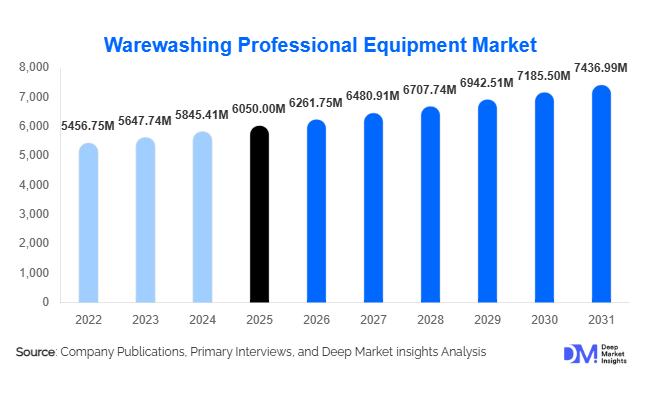
According to Deep Market Insights, the global warewashing professional equipment market size was valued at USD 6,050 million in 2025 and is projected to grow from USD 6,261.75 million in 2026 to reach USD 7,436.99 million by 2031, expanding at a CAGR of 3.5% during the forecast period (2026–2031). The warewashing professional equipment market growth is primarily driven by the rapid expansion of commercial foodservice establishments, increasing hygiene compliance requirements in hospitality and institutional kitchens, and rising adoption of automated dishwashing systems designed to reduce labor dependency and improve operational efficiency.
Professional warewashing equipment plays a critical role in maintaining sanitation and food safety standards across restaurants, hotels, hospitals, catering facilities, and large institutional kitchens. The increasing global footprint of quick-service restaurants, cloud kitchens, and centralized food production facilities is significantly boosting demand for high-capacity commercial dishwashers and integrated warewashing lines. In addition, the industry is witnessing strong technological advancements, including energy-efficient washing systems, water recycling technologies, automated chemical dosing, and IoT-enabled monitoring systems that optimize performance while reducing operating costs.
Developed markets such as North America and Europe currently dominate adoption due to strict food safety regulations and advanced kitchen infrastructure. Meanwhile, Asia-Pacific is emerging as the fastest-growing region as rapid urbanization, rising disposable incomes, and the expansion of global restaurant chains accelerate demand for modern commercial kitchen equipment. As sustainability concerns grow, manufacturers are increasingly developing environmentally friendly systems capable of reducing water consumption, energy usage, and detergent waste. These innovations are expected to play a key role in shaping the long-term evolution of the warewashing professional equipment market.
Key Market Insights
- Commercial dishwashers represent the largest product segment, accounting for more than 60% of global warewashing equipment demand due to their extensive use in restaurants, hotels, and institutional kitchens.
- Automation is transforming professional kitchens, with fully automatic warewashing systems gaining rapid adoption as foodservice operators seek to reduce labor costs and increase productivity.
- North America dominates the global market, supported by a mature restaurant industry, strong regulatory standards, and widespread adoption of advanced commercial kitchen equipment.
- Asia-Pacific is the fastest-growing regional market, driven by the rapid expansion of quick-service restaurant chains, urbanization, and growing hospitality infrastructure.
- Sustainability is becoming a major purchasing factor, with operators prioritizing water-efficient dishwashing systems and energy-saving heat recovery technologies.
- IoT-enabled smart dishwashing systems are gaining traction, allowing remote monitoring, predictive maintenance, and automated chemical dosing to optimize cleaning performance.
What are the latest trends in the warewashing professional equipment market?
Smart and Connected Warewashing Systems
The adoption of IoT-enabled warewashing equipment is rapidly transforming commercial kitchens worldwide. Manufacturers are integrating sensors, digital control panels, and cloud connectivity into dishwashing systems to enable real-time monitoring of washing cycles, water consumption, energy usage, and equipment performance. These connected systems allow operators to track operational efficiency remotely and receive predictive maintenance alerts before equipment failures occur. Such innovations are particularly valuable for restaurant chains and hotel groups operating multiple kitchens, as centralized monitoring improves operational consistency and reduces downtime. Digital dashboards and analytics platforms are also being introduced to help operators optimize detergent usage and reduce operational costs.
Growing Focus on Sustainable and Resource-Efficient Equipment
Sustainability is becoming a key priority across the commercial kitchen equipment industry. Warewashing systems consume substantial quantities of water, electricity, and detergents, prompting manufacturers to develop eco-friendly alternatives that minimize resource consumption. Modern dishwashers now feature heat recovery systems, low-water wash cycles, and high-efficiency booster heaters that significantly reduce energy usage. Some advanced systems can lower water consumption by nearly 40% compared with traditional machines. As environmental regulations tighten across Europe and North America, foodservice operators are increasingly investing in energy-efficient warewashing solutions that reduce environmental impact while lowering operating expenses.
What are the key drivers in the warewashing professional equipment market?
Rapid Expansion of the Global Foodservice Industry
The continued expansion of restaurants, cafés, and quick-service restaurant chains worldwide is a primary driver of the warewashing professional equipment market. The global foodservice industry is valued at more than USD 3 trillion and continues to grow steadily, particularly in emerging markets. Every commercial kitchen requires efficient cleaning systems to maintain hygiene standards and manage high dishwashing volumes. As foodservice establishments expand operations and increase customer throughput, the need for high-capacity automated dishwashing systems becomes essential for maintaining service efficiency and sanitation compliance.
Strict Food Safety and Hygiene Regulations
Food safety regulations are becoming increasingly stringent across major economies. Government agencies require restaurants and institutional kitchens to comply with strict sanitation standards related to washing temperatures, chemical sanitization, and contamination prevention. Professional warewashing equipment provides reliable temperature control and automated cleaning cycles that ensure consistent hygiene performance. Compliance with international standards such as HACCP has made automated dishwashing systems an essential component of modern commercial kitchens.
What are the restraints for the global market?
High Initial Capital Investment
Despite their long-term operational benefits, professional warewashing systems require significant upfront investment. High-capacity conveyor dishwashers and flight-type machines can cost tens of thousands of dollars, making them less accessible for small independent restaurants and foodservice operators. Budget constraints in emerging markets often lead smaller establishments to rely on manual washing systems, slowing the adoption of advanced warewashing technologies.
Infrastructure and Utility Requirements
Professional warewashing equipment requires adequate plumbing, drainage, electrical capacity, and water supply infrastructure. In many developing regions, commercial kitchens may lack the necessary facilities to support high-capacity automated dishwashing systems. Installation complexity and infrastructure upgrades can increase total project costs, presenting a challenge for widespread adoption in smaller establishments.
What are the key opportunities in the warewashing professional equipment industry?
Growth of Cloud Kitchens and Centralized Food Production
The rise of cloud kitchens and centralized food production facilities presents a significant growth opportunity for warewashing equipment manufacturers. These facilities prepare large volumes of meals for delivery platforms and restaurant chains, requiring high-capacity dishwashing systems capable of processing large quantities of utensils and cookware efficiently. As food delivery services expand globally, demand for integrated warewashing lines in centralized kitchens is expected to grow steadily.
Emerging Market Hospitality Expansion
Rapid growth in tourism infrastructure across the Asia-Pacific and the Middle East is creating new opportunities for the warewashing professional equipment market. Countries such as India, China, the UAE, and Saudi Arabia are investing heavily in hotels, resorts, and entertainment complexes. These developments require modern commercial kitchens equipped with advanced dishwashing systems. International hospitality chains entering emerging markets are also standardizing kitchen equipment across properties, creating long-term supply opportunities for global warewashing equipment manufacturers.
Report Scope
| Report Metric | Details |
|---|---|
| Market Size in 2025 | USD 6050 Million |
| Market Size in 2026 | USD 6261.75 Million |
| Market Size in 2031 | USD 7436.99 Million |
| CAGR | 3.5% (2026-2031) |
| Base Year for Estimation | 2025 |
| Historical Data | 2022-2024 |
| Forecast Period | 2026-2031 |
| Report Coverage | Revenue Forecast, Competitive Landscape, Supply Chain Disruption, Growth Factors, Environment & Regulatory Landscape and Trends |
| Geographies Covered | North America, Europe, APAC, Middle East and Africa, LATAM |
| Countries Covered | U.S., Canada, U.K., Germany, France, Spain, Italy, Russia, Nordic, Benelux, Rest of Europe, China, Korea, Japan, India, Australia, Singapore, Taiwan, South East Asia, Rest of Asia-Pacific, UAE, Turky, Saudi Arabia, South Africa, Egypt, Nigeria, Rest of MEA, Brazil, Mexico, Argentina, Chile, Colombia, Rest of LATAM |
Explore more data points, trends and opportunities Download Free Sample Report
Equipment Type Insights
Commercial dishwashers dominate the warewashing professional equipment market, accounting for approximately 62% of global revenue. These systems are widely used in restaurants, hotels, and institutional kitchens due to their ability to process large volumes of dishes efficiently. Undercounter dishwashers are popular in smaller restaurants and cafés due to their compact size and affordability, while door-type and hood-type machines are commonly used in mid-scale kitchens that require higher throughput. Conveyor and flight-type dishwashers are deployed in high-capacity facilities such as hospitals, universities, and catering kitchens where thousands of dishes must be cleaned daily. Glasswashers represent another important segment, particularly in bars and beverage-focused establishments where rapid cleaning cycles are required to maintain continuous service.
Automation Level Insights
Fully automatic warewashing systems represent the fastest-growing segment, accounting for nearly 58% of the market. Automation allows operators to reduce labor requirements while maintaining consistent cleaning performance and hygiene standards. Semi-automatic systems remain widely used in mid-sized establishments that require some operational flexibility while still benefiting from mechanical washing cycles. Manual warewashing equipment continues to exist in small foodservice operations, although its share is gradually declining as labor costs increase and sanitation requirements become more stringent.
Capacity Insights
Medium-capacity warewashing equipment capable of processing between 500 and 1,500 racks per hour represents the largest capacity segment, accounting for approximately 46% of the global market. These systems provide an ideal balance between cost and operational efficiency, making them suitable for mid-scale restaurants, cafeterias, and catering services. High-capacity conveyor dishwashers are primarily used in large institutional kitchens and food production facilities, while low-capacity machines remain common in small cafés and bars with limited dishwashing volumes.
End-Use Industry Insights
The foodservice industry represents the largest end-use sector for warewashing professional equipment, accounting for more than 55% of total market demand. Restaurants, quick-service chains, cafés, and catering services rely heavily on automated dishwashing systems to maintain operational efficiency and hygiene compliance. The hospitality sector, including hotels and resorts, represents another significant segment due to the large volume of tableware used in hotel restaurants and banquet operations. Institutional kitchens in hospitals, universities, and corporate cafeterias are also major consumers of large-scale conveyor dishwashing systems. In recent years, centralized food production kitchens and cloud kitchen facilities have emerged as new application areas, requiring high-throughput warewashing lines to support large-scale meal preparation operations.
Explore more data points, trends and opportunities Download Free Sample Report
Warewashing Professional Equipment Market Segmentations
By Equipment Type
- Commercial Dishwashers
- Glasswashers
- Utensil and Cookware Wash Systems
- Pre-Rinse and Washing Systems
- Drying and Sanitizing Equipment
- Ancillary Warewashing Equipment
By Automation Level
- Manual Warewashing Equipment
- Semi-Automatic Warewashing Systems
- Fully Automatic Warewashing Systems
By Installation Type
- Freestanding Warewashing Systems
- Built-In Integrated Systems
- Conveyor Line Integrated Systems
By End-Use Industry
- Foodservice Industry
- Hospitality Sector
- Institutional Facilities
- Food Processing and Central Kitchens
- Retail and Commercial Establishments
By Distribution Channel
- Direct OEM Sales
- Foodservice Equipment Distributors
- Facility Management Procurement Contracts
- Online B2B Equipment Platforms
Regional Insights
North America
North America holds the largest share of the warewashing professional equipment market, accounting for approximately 32% of global demand in 2025. The United States dominates regional consumption due to its extensive restaurant industry and strong adoption of advanced commercial kitchen technologies. The presence of large restaurant chains, institutional catering operations, and hospitality infrastructure continues to drive demand for high-capacity automated dishwashing systems. Canada also contributes to regional growth through expanding foodservice establishments and strong regulatory requirements related to food safety and sanitation.
Europe
Europe represents nearly 29% of the global market and remains a major hub for professional warewashing equipment manufacturing. Countries such as Germany, Italy, France, and the United Kingdom are key demand centers due to their well-established hospitality sectors and strict hygiene regulations. European operators are particularly focused on sustainability, driving demand for water-efficient and energy-saving dishwashing systems. The region is also home to several leading manufacturers that export equipment globally.
Asia-Pacific
Asia-Pacific is the fastest-growing region in the warewashing professional equipment market, driven by the rapid expansion of restaurant chains and hospitality infrastructure. China and India are major demand centers due to rapid urbanization and growing middle-class consumption. Japan and South Korea represent technologically advanced markets with strong adoption of automated kitchen equipment. Increasing investments in hotels, resorts, and foodservice facilities across Southeast Asia are also contributing to regional market expansion.
Latin America
Latin America is witnessing steady growth in warewashing equipment demand, particularly in Brazil and Mexico, where the foodservice industry continues to expand. International restaurant chains and tourism infrastructure developments are supporting market growth in the region. Although adoption of high-capacity automated systems remains limited compared with developed markets, modernization of commercial kitchens is gradually increasing demand for professional dishwashing equipment.
Middle East & Africa
The Middle East and Africa region is experiencing increasing demand for warewashing professional equipment due to rapid expansion of hospitality and tourism infrastructure. Countries such as the UAE and Saudi Arabia are investing heavily in hotels, entertainment venues, and large catering operations. Africa’s hospitality sector is also gradually expanding, particularly in South Africa and Kenya, where tourism and restaurant industries are growing steadily. These developments are expected to drive increased adoption of commercial dishwashing systems across the region.
Key Players in the Warewashing Professional Equipment Market
- Hobart (ITW Food Equipment Group)
- Electrolux Professional
- Meiko Maschinenbau
- Winterhalter Gastronom
- Ali Group
- Fagor Industrial
- Insinger Machine Company
- Jackson Warewashing Systems
- Champion Industries
- Comenda
- Sammic
- Smeg Foodservice Equipment
- Washtech
- Classeq
- Krupps