Virgin Coconut Oil Market Size
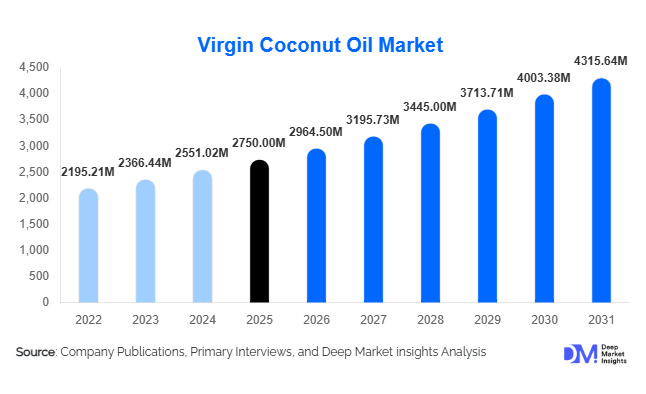
According to Deep Market Insights, the global virgin coconut oil market size was valued at USD 2,750 million in 2025 and is projected to grow from USD 2,964.50 million in 2026 to reach USD 4,315.64 million by 2031, expanding at a CAGR of 7.8% during the forecast period (2026–2031). The market growth is primarily driven by rising consumer preference for natural, minimally processed oils, increasing adoption in personal care formulations, and expanding use in functional foods and nutraceuticals.
Key Market Insights
- Demand for organic and clean-label products is accelerating globally, positioning virgin coconut oil as a premium alternative to refined edible oils.
- Personal care and cosmetics applications dominate usage, driven by increasing consumer shift toward plant-based and chemical-free products.
- Asia-Pacific leads global production and consumption, supported by abundant raw material availability and rising domestic demand.
- North America remains a key high-value market, driven by strong retail penetration and health-conscious consumers.
- E-commerce channels are rapidly expanding, improving accessibility and brand visibility across emerging markets.
- Technological advancements in extraction methods are improving yield, quality, and shelf life, enhancing overall market efficiency.
What are the latest trends in the virgin coconut oil market?
Rising Popularity of Functional and Keto-Friendly Ingredients
Virgin coconut oil is increasingly being integrated into functional foods and ketogenic diet products due to its high medium-chain triglyceride (MCT) content. Consumers are actively seeking ingredients that support metabolism, energy levels, and weight management. This trend is particularly strong in North America and Europe, where health-conscious consumers are incorporating VCO into beverages, snacks, and dietary supplements. Food manufacturers are launching fortified products such as protein bars, smoothies, and ready-to-eat meals enriched with coconut oil, expanding its application scope beyond traditional cooking uses.
Shift Toward Sustainable and Ethical Sourcing
Sustainability has become a critical factor influencing purchasing decisions. Consumers are increasingly favoring virgin coconut oil products that are ethically sourced and certified organic. Companies are responding by investing in traceability systems, fair trade certifications, and eco-friendly packaging solutions. Sustainable sourcing not only enhances brand value but also ensures long-term supply stability. Additionally, brands are promoting transparent supply chains that highlight farmer partnerships and environmentally responsible production practices, strengthening consumer trust and loyalty.
What are the key drivers in the virgin coconut oil market?
Growing Health Awareness and Natural Product Demand
Increasing awareness of lifestyle diseases and the benefits of natural products is a major driver of the virgin coconut oil market. Consumers are shifting away from chemically processed oils toward natural alternatives that offer nutritional and therapeutic benefits. Virgin coconut oil’s antimicrobial, antioxidant, and metabolism-boosting properties make it highly appealing across food and wellness segments. This shift is further supported by rising adoption of clean-label products globally.
Expansion of Natural Personal Care Industry
The rapid growth of the global natural cosmetics industry is significantly boosting demand for virgin coconut oil. It is widely used in hair care, skincare, and cosmetic formulations due to its moisturizing and anti-inflammatory properties. As consumers increasingly avoid synthetic chemicals, manufacturers are reformulating products using plant-based ingredients, with VCO emerging as a key component. This trend is especially prominent in premium skincare and organic beauty segments.
What are the restraints for the global market?
High Product Cost Compared to Conventional Oils
Virgin coconut oil is relatively expensive due to labor-intensive extraction processes and limited scalability. This pricing premium restricts its adoption among price-sensitive consumers, particularly in developing markets. While demand remains strong in premium segments, widespread penetration is constrained by affordability challenges.
Supply Chain and Climatic Vulnerabilities
The production of coconut-based products is highly dependent on climatic conditions. Natural disasters, pests, and seasonal variations can significantly impact coconut yields, leading to supply shortages and price volatility. This unpredictability poses a challenge for manufacturers in maintaining a consistent supply and stable pricing.
What are the key opportunities in the virgin coconut oil industry?
Expansion in Emerging Markets
Emerging economies such as India, Indonesia, and African nations present strong growth opportunities due to rising disposable incomes and increasing awareness of health benefits. Governments in these regions are also promoting agro-processing industries, creating favorable conditions for domestic production and export expansion. Companies can leverage localized supply chains and targeted marketing strategies to tap into these high-growth markets.
Integration into Nutraceuticals and Wellness Products
The growing global nutraceutical market offers significant opportunities for virgin coconut oil manufacturers. Its incorporation into supplements, capsules, and fortified foods is gaining traction among fitness enthusiasts and aging populations. This diversification into health-focused products allows companies to expand beyond traditional applications and access high-margin segments.
Report Scope
| Report Metric | Details |
|---|---|
| Market Size in 2025 | USD 2750 Million |
| Market Size in 2026 | USD 2964.50 Million |
| Market Size in 2031 | USD 4315.64 Million |
| CAGR | 7.8% (2026-2031) |
| Base Year for Estimation | 2025 |
| Historical Data | 2022-2024 |
| Forecast Period | 2026-2031 |
| Report Coverage | Revenue Forecast, Competitive Landscape, Supply Chain Disruption, Growth Factors, Environment & Regulatory Landscape and Trends |
| Geographies Covered | North America, Europe, APAC, Middle East and Africa, LATAM |
| Countries Covered | U.S., Canada, U.K., Germany, France, Spain, Italy, Russia, Nordic, Benelux, Rest of Europe, China, Korea, Japan, India, Australia, Singapore, Taiwan, South East Asia, Rest of Asia-Pacific, UAE, Turky, Saudi Arabia, South Africa, Egypt, Nigeria, Rest of MEA, Brazil, Mexico, Argentina, Chile, Colombia, Rest of LATAM |
Explore more data points, trends and opportunities Download Free Sample Report
Product Type Insights
Cold-pressed virgin coconut oil continues to dominate the global market, accounting for approximately 48% of the total market share in 2025. This segment’s leadership is primarily driven by strong consumer preference for minimally processed, nutrient-rich oils that retain natural aroma, antioxidants, and medium-chain triglycerides (MCTs). The clean-label movement and increasing awareness around chemical-free food and personal care ingredients have further reinforced demand for cold-pressed variants, particularly in North America and Europe. Additionally, premium pricing and strong brand positioning in organic retail channels contribute to its value dominance. Centrifuge-extracted virgin coconut oil is witnessing growing adoption in industrial and large-scale applications due to its higher extraction efficiency and consistency in quality, making it suitable for cosmetics and food manufacturing. Meanwhile, fermentation-based oils occupy a niche but steadily growing segment, particularly among specialty organic consumers seeking traditional and artisanal production methods. The continued innovation in extraction technologies and increasing certification standards are expected to further strengthen the dominance of cold-pressed oils globally.
Application Insights
The personal care and cosmetics segment leads the application landscape, contributing approximately 38% of the global market share in 2025. This dominance is driven by the widespread use of virgin coconut oil in hair care products, skin moisturizers, anti-aging formulations, and natural cosmetics. The shift away from synthetic chemicals toward plant-based and sustainable ingredients has significantly accelerated demand in this segment. Additionally, the growing global beauty and personal care market, particularly in Asia-Pacific and North America, continues to drive volume consumption. The food and beverage segment follows closely, supported by increasing adoption of virgin coconut oil in functional foods, ketogenic diets, and clean-label cooking oils. Rising consumer awareness regarding heart health and natural fats is boosting its use in premium edible oil categories. Pharmaceutical and nutraceutical applications are emerging as high-growth segments, driven by increasing demand for immune-boosting supplements, anti-inflammatory formulations, and therapeutic products. This diversification across applications is strengthening the overall market resilience and expanding revenue streams.
Distribution Channel Insights
B2C distribution channels dominate the virgin coconut oil market, accounting for nearly 60% of the total market share. This dominance is fueled by the increasing availability of products through supermarkets, hypermarkets, specialty organic stores, and rapidly expanding e-commerce platforms. The growth of online retail has been particularly transformative, enabling consumers to access a wide range of brands, compare prices, and make informed purchasing decisions. Digital marketing, influencer promotions, and direct-to-consumer (D2C) strategies are further accelerating online sales. Specialty health and organic stores also play a crucial role in driving premium product adoption, especially in developed markets. On the other hand, B2B channels, including bulk supply to food processors, cosmetic manufacturers, and pharmaceutical companies, remain significant contributors but hold a comparatively smaller share. The increasing integration of omnichannel strategies and improvements in global logistics networks are expected to further enhance distribution efficiency and market penetration.
End-Use Industry Insights
Household consumption represents a significant portion of demand, accounting for approximately 35% of the global market in 2025. This segment’s growth is driven by increasing use of virgin coconut oil in daily cooking, dietary supplementation, and home-based wellness routines. Consumers are increasingly incorporating VCO into their lifestyles due to its perceived health benefits and versatility. The cosmetics and personal care industry is the fastest-growing end-use segment, with a CAGR exceeding 8.5%, supported by the global shift toward natural, organic, and sustainable beauty products. Rapid product innovation, rising disposable incomes, and growing awareness of chemical-free skincare are key drivers in this segment. The food processing industry continues to expand steadily, integrating VCO into packaged foods, snacks, and functional products. Meanwhile, healthcare and wellness applications are emerging as high-growth areas, driven by increasing use in nutraceuticals, therapeutic oils, and preventive healthcare products. The convergence of food, beauty, and wellness industries is creating new opportunities for cross-sector demand.
Explore more data points, trends and opportunities Download Free Sample Report
Virgin Coconut Oil Market Segmentations
By Product Type
- Cold-Pressed Virgin Coconut Oil
- Centrifuge-Extracted Virgin Coconut Oil
- Fermentation-Based Virgin Coconut Oil
By Application
- Food & Beverage
- Personal Care & Cosmetics
- Pharmaceuticals & Nutraceuticals
- Industrial Applications
By Distribution Channel
- Supermarkets/Hypermarkets
- Specialty Stores (Organic/Natural Stores)
- Online Retail/E-commerce
- Pharmacies/Health Stores
- B2B/Wholesale Distribution
By End-Use Industry
- Household Consumption
- Food Processing Industry
- Cosmetics & Personal Care Industry
- Healthcare & Wellness Industry
Regional Insights
Asia-Pacific
Asia-Pacific dominates the global virgin coconut oil market, holding approximately 42% market share in 2025. The region’s leadership is primarily driven by abundant coconut production in countries such as India, Indonesia, and the Philippines, which ensures a stable raw material supply and cost advantages. India is experiencing robust demand growth due to rising health awareness, increasing urbanization, and government initiatives supporting coconut farming and processing industries. Indonesia and the Philippines serve as major export hubs, supplying large volumes to North America and Europe. Additionally, the expansion of domestic food processing and personal care industries is further boosting regional consumption. The presence of low-cost labor and increasing investments in agro-processing infrastructure are also key growth drivers.
North America
North America accounts for approximately 25% of the global market share, with the United States being the largest contributor. The region’s growth is driven by high consumer awareness regarding health and wellness, strong demand for organic and clean-label products, and widespread adoption of functional foods. The mature retail ecosystem, including supermarkets and e-commerce platforms, supports easy product availability. Additionally, the popularity of ketogenic and plant-based diets has significantly increased the use of virgin coconut oil in food applications. Premium product positioning and strong branding strategies further enhance market growth in this region.
Europe
Europe holds nearly 20% of the global market share, led by countries such as Germany, the UK, and France. The region’s growth is driven by stringent regulatory standards, high demand for certified organic products, and increasing consumer focus on sustainability and ethical sourcing. European consumers are highly inclined toward eco-friendly and fair-trade products, which has encouraged manufacturers to adopt transparent supply chains. Additionally, the expanding natural cosmetics industry and rising adoption of plant-based diets are key drivers supporting market expansion across the region.
Latin America
Latin America represents a smaller but steadily growing market, with Brazil and Mexico emerging as key contributors. Growth in this region is primarily driven by increasing consumer awareness of natural and organic products, rising middle-class incomes, and expanding retail infrastructure. The growing influence of global health trends and increasing imports of premium coconut products are also supporting market development. Additionally, the region’s proximity to coconut-producing countries provides opportunities for supply chain optimization and cost-effective imports.
Middle East & Africa
The Middle East & Africa region is emerging as a promising growth market for virgin coconut oil. Countries such as the UAE and South Africa are leading demand due to rising health awareness, increasing disposable incomes, and expanding modern retail networks. The growing popularity of natural beauty products and wellness trends is further boosting demand in the region. Additionally, Africa holds significant potential as a production base due to favorable climatic conditions for coconut cultivation. Government initiatives aimed at agricultural development and increasing foreign investments in agro-processing are expected to enhance regional production capabilities and support long-term market growth.
Key Players in the Virgin Coconut Oil Market
- Nutiva Inc.
- Vita Coco Company
- Garden of Life LLC
- Spectrum Organics Products LLC
- Barlean’s Organic Oils LLC
- Dr. Bronner’s
- Nature’s Way Products LLC
- NOW Foods
- Greenville Agro Corporation
- Celebes Coconut Corporation
- Healthy Traditions Inc.
- Radha Beauty
- Carrington Farms
- Coco Soul
- Marico Limited