TV Wall Mounts Market Size
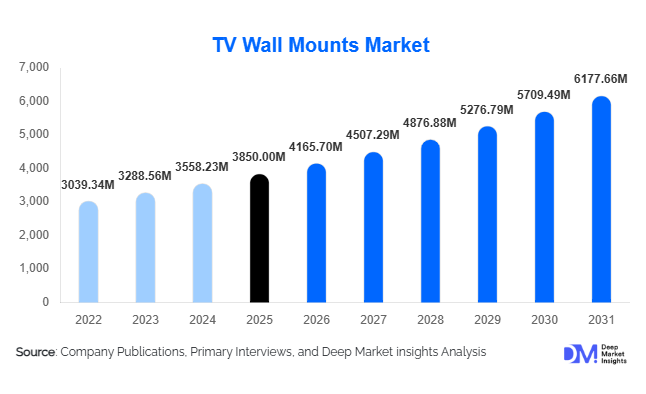
According to Deep Market Insights, the global TV wall mounts market size was valued at USD 3,850 million in 2025 and is projected to grow from USD 4,165.70 million in 2026 to reach USD 6,177.66 million by 2031, expanding at a CAGR of 8.2% during the forecast period (2026–2031). The market growth is primarily driven by the increasing adoption of large-screen and smart televisions, rising urbanization leading to space optimization needs, and growing demand for aesthetically appealing home entertainment setups. Additionally, the expansion of digital signage across commercial sectors such as retail, hospitality, and corporate offices is further accelerating demand for advanced mounting solutions globally.
Key Market Insights
- Full-motion and articulating mounts dominate product demand, driven by their flexibility and enhanced viewing angles for modern living spaces.
- Residential applications account for the majority share, supported by rising home renovation trends and increasing penetration of smart TVs.
- Asia-Pacific leads the global market, fueled by strong manufacturing capabilities and rising consumer electronics demand in China and India.
- Commercial applications are the fastest-growing segment, particularly in digital signage and corporate environments.
- Online distribution channels are rapidly expanding, offering competitive pricing and broader product availability.
- Technological advancements, including motorized and smart mounts, are driving premiumization in developed markets.
What are the latest trends in the TV wall mounts market?
Smart and Motorized Mounts Gaining Traction
The market is witnessing a shift toward smart and motorized wall mounts that can be controlled via mobile apps or voice assistants. These mounts enable automatic adjustment of viewing angles, enhancing user convenience and experience. Integration with smart home ecosystems is becoming a key differentiator, particularly in premium residential and commercial installations. Manufacturers are focusing on IoT-enabled designs that allow remote operation, memory positioning, and energy-efficient functionality. This trend is expected to gain momentum as smart homes become more widespread globally.
Expansion of Digital Signage Applications
The increasing use of digital displays in retail stores, airports, corporate offices, and public infrastructure is driving demand for specialized wall mounts. Multi-screen video walls and heavy-duty mounts are becoming essential for commercial installations. Retailers are leveraging digital signage for customer engagement and advertising, while corporate environments use mounted displays for communication and collaboration. This trend is particularly strong in emerging markets where infrastructure development is accelerating, creating significant growth opportunities for manufacturers.
What are the key drivers in the TV wall mounts market?
Rising Adoption of Large-Screen and Smart TVs
The growing demand for large-screen televisions, particularly those above 55 inches, is a major driver for wall mounts. Consumers are increasingly upgrading to advanced smart TVs, which require sturdy and flexible mounting solutions. Declining prices of large displays and the availability of high-definition content are further supporting this trend, leading to higher adoption of wall-mounted setups globally.
Increasing Focus on Space Optimization and Aesthetics
Urbanization and shrinking living spaces are encouraging consumers to adopt wall-mounted TVs to save floor space and enhance interior aesthetics. Modern consumers prefer minimalist and clutter-free living environments, making wall mounts an essential accessory. This trend is particularly prominent in metropolitan areas across the Asia-Pacific and Europe, where compact housing is common.
What are the restraints for the global market?
High Installation Costs and Complexity
Advanced mounting solutions, such as full-motion and motorized mounts, often require professional installation, increasing overall costs for consumers. The complexity of installation can deter price-sensitive buyers, particularly in developing markets. Additionally, improper installation can lead to safety risks, further limiting adoption among certain consumer segments.
Compatibility and Safety Concerns
Compatibility issues between TV models and mounts, along with concerns about load capacity and wall strength, act as barriers to market growth. Consumers often face challenges in selecting the appropriate mount, leading to hesitation in purchase decisions. Ensuring product standardization and providing clear installation guidelines remain critical for addressing these concerns.
What are the key opportunities in the TV wall mounts industry?
Growth in Emerging Markets
Rapid urbanization and rising disposable incomes in emerging economies such as India, Brazil, and Southeast Asian countries present significant growth opportunities. Increasing adoption of consumer electronics and government initiatives supporting affordable housing are driving demand for space-saving solutions like wall mounts. Manufacturers can expand their presence in these regions through localized production and distribution strategies.
Integration with Smart Home Ecosystems
The growing adoption of smart home technologies creates opportunities for integrating wall mounts with home automation systems. Features such as voice control, app-based adjustments, and automated positioning are gaining popularity among tech-savvy consumers. This integration not only enhances user experience but also allows manufacturers to tap into the premium segment with higher-margin products.
Report Scope
| Report Metric | Details |
|---|---|
| Market Size in 2025 | USD 3850 Million |
| Market Size in 2026 | USD 4165.70 Million |
| Market Size in 2031 | USD 6177.66 Million |
| CAGR | 8.2% (2026-2031) |
| Base Year for Estimation | 2025 |
| Historical Data | 2022-2024 |
| Forecast Period | 2026-2031 |
| Report Coverage | Revenue Forecast, Competitive Landscape, Supply Chain Disruption, Growth Factors, Environment & Regulatory Landscape and Trends |
| Geographies Covered | North America, Europe, APAC, Middle East and Africa, LATAM |
| Countries Covered | U.S., Canada, U.K., Germany, France, Spain, Italy, Russia, Nordic, Benelux, Rest of Europe, China, Korea, Japan, India, Australia, Singapore, Taiwan, South East Asia, Rest of Asia-Pacific, UAE, Turky, Saudi Arabia, South Africa, Egypt, Nigeria, Rest of MEA, Brazil, Mexico, Argentina, Chile, Colombia, Rest of LATAM |
Explore more data points, trends and opportunities Download Free Sample Report
Product Type Insights
Full-motion (articulating) mounts dominate the TV wall mounts market, accounting for approximately 38% of the global share in 2025. The leadership of this segment is primarily driven by increasing consumer preference for flexibility and multi-angle viewing, particularly in modern living spaces and commercial environments. These mounts enable extension, tilt, swivel, and rotation, making them highly suitable for open-plan homes, offices, and retail spaces where viewing positions vary. The rising adoption of larger TVs (above 55 inches) and the growing need for ergonomic viewing are further strengthening demand for full-motion mounts globally. Fixed mounts continue to maintain a strong presence, especially in price-sensitive markets, due to their affordability, ease of installation, and minimalistic design, which appeals to consumers seeking a clean aesthetic. Tilting mounts are widely adopted in residential settings, particularly for bedroom and elevated installations, where glare reduction and slight viewing angle adjustments are required. Meanwhile, motorized mounts are emerging as a premium segment, driven by the integration of smart home technologies and increasing demand for automated, remote-controlled solutions. Growth in this category is particularly strong in North America and parts of Europe, where consumers are willing to invest in advanced home automation systems.
Application Insights
Residential applications lead the market, accounting for approximately 62% of total demand in 2025, primarily driven by the rapid adoption of smart TVs, increasing home renovation activities, and the growing trend of space optimization. Urban households, particularly in Asia-Pacific and Europe, are increasingly shifting toward wall-mounted setups to maximize usable space and enhance interior aesthetics. The surge in streaming services and home entertainment consumption has further accelerated the adoption of mounted displays in living rooms and bedrooms. Commercial applications are the fastest-growing segment, supported by the rapid expansion of digital signage in retail, hospitality, and transportation sectors. Retailers are leveraging wall-mounted displays for advertising and customer engagement, while corporate offices are adopting them for conferencing, collaboration, and hybrid work environments. Additionally, healthcare facilities are using mounted displays for patient communication and monitoring, and educational institutions are integrating them into digital classrooms. Public infrastructure projects, including airports, metro stations, and smart city initiatives, are also contributing significantly to demand, as governments invest in information display systems and passenger communication technologies.
Distribution Channel Insights
Offline retail channels continue to dominate the market, holding approximately 55% share in 2025, driven by consumer preference for physical product evaluation, expert consultation, and bundled installation services. Electronics stores and specialty retailers play a critical role in influencing purchase decisions, particularly for high-value and complex mounting solutions. However, online channels are witnessing rapid growth, fueled by increasing internet penetration, competitive pricing, and the convenience of home delivery. E-commerce platforms are expanding their offerings with detailed product descriptions, compatibility guides, and customer reviews, which help reduce buyer uncertainty. Younger, tech-savvy consumers are increasingly relying on digital platforms for purchasing wall mounts, especially in emerging markets. A key trend shaping this segment is the rise of hybrid distribution models, where manufacturers combine direct-to-consumer online sales with offline service networks for installation and after-sales support. This omnichannel approach is enhancing customer experience and expanding market reach.
End-Use Insights
The residential sector remains the largest end-use segment, supported by the growing demand for modern home entertainment systems and increasing penetration of flat-panel televisions. Rising disposable incomes and the trend toward premium home interiors are encouraging consumers to invest in aesthetically pleasing mounting solutions. The commercial sector, particularly retail and hospitality, is the fastest-growing end-use segment, driven by the increasing adoption of digital signage and interactive displays. The global digital signage market, growing at a CAGR exceeding 9%, is directly influencing demand for advanced wall mounts, especially those designed for multi-screen and heavy-duty applications. Corporate offices are also contributing to growth as they upgrade meeting rooms and collaborative spaces with wall-mounted displays. Emerging applications in healthcare and education are further diversifying the market, with mounted displays being used for telemedicine, patient engagement, and digital learning. Additionally, export-driven demand from manufacturing hubs such as China and Vietnam continues to support global supply chains, ensuring the consistent availability of cost-effective products worldwide.
Explore more data points, trends and opportunities Download Free Sample Report
TV Wall Mounts Market Segmentations
By Product Type
- Fixed Wall Mounts
- Tilting Wall Mounts
- Full-Motion (Articulating) Wall Mounts
- Ceiling Mounts
- Motorized / Automated Wall Mounts
By Application
- Residential
- Commercial
By Distribution Channel
- Online Retail
- Electronics & Specialty Stores
- Hypermarkets & Supermarkets
- Direct-to-Consumer
Regional Insights
North America
North America accounts for approximately 32% of the global market in 2025, with the United States contributing the majority of regional demand. Growth in this region is driven by high adoption of large-screen and ultra-high-definition TVs, widespread penetration of smart home ecosystems, and strong consumer spending on home improvement projects. The increasing popularity of premium home entertainment systems, including home theaters, is boosting demand for advanced mounting solutions such as full-motion and motorized mounts. Canada also contributes significantly, supported by high disposable incomes, rising urban housing developments, and a growing trend of home renovation. Additionally, the presence of leading manufacturers and well-established distribution networks further strengthens market growth in this region.
Asia-Pacific
Asia-Pacific leads the global market with approximately 36% share in 2025, driven by strong demand in China, India, Japan, and Southeast Asia. China dominates both production and consumption, benefiting from large-scale manufacturing capabilities, cost advantages, and a robust electronics supply chain. India is the fastest-growing market in the region, with a CAGR exceeding 10%, fueled by rapid urbanization, rising middle-class income, and increasing penetration of smart TVs. Government initiatives such as housing development programs and digital infrastructure expansion are further accelerating demand. Southeast Asian countries are also witnessing growth due to increasing consumer electronics adoption and expanding retail infrastructure. The region’s growth is further supported by export-oriented manufacturing, making Asia-Pacific a key hub for global supply.
Europe
Europe holds approximately 22% of the global market, with major contributions from Germany, the United Kingdom, and France. Growth in this region is driven by strong consumer demand for premium home entertainment systems, increasing adoption of space-saving solutions in urban housing, and a growing focus on interior aesthetics. The region also benefits from high awareness of product quality and safety standards, leading to increased demand for certified and durable mounting solutions. Additionally, the rising trend of smart homes and energy-efficient living is encouraging the adoption of advanced wall mounts, including motorized and integrated systems. Renovation activities in older residential buildings across Western Europe further contribute to market expansion.
Latin America
Latin America is experiencing moderate growth, led by Brazil and Mexico, which together account for a significant share of regional demand. Growth drivers include improving economic conditions, rising disposable incomes, and increasing consumer spending on electronics. The expansion of organized retail and e-commerce platforms is enhancing product accessibility across the region. Additionally, the growing adoption of digital signage in retail and public infrastructure is supporting commercial demand. Urbanization and the development of modern housing projects are also encouraging the adoption of wall-mounted TV setups, particularly in metropolitan areas.
Middle East & Africa
The Middle East & Africa region is witnessing steady growth, with key markets including the UAE, Saudi Arabia, and South Africa. Growth in the Middle East is driven by large-scale infrastructure development, expansion of the hospitality sector, and increasing investments in smart cities and commercial real estate. High-income populations in the Gulf countries are also contributing to demand for premium and motorized mounting solutions. In Africa, rising urbanization, improving economic conditions, and increasing penetration of consumer electronics are supporting gradual market expansion. Government investments in public infrastructure, including transportation hubs and educational institutions, are further driving demand for display systems and associated mounting solutions.
Key Players in the TV Wall Mounts Market
- Legrand AV
- Vogel’s Products
- Milestone AV Technologies
- LG Electronics
- Samsung Electronics
- Sony Corporation
- Peerless-AV
- AVF Group
- Loctek Ergonomic Technology
- Shenzhen Xinadda
- ZILLA (DWS Inc.)
- Mounting Dream
- VideoSecu
- OmniMount
- Fleximounts