TV Remote Controller Market Size
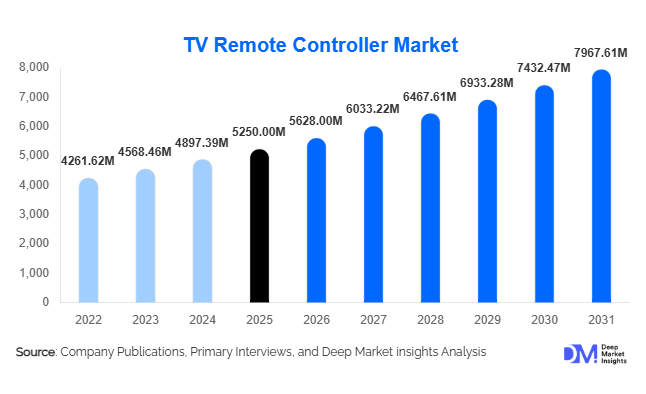
According to Deep Market Insights, the global TV remote controller market size was valued at USD 5,250 million in 2025 and is projected to grow from USD 5,628.00 million in 2026 to reach USD 7,967.61 million by 2031, expanding at a CAGR of 7.2% during the forecast period (2026–2031). The TV remote controller market growth is primarily driven by the increasing adoption of smart televisions, rising consumption of OTT content, and the growing demand for multi-functional and voice-enabled remote devices. As consumer electronics ecosystems evolve, remote controllers are transforming from basic accessories into intelligent control hubs integrated with AI, Bluetooth, and IoT capabilities.
Key Market Insights
- Smart remote controllers are gaining rapid adoption, driven by voice assistants and seamless integration with OTT platforms and smart home devices.
- OEM distribution dominates the market, accounting for a majority share due to bundled remote supply with television units.
- Asia-Pacific leads the global market, supported by strong electronics manufacturing and rising smart TV penetration.
- Aftermarket sales are steadily growing, driven by replacement demand and affordability in emerging economies.
- Bluetooth and RF technologies are replacing traditional IR remotes, offering better connectivity and user experience.
- Minimalist design and multifunctionality are emerging as key consumer preferences globally.
What are the latest trends in the TV remote controller market?
Rise of Voice-Enabled and AI-Powered Remotes
One of the most prominent trends in the TV remote controller market is the growing adoption of voice-enabled remotes integrated with artificial intelligence. Consumers are increasingly seeking hands-free control, driving demand for remotes equipped with voice assistants such as Alexa and Google Assistant. These remotes allow users to search content, control smart home devices, and navigate applications through simple voice commands. AI integration further enhances personalization by learning user preferences and offering tailored recommendations. This trend is particularly strong in North America and Europe, where smart home adoption is high, and premium consumer electronics dominate purchasing behavior.
Shift Toward Universal and Multi-Device Control
With the proliferation of multiple entertainment devices such as streaming sticks, gaming consoles, and home theater systems, there is a growing demand for universal remote controllers. These devices enable users to control multiple systems through a single interface, reducing clutter and improving convenience. Advanced universal remotes now feature learning capabilities, app-based customization, and seamless synchronization with connected devices. This trend is gaining traction globally, particularly in urban households where consumers seek integrated entertainment solutions and simplified user experiences.
What are the key drivers in the TV remote controller market?
Rapid Growth of Smart TV Adoption
The increasing penetration of smart televisions is a primary driver of the TV remote controller market. As smart TVs become more affordable and widely available, demand for advanced remotes with enhanced functionalities has surged. These remotes are essential for navigating streaming platforms, accessing applications, and controlling connected devices, making them a critical component of the modern home entertainment ecosystem.
Expansion of OTT and Digital Content Consumption
The global rise in OTT platforms such as Netflix, Amazon Prime Video, and Disney+ has significantly increased the usage of television systems. This has led to higher wear and tear of remote controllers, boosting replacement demand. Additionally, OTT integration has driven the need for remotes with dedicated shortcut buttons and advanced navigation features, further accelerating market growth.
What are the restraints for the global market?
Increasing Adoption of Smartphone-Based Remote Applications
The availability of mobile applications that replicate remote control functions is reducing reliance on physical remote controllers. Many smart TVs now offer app-based control, allowing users to operate their devices through smartphones. This trend poses a challenge to the traditional remote controller market, particularly among tech-savvy consumers.
Price Sensitivity and Counterfeit Products
In emerging markets, the presence of low-cost and counterfeit remote controllers significantly impacts the profitability of established brands. Price-sensitive consumers often prefer cheaper alternatives, limiting the adoption of premium and technologically advanced remote devices.
What are the key opportunities in the TV remote controller industry?
Integration with Smart Home Ecosystems
The rapid expansion of smart home technologies presents a significant opportunity for remote controller manufacturers. By integrating remotes with smart home ecosystems, companies can position their products as central control units for multiple connected devices, including lighting, security systems, and voice assistants. This integration enhances product value and creates new revenue streams in the premium segment.
Growth in Emerging Markets
Emerging economies in Asia-Pacific, Latin America, and Africa offer substantial growth opportunities due to increasing disposable incomes, urbanization, and rising adoption of consumer electronics. Governments promoting digitalization and local manufacturing are further supporting market expansion in these regions.
Report Scope
| Report Metric | Details |
|---|---|
| Market Size in 2025 | USD 5250 Million |
| Market Size in 2026 | USD 5628 Million |
| Market Size in 2031 | USD 7967.61 Million |
| CAGR | 7.2% (2026-2031) |
| Base Year for Estimation | 2025 |
| Historical Data | 2022-2024 |
| Forecast Period | 2026-2031 |
| Report Coverage | Revenue Forecast, Competitive Landscape, Supply Chain Disruption, Growth Factors, Environment & Regulatory Landscape and Trends |
| Geographies Covered | North America, Europe, APAC, Middle East and Africa, LATAM |
| Countries Covered | U.S., Canada, U.K., Germany, France, Spain, Italy, Russia, Nordic, Benelux, Rest of Europe, China, Korea, Japan, India, Australia, Singapore, Taiwan, South East Asia, Rest of Asia-Pacific, UAE, Turky, Saudi Arabia, South Africa, Egypt, Nigeria, Rest of MEA, Brazil, Mexico, Argentina, Chile, Colombia, Rest of LATAM |
Explore more data points, trends and opportunities Download Free Sample Report
Product Type Insights
Standard infrared (IR) remote controllers continue to dominate the market, accounting for approximately 42% of the global share in 2025, primarily due to their cost-effectiveness, simple technology architecture, and universal compatibility across a wide range of television models. The dominance of IR remotes is further supported by their extensive adoption in entry-level and mid-range television segments, particularly in price-sensitive markets across Asia and Latin America. However, growth in this segment is relatively moderate as technological advancements shift toward more sophisticated alternatives.
Smart and universal remote controllers are emerging as the fastest-growing product categories, driven by increasing consumer demand for integrated and seamless control experiences. The rising penetration of smart TVs and connected devices has accelerated the adoption of remotes with features such as voice control, AI-based personalization, and multi-device compatibility. Bluetooth and RF-based remotes are gaining strong traction in premium segments due to their superior range, faster response time, and ability to function without direct line-of-sight. The key growth driver for these advanced remotes is the expanding smart home ecosystem, where consumers prefer centralized control solutions for multiple devices, positioning smart remotes as a long-term growth engine in the market.
Application Insights
Television-specific remote controllers represent the largest application segment, contributing nearly 55% of the global market share, primarily driven by continuous global television shipments exceeding 200 million units annually. The OEM bundling of remotes with TVs ensures consistent demand, making this segment highly stable and volume-driven. The leading growth driver for this segment is the sustained expansion of smart TV adoption across both developed and emerging economies, where each new television unit directly translates into remote controller demand.
Multi-device remote controllers are the fastest-growing application segment, supported by the increasing complexity of home entertainment systems. Consumers today use multiple devices such as streaming sticks, gaming consoles, and sound systems, creating a strong need for unified control interfaces. These remotes enhance user convenience by reducing device clutter and simplifying navigation. The primary driver for this segment is the rapid proliferation of OTT platforms and connected devices, which is transforming traditional TV viewing into a multi-platform entertainment experience.
Distribution Channel Insights
OEM distribution channels dominate the market, accounting for approximately 60% of total sales, as remote controllers are primarily sold as bundled components with televisions. This dominance is driven by strong partnerships between remote manufacturers and TV brands, ensuring consistent volume demand. The key driver for OEM growth is the steady increase in global TV production, particularly in Asia-Pacific manufacturing hubs, where large-scale production ensures economies of scale and cost efficiency.
The aftermarket segment is witnessing steady growth, fueled by replacement demand, product wear and tear, and consumer preference for affordable alternatives. The increasing availability of universal remotes and compatible third-party products has expanded the aftermarket landscape. E-commerce platforms are playing a transformative role in this segment by providing easy access to a wide variety of products, competitive pricing, and doorstep delivery. The leading driver for aftermarket growth is the rising average lifespan of televisions compared to remote controllers, creating recurring replacement demand.
End-Use Insights
The residential segment leads the market with over 75% share, supported by widespread television ownership, increasing smart home adoption, and growing digital content consumption. The primary growth driver for this segment is the rising penetration of smart TVs and connected devices in households, which increases the need for advanced and multifunctional remote controllers. Additionally, higher engagement with OTT platforms is contributing to frequent usage and replacement cycles of remotes.
The commercial segment, particularly hospitality, is emerging as a high-growth area due to rising investments in hotels, resorts, and serviced apartments that require integrated entertainment solutions. The hospitality industry increasingly demands customized remote controllers for seamless guest experiences, including control over TV, lighting, and room settings. Healthcare and corporate sectors are also contributing to demand by integrating smart TVs for patient engagement, internal communication, and digital displays. The key driver for commercial growth is the expansion of infrastructure and service-oriented industries globally.
Explore more data points, trends and opportunities Download Free Sample Report
TV Remote Controller Market Segmentations
By Product Type
- Standard Infrared (IR) Remote Controllers
- Radio Frequency (RF) Remote Controllers
- Bluetooth Remote Controllers
- Smart / Voice-Enabled Remote Controllers
- Universal Remote Controllers
By Application
- Television-Specific Remote Controllers
- Multi-Device Remote Controllers
- Streaming & OTT Device Control
- Home Theater System Control
By Distribution Channel
- OEM
- Online Retail
- Offline Retail Stores
- Electronics Specialty Stores
By End-Use
- Residential
- Hospitality
- Corporate Offices
- Healthcare Facilities
- Educational Institutions
Regional Insights
North America
North America accounts for approximately 25% of the global market, led by the United States. The region is characterized by high adoption of smart home technologies, premium consumer electronics, and advanced entertainment systems. The primary growth driver in North America is the strong penetration of smart TVs integrated with voice assistants, which fuels demand for AI-enabled and Bluetooth-based remote controllers. Additionally, high disposable income and early adoption of innovative technologies contribute to increased demand for premium remote solutions. The growing ecosystem of connected devices further reinforces the need for multifunctional remotes, making this region a key market for advanced product segments.
Asia-Pacific
Asia-Pacific dominates the market with around 38% share in 2025, driven by countries such as China, India, Japan, and South Korea. China leads both in manufacturing and consumption due to its strong electronics production base and export capabilities. India is one of the fastest-growing markets, supported by rising disposable incomes, rapid urbanization, and increasing affordability of smart TVs. The key growth driver in this region is large-scale consumer electronics manufacturing combined with expanding domestic demand. Government initiatives promoting local production and digitalization are further accelerating market growth, making Asia-Pacific the most dynamic region globally.
Europe
Europe holds nearly 20% of the global market share, with Germany, the UK, and France leading demand. Consumers in this region prioritize high-quality, durable, and energy-efficient products, driving the adoption of advanced remote technologies such as Bluetooth and smart remotes. The primary growth driver in Europe is the strong regulatory focus on energy efficiency and sustainability, encouraging the development of eco-friendly and rechargeable remote controllers. Additionally, the mature consumer electronics market and high smart TV penetration support steady demand across the region.
Latin America
Latin America represents a growing market, with Brazil and Mexico as key contributors. The region is witnessing increasing adoption of consumer electronics, supported by a rising middle-class population and improving economic conditions. The main growth driver in Latin America is the expanding access to affordable smart TVs and digital content platforms, which is boosting demand for both OEM and aftermarket remote controllers. Additionally, the growing presence of e-commerce platforms is improving product accessibility, further supporting market expansion.
Middle East & Africa
The Middle East & Africa region is experiencing steady growth, driven by rapid urbanization and expansion of the hospitality and real estate sectors. Countries such as the UAE and South Africa are leading demand due to increasing investments in smart infrastructure and luxury living spaces. The key growth driver in this region is the rising demand for advanced entertainment systems in hotels, residential complexes, and commercial establishments. Additionally, increasing digitalization and improving access to consumer electronics are contributing to the gradual expansion of the TV remote controller market across the region.
Key Players in the TV Remote Controller Market
- Samsung Electronics
- LG Electronics
- Sony Corporation
- Panasonic Corporation
- Philips
- Logitech
- Universal Electronics Inc.
- Roku Inc.
- Amazon
- Xiaomi Corporation
- TCL Electronics
- Hisense
- Skyworth
- Haier Group
- Sharp Corporation