Triathlon Apparel Market Size
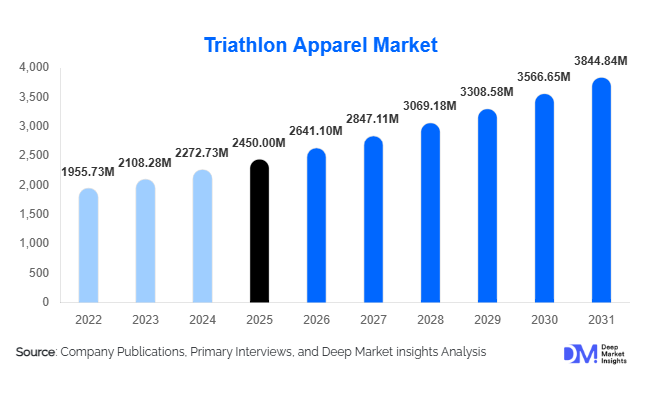
According to Deep Market Insights, the global triathlon apparel market size was valued at USD 2,450 million in 2025 and is projected to grow from USD 2,641.10 million in 2026 to reach USD 3,844.84 million by 2031, expanding at a CAGR of 7.8% during the forecast period (2026–2031). The triathlon apparel market growth is primarily driven by increasing participation in endurance sports, rising health and fitness awareness, and continuous innovation in high-performance sportswear materials. The demand for multifunctional apparel designed for swimming, cycling, and running has expanded beyond professional athletes to include amateur participants and fitness enthusiasts. Additionally, the integration of advanced fabrics such as moisture-wicking, UV-protective, and compression textiles is enhancing product performance and consumer appeal globally.
Key Market Insights
- Triathlon suits dominate the product segment, accounting for nearly 38% of total demand due to their multi-sport functionality and performance advantages.
- Online retail channels lead distribution, contributing over 40% of global sales, driven by direct-to-consumer strategies and e-commerce growth.
- North America dominates the global market, supported by high participation rates and premium product adoption.
- Asia-Pacific is the fastest-growing region, fueled by rising disposable incomes and expanding fitness culture in countries like China and India.
- The mid-range pricing segment holds the largest share, balancing affordability and performance features for mass adoption.
- Sustainability and smart textile integration are emerging as key differentiators among leading brands.
What are the latest trends in the triathlon apparel market?
Rise of Sustainable and Eco-Friendly Apparel
Sustainability is becoming a central trend in the triathlon apparel market, with manufacturers increasingly adopting recycled materials such as ocean plastics and biodegradable fibers. Consumers are actively seeking environmentally responsible products, particularly in developed markets like Europe and North America. Brands are introducing circular economy initiatives, including product recycling programs and low-emission manufacturing processes. This shift is not only enhancing brand positioning but also ensuring compliance with tightening environmental regulations. As sustainability becomes a purchase driver, companies investing in green innovation are gaining a competitive advantage and customer loyalty.
Integration of Smart and Performance-Enhancing Textiles
Technological advancements are transforming triathlon apparel into high-performance gear equipped with smart features. Innovations include sensor-integrated fabrics capable of tracking biometric data such as heart rate, muscle activity, and hydration levels. Additionally, aerodynamic designs and thermoregulation fabrics are improving athletic performance across all three triathlon disciplines. These advancements are particularly appealing to professional athletes and tech-savvy consumers, creating a premium segment within the market. The convergence of wearable technology and apparel is expected to redefine product innovation and open new revenue streams for manufacturers.
What are the key drivers in the triathlon apparel market?
Growing Participation in Endurance Sports
The increasing popularity of triathlons and endurance events is a major growth driver. The expansion of amateur and entry-level competitions has significantly broadened the consumer base. Organized events, fitness communities, and corporate wellness programs are encouraging participation, thereby boosting demand for specialized apparel. This trend is particularly strong in North America and Europe, where triathlon participation rates continue to rise annually.
Advancements in Fabric Technology
Continuous innovation in textile engineering is driving market growth. Features such as compression support, moisture management, UV protection, and seamless construction enhance comfort and performance. These advancements are attracting both professional athletes and recreational users, leading to increased adoption of premium products. Manufacturers investing in R&D can differentiate their offerings and command higher margins.
What are the restraints for the global market?
High Cost of Premium Apparel
Triathlon apparel, particularly premium products, is relatively expensive due to advanced materials and specialized manufacturing processes. This limits accessibility for entry-level consumers and price-sensitive markets, potentially slowing adoption rates in developing regions. The high cost also creates a barrier for new participants entering the sport.
Seasonal and Event-Driven Demand
The market is influenced by seasonal demand patterns, with peak sales aligned with major triathlon events and racing seasons. This creates fluctuations in revenue and challenges in inventory management for manufacturers and retailers. Off-season demand remains relatively lower, impacting overall market stability.
What are the key opportunities in the triathlon apparel industry?
Expansion in Emerging Markets
Emerging economies in the Asia-Pacific and Latin America present significant growth opportunities due to increasing urbanization, rising disposable incomes, and growing awareness of fitness and endurance sports. Countries such as China, India, and Brazil are witnessing a surge in participation, supported by improved sports infrastructure and international event hosting. Companies can tap into these markets by offering affordable and region-specific product lines.
Women-Centric Product Innovation
The growing participation of women in triathlons presents an untapped opportunity for manufacturers. Developing ergonomically designed, performance-oriented apparel tailored specifically for women can drive market expansion. Inclusive sizing, improved comfort, and targeted marketing strategies can further enhance adoption in this segment.
Report Scope
| Report Metric | Details |
|---|---|
| Market Size in 2025 | USD 2450 Million |
| Market Size in 2026 | USD 2641.10 Million |
| Market Size in 2031 | USD 3844.84 Million |
| CAGR | 7.8% (2026-2031) |
| Base Year for Estimation | 2025 |
| Historical Data | 2022-2024 |
| Forecast Period | 2026-2031 |
| Report Coverage | Revenue Forecast, Competitive Landscape, Supply Chain Disruption, Growth Factors, Environment & Regulatory Landscape and Trends |
| Geographies Covered | North America, Europe, APAC, Middle East and Africa, LATAM |
| Countries Covered | U.S., Canada, U.K., Germany, France, Spain, Italy, Russia, Nordic, Benelux, Rest of Europe, China, Korea, Japan, India, Australia, Singapore, Taiwan, South East Asia, Rest of Asia-Pacific, UAE, Turky, Saudi Arabia, South Africa, Egypt, Nigeria, Rest of MEA, Brazil, Mexico, Argentina, Chile, Colombia, Rest of LATAM |
Explore more data points, trends and opportunities Download Free Sample Report
Product Type Insights
Triathlon suits remain the dominant product category, contributing approximately 38% of global revenue in 2025, primarily due to their integrated, multi-functional design that seamlessly supports swimming, cycling, and running. The leading driver for this segment is the growing preference for performance optimization and transition efficiency, as athletes seek apparel that minimizes time loss between disciplines while maximizing aerodynamics and comfort. Continuous innovation in compression fabrics, hydrophobic coatings, and ergonomic paneling further strengthens the adoption of trisuits among both professional and amateur athletes.
Swimwear, including wetsuits and swimsuits, holds a significant share driven by performance enhancement in open-water swimming and regulatory compliance in competitive events. The demand is particularly strong in colder regions where wetsuits are essential. Cycling and running apparel segments are experiencing steady growth, supported by their cross-functional usage in standalone cycling and running activities, expanding their applicability beyond triathlon events. Accessories such as compression socks, visors, and race belts, while contributing a smaller share, are gaining traction due to the increasing focus on marginal performance gains and athlete convenience, particularly among competitive participants.
Application Insights
Professional athletes represent a high-value segment, driving demand for premium, technologically advanced apparel. The primary driver for this segment is the need for performance differentiation through advanced materials and aerodynamic design. However, amateur athletes constitute the largest and fastest-growing segment, accounting for the majority of volume demand. This growth is driven by the rising participation in recreational and entry-level triathlon events, supported by fitness trends and community-based sporting initiatives.
Additionally, triathlon apparel is increasingly being adopted for general fitness, endurance training, and multi-sport workouts. The key driver here is the versatility and durability of triathlon apparel, which allows consumers to use a single product across multiple activities. This crossover application is significantly expanding the addressable market and contributing to consistent demand growth across diverse consumer segments.
Distribution Channel Insights
Online retail channels dominate the triathlon apparel market, accounting for over 40% of total sales. The leading driver for this segment is the rapid expansion of e-commerce platforms combined with direct-to-consumer (D2C) strategies, enabling brands to reach niche audiences globally while offering competitive pricing and broader product assortments. Digital marketing, influencer endorsements, and personalized shopping experiences are further accelerating online adoption.
Specialty sports stores continue to play a crucial role, particularly for premium products, driven by the need for expert guidance, product fitting, and personalized recommendations. Multi-brand retail chains provide accessibility to a wider consumer base, especially in urban centers. Event-based sales during triathlon expos and competitions remain highly influential, as they are driven by the impulse purchasing behavior of participants and immediate product requirements during events, contributing to brand visibility and customer acquisition.
End-Use Insights
Individual athletes, including both professionals and amateurs, represent the primary end-use segment for triathlon apparel. The leading driver for this segment is the increasing global participation in endurance sports and fitness-focused lifestyles. Among these, the amateur segment is growing at the fastest pace, supported by the expansion of entry-level races, corporate wellness programs, and social fitness communities.
Fitness enthusiasts using triathlon apparel for training and recreational purposes are also contributing significantly to demand growth. The key driver here is the shift toward multi-functional and high-performance activewear, which aligns with broader athleisure trends. Export-driven demand remains robust, with Asia acting as a major manufacturing hub. The region’s cost-efficient production capabilities and strong supply chain networks are enabling large-scale exports to North America and Europe, sustaining global market supply.
Explore more data points, trends and opportunities Download Free Sample Report
Triathlon Apparel Market Segmentations
By Product Type
- Triathlon Suits
- Swimwear
- Cycling Apparel
- Running Apparel
- Accessories
By Gender
- Men
- Women
- Unisex
By Price Tier
- Economy (Below $75)
- Mid-range ($75–$200)
- Premium (Above $200)
By Distribution Channel
- Online Retail
- Specialty Sports Stores
- Multi-brand Retail Chains
- Event-based Sales
Regional Insights
North America
North America holds the largest market share at approximately 34% in 2025, with the United States accounting for the majority of demand. The primary growth driver in this region is the high participation rate in triathlon events combined with strong consumer purchasing power, enabling widespread adoption of premium and technologically advanced apparel. The presence of established triathlon organizations, frequent competitive events, and strong brand penetration further supports market growth. Canada also contributes to regional expansion, driven by increasing health awareness and government-supported sports initiatives.
Europe
Europe accounts for around 29% of the global market, led by countries such as the UK, Germany, and France. The key driver for regional growth is the strong cultural inclination toward endurance sports and sustainability-focused consumption. European consumers show a high preference for eco-friendly and performance-oriented apparel, encouraging brands to innovate in sustainable materials. Additionally, stringent environmental regulations and government support for green manufacturing are accelerating the adoption of sustainable triathlon apparel across the region.
Asia-Pacific
Asia-Pacific is the fastest-growing region, with a CAGR exceeding 9%. China, Japan, and Australia are major contributors, while India is emerging as a high-growth market. The primary driver in this region is the rapid urbanization and rising disposable incomes, which are increasing consumer spending on fitness and sports apparel. Additionally, the growing popularity of endurance sports, the expanding middle-class population, and increasing digital penetration are driving demand. Government initiatives promoting sports participation and the expansion of local triathlon events further support regional growth.
Latin America
Latin America accounts for approximately 8% of the market, with Brazil and Mexico leading demand. The key growth driver is the rising interest in international triathlon events and increasing sports participation among younger demographics. Improvements in sports infrastructure and the growing influence of global fitness trends are also contributing to market expansion. Additionally, the emergence of local sporting communities and sponsorship-driven events is supporting the adoption of specialized apparel in the region.
Middle East & Africa
The Middle East & Africa region holds a smaller share of around 5% but is witnessing steady growth. The primary driver is the increasing government investment in sports infrastructure and promotion of fitness initiatives, particularly in countries such as the UAE and South Africa. High disposable incomes in the Middle East are supporting the adoption of premium sportswear, while Africa is benefiting from the growing popularity of endurance events and international competitions. Additionally, the development of sports tourism and global event hosting is further boosting regional demand for triathlon apparel.
Key Players in the Triathlon Apparel Market
- Nike
- Adidas
- Puma
- Under Armour
- Zoot Sports
- 2XU
- Orca
- Castelli
- HUUB
- Zone3
- TYR Sport
- ROKA Sports
- Pearl Izumi
- Decathlon
- Sailfish