Tremolo Harmonica Market Size
According to Deep Market Insights, the global tremolo harmonica market size was valued at USD 1320 million in 2025 and is projected to grow from USD 1387.32 million in 2026 to reach USD 1749.11 million by 2031, expanding at a CAGR of 5.1% during the forecast period (2026–2031). The tremolo harmonica market growth is primarily driven by sustained demand from folk and traditional music genres, rising participation in music education programs, and the growing popularity of affordable, beginner-friendly musical instruments across emerging and developed economies.
Key Market Insights
- Tremolo harmonicas remain one of the most widely adopted entry-level wind instruments, benefiting from low price points, portability, and ease of learning.
- The Asia-Pacific region dominates global demand, driven by the strong cultural relevance in China, Japan, and Southeast Asia.
- Online sales channels are gaining share rapidly, driven by direct-to-consumer brand strategies and growing e-commerce penetration.
- Beginner-grade harmonicas account for the majority of unit sales, while professional-grade models contribute disproportionately to revenue.
- Plastic comb tremolo harmonicas are replacing wood-based models due to durability, moisture resistance, and lower maintenance requirements.
- Market competition remains moderately fragmented, with established global brands maintaining leadership through quality differentiation and brand loyalty.
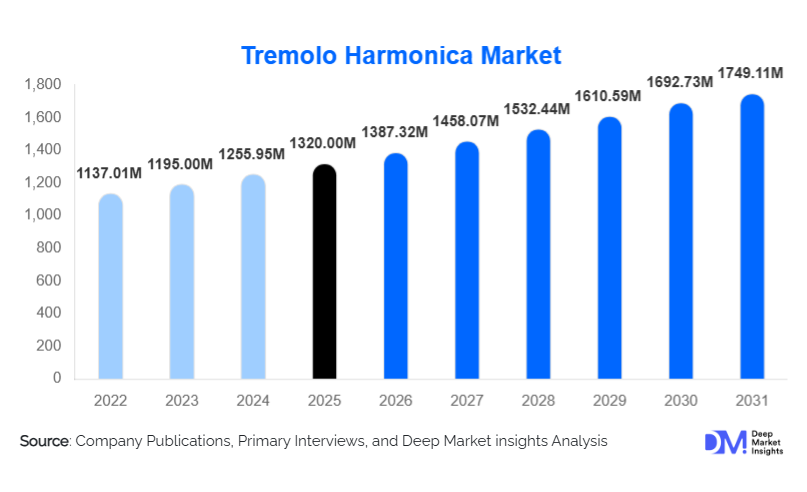
What are the latest trends in the tremolo harmonica market?
Growing Adoption Through Music Education and Hobbyist Learning
One of the most prominent trends in the tremolo harmonica market is its increasing integration into music education curricula and self-learning ecosystems. Schools, community music programs, and private instructors favour tremolo harmonicas due to their affordability and suitability for teaching fundamental music concepts. Additionally, the proliferation of online tutorials, mobile learning apps, and video-based instruction has significantly lowered the entry barrier for beginners. Hobbyist musicians, particularly adults seeking recreational creative outlets, are driving consistent replacement and upgrade demand. This trend is reinforcing volume growth and stabilising long-term consumption patterns across regions.
Material Innovation and Product Durability Improvements
Manufacturers are increasingly focusing on material innovation to improve product lifespan and sound consistency. Plastic and composite combs are gaining popularity over traditional wood due to resistance to swelling, cracking, and moisture damage. Advanced reed alloys, anti-corrosion coatings, and precision CNC machining are improving tonal accuracy and reducing air leakage. These enhancements are encouraging consumers to trade up from low-cost beginner models to mid-range and professional-grade tremolo harmonicas, supporting value growth within the market.
What are the key drivers in the tremolo harmonica market?
Resurgence of Folk and Traditional Music
The revival of folk and traditional music across Europe, Asia, and parts of Latin America is a major growth driver for the tremolo harmonica market. Tremolo harmonicas are integral to many regional music styles, including East Asian folk, Alpine music, and Eastern European traditions. Cultural festivals, heritage preservation initiatives, and regional music competitions continue to stimulate demand for these instruments. Governments and cultural organisations increasingly support traditional music education, indirectly driving institutional procurement of tremolo harmonicas.
Rising Demand for Affordable Musical Instruments
As disposable incomes rise in emerging markets, consumers are increasingly investing in affordable musical instruments for leisure and personal development. Tremolo harmonicas offer an attractive balance between cost and musical richness, making them a preferred choice for first-time learners. Their compact size and minimal maintenance requirements further enhance appeal, particularly in urban households and among students. This driver is especially strong in Asia-Pacific and parts of Eastern Europe.
What are the restraints for the global market?
Competition from Digital and Electronic Music Alternatives
Digital music production tools, mobile applications, and electronic instruments present a significant competitive challenge, particularly among younger demographics. Virtual instruments and music software offer instant gratification and broader creative possibilities, reducing interest in traditional acoustic instruments. This shift limits penetration among Gen-Z consumers and constrains long-term volume growth potential.
Price Sensitivity and Limited Differentiation at Entry Level
The beginner-grade tremolo harmonica segment is highly price-sensitive, with numerous low-cost manufacturers competing primarily on price. Limited product differentiation at the entry level exerts downward pressure on margins and intensifies competition. Brands must invest in quality, branding, and distribution efficiency to avoid commoditization risks.
What are the key opportunities in the tremolo harmonica industry?
Premium and Professional-Grade Product Expansion
There is a growing opportunity to expand the premium segment of the tremolo harmonica market. Professional musicians and serious hobbyists are increasingly willing to pay for superior sound quality, precision tuning, and durable materials. Customised tunings, concert-grade reeds, and ergonomic designs can significantly enhance average selling prices and margins. This segment, while smaller in volume, offers strong profitability and brand differentiation potential.
Emerging Market Penetration Through E-Commerce
E-commerce platforms are enabling manufacturers to access underserved markets in Southeast Asia, Latin America, and Africa. Direct-to-consumer sales reduce reliance on traditional distributors and allow brands to capture higher margins. Localised digital marketing, influencer collaborations, and bundled learning kits present strong opportunities for market expansion in these regions.
Report Scope
| Report Metric | Details |
|---|---|
| Market Size in 2025 | USD 1320 Million |
| Market Size in 2026 | USD 1387.32 Million |
| Market Size in 2031 | USD 1749.11 Million |
| CAGR | 5.1% (2026-2031) |
| Base Year for Estimation | 2025 |
| Historical Data | 2022-2024 |
| Forecast Period | 2026-2031 |
| Report Coverage | Revenue Forecast, Competitive Landscape, Supply Chain Disruption, Growth Factors, Environment & Regulatory Landscape and Trends |
| Geographies Covered | North America, Europe, APAC, Middle East and Africa, LATAM |
| Countries Covered | U.S., Canada, U.K., Germany, France, Spain, Italy, Russia, Nordic, Benelux, Rest of Europe, China, Korea, Japan, India, Australia, Singapore, Taiwan, South East Asia, Rest of Asia-Pacific, UAE, Turky, Saudi Arabia, South Africa, Egypt, Nigeria, Rest of MEA, Brazil, Mexico, Argentina, Chile, Colombia, Rest of LATAM |
Explore more data points, trends and opportunities Download Free Sample Report
Product Type Insights
Double-row tremolo harmonicas dominate the global market, accounting for approximately 52% of total revenue in 2025. Their fuller sound, versatility across musical styles, and suitability for both beginners and professionals drive widespread adoption. Single-row tremolo harmonicas are primarily used in entry-level and educational settings, while octave-tuned tremolo harmonicas serve niche professional and ensemble applications, contributing higher value per unit despite lower volumes.
Material Insights
Plastic comb tremolo harmonicas represent the largest material segment, holding nearly 46% of the global market in 2025. Their durability, moisture resistance, and cost efficiency make them ideal for beginners and institutional buyers. Wood comb harmonicas retain appeal among traditionalists and professional musicians seeking warmer tonal characteristics, while metal comb models remain a premium niche focused on durability and precision.
Distribution Channel Insights
Online marketplaces and brand-owned e-commerce platforms together account for approximately 39% of global tremolo harmonica sales. Consumers increasingly prefer online channels for wider product selection, price comparison, and access to global brands. Offline retail, including music stores and specialty shops, remains important for professional buyers who value hands-on testing and expert guidance, though its share is gradually declining.
End-Use Insights
Individual hobbyist musicians constitute the largest end-use segment, representing about 61% of total demand in 2025. Music education institutions are the fastest-growing segment, supported by government-backed arts education programs and private learning centers. Professional performers contribute a smaller share by volume but generate higher revenue through premium instrument purchases.
Explore more data points, trends and opportunities Download Free Sample Report
Tremolo Harmonica Market Segmentations
By Product Type
- Single-Row Tremolo Harmonicas
- Double-Row Tremolo Harmonicas
- Octave-Tuned Tremolo Harmonicas
By Material Composition
- Plastic Comb Tremolo Harmonicas
- Wood Comb Tremolo Harmonicas
- Metal Comb Tremolo Harmonicas
By Skill Level
- Beginner-Grade Instruments
- Intermediate-Grade Instruments
- Professional / Concert-Grade Instruments
By Distribution Channel
- Offline Music Stores & Specialty Retail
- Online Brand-Owned Websites
- Online Marketplaces
By End-Use
- Individual / Hobbyist Musicians
- Professional Performers & Recording Artists
- Music Education Institutions
- Cultural & Folk Performance Groups
Regional Insights
Asia-Pacific
Asia-Pacific leads the global tremolo harmonica market with an estimated 42% share in 2025. China is the largest single-country market, driven by large-scale manufacturing, strong domestic consumption, and institutional music education demand. Japan and South Korea follow, supported by established music cultures and a preference for high-quality instruments. Southeast Asia is the fastest-growing sub-region, expanding at nearly 7% CAGR.
Europe
Europe accounts for approximately 28% of global demand, led by Germany, Italy, and Eastern European countries, where folk music traditions remain strong. The region shows steady replacement demand and growing interest in premium harmonicas among professional musicians.
North America
North America represents around 17% of the market, driven by hobbyist musicians, folk and blues enthusiasts, and educational use. The United States dominates regional demand, supported by strong e-commerce penetration and brand awareness.
Latin America
Latin America is an emerging market, with Brazil and Mexico showing increasing adoption among younger musicians and cultural groups. Growth is supported by improving access through online retail channels.
Middle East & Africa
This region holds a smaller share but offers long-term potential, particularly through cultural music programs and expanding middle-class populations in select countries.
Key Players in the Tremolo Harmonica Market
- Hohner
- Suzuki Musical Instruments
- Tombo (Lee Oskar)
- Seydel
- Easttop Musical Instruments
- Huang Harmonicas
- Swan Harmonicas
- Kongsheng
- Dabell
- Golden Cup
- Hero Harmonica
- Hering Harmonicas
- Bushman Harmonicas
- Tombo China
- Suzuki Harp China