Travel Size Toiletries Market Size
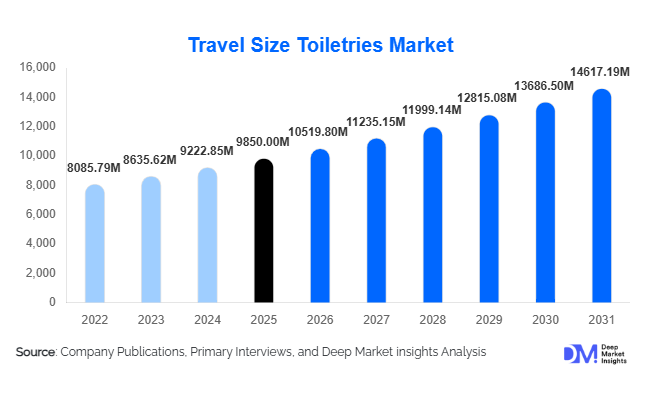
According to Deep Market Insights, the global travel-size toiletries market size was valued at USD 9,850 million in 2025 and is projected to grow from USD 10,519.80 million in 2026 to reach USD 14,617.19 million by 2031, expanding at a CAGR of 6.8% during the forecast period (2026–2031). The market growth is primarily driven by rising global travel frequency, stringent airline liquid regulations, and increasing consumer demand for convenience-oriented personal care products. Travel-sized formats are becoming essential for both leisure and business travelers, while the hospitality sector continues to contribute significantly through bulk procurement of mini toiletries.
Key Market Insights
- Growing global tourism and short-haul travel trends are significantly boosting demand for compact and compliant toiletries.
- Plastic packaging dominates, but sustainability is reshaping the market, with biodegradable and refillable formats gaining traction.
- North America leads the global market, driven by high travel frequency and premium product demand.
- Asia-Pacific is the fastest-growing region, supported by rising middle-class income and domestic tourism growth.
- Online retail channels are expanding rapidly, offering curated travel kits and subscription-based hygiene solutions.
- Hospitality and airline partnerships are emerging as key revenue streams for branded travel-size product manufacturers.
What are the latest trends in the travel-size toiletries market?
Sustainable and Eco-Friendly Packaging Innovation
The shift toward sustainability is one of the most prominent trends shaping the travel-size toiletries market. Increasing environmental awareness and regulatory restrictions on single-use plastics are encouraging manufacturers to adopt biodegradable materials, refillable containers, and recyclable packaging formats. Companies are investing in compostable sachets, paper-based tubes, and reusable travel kits that reduce environmental impact. Hospitality players are also transitioning to bulk dispensers and refillable mini-bottle systems to minimize waste. This trend is particularly strong in Europe and North America, where regulatory frameworks and consumer preferences are aligned toward eco-conscious consumption. Sustainable innovation is not only helping companies meet compliance requirements but also enhancing brand positioning and customer loyalty.
Premiumization and Personalized Travel Kits
Consumers are increasingly seeking premium and personalized travel experiences, extending to their choice of toiletries. High-end skincare, organic formulations, and dermatologist-approved products are being offered in compact formats, targeting affluent and health-conscious travelers. Brands are introducing curated travel kits tailored to specific needs such as long-haul flights, sensitive skin, or wellness travel. Subscription-based models and direct-to-consumer platforms are enabling customization, allowing users to select products based on preferences. This trend is particularly popular among millennials and Gen Z consumers, who value both convenience and brand experience. Premium miniaturization is also being leveraged as a marketing tool to drive product trials and brand engagement.
What are the key drivers in the travel-size toiletries market?
Rising Global Travel and Tourism
The steady increase in international and domestic travel is a major growth driver for the market. The expansion of low-cost airlines, weekend travel culture, and business travel recovery have all contributed to higher demand for portable personal care products. Travel-size toiletries are essential for carry-on luggage compliance, making them a staple purchase for frequent travelers. Emerging economies in the Asia-Pacific and Latin America are witnessing rapid tourism growth, further accelerating demand.
Stringent Airline Liquid Regulations
Aviation security regulations limiting liquid volumes to 100 ml per container have structurally reinforced the need for travel-sized packaging. These regulations have created a consistent and non-substitutable demand for compact toiletries. Manufacturers are designing products specifically to meet compliance standards, ensuring convenience without compromising usability.
Increased Hygiene Awareness
Post-pandemic behavioral shifts have heightened awareness around personal hygiene, especially during travel. Products such as hand sanitizers, disinfectant wipes, and hygiene kits have become essential travel items. Consumers are prioritizing safety and cleanliness, leading to higher adoption of travel-size personal care products across all demographics.
What are the restraints for the global market?
Environmental Concerns Over Single-Use Plastics
Travel-size toiletries often rely on single-use plastic packaging, which contributes significantly to environmental waste. Regulatory pressures and consumer backlash against plastic usage are creating challenges for manufacturers. Companies must invest in sustainable alternatives, which can increase production costs and impact pricing strategies.
Higher Cost Per Unit Volume
Travel-sized products typically have a higher cost per milliliter compared to standard packaging, making them less attractive to price-sensitive consumers. This limits market penetration in developing regions and requires brands to balance affordability with convenience.
What are the key opportunities in the travel-size toiletries industry?
Expansion in Emerging Travel Markets
Rapid growth in domestic and international travel across Asia-Pacific, the Middle East, and Latin America presents significant opportunities. Countries such as India, China, and Indonesia are experiencing rising disposable incomes and increased tourism activity. This creates demand for affordable and mid-range travel toiletries, allowing new entrants to capture untapped markets.
Hospitality and Airline Collaborations
Partnerships with hotels, airlines, and travel operators offer strong growth potential. Branded toiletries provided in hotel rooms or airline kits enhance customer experience while serving as a marketing channel for manufacturers. Premium collaborations with luxury hospitality brands can further elevate brand positioning and drive revenue.
Technological Innovation in Packaging
Advancements in packaging technology, such as leak-proof containers, airless pumps, and smart dispensing systems, are creating opportunities for differentiation. These innovations improve product usability and reduce wastage, appealing to frequent travelers and premium consumers.
Report Scope
| Report Metric | Details |
|---|---|
| Market Size in 2025 | USD 9850 Million |
| Market Size in 2026 | USD 10519.80 Million |
| Market Size in 2031 | USD 14617.19 Million |
| CAGR | 6.8% (2026-2031) |
| Base Year for Estimation | 2025 |
| Historical Data | 2022-2024 |
| Forecast Period | 2026-2031 |
| Report Coverage | Revenue Forecast, Competitive Landscape, Supply Chain Disruption, Growth Factors, Environment & Regulatory Landscape and Trends |
| Geographies Covered | North America, Europe, APAC, Middle East and Africa, LATAM |
| Countries Covered | U.S., Canada, U.K., Germany, France, Spain, Italy, Russia, Nordic, Benelux, Rest of Europe, China, Korea, Japan, India, Australia, Singapore, Taiwan, South East Asia, Rest of Asia-Pacific, UAE, Turky, Saudi Arabia, South Africa, Egypt, Nigeria, Rest of MEA, Brazil, Mexico, Argentina, Chile, Colombia, Rest of LATAM |
Explore more data points, trends and opportunities Download Free Sample Report
Product Type Insights
Hair care products dominate the travel-size toiletries market, accounting for approximately 28% of the total market share in 2025. This segment leads primarily due to its universal necessity across all traveler categories and high frequency of use compared to other personal care items. Products such as shampoo and conditioner miniatures are essential for short- and long-duration travel, making them a staple in both individual purchases and hospitality offerings. Additionally, strict airline liquid restrictions have reinforced the demand for compact hair care formats, as consumers prefer branded, travel-compliant packaging over decanting products manually. The segment is further supported by continuous product innovation, including sulfate-free, organic, and multi-functional formulations such as 2-in-1 shampoo-conditioners, which enhance convenience for travelers.
Skin care products represent the second-largest segment, driven by increasing awareness around personal grooming and skincare routines even during travel. Rising demand for sunscreens, moisturizers, and facial cleansers reflects consumer preference for maintaining skincare regimens irrespective of location. Bath and shower products, including body wash and soaps, hold a strong position due to significant bulk procurement by hotels and airlines, which use these products as part of guest amenity kits. Oral care and personal hygiene products, such as toothpaste, mouthwash, hand sanitizers, and deodorants, are experiencing steady growth fueled by heightened hygiene awareness post-pandemic. These segments are also benefiting from the introduction of compact, spill-proof packaging and growing consumer inclination toward hygiene-focused travel essentials.
Distribution Channel Insights
Supermarkets and hypermarkets continue to dominate the distribution landscape, holding approximately 35% of the total market share in 2025. Their leadership is driven by strong shelf visibility, strategic product placement, and the availability of bundled travel kits that encourage impulse purchases. These retail formats allow consumers to conveniently access multiple product categories under one roof, making them a preferred shopping destination for pre-travel purchases. Additionally, private-label offerings by large retail chains are gaining traction, providing cost-effective alternatives to branded travel-size products.
Online retail is emerging as the fastest-growing channel, supported by increasing digital adoption and the convenience of doorstep delivery. E-commerce platforms are offering curated travel kits, subscription-based hygiene packs, and personalized product selections tailored to specific travel needs. This channel is particularly appealing to younger consumers and frequent travelers who value convenience, variety, and competitive pricing. Travel retail channels, including airports, airlines, and duty-free stores, also play a critical role by capturing last-minute purchases, especially for international travelers. Pharmacies and drugstores remain important distribution points for hygiene-focused products, particularly in urban markets where consumers prioritize trusted and medically approved brands.
End-Use Insights
Leisure travelers represent the largest end-use segment, contributing nearly 40% of total demand in 2025. This dominance is driven by the global rise in tourism, weekend travel culture, and increasing preference for carry-on luggage, which necessitates compact toiletries. Travelers in this segment prioritize convenience, portability, and compliance with airline regulations, making travel-size products indispensable. Additionally, the growing trend of experiential travel and frequent short trips has further reinforced demand within this segment.
The hospitality industry is the fastest-growing end-use segment, expanding at over 7.5% CAGR. Hotels, resorts, and airlines are increasingly investing in branded toiletries to enhance customer experience and strengthen brand identity. Premium and luxury hotels, in particular, are partnering with high-end personal care brands to offer curated in-room amenities, thereby driving bulk demand. Business travelers also contribute significantly, especially in developed regions such as North America and Europe, where frequent corporate travel ensures consistent consumption of travel-size products. Emerging applications, including corporate gifting, wellness kits, and institutional hygiene packs, are creating new growth avenues. Furthermore, export-driven demand from manufacturing hubs in Asia is supporting global supply chains, enabling cost-effective production and distribution.
Explore more data points, trends and opportunities Download Free Sample Report
Travel Size Toiletries Market Segmentations
By Product Type
- Hair Care Products
- Skin Care Products
- Bath & Shower Products
- Oral Care Products
- Personal Hygiene Products
- Others
By Packaging Type
- Bottles
- Tubes
- Sachets
- Aerosol Containers
- Solid/Bar Format
By Distribution Channel
- Supermarkets & Hypermarkets
- Online Retail
- Convenience Stores
- Travel Retail
- Pharmacies & Drugstores
By End-Use
- Leisure Travelers
- Business Travelers
- Hospitality Industry
- Institutional Use
Regional Insights
North America
North America holds approximately 32% of the global market share in 2025, making it the leading regional market. The United States accounts for the majority of this demand, supported by high travel frequency, strong consumer purchasing power, and a well-established retail and e-commerce ecosystem. The region’s growth is driven by the widespread adoption of premium personal care products, frequent business travel, and a strong culture of convenience-oriented consumption. Additionally, the presence of leading global brands and continuous innovation in packaging and product formulations further strengthen market expansion. The increasing popularity of subscription-based travel kits and eco-friendly products is also contributing to sustained growth.
Europe
Europe accounts for around 27% of the global market share, with key countries such as Germany, the United Kingdom, and France driving demand. The region’s growth is strongly influenced by stringent environmental regulations, which are accelerating the adoption of sustainable and biodegradable packaging solutions. European consumers exhibit high awareness of eco-friendly products, encouraging manufacturers to innovate in recyclable and refillable formats. Additionally, strong intra-regional travel within the European Union, supported by well-connected transportation networks, is boosting demand for travel-size toiletries. The presence of a mature hospitality industry and increasing preference for premium and organic products further support market growth.
Asia-Pacific
Asia-Pacific is the fastest-growing region, expanding at over 8.5% CAGR. China and India are the primary growth engines, driven by rising middle-class populations, increasing disposable incomes, and rapid growth in domestic and international tourism. Government initiatives promoting tourism infrastructure development, such as airport expansions and hospitality investments, are further fueling demand. In addition, the region serves as a major manufacturing hub for travel-size toiletries, enabling cost-efficient production and large-scale exports. Japan and South Korea contribute through demand for premium, innovative, and technologically advanced personal care products. The growing influence of e-commerce platforms and digital marketing is also accelerating market penetration across urban and semi-urban areas.
Latin America
Latin America is experiencing gradual but steady growth, with Brazil and Mexico leading regional demand. The expansion of the middle class, increasing regional travel, and improving retail infrastructure are key drivers supporting market growth. Additionally, the growing presence of international retail chains and e-commerce platforms is enhancing product accessibility. Tourism development initiatives and rising awareness of personal hygiene are further contributing to increased adoption of travel-size toiletries. However, price sensitivity among consumers continues to influence demand, favoring mid-range and economy product segments.
Middle East & Africa
The Middle East and Africa region is driven by strong tourism activity and the presence of major transit hubs such as the United Arab Emirates and Saudi Arabia. High passenger traffic through international airports, coupled with a rapidly expanding hospitality sector, is a key driver of demand for travel-size toiletries. Luxury hotels and premium airline services in the region are increasingly offering branded personal care kits, contributing to market growth. In Africa, the tourism industry is gradually expanding, supporting demand for basic and mid-range travel-size products. Government investments in tourism infrastructure and the rise of international travel are expected to further enhance market opportunities across the region.
Key Players in the Travel Size Toiletries Market
- Procter & Gamble
- Unilever
- L’Oréal Group
- Johnson & Johnson
- Colgate-Palmolive
- Beiersdorf AG
- Henkel AG
- Reckitt Benckiser
- Shiseido Company
- Kao Corporation
- Amorepacific Corporation
- Estée Lauder Companies
- Church & Dwight
- Edgewell Personal Care
- Lion Corporation