Travel Bag Market Size
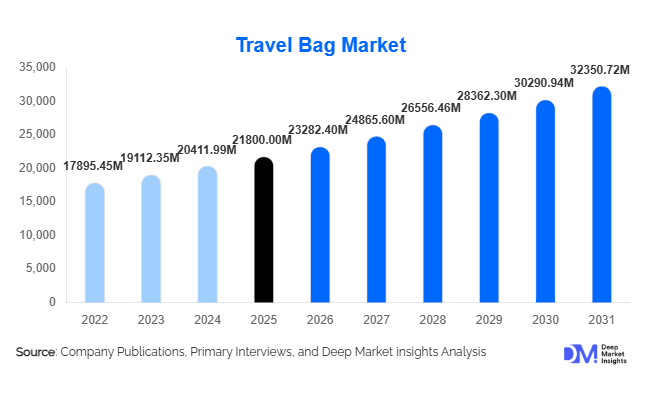
According to Deep Market Insights, the global travel bag market size was valued at USD 21,800 million in 2025 and is projected to grow from USD 23,282.40 million in 2026 to reach USD 32,350.72 million by 2031, expanding at a CAGR of 6.8% during the forecast period (2026–2031). The travel bag market growth is primarily driven by the resurgence of global tourism, rising disposable incomes, and increasing demand for durable, lightweight, and multifunctional travel solutions. The rapid expansion of e-commerce channels and the emergence of smart luggage technologies are further accelerating market penetration across both developed and emerging economies.
Key Market Insights
- Suitcases dominate the market, accounting for nearly 38% share due to increasing air travel and airline baggage standardization.
- Mid-range travel bags lead pricing segments, capturing around 42% of total demand, driven by affordability and quality balance.
- Asia-Pacific dominates the global market, with approximately 34% share, led by China and India.
- Online distribution channels are rapidly expanding, contributing about 35% of total sales globally.
- Sustainable and eco-friendly materials are gaining traction, driven by regulatory pressure and consumer awareness.
- Smart luggage adoption is increasing, integrating features such as GPS tracking, USB charging, and biometric locks.
What are the latest trends in the travel bag market?
Rise of Smart and Connected Luggage
The integration of smart technology into travel bags is transforming the industry landscape. Features such as GPS tracking, digital locking systems, USB charging ports, and weight sensors are increasingly being incorporated into premium luggage. These innovations are particularly appealing to business travelers and tech-savvy consumers who prioritize convenience and security. Airlines and regulatory bodies are also influencing product design, especially regarding battery safety standards for smart luggage. Manufacturers are investing in IoT-enabled travel solutions, which are expected to gradually penetrate mid-range segments as production costs decline.
Growing Demand for Sustainable Materials
Sustainability is emerging as a key trend in the travel bag market. Consumers are increasingly opting for products made from recycled plastics, biodegradable fabrics, and vegan leather alternatives. Brands are responding by launching eco-friendly product lines and adopting circular manufacturing processes. European and North American markets are leading this shift due to stringent environmental regulations and higher consumer awareness. This trend is also influencing branding strategies, with companies highlighting sustainability certifications and ethical sourcing practices to differentiate themselves in a competitive market.
What are the key drivers in the travel bag market?
Expansion of Global Tourism and Air Travel
The recovery and expansion of global tourism are major drivers of the travel bag market. Increasing international and domestic travel volumes, supported by low-cost airlines and improved connectivity, are boosting demand for luggage across all categories. Short-duration travel trends, such as weekend getaways, are further driving demand for compact and carry-on bags.
Shift Toward Lightweight and Multifunctional Products
Consumers are increasingly prioritizing lightweight, durable, and multifunctional travel bags. Innovations such as expandable compartments, ergonomic designs, and high-strength materials like polycarbonate are enhancing product appeal. This trend is particularly strong among younger travelers who value convenience and versatility.
What are the restraints for the global market?
High Price Competition and Market Fragmentation
The presence of numerous local and unorganized players creates intense price competition, especially in emerging markets. This leads to margin pressures for established brands and challenges in maintaining product differentiation.
Volatility in Raw Material Prices
Fluctuations in the prices of raw materials such as polyester, nylon, and plastics significantly impact manufacturing costs. This volatility can lead to inconsistent pricing strategies and reduced profitability for manufacturers.
What are the key opportunities in the travel bag industry?
Smart Luggage and Technology Integration
The adoption of smart features in travel bags presents a significant growth opportunity. As travelers increasingly seek connected experiences, manufacturers can leverage technology to offer differentiated products with higher margins. The integration of IoT, AI, and mobile connectivity is expected to redefine user experience and drive premium segment growth.
Expansion in Emerging Markets
Emerging economies such as India, Brazil, and Southeast Asian countries present strong growth opportunities due to rising middle-class populations and increasing travel frequency. Localized product offerings and competitive pricing strategies can help companies capture these markets effectively.
Report Scope
| Report Metric | Details |
|---|---|
| Market Size in 2025 | USD 21800 Million |
| Market Size in 2026 | USD 23282.40 Million |
| Market Size in 2031 | USD 32350.72 Million |
| CAGR | 6.8% (2026-2031) |
| Base Year for Estimation | 2025 |
| Historical Data | 2022-2024 |
| Forecast Period | 2026-2031 |
| Report Coverage | Revenue Forecast, Competitive Landscape, Supply Chain Disruption, Growth Factors, Environment & Regulatory Landscape and Trends |
| Geographies Covered | North America, Europe, APAC, Middle East and Africa, LATAM |
| Countries Covered | U.S., Canada, U.K., Germany, France, Spain, Italy, Russia, Nordic, Benelux, Rest of Europe, China, Korea, Japan, India, Australia, Singapore, Taiwan, South East Asia, Rest of Asia-Pacific, UAE, Turky, Saudi Arabia, South Africa, Egypt, Nigeria, Rest of MEA, Brazil, Mexico, Argentina, Chile, Colombia, Rest of LATAM |
Explore more data points, trends and opportunities Download Free Sample Report
Product Type Insights
Suitcases remain the leading product segment, accounting for approximately 38% of the global market in 2025. This dominance is primarily driven by the rapid expansion of air travel, increasing standardization of airline baggage requirements, and consumer preference for structured, impact-resistant luggage. The rising adoption of hard-side suitcases made from polycarbonate and ABS materials has further strengthened this segment, as they offer enhanced durability, security, and lightweight performance. Additionally, frequent international travelers and business professionals prefer suitcases for their organized compartments and ease of mobility, particularly with the widespread use of spinner wheels and TSA-approved locking systems.
Backpacks are the fastest-evolving segment, gaining strong traction among millennials, Gen Z travelers, and adventure tourists. Their versatility, ergonomic design, and suitability for both travel and daily use are key growth drivers. Travel backpacks with anti-theft features, USB charging ports, and modular compartments are increasingly popular. Duffel bags and carry-ons continue to witness steady demand, supported by the growing trend of short-duration trips and airline cabin baggage policies that encourage compact and lightweight travel solutions. The increasing popularity of hybrid designs—combining features of backpacks and duffel bags—is also contributing to segment innovation and expansion.
Application Insights
Leisure travel dominates the market, contributing nearly 48% of total demand, driven by the global surge in tourism, rising disposable incomes, and increased preference for experiential travel. The expansion of low-cost airlines and digital travel booking platforms has made leisure travel more accessible, directly boosting demand for travel bags across all price segments. Seasonal travel trends and increasing frequency of vacations are further reinforcing this segment’s leadership.
Business travel, valued at over USD 6,000 million in 2025, is steadily recovering as corporate travel, conferences, and international trade activities resume. This segment is characterized by demand for premium, compact, and highly functional bags, including laptop-compatible luggage and smart carry-ons. Meanwhile, the adventure and outdoor travel segment is the fastest-growing, with a CAGR exceeding 8%, fueled by rising participation in trekking, camping, and sports tourism. This has increased demand for rugged, weather-resistant, and high-capacity travel bags. Export-driven demand also plays a crucial role, particularly from Asian manufacturing hubs supplying cost-efficient products to North America and Europe, thereby supporting global volume growth.
Distribution Channel Insights
Online retail channels account for approximately 35% of global sales and represent the fastest-growing distribution segment. The growth of e-commerce is driven by factors such as convenience, competitive pricing, wider product availability, and access to customer reviews, which significantly influence purchasing decisions. The proliferation of mobile commerce and digital payment systems has further accelerated online adoption, especially in emerging markets.
Offline channels, including specialty luggage stores, department stores, and hypermarkets, continue to play a vital role, particularly for premium and luxury products where consumers prefer physical inspection before purchase. These channels also provide personalized services and brand experience, which are critical for high-value purchases. Increasingly, brands are adopting omnichannel strategies, integrating online and offline platforms to enhance customer engagement, improve inventory management, and provide seamless shopping experiences.
End-User Insights
Leisure travelers represent the largest end-user segment, driven by the sustained growth in global tourism and increasing travel frequency among middle-class populations. This segment demands a wide range of products, from budget-friendly options to premium luggage, depending on travel preferences and destinations. Business travelers form a high-value segment, characterized by demand for durable, lightweight, and technologically advanced bags that cater to professional needs. Features such as laptop compartments, anti-theft systems, and smart connectivity are particularly important for this group. Adventure travelers are significantly influencing product innovation, driving demand for rugged, weatherproof, and high-performance bags designed for extreme conditions. Meanwhile, students and young travelers prefer affordable, stylish, and multifunctional bags that can be used for both travel and daily activities. The increasing diversification of end-user preferences is encouraging manufacturers to expand their portfolios and target niche segments with specialized offerings.
Explore more data points, trends and opportunities Download Free Sample Report
Travel Bag Market Segmentations
By Product Type
- Backpacks
- Suitcases
- Duffel Bags
- Travel Totes & Carry-ons
- Garment Bags
- Laptop & Business Travel Bags
- Specialty Travel Bags
By Application
- Leisure Travel
- Business Travel
- Adventure & Outdoor Travel
- Student & Youth Travel
By Distribution Channel
- Online Retail
- Specialty Luggage Stores
- Department Stores
- Hypermarkets & Supermarkets
- Brand-owned Stores
Regional Insights
Asia-Pacific
Asia-Pacific dominates the global travel bag market with approximately 34% share in 2025, making it the largest regional market. China leads both production and consumption, supported by its strong manufacturing infrastructure, cost advantages, and extensive export capabilities. The presence of large-scale production facilities enables competitive pricing and high-volume output, strengthening its global position.
India is emerging as one of the fastest-growing markets in the region, driven by increasing domestic travel, rising disposable incomes, and government initiatives promoting tourism and infrastructure development. The expansion of low-cost airlines and railway connectivity is further boosting travel frequency. Japan and South Korea contribute significantly through demand for premium, technologically advanced, and high-quality travel products. Additionally, the rapid growth of e-commerce platforms across APAC is enhancing product accessibility and driving regional market expansion.
North America
North America accounts for around 25% of the global market, with the United States being the dominant contributor, representing nearly 20% of global demand. The region’s growth is driven by high disposable income, frequent business and leisure travel, and a strong preference for premium and branded luggage.
Technological adoption is a key driver in this region, with increasing demand for smart luggage featuring GPS tracking, charging ports, and enhanced security systems. Sustainability trends are also influencing purchasing decisions, with consumers favoring eco-friendly materials and ethical manufacturing practices. Additionally, the presence of established global brands and strong retail infrastructure further supports market growth in North America.
Europe
Europe holds approximately 22% market share, led by major economies such as Germany, the United Kingdom, and France. The region is characterized by a mature market structure with high demand for premium, durable, and sustainably manufactured travel bags.
Stringent environmental regulations and strong consumer awareness are driving the adoption of eco-friendly materials and sustainable production practices. Europe’s well-developed tourism sector, including both inbound and outbound travel, significantly contributes to market demand. Additionally, increasing preference for luxury travel and designer luggage is supporting growth in the premium segment.
Latin America
Latin America is experiencing moderate growth, driven by expanding middle-class populations and increasing travel activity in countries such as Brazil and Mexico. Economic development and improving transportation infrastructure are facilitating higher travel frequency, thereby supporting demand for travel bags.
The region is largely price-sensitive, with strong demand for mid-range and economy products. However, the growing influence of global brands and e-commerce platforms is gradually shifting consumer preferences toward higher-quality and branded products. Tourism development initiatives and international travel growth are expected to further boost market expansion in the coming years.
Middle East & Africa
The Middle East & Africa region is the fastest-growing market, with a CAGR exceeding 8% during the forecast period. Growth in the Middle East is primarily driven by countries such as the UAE and Saudi Arabia, which are investing heavily in tourism infrastructure, including airports, airlines, and hospitality sectors. These investments are significantly increasing travel volumes and, consequently, demand for travel accessories.
In Africa, rising intra-regional travel and improving connectivity are contributing to market growth. The expansion of tourism in countries such as South Africa, Kenya, and Morocco is also driving demand. Additionally, increasing urbanization and a growing young population are supporting long-term market potential in the region.
Key Players in the Travel Bag Market
- Samsonite International
- VIP Industries
- American Tourister
- Tumi Holdings
- Delsey
- Briggs & Riley
- Travelpro
- Victorinox
- Rimowa
- Antler
- Wildcraft India
- Safari Industries
- Eagle Creek
- Herschel Supply Co.
- IT Luggage