Trail Cameras Market Size
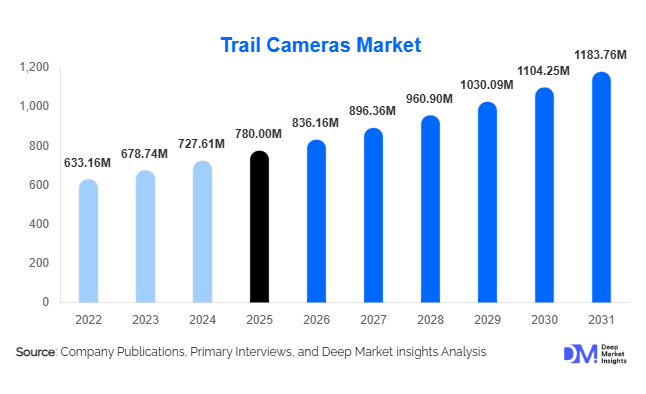
According to Deep Market Insights, the global trail cameras market size was valued at USD 780 million in 2025 and is projected to grow from USD 836.16 million in 2026 to reach USD 1,183.76 million by 2031, expanding at a CAGR of 7.2% during the forecast period (2026–2031). The trail cameras market growth is primarily driven by the rising adoption of remote monitoring technologies across wildlife conservation, hunting, agriculture, and security applications. Increasing demand for real-time surveillance through cellular-enabled devices, along with advancements in AI-powered motion detection and cloud integration, is significantly enhancing the functionality and value proposition of trail cameras.
Key Market Insights
- Cellular-enabled trail cameras are witnessing strong adoption, enabling real-time image transmission and remote monitoring across applications.
- Wildlife monitoring and hunting remain the dominant applications, collectively accounting for a significant portion of global demand.
- North America dominates the market, supported by a strong hunting culture and technological adoption.
- Asia-Pacific is the fastest-growing region, driven by agricultural modernization and rising awareness of surveillance technologies.
- Mid-range priced cameras (USD 100–300) lead the market, offering a balance between affordability and advanced features.
- Technological advancements such as AI analytics and solar-powered devices are reshaping product innovation and customer preferences.
What are the latest trends in the trail cameras market?
AI and Smart Connectivity Integration
Trail cameras are increasingly integrating artificial intelligence and IoT connectivity to enhance functionality. AI-enabled features such as species recognition, motion filtering, and smart alerts are improving accuracy and reducing false triggers. Cellular connectivity allows real-time data transmission, enabling users to monitor remote locations without physical access. Cloud-based storage and mobile applications further enhance usability by offering instant access to captured images and videos. These advancements are transforming trail cameras from simple recording devices into intelligent monitoring systems, expanding their applications into security, infrastructure monitoring, and smart agriculture.
Shift Toward Solar-Powered and Energy-Efficient Devices
Energy efficiency is becoming a key focus area, with solar-powered trail cameras gaining traction, particularly in remote and off-grid locations. These devices reduce dependency on disposable batteries, lowering operational costs and environmental impact. Manufacturers are investing in improved battery life, hybrid power solutions, and rugged designs to ensure long-term usability. This trend aligns with global sustainability goals and is particularly relevant for wildlife monitoring and conservation projects where frequent maintenance is not feasible.
What are the key drivers in the trail cameras market?
Rising Demand for Wildlife Monitoring and Conservation
Governments, NGOs, and research organizations are increasingly deploying trail cameras for wildlife tracking and ecosystem monitoring. These devices provide non-invasive observation capabilities, making them essential tools for biodiversity conservation. Increased funding for environmental protection and anti-poaching initiatives is further driving demand, particularly for high-resolution and durable cameras.
Growing Adoption in Security and Surveillance
Trail cameras are being widely used for residential and commercial security, especially in rural and remote areas. Their motion detection capabilities, cost-effectiveness, and ease of installation make them an attractive alternative to traditional surveillance systems. Rising concerns over property security and the need for off-grid monitoring solutions are contributing significantly to market growth.
Technological Advancements Enhancing Product Value
Continuous innovation in imaging technology, trigger speed, and connectivity is improving product performance. Features such as faster trigger speeds, higher megapixel resolution, and smartphone integration are enhancing the user experience. These advancements are encouraging consumers to upgrade to newer models, driving market expansion.
What are the restraints for the global market?
High Cost of Advanced Trail Cameras
Premium trail cameras with cellular connectivity, AI features, and high-resolution imaging are relatively expensive, limiting their adoption among price-sensitive consumers. This is particularly challenging in emerging markets where affordability remains a key concern.
Connectivity Limitations in Remote Areas
While cellular trail cameras offer real-time monitoring, their effectiveness is dependent on network availability. Limited connectivity in remote forests and rural regions restricts functionality, posing a challenge for widespread adoption.
What are the key opportunities in the trail cameras industry?
Expansion into Emerging Markets
Emerging economies in the Asia-Pacific, Latin America, and Africa present significant growth opportunities due to increasing investments in agriculture and wildlife conservation. Rising disposable incomes and growing awareness of surveillance technologies are further driving demand in these regions.
Integration with Smart Agriculture Systems
The adoption of precision agriculture and smart farming practices is creating new opportunities for trail cameras. Farmers are using these devices to monitor livestock, detect intrusions, and manage crops more effectively. Integration with IoT platforms can further enhance their utility, opening new revenue streams for manufacturers.
Development of Eco-Friendly and Solar Solutions
Growing environmental concerns are driving demand for sustainable products. Solar-powered and energy-efficient trail cameras are gaining popularity, particularly for long-term deployments in remote areas. Companies focusing on green innovations are likely to gain a competitive edge.
Report Scope
| Report Metric | Details |
|---|---|
| Market Size in 2025 | USD 780 Million |
| Market Size in 2026 | USD 836.16 Million |
| Market Size in 2031 | USD 1183.76 Million |
| CAGR | 7.2% (2026-2031) |
| Base Year for Estimation | 2025 |
| Historical Data | 2022-2024 |
| Forecast Period | 2026-2031 |
| Report Coverage | Revenue Forecast, Competitive Landscape, Supply Chain Disruption, Growth Factors, Environment & Regulatory Landscape and Trends |
| Geographies Covered | North America, Europe, APAC, Middle East and Africa, LATAM |
| Countries Covered | U.S., Canada, U.K., Germany, France, Spain, Italy, Russia, Nordic, Benelux, Rest of Europe, China, Korea, Japan, India, Australia, Singapore, Taiwan, South East Asia, Rest of Asia-Pacific, UAE, Turky, Saudi Arabia, South Africa, Egypt, Nigeria, Rest of MEA, Brazil, Mexico, Argentina, Chile, Colombia, Rest of LATAM |
Explore more data points, trends and opportunities Download Free Sample Report
Product Type Insights
Cellular trail cameras dominate the market, accounting for approximately 58% of the global share in 2025. This leadership is primarily driven by the increasing need for real-time monitoring, remote accessibility, and instant data transmission, particularly across wildlife research, security, and farm surveillance applications. The integration of 4G/5G connectivity, cloud storage, and mobile app control has significantly enhanced the usability and operational efficiency of these devices, making them the preferred choice for both professional and commercial users. Additionally, declining data costs and improved network infrastructure in developed markets have further accelerated adoption. Non-cellular cameras, while technologically simpler, continue to maintain steady demand among budget-conscious consumers and users operating in low-connectivity regions. Their lower upfront cost, ease of use, and reliability in remote environments without network dependency ensure their continued relevance, especially in emerging markets and recreational hunting segments.
Application Insights
Hunting and game tracking represent the largest application segment, contributing around 40% of the market share. This dominance is driven by strong cultural acceptance of hunting in regions such as North America and parts of Europe, coupled with the need for efficient wildlife tracking and scouting tools. Hunters increasingly rely on trail cameras for pattern recognition, animal movement tracking, and habitat analysis, which enhances hunting efficiency and success rates. Wildlife monitoring is another key segment, supported by rising global investments in biodiversity conservation, ecological research, and anti-poaching initiatives. Governments and NGOs are deploying large-scale camera networks to track endangered species and monitor ecosystems. Meanwhile, the security and surveillance segment is the fastest-growing, driven by increasing demand for cost-effective, off-grid monitoring solutions in rural properties, construction sites, and agricultural lands. The versatility of trail cameras in detecting motion and capturing high-quality images in low-light conditions is expanding their adoption across non-traditional applications.
Distribution Channel Insights
Online retail channels lead the market with approximately 55% share, reflecting the rapid growth of e-commerce and direct-to-consumer (D2C) sales models. Consumers increasingly prefer online platforms due to wider product availability, competitive pricing, access to customer reviews, and convenience. Manufacturers are also leveraging their own websites and digital marketing strategies to build brand loyalty and improve margins by bypassing intermediaries. Subscription-based services, bundled data plans for cellular cameras, and online-exclusive product launches are further strengthening this channel. Offline channels, including specialty outdoor stores, hunting equipment retailers, and electronics outlets, continue to play a critical role in hands-on product demonstrations, customer education, and after-sales support. These channels are particularly important for first-time buyers and professional users who require technical guidance before purchase.
Price Range Insights
The mid-range segment (USD 100–300) dominates the market with nearly 48% share, driven by its ability to offer an optimal balance between affordability and advanced functionality. These cameras typically include features such as HD image resolution, moderate trigger speeds, and basic connectivity options, making them highly attractive to both recreational and semi-professional users. The segment benefits from high-volume sales and broad consumer appeal, particularly in developed markets. Premium products are gaining traction as technological advancements such as AI-based analytics, cellular connectivity, and solar power integration become more accessible. These high-end models are preferred by professional wildlife researchers, security operators, and commercial users who prioritize performance and reliability. On the other hand, economy models remain relevant in price-sensitive markets, serving entry-level users and contributing to overall market penetration.
Explore more data points, trends and opportunities Download Free Sample Report
Trail Cameras Market Segmentations
By Product Type
- Cellular Trail Cameras
- Non-Cellular Trail Cameras
By Application
- Wildlife Monitoring & Research
- Hunting & Game Tracking
- Security & Surveillance
- Agriculture & Farm Monitoring
By Distribution Channel
- Online Retail
- Specialty Outdoor Stores
- Electronics Retail Stores
- Direct-to-Consumer (Brand Websites)
By Price Range
- Economy (Below USD 100)
- Mid-Range (USD 100–300)
- Premium (Above USD 300)
Regional Insights
North America
North America holds the largest share of the trail cameras market at approximately 38% in 2025, with the United States accounting for the majority of demand. The region’s dominance is driven by a well-established hunting culture, high disposable income, and strong adoption of advanced outdoor technologies. The presence of large private lands and wildlife reserves further supports the use of trail cameras for both recreational and professional purposes. Additionally, increasing demand for rural property surveillance and farm monitoring is expanding the application scope. Canada also contributes significantly, driven by extensive forest areas, government-backed wildlife conservation programs, and growing participation in outdoor recreational activities.
Europe
Europe accounts for around 27% of the market share, with key countries such as Germany, France, and the UK leading demand. Growth in this region is primarily supported by strict environmental regulations, strong conservation frameworks, and widespread use of trail cameras in ecological research. European governments and research institutions активно deploy these devices for biodiversity monitoring and habitat management. Additionally, increasing awareness of farm security and crop protection is driving adoption in the agricultural sector. The region also benefits from a growing interest in outdoor activities and wildlife observation, further supporting market expansion.
Asia-Pacific
Asia-Pacific is the fastest-growing region, with a CAGR of approximately 9%, driven by rapid economic development and expanding application areas. China, India, and Australia are key markets, where demand is fueled by agricultural modernization, increasing need for farm and livestock monitoring, and rising awareness of wildlife conservation. Government initiatives promoting smart farming and digital agriculture are accelerating adoption, particularly in India and China. Additionally, the expansion of e-commerce platforms and availability of low-cost devices are improving market accessibility. Australia’s strong focus on wildlife research and environmental monitoring also contributes significantly to regional growth.
Latin America
Latin America is witnessing moderate growth, led by Brazil and Mexico. The region’s expansion is driven by increasing agricultural activities, rising need for crop protection, and growing adoption of surveillance technologies in rural areas. Large farmlands and livestock operations create demand for cost-effective monitoring solutions, where trail cameras serve as a practical tool. Additionally, wildlife conservation efforts in biodiversity-rich regions such as the Amazon are supporting adoption. However, economic constraints and limited awareness in some areas may moderate growth compared to other regions.
Middle East & Africa
The Middle East & Africa region is experiencing steady growth, particularly in South Africa and the UAE. Demand is driven by wildlife tourism, conservation initiatives, and increasing investments in protected reserves and national parks. Trail cameras are widely used for monitoring wildlife populations and preventing poaching activities. In the Middle East, rising demand for security and surveillance solutions in remote infrastructure and desert environments is supporting market growth. Additionally, government-led tourism development projects and increasing focus on environmental sustainability are further contributing to the adoption of advanced monitoring technologies across the region.