Trading Card Game Market Size
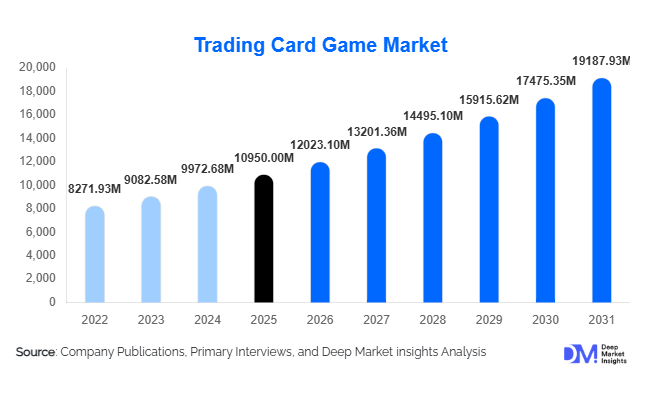
According to Deep Market Insights, the global trading card game market size was valued at USD 10,950 million in 2025 and is projected to grow from USD 12,023.10 million in 2026 to reach USD 19,187.93 million by 2031, expanding at a CAGR of 9.8% during the forecast period (2026–2031). The trading card game market growth is primarily driven by the increasing convergence of gaming and collectibles, rising demand for rare and premium cards as alternative investment assets, and the rapid expansion of digital trading card ecosystems that enhance accessibility and monetization opportunities globally.
Key Market Insights
- Physical trading card games continue to dominate revenue generation, supported by strong collector demand and high-value rare card sales.
- Digital trading card games are witnessing accelerated growth, driven by mobile accessibility, global player engagement, and microtransaction-based revenue models.
- North America leads the global market, with strong consumer spending and an established gaming and collectibles culture.
- Asia-Pacific is the fastest-growing region, fueled by rising digital adoption, expanding middle-class populations, and strong franchise ecosystems.
- Licensed intellectual property-based games remain dominant, leveraging established fan bases across entertainment franchises.
- Blockchain and NFT integration are emerging as transformative technologies, enabling digital ownership and secondary market expansion.
What are the latest trends in the trading card game market?
Rise of Hybrid Physical-Digital Ecosystems
The trading card game market is increasingly shifting toward hybrid models that integrate physical cards with digital gameplay. Companies are embedding QR codes, augmented reality features, and digital redemption systems into physical cards, allowing users to interact across platforms. This convergence enhances engagement, extends gameplay beyond traditional formats, and enables publishers to monetize across multiple channels simultaneously. Hybrid ecosystems also create opportunities for cross-platform tournaments, global matchmaking, and unified player progression systems, making the overall gaming experience more immersive and scalable.
Growing Investment Appeal of Rare Cards
Trading cards are evolving into alternative investment assets, with rare and graded cards commanding premium prices in global secondary markets. Auction platforms, grading services, and collector communities are fueling this trend, attracting high-net-worth individuals and institutional interest. Limited-edition releases and controlled print runs are being strategically used to create scarcity, further driving value appreciation. This trend is transforming the market from a purely entertainment-driven industry into a dual-purpose ecosystem combining gaming and financial investment opportunities.
What are the key drivers in the trading card game market?
Expansion of Digital Gaming Infrastructure
The rapid growth of digital infrastructure, including high-speed internet and mobile gaming platforms, has significantly expanded the reach of trading card games. Digital TCGs enable instant access, global multiplayer engagement, and continuous content updates, making them highly appealing to modern gamers. This accessibility has broadened the player base and introduced new monetization avenues such as in-game purchases and subscription models.
Strong Franchise and Brand Loyalty
Established franchises with strong intellectual property continue to drive consistent demand in the TCG market. Popular franchises attract multi-generational audiences, ensuring sustained engagement and repeat purchases. Companies leverage storytelling, character development, and cross-media integration to strengthen brand loyalty and maintain market dominance.
What are the restraints for the global market?
High Cost of Competitive Participation
The cost of acquiring competitive decks, especially in physical TCGs, remains a significant barrier for new players. Rare and meta-relevant cards often command high prices, limiting accessibility and potentially restricting market expansion among price-sensitive consumers.
Market Saturation and Fragmentation
The increasing number of new trading card game releases has led to market fragmentation, making it challenging for smaller publishers to sustain player engagement. Over-reliance on a few dominant franchises also limits diversity and innovation within the market.
What are the key opportunities in the trading card game industry?
Blockchain-Based Ownership Models
The integration of blockchain technology presents a major opportunity for the trading card game market. Tokenized cards with verifiable ownership enable secure trading and global liquidity, enhancing the value proposition for collectors and investors. This innovation is expected to redefine digital ownership and create new revenue streams for publishers.
Expansion into Emerging Markets
Emerging economies in Asia-Pacific and Latin America offer significant growth potential due to rising disposable incomes and expanding gaming populations. Localization strategies, affordable product offerings, and regional tournaments can help companies tap into these high-growth markets effectively.
Report Scope
| Report Metric | Details |
|---|---|
| Market Size in 2025 | USD 10950 Million |
| Market Size in 2026 | USD 12023.10 Million |
| Market Size in 2031 | USD 19187.93 Million |
| CAGR | 9.8% (2026-2031) |
| Base Year for Estimation | 2025 |
| Historical Data | 2022-2024 |
| Forecast Period | 2026-2031 |
| Report Coverage | Revenue Forecast, Competitive Landscape, Supply Chain Disruption, Growth Factors, Environment & Regulatory Landscape and Trends |
| Geographies Covered | North America, Europe, APAC, Middle East and Africa, LATAM |
| Countries Covered | U.S., Canada, U.K., Germany, France, Spain, Italy, Russia, Nordic, Benelux, Rest of Europe, China, Korea, Japan, India, Australia, Singapore, Taiwan, South East Asia, Rest of Asia-Pacific, UAE, Turky, Saudi Arabia, South Africa, Egypt, Nigeria, Rest of MEA, Brazil, Mexico, Argentina, Chile, Colombia, Rest of LATAM |
Explore more data points, trends and opportunities Download Free Sample Report
Product Type Insights
The global trading card game (TCG) market continues to be structurally anchored by physical trading card games, which account for approximately 62% of the total market share in 2025. This dominance is not merely a reflection of legacy demand but is deeply rooted in the intrinsic value proposition that physical cards offer to consumers. Tangibility remains a critical differentiator, as collectors and players alike derive emotional and financial value from owning physical assets that can be displayed, traded, graded, and preserved over time. The premium pricing dynamics associated with rare and limited-edition card releases further reinforce the segment’s leadership position. Manufacturers have increasingly leveraged scarcity-driven strategies, including limited print runs, serialized cards, and special edition releases, which stimulate demand and create a thriving secondary market ecosystem.Hybrid models are emerging as a transformative innovation within the product type segment, effectively bridging the gap between physical and digital formats. These models leverage technologies such as augmented reality (AR), QR code integration, and companion mobile applications to create interconnected experiences. For instance, physical cards can unlock digital content, while digital achievements can translate into physical rewards. The leading driver behind hybrid adoption is the ability to enhance user engagement by combining the tactile appeal of physical cards with the dynamic interactivity of digital platforms. This convergence is expected to play a pivotal role in shaping the future of the TCG market, as it aligns with evolving consumer expectations for immersive and multi-channel experiences.
Application Insights
Entertainment and recreational gaming remain the cornerstone application of trading card games, supported by a vast and diverse global player base. The segment’s dominance is primarily driven by its accessibility and versatility, as TCGs cater to casual players, hobbyists, and competitive gamers alike. The ease of entry, coupled with continuous content updates and expansions, ensures sustained engagement across different age groups and demographics. Publishers consistently introduce new themes, mechanics, and narratives to maintain player interest and drive repeat purchases.The leading driver for the entertainment segment is the ongoing gamification of social interaction, where trading card games serve as both a recreational activity and a social platform. Local gaming stores, online communities, and organized events foster a sense of belonging and competition, encouraging long-term participation. Additionally, the integration of digital features such as matchmaking systems, leaderboards, and live streaming has amplified the entertainment value of TCGs.The leading driver for esports adoption is the professionalization of gameplay, supported by structured tournament frameworks and digital broadcasting capabilities. Online platforms enable real-time participation and viewership, significantly expanding audience reach. Additionally, the integration of analytics, coaching tools, and performance tracking has enhanced the competitive landscape, attracting serious gamers and fostering a new generation of professional players.
Distribution Channel Insights
E-commerce platforms dominate the distribution landscape, accounting for approximately 38% of the global market share. The shift toward online purchasing has been accelerated by changing consumer preferences, convenience, and the availability of a wide product range. E-commerce platforms provide access to global inventories, competitive pricing, and user reviews, enabling informed purchasing decisions. The ability to pre-order new releases, participate in exclusive drops, and access international markets has further strengthened the position of online channels.The leading driver behind the growth of e-commerce distribution is the digital transformation of retail, supported by advancements in logistics, payment systems, and user experience design. Mobile commerce, personalized recommendations, and subscription-based models have enhanced customer engagement and retention. Additionally, the integration of social commerce and influencer marketing has amplified product visibility and demand.A key growth driver for specialty stores is their ability to cultivate community engagement and provide personalized customer experiences. Knowledgeable staff, curated product offerings, and exclusive events differentiate these stores from generic retail channels. Furthermore, partnerships with publishers and distributors enable specialty stores to access exclusive products and promotional materials, enhancing their competitive advantage.The leading driver for DTC growth is the increasing emphasis on customer-centric business models, where publishers seek to establish direct connections with their audience. Data analytics, targeted marketing, and personalized offerings enable companies to tailor their strategies to individual preferences, enhancing customer satisfaction and lifetime value.
End-User Insights
Adults aged 20–35 represent the largest end-user segment, accounting for approximately 41% of the market. This demographic is characterized by higher disposable income, strong purchasing power, and a deep sense of nostalgia associated with trading card games. Many individuals within this age group grew up playing TCGs and continue to engage with the market as both players and collectors. Their willingness to invest in premium products, rare cards, and collectibles significantly contributes to market revenue.A key growth driver for younger users is the increasing integration of TCGs with digital platforms and gaming ecosystems. Free-to-play models, in-game rewards, and social connectivity enhance engagement and retention among this group. Additionally, collaborations with popular media franchises and influencers resonate strongly with younger audiences, driving adoption.Collectors and investors represent a niche but high-value segment within the TCG market. These individuals focus on acquiring rare, graded, and historically significant cards, often with the intention of long-term value appreciation. The segment is characterized by high transaction values and a strong emphasis on authenticity and condition.The leading driver for this segment is the perception of trading cards as alternative investment assets. Market transparency, price tracking tools, and professional grading services have legitimized the investment potential of TCGs, attracting a diverse range of participants, including institutional investors.
Explore more data points, trends and opportunities Download Free Sample Report
Trading Card Game Market Segmentations
By Product Type
- Physical Trading Card Games
- Digital Trading Card Games
- Hybrid / Phygital Trading Card Games
By Game Franchise Type
- Licensed IP-Based TCGs
- Original / Proprietary TCGs
- Sports-Based Trading Card Games
- Fantasy & Sci-Fi Themed TCGs
- Strategy / Historical / Niche Genre TCGs
By Revenue Model
- Booster Packs Sales
- Starter Decks & Bundles
- Subscription-Based Digital Models
- In-Game Purchases
- Secondary Market
By Distribution Channel
- Specialty Game Stores
- Mass Retail
- E-commerce Platforms
- Direct-to-Consumer
- Digital App Stores / Platforms
By Gameplay Format
- Casual / Kitchen Table Play
- Competitive / Tournament Play
- Online Ranked / Esports Play
Regional Insights
North America
North America accounts for approximately 38% of the global trading card game market, with the United States serving as the primary driver of regional demand. The region benefits from a mature and well-established gaming ecosystem, characterized by a strong culture of organized play, extensive retail networks, and a highly engaged consumer base. The presence of leading publishers, distributors, and event organizers further reinforces market growth.Another critical factor is the robust secondary market infrastructure, including auction houses, online marketplaces, and grading services. These elements create a dynamic ecosystem where trading cards are actively bought, sold, and traded, enhancing market liquidity and value creation. The integration of digital platforms and hybrid models is also gaining traction, further expanding the market.
Asia-Pacific
Asia-Pacific holds approximately 34% of the global market and is the fastest-growing region, with a compound annual growth rate exceeding 11%. The region is characterized by a diverse and rapidly expanding consumer base, supported by increasing urbanization, rising disposable incomes, and technological advancements. Countries such as Japan, China, and South Korea play pivotal roles in driving regional growth.Emerging markets such as India and Southeast Asia are experiencing significant growth due to expanding gaming populations and improving internet connectivity. The increasing availability of affordable smartphones and data plans has made digital gaming more accessible, driving adoption among younger demographics. Additionally, localized content, language support, and culturally relevant themes are enhancing market penetration in these regions.
Europe
Europe accounts for approximately 18% of the global trading card game market, with key contributions from countries such as Germany, France, and the United Kingdom. The region is characterized by a strong community-driven gaming culture, supported by local tournaments, conventions, and hobby stores. The growing interest in collectibles and organized play has contributed to steady market expansion.A primary growth driver in Europe is the increasing popularity of trading cards as both a hobby and an investment. The region has witnessed a surge in demand for graded cards and rare collectibles, supported by a well-developed secondary market. Additionally, the integration of digital platforms and online communities has enhanced accessibility and engagement.Regulatory frameworks and consumer protection standards in Europe also contribute to market stability and transparency, fostering consumer confidence. The region’s emphasis on sustainability and ethical sourcing is influencing production and distribution practices, encouraging innovation within the industry.
Latin America
Latin America represents a growing market for trading card games, with countries such as Brazil and Mexico leading regional demand. The market is characterized by increasing internet penetration, rising disposable incomes, and a growing interest in gaming and entertainment. Digital trading card games are particularly popular in this region, driven by accessibility and affordability.The leading driver in Latin America is the rapid expansion of digital infrastructure, which has enabled broader access to online gaming platforms. Mobile gaming, in particular, has gained significant traction, as smartphones serve as the primary gaming device for many consumers. Additionally, the influence of global gaming trends and media has contributed to increased awareness and adoption of trading card games.Local communities and grassroots initiatives are also playing a crucial role in promoting TCGs, with tournaments and events fostering engagement and brand loyalty. As economic conditions improve, the demand for physical cards and collectibles is expected to rise, further supporting market growth.
Middle East & Africa
The Middle East and Africa region accounts for a smaller but steadily growing share of the global trading card game market. Key markets such as the United Arab Emirates and South Africa are leading regional growth, supported by increasing digital adoption and a growing interest in gaming and collectibles. The region is characterized by a young population and a rapidly evolving digital landscape.A major driver of growth in this region is the expansion of internet connectivity and mobile penetration, which has facilitated access to digital gaming platforms. Government initiatives aimed at promoting digital transformation and innovation are also contributing to market development. Additionally, the rising popularity of esports and online gaming communities is driving engagement and participation.
Key Players in the Trading Card Game Market
- The Pokémon Company
- Konami Group Corporation
- Hasbro Inc.
- Bushiroad Inc.
- Bandai Namco Holdings Inc.
- Blizzard Entertainment
- Tencent Holdings Ltd.
- Square Enix Holdings Co., Ltd.
- Riot Games Inc.
- Sky Mavis
- Animoca Brands
- Upper Deck Company
- Panini Group
- Cryptozoic Entertainment
- Ravensburger AG