Towel Market Size
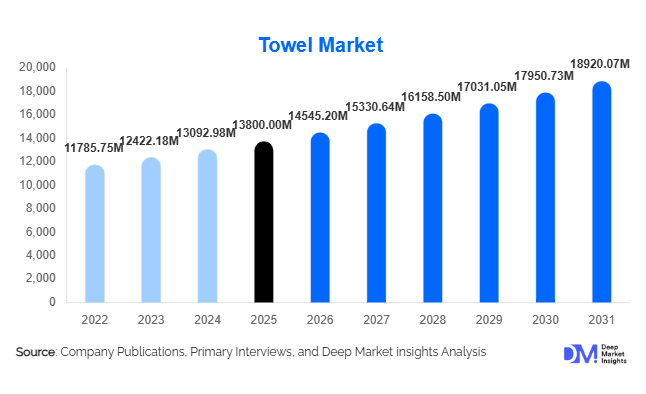
According to Deep Market Insights, the global towel market size was valued at USD 13,800 million in 2025 and is projected to grow from USD 14,545.20 million in 2026 to reach USD 18,920.07 million by 2031, expanding at a CAGR of 5.4% during the forecast period (2026–2031). The towel market growth is primarily driven by rising hygiene awareness, expanding global hospitality infrastructure, and increasing consumer preference for premium and sustainable home textile products.
Key Market Insights
- Cotton-based towels dominate globally, accounting for nearly 65% of total market demand due to superior absorbency and comfort.
- Asia-Pacific leads production and consumption, supported by strong textile manufacturing hubs in China and India.
- Household consumption remains the largest segment, contributing approximately 50% of overall demand.
- Hospitality and institutional demand are growing rapidly, driven by tourism expansion and hotel infrastructure investments.
- Sustainability trends are reshaping product innovation, with growing demand for organic cotton and bamboo towels.
- E-commerce channels are expanding quickly, transforming consumer buying behavior and increasing price transparency.
What are the latest trends in the towel market?
Sustainability and Eco-Friendly Materials Gaining Momentum
The towel market is witnessing a strong shift toward environmentally sustainable materials such as organic cotton, bamboo fibers, and recycled textiles. Consumers, particularly in developed markets, are prioritizing eco-certified products that minimize environmental impact. Manufacturers are increasingly adopting water-efficient dyeing processes and sustainable sourcing practices. Certifications related to organic and fair-trade textiles are becoming key differentiators, while brands are leveraging sustainability as a core marketing proposition to attract environmentally conscious consumers.
Rise of Quick-Dry and Antimicrobial Towels
Technological advancements in textile engineering are driving the adoption of microfiber and blended fiber towels with enhanced properties. Quick-dry, lightweight, and antimicrobial towels are gaining popularity across fitness, travel, and healthcare applications. These innovations improve hygiene, reduce drying time, and enhance durability, making them attractive for both consumers and institutional buyers. The trend is particularly strong in urban markets and among younger consumers seeking convenience-driven products.
What are the key drivers in the towel market?
Growing Hygiene Awareness
Increasing global awareness around personal hygiene has significantly boosted towel consumption across households and institutions. Post-pandemic behavioral shifts have led to more frequent replacement cycles and higher demand for specialized towels, particularly in healthcare and fitness sectors. This trend is expected to sustain long-term demand growth.
Expansion of Hospitality Industry
The rapid growth of the global hospitality sector is a major driver for towel demand. Hotels, resorts, and vacation rentals require consistent and high-volume towel procurement. With global tourism rebounding strongly, institutional demand is expected to remain a key growth pillar, particularly in emerging tourism markets across Asia and the Middle East.
Premiumization in Home Textiles
Consumers are increasingly investing in high-quality home textiles, including luxury towels made from premium cotton and bamboo. Rising disposable incomes and lifestyle upgrades are supporting this trend, particularly in urban regions. Premium towels offer higher margins for manufacturers, contributing positively to overall market value growth.
What are the restraints for the global market?
Volatility in Raw Material Prices
Fluctuations in cotton prices, driven by climatic conditions and agricultural output, pose a significant challenge for manufacturers. Rising raw material costs can compress margins and lead to price instability in the market.
High Market Competition and Price Sensitivity
The towel market is highly competitive, particularly in the economy and mid-range segments. The presence of numerous local and regional players leads to price wars, limiting profitability and making differentiation difficult for manufacturers.
What are the key opportunities in the towel industry?
Growth in Sustainable Product Lines
The increasing demand for eco-friendly products presents a significant opportunity for manufacturers to expand their sustainable product portfolios. Companies investing in organic cotton, bamboo fibers, and recyclable materials can capture premium market segments and strengthen brand positioning.
Rising Demand from Hospitality and Tourism
Expanding tourism infrastructure in emerging economies is creating a strong demand for institutional towel supply. Long-term contracts with hotel chains and resorts offer stable revenue streams and opportunities for scale expansion.
Technological Innovation in Textile Manufacturing
Advancements in textile technologies, including antimicrobial coatings and quick-dry fabrics, are opening new avenues for product differentiation. These innovations are particularly relevant for healthcare and fitness applications, enabling companies to tap into niche but high-growth segments.
Report Scope
| Report Metric | Details |
|---|---|
| Market Size in 2025 | USD 13800 Million |
| Market Size in 2026 | USD 14545.20 Million |
| Market Size in 2031 | USD 18920.07 Million |
| CAGR | 5.4% (2026-2031) |
| Base Year for Estimation | 2025 |
| Historical Data | 2022-2024 |
| Forecast Period | 2026-2031 |
| Report Coverage | Revenue Forecast, Competitive Landscape, Supply Chain Disruption, Growth Factors, Environment & Regulatory Landscape and Trends |
| Geographies Covered | North America, Europe, APAC, Middle East and Africa, LATAM |
| Countries Covered | U.S., Canada, U.K., Germany, France, Spain, Italy, Russia, Nordic, Benelux, Rest of Europe, China, Korea, Japan, India, Australia, Singapore, Taiwan, South East Asia, Rest of Asia-Pacific, UAE, Turky, Saudi Arabia, South Africa, Egypt, Nigeria, Rest of MEA, Brazil, Mexico, Argentina, Chile, Colombia, Rest of LATAM |
Explore more data points, trends and opportunities Download Free Sample Report
Product Type Insights
Bath towels continue to dominate the global towel market, accounting for approximately 35% of total revenue in 2025. Their leadership is primarily driven by universal applicability across both household and institutional settings, including hospitality and healthcare. Higher unit pricing compared to smaller towel categories further strengthens their revenue contribution. The segment is also benefiting from premiumization trends, with consumers increasingly opting for larger, softer, and higher GSM (grams per square meter) bath towels, particularly in developed markets.
Hand towels and face towels collectively represent a significant share, supported by frequent usage cycles and replacement demand driven by daily hygiene practices. These segments benefit from volume sales rather than pricing, making them essential for market stability. Beach and sports towels, while niche, are witnessing strong growth momentum due to rising travel, outdoor recreation, and fitness activities. Innovations such as quick-dry and sand-resistant fabrics are further accelerating their adoption. Kitchen towels maintain a steady demand, driven by both residential usage and commercial food service industries, where hygiene compliance and frequent replacement cycles support consistent consumption.
Material Type Insights
Cotton remains the dominant material segment, contributing nearly 65% of the global market in 2025. Its leadership is driven by superior absorbency, softness, durability, and widespread consumer acceptance. The segment is further strengthened by the availability of premium variants such as Egyptian cotton and organic cotton, which command higher price points and cater to luxury and eco-conscious consumers. Increasing demand for sustainable and skin-friendly products continues to reinforce cotton’s dominance globally.
Microfiber and synthetic materials are the fastest-growing segments, supported by their lightweight nature, quick-dry capabilities, and cost-effectiveness. These materials are particularly popular in sports, travel, and cleaning applications, where performance and convenience are key purchasing factors. Bamboo towels are emerging as a strong alternative within the sustainable segment, driven by their natural antibacterial properties and environmental benefits. Blended fabrics are also gaining traction, offering a balance between performance and affordability, especially in mid-range product categories.
Distribution Channel Insights
Offline retail channels dominate the towel market, accounting for approximately 60% of total sales in 2025. This dominance is driven by consumer preference for physically evaluating textile products in terms of texture, thickness, and quality before purchase. Supermarkets, hypermarkets, and specialty home textile stores play a crucial role in driving sales, particularly in emerging markets where traditional retail remains strong.
However, online retail is the fastest-growing distribution channel, driven by increasing internet penetration, convenience, and access to a wider product range. E-commerce platforms are enabling price comparison, customer reviews, and direct-to-consumer sales models, which are reshaping purchasing behavior. The growth of online channels is particularly strong in urban areas and among younger consumers, with premium and niche products gaining visibility through digital platforms.
End-Use Insights
The household segment leads the global towel market, contributing approximately 50% of total demand in 2025. This dominance is driven by continuous replacement cycles, population growth, and increasing awareness of hygiene standards. Rising disposable incomes are also encouraging consumers to upgrade to higher-quality and premium towels, further supporting segment growth.
The hospitality sector is the fastest-growing end-use segment, expanding at a CAGR of over 6% during the forecast period. Growth in global tourism, increasing hotel construction, and rising occupancy rates are key drivers. Hotels and resorts require bulk procurement and frequent replacement of towels to maintain service quality, making this segment highly lucrative for manufacturers. Healthcare applications are also witnessing steady growth due to increasing demand for hygienic, disposable, and antimicrobial towels in hospitals and clinics. The fitness and sports segment, although smaller in size, is expanding rapidly due to the global wellness trend and increasing gym memberships, driving demand for specialized performance towels.
Explore more data points, trends and opportunities Download Free Sample Report
Towel Market Segmentations
By Product Type
- Bath Towels
- Hand Towels
- Face Towels / Washcloths
- Beach Towels
- Kitchen Towels
- Sports & Gym Towels
- Disposable Towels
By Material Type
- Cotton Towels
- Synthetic Towels
- Bamboo Towels
- Linen Towels
- Blended Fiber Towels
By Distribution Channel
- Online Retail
- Supermarkets & Hypermarkets
- Specialty Stores
- Department Stores
- Institutional / Bulk Sales
By End-Use Industry
- Household / Residential
- Hospitality
- Healthcare
- Fitness & Sports Facilities
- Industrial & Commercial Cleaning
Regional Insights
Asia-Pacific
Asia-Pacific dominates the global towel market with approximately 40% share in 2025, driven by both strong production and consumption. China and India are the key contributors, supported by large-scale textile manufacturing infrastructure and cost advantages. The region benefits from abundant raw material availability, particularly cotton, and competitive labor costs, making it a global export hub. On the demand side, rapid urbanization, rising middle-class population, and increasing disposable incomes are significantly boosting household consumption. Government initiatives supporting textile exports and manufacturing, along with expanding e-commerce penetration, are further accelerating regional growth. Additionally, rising domestic tourism in countries such as India and Southeast Asian nations is contributing to increased institutional demand.
North America
North America accounts for approximately 25% of the global market, with the United States being the primary contributor. The region’s growth is driven by high consumer spending power, strong preference for premium and luxury home textiles, and increasing demand for sustainable products. Consumers in this region are more inclined toward branded and high-quality towels, supporting premium segment expansion. The presence of a well-established hospitality industry and high standards of hygiene in healthcare and commercial sectors further drives demand. Additionally, the rapid growth of e-commerce and direct-to-consumer brands is reshaping the distribution landscape, making premium products more accessible to a broader audience.
Europe
Europe holds around 20% market share, with major contributions from Germany, the UK, and France. The region is characterized by strong demand for sustainable and eco-friendly products, driven by stringent environmental regulations and high consumer awareness. This has led to increased adoption of organic cotton and certified sustainable textiles. Growth in Europe is also supported by a mature hospitality sector and consistent demand from residential consumers. Technological advancements in textile manufacturing and innovation in product design are further enhancing market competitiveness. Additionally, the region’s focus on circular economy practices is encouraging recycling and sustainable production methods.
Middle East & Africa
The Middle East & Africa region is experiencing robust growth, driven primarily by expanding tourism infrastructure and large-scale hospitality investments. Countries such as the UAE and Saudi Arabia are investing heavily in luxury hotels and tourism projects, significantly increasing institutional demand for towels. In Africa, improving living standards and urbanization are supporting gradual growth in household consumption. The region also benefits from increasing foreign investments in the hospitality sector and government initiatives aimed at boosting tourism. The demand for premium towels is particularly strong in high-end hotels and resorts across the Middle East.
Latin America
Latin America demonstrates moderate growth, led by Brazil and Mexico, which are the largest markets in the region. Urbanization and improving economic conditions are driving household consumption, while expanding retail infrastructure is enhancing product accessibility. The region’s growth is also supported by increasing tourism activity and the gradual expansion of the hospitality sector. However, price sensitivity remains a key factor, with demand largely concentrated in mid-range and economy segments. Local manufacturing and imports from Asia play a crucial role in meeting regional demand.
Key Players in the Towel Market
- Welspun India Ltd.
- Trident Group
- Springs Global
- WestPoint Home
- 1888 Mills
- Sunvim Group
- Loftex China
- Grace Textile Mills
- Uchino Co. Ltd.
- Kingshore Enterprises
- Avanti Linens
- Alok Industries
- Himatsingka Seide Ltd.
- American Textile Company
- Standard Textile Co.