Topical Pet Sprays Market Size
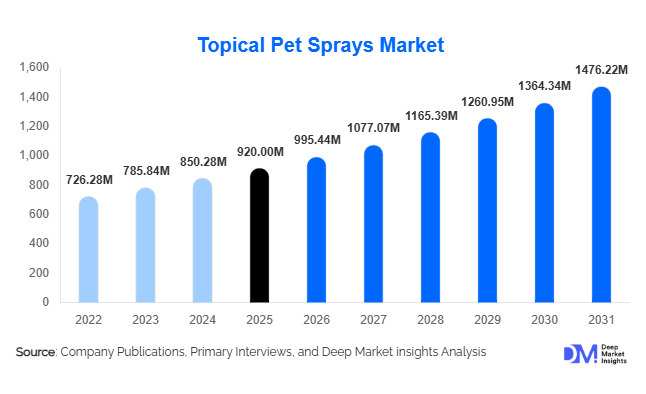
According to Deep Market Insights, the global topical pet sprays market size was valued at USD 920 million in 2025 and is projected to grow from USD 995.44 million in 2026 to reach USD 1,476.22 million by 2031, expanding at a CAGR of 8.2% during the forecast period (2026–2031). The topical pet sprays market growth is primarily driven by increasing pet ownership, rising awareness regarding pet hygiene and preventive healthcare, and the growing preference for easy-to-apply, multi-functional treatment solutions.
Key Market Insights
- Flea & tick control sprays dominate the market, accounting for over 30% share due to their essential role in parasite prevention.
- Natural and herbal sprays are witnessing rapid growth, driven by consumer preference for chemical-free and safe formulations.
- North America leads the global market, supported by high pet healthcare expenditure and premium product adoption.
- Asia-Pacific is the fastest-growing region, fueled by rising disposable income and increasing pet humanization trends.
- Online retail channels are expanding significantly, contributing nearly 30% of total sales due to convenience and product variety.
- Technological innovations in spray formulations, including long-lasting and multi-functional products, are reshaping market competition.
What are the latest trends in the topical pet sprays market?
Shift Toward Natural and Organic Formulations
The market is witnessing a strong transition toward plant-based and organic topical sprays as pet owners become increasingly concerned about the side effects of synthetic chemicals. Ingredients such as neem, aloe vera, lavender, and tea tree oil are being widely adopted in product formulations. Manufacturers are leveraging this trend by launching eco-friendly, biodegradable sprays with minimal toxicity, especially targeting premium consumers in developed regions. Certification labels and clean-label products are becoming critical differentiators, while sustainable packaging solutions are also gaining traction. This trend is particularly prominent in North America and Europe, where regulatory frameworks and consumer awareness support safer alternatives.
Multi-Functional and Veterinary-Grade Products
Another major trend is the development of multi-purpose sprays that combine multiple benefits such as anti-parasitic, anti-fungal, deodorizing, and skin healing properties. These products reduce the need for multiple treatments, improving convenience for pet owners. Additionally, veterinary-grade medicated sprays are gaining popularity due to increasing reliance on professional recommendations. These products are being formulated with clinically tested ingredients and are often prescribed for specific conditions such as dermatitis, infections, and wounds. The convergence of grooming and healthcare functionalities is creating a new category of high-value products in the market.
What are the key drivers in the topical pet sprays market?
Rising Pet Ownership and Humanization Trends
The growing global pet population, particularly dogs and cats, is a major driver of market expansion. Pets are increasingly considered family members, leading to higher spending on healthcare and hygiene products. This trend is particularly strong in urban households, where companionship needs and lifestyle changes are boosting pet adoption rates. As a result, demand for convenient and effective solutions such as topical sprays is rising significantly.
Growing Awareness of Preventive Pet Healthcare
Pet owners are becoming more proactive in maintaining animal health, focusing on prevention rather than treatment. Awareness campaigns by veterinary organizations and increased access to information through digital platforms have encouraged the use of topical sprays for routine care. Preventive applications such as parasite control and skin protection are driving consistent product demand across regions.
What are the restraints for the global market?
Concerns Over Chemical Side Effects
Chemical-based sprays, particularly those containing synthetic insecticides, can cause skin irritation, allergies, or toxicity in pets. These concerns have led to increased scrutiny from regulatory authorities and cautious consumer behavior. This factor is limiting the adoption of certain product categories and pushing manufacturers toward reformulation.
Price Sensitivity in Emerging Markets
In developing regions, the relatively high cost of premium and medicated sprays restricts widespread adoption. Consumers in these markets often prioritize affordability, which can hinder the growth of high-margin product segments. This creates a challenge for companies aiming to expand their presence in price-sensitive economies.
What are the key opportunities in the topical pet sprays industry?
Expansion in Emerging Markets
Emerging economies such as India, China, and Brazil present significant growth opportunities due to increasing pet ownership and rising middle-class income levels. Market penetration of advanced pet care products remains relatively low in these regions, offering ample scope for expansion. Companies can leverage localized product offerings and digital distribution channels to capture untapped demand.
Innovation in Delivery Systems and Formulations
Technological advancements in spray delivery systems, such as non-aerosol pumps and eco-friendly packaging, are improving user convenience and environmental sustainability. Additionally, the development of long-lasting and fast-acting formulations is enhancing product efficacy. Companies investing in R&D and collaborating with veterinary professionals can gain a competitive advantage in this evolving landscape.
Report Scope
| Report Metric | Details |
|---|---|
| Market Size in 2025 | USD 920 Million |
| Market Size in 2026 | USD 995.44 Million |
| Market Size in 2031 | USD 1476.22 Million |
| CAGR | 8.2% (2026-2031) |
| Base Year for Estimation | 2025 |
| Historical Data | 2022-2024 |
| Forecast Period | 2026-2031 |
| Report Coverage | Revenue Forecast, Competitive Landscape, Supply Chain Disruption, Growth Factors, Environment & Regulatory Landscape and Trends |
| Geographies Covered | North America, Europe, APAC, Middle East and Africa, LATAM |
| Countries Covered | U.S., Canada, U.K., Germany, France, Spain, Italy, Russia, Nordic, Benelux, Rest of Europe, China, Korea, Japan, India, Australia, Singapore, Taiwan, South East Asia, Rest of Asia-Pacific, UAE, Turky, Saudi Arabia, South Africa, Egypt, Nigeria, Rest of MEA, Brazil, Mexico, Argentina, Chile, Colombia, Rest of LATAM |
Explore more data points, trends and opportunities Download Free Sample Report
Product Type Insights
Flea & tick control sprays continue to dominate the topical pet sprays market, accounting for approximately 32% of the total market share in 2025. The primary driver for this segment’s leadership is the increasing prevalence of parasitic infestations such as fleas, ticks, and mites across both developed and emerging regions. Climate change, rising temperatures, and increased outdoor pet activity have further amplified parasite exposure, making preventive solutions essential. Additionally, veterinary recommendations strongly favor routine parasite control, positioning these sprays as a first line of defense in pet healthcare. The segment also benefits from product innovation, including long-lasting formulations and combination sprays that offer multi-parasite protection.
Skin treatment sprays are gaining momentum due to the rising incidence of dermatological conditions such as allergies, infections, and dermatitis, particularly among indoor pets. Deodorizing and grooming sprays are expanding in urban markets where pet hygiene and aesthetic maintenance are prioritized, driven by the growing trend of pet humanization. Meanwhile, wound care and antimicrobial sprays are witnessing steady growth, supported by increased veterinary intervention and awareness of infection prevention, especially in post-surgical and injury-related care.
Application Insights
Preventive care applications lead the market, contributing around 40% of total demand, driven by the growing shift from reactive to proactive pet healthcare. Pet owners are increasingly investing in routine care solutions to avoid costly treatments and ensure long-term pet wellness. This trend is reinforced by veterinary guidance and rising awareness campaigns emphasizing early intervention and disease prevention.
Therapeutic applications represent a significant portion of the market, supported by the increasing diagnosis of skin infections, wounds, and chronic conditions. These products are often prescribed by veterinarians, ensuring consistent demand. Grooming and hygiene applications are expanding rapidly, particularly in urban households, where pets are kept indoors and cleanliness is a priority. Behavioral sprays, including calming and anti-anxiety solutions, are emerging as a niche but fast-growing segment, driven by increasing awareness of pet mental health and stress management, especially in high-density living environments.
Distribution Channel Insights
Online retail channels account for nearly 30% of market share and are the fastest-growing distribution segment, primarily driven by increasing digital adoption, convenience, and access to a wide product range. E-commerce platforms enable price comparison, subscription models, and doorstep delivery, making them highly attractive to modern consumers. The rise of direct-to-consumer (D2C) brands has further accelerated online sales.
Veterinary clinics remain a critical channel, particularly for medicated and therapeutic sprays, as they benefit from high consumer trust and professional recommendations. Pet specialty stores continue to hold a strong position by offering curated product assortments and personalized guidance. Supermarkets and pharmacies provide accessibility for mass-market products, especially in developed economies. Additionally, subscription-based pet care services are gaining traction, contributing to recurring revenue streams and improved customer retention.
Animal Type Insights
Dogs dominate the topical pet sprays market, contributing approximately 58% of total revenue. This leadership is driven by the higher global dog population, increased outdoor activity, and greater expenditure on canine healthcare. Dogs are more susceptible to parasitic infestations and skin conditions, necessitating frequent use of topical sprays, which further strengthens this segment.
Cats represent the second-largest segment, with growing demand for specialized formulations designed for feline sensitivities. The segment is supported by rising cat adoption rates, particularly in urban households. Equine and exotic pets form niche but expanding segments, driven by increasing spending on specialized animal care in developed markets. Small mammals such as rabbits and guinea pigs are also contributing to incremental growth, supported by their rising popularity as companion animals in urban settings.
Explore more data points, trends and opportunities Download Free Sample Report
Topical Pet Sprays Market Segmentations
By Product Type
- Flea and Tick Control Sprays
- Antimicrobial and Antifungal Sprays
- Deodorizing and Odor Control Sprays
- Skin Treatment Sprays
- Wound Care and Healing Sprays
- Behavioral/Calming Sprays
- Grooming and Coat Conditioning Sprays
By Application
- Preventive Care
- Therapeutic Treatment
- Hygiene and Grooming
- Behavioral Management
By Distribution Channel
- Online Retail/E-commerce
- Veterinary Clinics and Hospitals
- Pet Specialty Stores
- Supermarkets and Hypermarkets
- Pharmacies/Drugstores
By Animal Type
- Dogs
- Cats
- Equine
- Small Mammals
- Exotic Pets
By Active Ingredient Type
- Chemical-based
- Natural/Herbal
- Medicated
By Price Tier
- Economy
- Mid-range
- Premium
Regional Insights
North America
North America holds approximately 38% of the global market share in 2025, with the United States contributing nearly 30% of global demand. The region’s dominance is driven by high pet ownership rates, strong consumer spending on premium pet care products, and advanced veterinary infrastructure. Additionally, the presence of leading market players and continuous product innovation, particularly in natural and organic formulations, are accelerating growth. Increasing awareness of preventive healthcare and widespread adoption of pet insurance further support market expansion.
Europe
Europe accounts for around 27% of the global market share, led by Germany, the UK, and France. Growth in this region is primarily driven by stringent regulatory standards ensuring product safety and quality, which has boosted consumer confidence. Additionally, strong awareness regarding pet health, increasing adoption of eco-friendly products, and a well-established retail network are key drivers. The rising demand for organic and sustainable pet care solutions is further strengthening the market, particularly among environmentally conscious consumers.
Asia-Pacific
Asia-Pacific is the fastest-growing region, with a CAGR exceeding 9.5%. Key markets such as China, India, and Japan are witnessing rapid expansion due to rising disposable incomes, urbanization, and increasing pet adoption. The growing middle class and changing lifestyles are driving demand for premium and preventive pet care products. E-commerce penetration is significantly enhancing product accessibility, especially in China and India. Additionally, increasing awareness of pet hygiene and the expansion of veterinary services are acting as major growth catalysts in the region.
Latin America
Latin America, particularly Brazil and Mexico, is experiencing steady growth supported by rising pet humanization trends and increasing awareness of pet hygiene. Expanding retail infrastructure, including pet specialty stores and online platforms, is improving product availability. Economic development and growing middle-class populations are also contributing to increased spending on pet care products. Furthermore, the region’s warm climate increases the risk of parasitic infestations, driving demand for preventive sprays.
Middle East & Africa
The Middle East & Africa region represents a smaller but steadily growing market, driven by urbanization, rising disposable incomes, and increasing awareness of pet care. Countries such as the UAE and South Africa are leading demand due to improving veterinary infrastructure and growing adoption of companion animals. The expansion of premium retail outlets and increasing availability of international brands are also supporting market growth. Additionally, rising expatriate populations and changing cultural attitudes toward pet ownership are contributing to the region’s development.
Key Players in the Topical Pet Sprays Market
- Zoetis Inc.
- Elanco Animal Health
- Boehringer Ingelheim
- Virbac
- Ceva Santé Animale
- PetIQ Inc.
- Vetoquinol
- Bayer Animal Health
- Hartz Mountain Corporation
- Central Garden & Pet Company
- Beaphar
- SynergyLabs
- TropiClean
- Vet’s Best
- Himalaya Pet Care