Toothpick Market Size
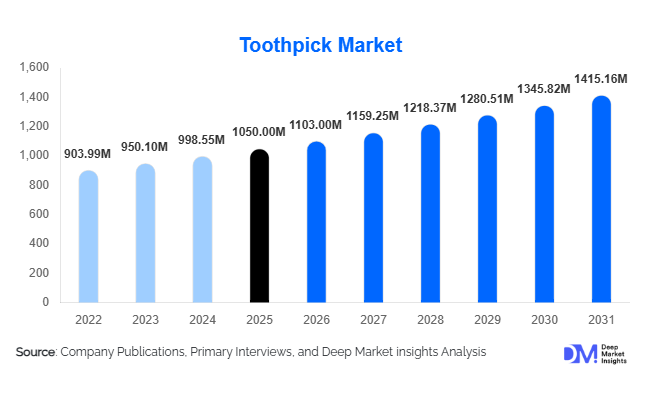
According to Deep Market Insights, the global toothpick market size was valued at USD 1,050 million in 2025 and is projected to grow from USD 1,103.55 million in 2026 to reach USD 1,415.16 million by 2031, expanding at a CAGR of 5.1% during the forecast period (2026–2031). The toothpick market growth is primarily driven by the expansion of the global foodservice industry, rising hygiene awareness, and increasing demand for low-cost disposable products across both developed and emerging economies.
Key Market Insights
- Wooden toothpicks dominate the market, accounting for nearly 78% share due to their biodegradability and cost efficiency.
- The foodservice industry remains the largest end-use segment, contributing approximately 65% of global demand.
- Asia-Pacific leads the global market, supported by strong manufacturing capabilities and high domestic consumption.
- Bulk packaging dominates distribution, driven by large-scale institutional demand from restaurants and hotels.
- Sustainability trends are accelerating the shift toward bamboo toothpicks, particularly in Europe and North America.
- Emerging niche segments, such as flavored and reusable toothpicks, are gaining traction among urban consumers.
What are the latest trends in the toothpick market?
Shift Toward Sustainable and Biodegradable Products
The toothpick market is increasingly witnessing a transition toward eco-friendly materials such as bamboo and sustainably sourced wood. Regulatory pressures on single-use plastics and growing environmental awareness among consumers are driving demand for biodegradable alternatives. Manufacturers are investing in certified forestry practices and eco-labeling to enhance product appeal, particularly in Europe and North America, where sustainability compliance is critical.
Premiumization Through Specialty Toothpicks
There is a growing trend toward value-added products such as flavored, infused, and reusable toothpicks. Flavored variants, including mint and cinnamon, are gaining popularity as lifestyle products, while metal toothpicks cater to environmentally conscious consumers seeking reusable options. These premium segments offer higher margins compared to traditional wooden toothpicks and are expanding the product portfolio of manufacturers.
What are the key drivers in the toothpick market?
Expansion of the Global Foodservice Industry
The rapid growth of restaurants, cafés, hotels, and quick-service chains globally is a major driver for the toothpick market. Increasing urbanization and changing consumer lifestyles have led to higher dining-out frequency, boosting demand for disposable hygiene products. Institutional buyers such as hotel chains and catering companies contribute significantly to bulk consumption.
Rising Hygiene Awareness
Post-pandemic consumer behavior has reinforced the importance of hygiene in food consumption. Individually wrapped toothpicks and dispenser packaging formats are increasingly preferred, especially in developed regions. This trend is encouraging manufacturers to innovate in packaging and improve product safety standards.
What are the restraints for the global market?
Raw Material Price Volatility
The availability and pricing of raw materials such as bamboo and wood are subject to environmental regulations and supply chain disruptions. Fluctuations in raw material costs directly impact production expenses, limiting profit margins in a price-sensitive market.
High Market Fragmentation and Commoditization
The toothpick market is highly fragmented, with numerous small and medium manufacturers offering similar products. Limited differentiation leads to intense price competition, making it challenging for companies to achieve strong brand loyalty or premium pricing.
What are the key opportunities in the toothpick industry?
Growth in Emerging Foodservice Markets
Emerging economies in the Asia-Pacific, the Middle East, and Africa present significant growth opportunities due to expanding hospitality sectors and increasing tourism. Establishing supply contracts with restaurant chains and hotels in these regions can ensure stable, high-volume demand.
Innovation in Specialty and Healthcare Applications
There is increasing potential for toothpicks in healthcare and dental hygiene applications, including medicated and antiseptic variants. Additionally, flavored and infused toothpicks are opening new consumer segments, particularly among younger demographics seeking functional and lifestyle-oriented products.
Report Scope
| Report Metric | Details |
|---|---|
| Market Size in 2025 | USD 1050 Million |
| Market Size in 2026 | USD 1103 Million |
| Market Size in 2031 | USD 1415.16 Million |
| CAGR | 5.1% (2026-2031) |
| Base Year for Estimation | 2025 |
| Historical Data | 2022-2024 |
| Forecast Period | 2026-2031 |
| Report Coverage | Revenue Forecast, Competitive Landscape, Supply Chain Disruption, Growth Factors, Environment & Regulatory Landscape and Trends |
| Geographies Covered | North America, Europe, APAC, Middle East and Africa, LATAM |
| Countries Covered | U.S., Canada, U.K., Germany, France, Spain, Italy, Russia, Nordic, Benelux, Rest of Europe, China, Korea, Japan, India, Australia, Singapore, Taiwan, South East Asia, Rest of Asia-Pacific, UAE, Turky, Saudi Arabia, South Africa, Egypt, Nigeria, Rest of MEA, Brazil, Mexico, Argentina, Chile, Colombia, Rest of LATAM |
Explore more data points, trends and opportunities Download Free Sample Report
Material Type Insights
Wooden toothpicks continue to dominate the global market, accounting for approximately 78% of the total revenue share in 2025. This leadership is primarily driven by their low production cost, high availability of raw materials such as birch and bamboo, and strong alignment with global sustainability trends. Among wooden variants, bamboo toothpicks are witnessing accelerated adoption, particularly in export-oriented markets, due to increasing regulatory pressure on plastic usage and growing consumer preference for biodegradable products. Countries in the Asia-Pacific, especially China and Vietnam, benefit from abundant bamboo resources, enabling cost-efficient large-scale production and export competitiveness.
Plastic toothpicks, although still present, are gradually declining due to environmental concerns and regulatory restrictions in developed regions. Meanwhile, metal toothpicks are emerging as a premium niche segment, driven by demand for reusable, durable, and lifestyle-oriented products among environmentally conscious consumers. However, their higher price point limits widespread adoption, keeping their market share relatively small.
Product Type Insights
Double-pointed toothpicks hold the leading position in the market, capturing nearly 52% of the global share. Their dominance is attributed to functional efficiency, dual usability, and cost-effectiveness, making them highly suitable for both household and foodservice applications. The symmetrical design allows users to utilize both ends, reducing wastage and enhancing value for bulk buyers such as restaurants and catering services.
Flat and single-pointed toothpicks serve specific use cases, including dental hygiene and precision cleaning applications, but remain secondary in terms of volume. Decorative and frilled toothpicks are gaining traction in premium dining, catering, and event management sectors, where presentation and aesthetics play a critical role. Additionally, flavored toothpicks are emerging as a niche but fast-growing segment, driven by lifestyle consumption trends and increasing demand for oral refreshment products.
Packaging Insights
Bulk packaging dominates the toothpick market with an estimated 60% share, primarily due to strong demand from institutional buyers such as restaurants, hotels, airlines, and catering companies. The key driver for this segment is cost efficiency and high-volume consumption, as bulk packs significantly reduce per-unit costs and support uninterrupted supply in high-usage environments.
Individually wrapped toothpicks are experiencing notable growth, particularly in North America and Europe, driven by heightened hygiene awareness and stringent food safety regulations. These products are increasingly preferred in premium dining establishments and takeaway services, where consumer perception of cleanliness is critical. Dispenser-based packaging is also gaining popularity in quick-service restaurants (QSRs), offering convenience and controlled usage.
End-Use Insights
The foodservice industry remains the dominant end-use segment, accounting for approximately 65% of global demand. This leadership is driven by the rapid expansion of restaurants, cafés, hotels, and quick-service chains worldwide. Increasing urbanization, rising disposable incomes, and evolving consumer lifestyles are contributing to higher dining-out frequency, thereby boosting toothpick consumption.
Household usage represents a stable segment, particularly in regions with strong cultural practices related to oral hygiene. Meanwhile, healthcare and dental applications are emerging as niche growth areas, with increasing use of specialized toothpicks for oral care. Industrial and utility applications, including crafts and cleaning, are also contributing to incremental demand, though their overall share remains limited.
Distribution Channel Insights
Wholesale and B2B distribution channels lead the market with approximately 55% share, reflecting the dominance of institutional buyers and long-term supply contracts. The primary driver for this segment is the consistent, high-volume procurement by foodservice operators, hospitality chains, and catering businesses, which rely on bulk purchasing to optimize costs and ensure supply continuity.
Retail channels, including supermarkets and convenience stores, cater mainly to household demand, while e-commerce platforms are witnessing steady growth. The rise of online purchasing is driven by increased digital penetration, convenience, and the availability of a wider range of product options, including specialty and premium toothpicks.
Explore more data points, trends and opportunities Download Free Sample Report
Toothpick Market Segmentations
By Material Type
- Wooden Toothpicks
- Plastic Toothpicks
- Metal Toothpicks
- Specialty Toothpicks
By Product Type
- Round Toothpicks
- Flat Toothpicks
- Double-Pointed Toothpicks
- Single-Pointed Toothpicks
- Decorative/Frilled Toothpicks
- Flavored Toothpicks
By Packaging
- Bulk Packaging
- Small Consumer Packs
- Individually Wrapped Toothpicks
- Dispenser Packs
By End-Use
- Household
- Foodservice Industry
- Healthcare (Dental Use)
- Industrial/Utility Applications
By Distribution Channel
- Retail Stores
- Online/E-commerce
- Wholesale/B2B Supply
- Institutional Sales
Regional Insights
Asia-Pacific
Asia-Pacific dominates the global toothpick market with approximately 42% share in 2025, driven by both strong production capabilities and high domestic consumption. China leads the region as the largest manufacturer and exporter, benefiting from abundant bamboo resources, low labor costs, and well-established supply chains. India is emerging as a significant consumption market, supported by population growth, increasing urbanization, and rapid expansion of the foodservice sector. Additionally, Southeast Asian countries such as Vietnam and Indonesia are strengthening their position as export hubs due to competitive manufacturing costs and favorable trade policies.
North America
North America accounts for around 22% of the global market, with the United States being the primary contributor. The region’s growth is driven by high hygiene standards, widespread adoption of individually wrapped toothpicks, and strong demand from the restaurant and hospitality industries. The presence of well-established QSR chains and a mature foodservice ecosystem further supports steady consumption. Additionally, increasing preference for eco-friendly products is boosting demand for bamboo toothpicks.
Europe
Europe holds approximately 18% market share, led by countries such as Germany, France, and the United Kingdom. The region’s growth is primarily driven by strict environmental regulations, strong consumer preference for sustainable products, and increasing adoption of biodegradable materials. The shift away from plastic toothpicks is particularly pronounced, creating opportunities for bamboo and certified wood products. Furthermore, the region’s well-developed hospitality sector contributes to stable institutional demand.
Latin America
Latin America represents about 10% of the global market, with Brazil and Mexico as key contributors. Growth in this region is supported by urbanization, rising middle-class incomes, and increasing penetration of restaurants and fast-food chains. While the market remains price-sensitive, there is gradual adoption of improved packaging formats and higher-quality products. Expanding tourism in select countries is also contributing to increased demand from the hospitality sector.
Middle East & Africa
The Middle East & Africa region is the fastest-growing market, with a projected CAGR of approximately 6.5–7%. Growth is driven by rapid expansion of tourism, increasing investments in hospitality infrastructure, and rising disposable incomes in key markets such as the UAE and Saudi Arabia. Mega-events, luxury hotel developments, and government initiatives to boost tourism are significantly increasing demand for foodservice consumables, including toothpicks. In Africa, improving urban infrastructure and growing foodservice industries are contributing to gradual market expansion.
Key Players in the Toothpick Market
- Nantong Jiajing Wood Products Co.
- Dalian Shenglong Wood Products
- Shanghai Toothpick Company
- Hunan Hongqi Wood Industry
- Bamboo Toothpick Co. Ltd.
- Taizhou Toothpick Manufacturing
- Fujian Bamboo Industry Group
- Vietnam Toothpick JSC
- PT Sinar Bamboo Indonesia
- Moso International
- Bamboo Village Company
- Pure Bamboo Products Ltd.
- EcoToothpick Global
- Nature Bamboo Solutions
- GreenWood Products Inc.