Toilet Bowl Cleaner Market Size
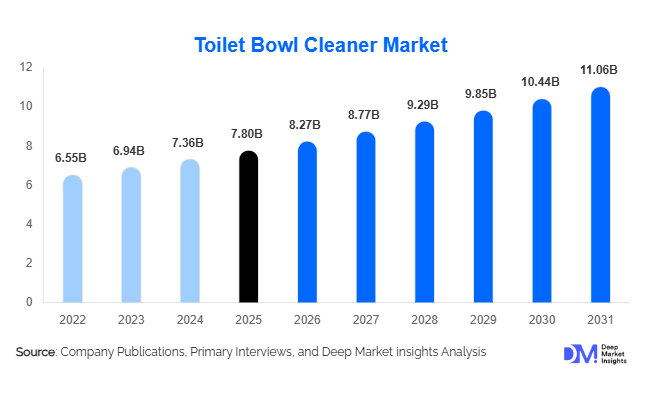
According to Deep Market Insights, the global toilet bowl cleaner market size was valued at USD 7.8 billion in 2025 and is projected to grow from USD 8.27 billion in 2026 to reach USD 11.06 billion by 2031, expanding at a CAGR of 6.0% during the forecast period (2026–2031). The market growth is primarily driven by rising hygiene awareness, increasing urbanization, and the growing demand for eco-friendly, convenient toilet sanitation solutions across residential, commercial, and institutional settings.
Key Market Insights
- Eco-friendly and bio-enzyme-based cleaners are gaining popularity, driven by regulatory pressure and consumer preference for sustainable cleaning solutions.
- Automatic and effervescent toilet bowl cleaners are emerging, offering convenience, labor savings, and hygiene consistency, particularly in commercial and institutional environments.
- Asia-Pacific dominates the market, led by China and India, due to rising urbanization, growing middle-class populations, and expanding retail penetration.
- North America holds a significant share, with high hygiene consciousness and widespread adoption of premium and antibacterial products.
- Online retail and modern trade channels are expanding, increasing accessibility and product visibility in both developed and emerging markets.
- Innovation in formulations and packaging, including concentrated gels, pre-measured tablets, and automatic dispensers, is reshaping consumer engagement and driving premium adoption.
What are the latest trends in the toilet bowl cleaner market?
Shift Toward Eco-Friendly Formulations
Manufacturers are increasingly investing in biodegradable, non-toxic, and plant-based toilet bowl cleaners. These formulations reduce environmental impact while complying with stringent regulatory norms on chemicals such as phosphates and chlorine. Eco-friendly cleaners also command premium pricing, appealing to environmentally conscious consumers, particularly in Europe and North America. Product innovation includes enzymatic cleaners that maintain effectiveness while minimizing chemical exposure, aligning with rising household and institutional hygiene standards.
Automation and Smart Cleaning Solutions
Automatic toilet bowl cleaners, including tablets, cartridges, and IoT-enabled dispensers, are becoming more prevalent in commercial and high-traffic facilities. These products ensure consistent dosing, reduce labor requirements, and maintain hygiene standards. Integration with smart facility management systems and sensor-based dispensing further enhances operational efficiency. Residential adoption of self-dosing tablets is also increasing for convenience, reducing human error, and promoting consistent cleaning performance.
What are the key drivers in the toilet bowl cleaner market?
Heightened Hygiene Awareness
Post-pandemic consumer consciousness around sanitation has surged globally. Households, commercial facilities, and institutions are increasingly adopting dedicated toilet bowl cleaners to prevent microbial contamination and maintain consistent hygiene. This trend drives frequent purchases and encourages the use of specialized formulations that offer antibacterial and anti-limescale benefits.
Urbanization and Rising Disposable Income
Rapid urban migration in Asia-Pacific, Latin America, and parts of Africa is fueling demand for branded, effective, and convenient cleaning solutions. Higher household income levels enable consumers to invest in premium and specialized toilet bowl cleaners, including eco-friendly or technologically advanced formats, further boosting market expansion.
Product Innovation and Advanced Formulations
Innovations such as thick gel formulas, slow-dissolving tablets, and combination disinfectant solutions enhance cleaning performance and user convenience. Automatic dispensers and pre-measured products cater to both residential and commercial demand, establishing differentiation and expanding adoption across segments.
What are the restraints for the global market?
Regulatory Constraints on Chemical Usage
Strict regulations on hazardous ingredients like hydrochloric acid, phosphates, and chlorine increase reformulation costs and complexity. Compliance challenges can limit product availability in certain markets, slowing growth for manufacturers reliant on traditional high-efficacy products.
Price Sensitivity in Developing Markets
Consumers in cost-conscious regions may opt for multipurpose or generic cleaning products over toilet-specific solutions. Economic downturns or currency fluctuations further constrain purchasing power, limiting premium adoption and impacting profit margins.
What are the key opportunities in the toilet bowl cleaner market?
Expansion in Emerging Markets
Emerging economies in Asia, Latin America, and Africa provide vast untapped potential. Rapid urbanization, growing sanitation awareness, and improved retail penetration enable both new entrants and established players to capture market share. Tailored products and region-specific pricing strategies are key success factors for these markets.
Eco-Friendly Product Portfolio Development
Growing environmental consciousness and regulatory pressures are encouraging brands to introduce biodegradable, enzyme-based, and low-toxicity products. This trend offers differentiation opportunities and supports higher-margin product segments, particularly in developed markets where consumers prioritize safety and sustainability.
Technology Integration in Commercial Facilities
Automated toilet cleaning solutions are increasingly adopted in commercial and institutional settings to ensure consistency, reduce labor costs, and maintain hygiene standards. IoT-enabled dispensers and smart dosing technologies provide operational insights, creating potential for innovation-led growth and premium pricing opportunities.
Report Scope
| Report Metric | Details |
|---|---|
| Market Size in 2025 | USD 7.8 Billion |
| Market Size in 2026 | USD 8.27 Billion |
| Market Size in 2031 | USD 11.06 Billion |
| CAGR | 6.0% (2026-2031) |
| Base Year for Estimation | 2025 |
| Historical Data | 2022-2024 |
| Forecast Period | 2026-2031 |
| Report Coverage | Revenue Forecast, Competitive Landscape, Supply Chain Disruption, Growth Factors, Environment & Regulatory Landscape and Trends |
| Geographies Covered | North America, Europe, APAC, Middle East and Africa, LATAM |
| Countries Covered | U.S., Canada, U.K., Germany, France, Spain, Italy, Russia, Nordic, Benelux, Rest of Europe, China, Korea, Japan, India, Australia, Singapore, Taiwan, South East Asia, Rest of Asia-Pacific, UAE, Turky, Saudi Arabia, South Africa, Egypt, Nigeria, Rest of MEA, Brazil, Mexico, Argentina, Chile, Colombia, Rest of LATAM |
Explore more data points, trends and opportunities Download Free Sample Report
Product Type Insights
Liquid toilet bowl cleaners dominate the global market with approximately 50% share in 2025, primarily due to their strong cleaning efficacy, affordability, and widespread availability across retail channels. Liquid formulations are highly preferred by households and institutional users because they provide immediate action against stains, limescale, and bacteria. Their flexible dispensing design allows targeted cleaning under toilet rims and hard-to-reach areas, making them a practical choice for routine sanitation. In addition, manufacturers continue to enhance liquid products with antibacterial agents, fragrance technology, and thickened formulations that improve surface contact time and cleaning performance.
Gel-based toilet bowl cleaners represent the second-largest product category and are gaining strong traction globally. Gel formulations adhere better to vertical surfaces, allowing active ingredients to remain in contact with stains and mineral deposits for longer periods. This extended contact improves cleaning effectiveness while reducing the amount of product required per use. Premium gel cleaners also include dual-action formulations that combine stain removal with disinfecting properties, making them attractive to consumers seeking higher-performance products.
Application Insights
The residential segment accounts for nearly 60% of total global demand in 2025, making it the largest application segment in the toilet bowl cleaner market. Household consumers frequently purchase toilet cleaners as part of routine home sanitation practices, driven by rising awareness regarding hygiene and germ prevention. Increasing urbanization, higher disposable incomes, and the growing adoption of branded household cleaning products are contributing significantly to residential demand. In many emerging economies, consumers are gradually shifting from traditional cleaning methods to specialized chemical cleaners that provide faster and more effective sanitation.
The commercial and institutional segment is the fastest-growing application category, driven by stringent sanitation requirements across industries such as hospitality, healthcare, corporate offices, retail centers, and public infrastructure facilities. Hotels, hospitals, shopping malls, and transportation hubs maintain high cleaning frequency to ensure public hygiene and regulatory compliance. The hospitality sector in particular is a key driver, as hotel chains and resorts emphasize strict sanitation standards to maintain customer satisfaction and brand reputation. Industrial applications represent a smaller but stable share of the market, mainly within manufacturing facilities, large office complexes, and industrial campuses where workplace hygiene standards must be maintained. Demand from industrial users often focuses on bulk cleaning solutions and professional-grade disinfectants that meet occupational health and safety regulations. Although smaller in volume compared to residential demand, industrial applications contribute to steady long-term market growth due to consistent procurement cycles.
Distribution Channel Insights
Supermarkets and hypermarkets account for approximately 45% of total toilet bowl cleaner sales globally, making them the dominant distribution channel. These retail outlets offer strong product visibility, extensive brand variety, and competitive pricing, encouraging impulse purchases among consumers. Large retail chains also support promotional campaigns, bundle offers, and in-store marketing activities that significantly boost product sales. Consumers prefer purchasing cleaning products from supermarkets because they can easily compare brands and product formats within a single location.
Online retail channels are rapidly expanding and represent one of the fastest-growing sales channels in the market. E-commerce platforms provide consumers with access to a wide range of products, including premium and eco-friendly toilet cleaners that may not be readily available in traditional retail outlets. The convenience of home delivery, subscription-based replenishment services, and digital discounts are encouraging consumers to shift toward online purchasing. In addition, online marketplaces enable manufacturers to launch new products quickly and gather consumer feedback in real time. Specialty stores and institutional supply channels play an important role in serving commercial buyers and professional cleaning service providers. These channels supply bulk quantities of cleaning chemicals to industries such as hospitality, healthcare, and facility management. Institutional distribution networks also provide customized solutions, including concentrated cleaning formulations and automated dispensing systems designed for large-scale sanitation operations.
End-Use Insights
The residential end-use segment continues to dominate the toilet bowl cleaner market, driven by rising consumer awareness regarding hygiene and sanitary households. Frequent cleaning habits, especially in urban households, encourage regular purchases of specialized toilet cleaning products. The expansion of organized retail networks and online shopping platforms has also improved accessibility to branded cleaning products, further strengthening residential demand. The commercial sector represents the fastest-growing end-use segment, particularly across industries such as hospitality, healthcare, and commercial real estate. Hotels, restaurants, hospitals, and office complexes require regular sanitation of restroom facilities to maintain hygiene standards and comply with public health regulations. The rapid expansion of the global tourism and hospitality industries has significantly increased the number of high-traffic public restrooms, creating sustained demand for effective toilet cleaning solutions.
Institutional applications, including schools, airports, government buildings, and transportation facilities, are increasingly adopting automated and semi-automated toilet cleaning systems. These systems utilize tablets, cartridges, or dispensing units that release cleaning agents at controlled intervals, ensuring consistent sanitation in heavily used restrooms. Export-driven demand is also emerging as an important factor supporting market expansion. Manufacturers in Asia-Pacific, particularly India and China, are increasingly exporting toilet cleaning products to Africa and the Middle East, where urbanization and public sanitation programs are driving demand for affordable hygiene solutions.
Explore more data points, trends and opportunities Download Free Sample Report
Toilet Bowl Cleaner Market Segmentations
By Product Type
- Liquid Toilet Bowl Cleaners
- Gel-Based Toilet Bowl Cleaners
- Tablet and Drop-In Cleaners
- Foam and Spray Cleaners
By Application
- Residential
- Commercial
- Institutional
By Distribution Channel
- Supermarkets and Hypermarkets
- Convenience Stores
- Online Retail
- Specialty Stores
- Wholesale and Distributors
Regional Insights
North America
North America accounts for approximately 30% of the global toilet bowl cleaner market in 2025, with the United States representing the largest share within the region. High consumer awareness regarding household hygiene, widespread adoption of specialized cleaning products, and strong purchasing power are key factors driving regional demand. Consumers in the U.S. and Canada increasingly prefer premium and antibacterial cleaning products that provide both stain removal and disinfection.
Commercial demand is also a major growth driver in North America, supported by strict sanitation standards in industries such as healthcare, hospitality, and corporate offices. Regulatory frameworks related to workplace hygiene and public health encourage frequent restroom cleaning in commercial facilities. In addition, the region is witnessing increasing adoption of eco-friendly and biodegradable cleaning products, driven by environmental awareness and regulatory restrictions on harsh chemicals.
Europe
Europe contributes roughly 25% of global market revenue, with key markets including Germany, the United Kingdom, and France. The region demonstrates strong demand for sustainable and environmentally friendly cleaning products due to stringent environmental regulations and high consumer awareness regarding chemical safety. Many European consumers actively seek plant-based, biodegradable toilet bowl cleaners that minimize environmental impact.
Regulatory standards governing chemical composition and product safety are particularly strict within the European Union, encouraging manufacturers to develop low-toxicity and eco-labeled products. Additionally, the presence of established retail networks and strong brand penetration supports consistent product demand. Premium product segments perform especially well in Europe, where consumers are willing to pay higher prices for environmentally responsible and high-performance cleaning solutions.
Asia-Pacific
Asia-Pacific holds the largest share of the global toilet bowl cleaner market at around 35% in 2025 and is also the fastest-growing regional market. Rapid urbanization, rising disposable incomes, and expanding middle-class populations in countries such as China, India, Indonesia, and Vietnam are key factors driving demand for modern household cleaning products. Government sanitation initiatives play a significant role in market expansion across the region. Public hygiene campaigns, infrastructure development, and investments in sanitation facilities are encouraging the adoption of specialized cleaning products. Additionally, the rapid expansion of supermarkets, hypermarkets, and e-commerce platforms across the Asia-Pacific has improved product accessibility, enabling manufacturers to reach a wider consumer base.
Another important driver is the region’s growing role as a manufacturing and export hub for cleaning products. Countries such as China and India produce large volumes of affordable toilet bowl cleaners that are exported to emerging markets in Africa and the Middle East, further strengthening Asia-Pacific’s position in the global market.
Latin America
Latin America represents a steadily expanding market, with Brazil, Mexico, and Argentina serving as the primary demand centers. Urbanization and the gradual expansion of the middle class are encouraging consumers to adopt specialized household cleaning products rather than traditional cleaning agents. Growing retail penetration, particularly through supermarket chains and discount stores, has improved access to branded toilet cleaning solutions.
The hospitality sector is also contributing to market growth across Latin America. Increasing tourism in countries such as Mexico and Brazil has led to the expansion of hotels, resorts, and commercial facilities that require regular restroom sanitation. Additionally, local manufacturing capacity combined with imports from Asia-Pacific enables competitive pricing, supporting broader consumer adoption.
Middle East & Africa
The Middle East and Africa region accounts for approximately 10% of the global toilet bowl cleaner market. Demand is primarily concentrated in urban centers and high-income economies such as the United Arab Emirates, Saudi Arabia, and South Africa. Rapid infrastructure development, expansion of commercial real estate, and growing hospitality industries are key factors driving regional demand. In the Middle East, high standards of sanitation in hotels, shopping malls, airports, and office buildings generate strong demand for professional cleaning products. Meanwhile, in Africa, increasing urbanization and government-led public hygiene campaigns are encouraging households to adopt modern cleaning products.
Tourism-driven economies within the region also contribute significantly to market growth. Countries that host large numbers of international visitors maintain strict sanitation standards across hotels, restaurants, and transportation facilities, which increases the demand for effective toilet cleaning products. Imports from Asia-Pacific manufacturers further support market supply and product affordability in developing African markets.
Key Players in the Toilet Bowl Cleaner Market
- Reckitt Benckiser
- Procter & Gamble
- Henkel AG
- SC Johnson
- Unilever
- Clorox
- Ecolab
- Diversey
- Colgate-Palmolive
- Godrej Consumer Products
- Kao Corporation
- Zep Inc.
- 3M (Cleaning Division)
- Method Products
- Seventh Generation