Thermal Imager for Hunting Market Size
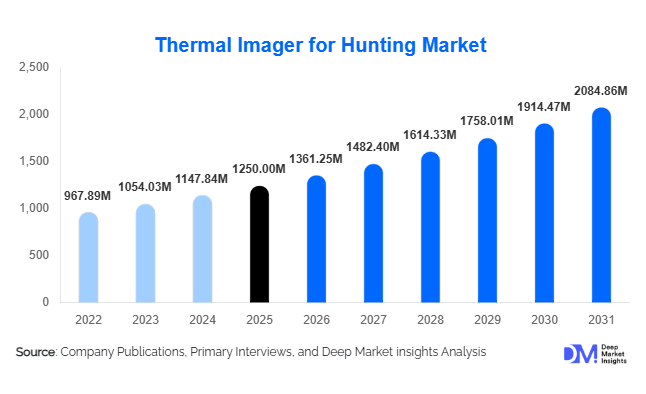
According to Deep Market Insights, the global thermal imager for hunting market size was valued at USD 1,250 million in 2025 and is projected to grow from USD 1,361.25 million in 2026 to reach USD 2,084.86 million by 2031, expanding at a CAGR of 8.9% during the forecast period (2026–2031). The market growth is primarily driven by increasing demand for night hunting efficiency, advancements in infrared sensor technologies, and the rising adoption of thermal imaging devices among recreational and professional hunters worldwide.
Key Market Insights
- Thermal imaging devices are replacing traditional night vision tools, offering superior performance in low-light and adverse weather conditions.
- Mid-range thermal imagers are witnessing the highest demand, driven by affordability and improved feature sets for hobbyist hunters.
- North America dominates the global market, supported by a strong hunting culture and favorable regulatory frameworks.
- Asia-Pacific is the fastest-growing region, driven by pest control initiatives and increasing outdoor recreational activities.
- Technological advancements in uncooled sensors are significantly reducing costs and enhancing accessibility.
- Integration with AI and mobile applications is transforming user experience and expanding product capabilities.
What are the latest trends in the thermal imager for the hunting market?
Shift Toward Smart and Connected Devices
Thermal imagers are increasingly being integrated with smart technologies such as mobile connectivity, GPS tracking, and AI-based object detection. These features allow hunters to identify targets, track movements, and record hunting sessions in real time. Manufacturers are focusing on app-based ecosystems that enable users to store data, share experiences, and access advanced analytics. This trend is particularly appealing to younger, tech-savvy hunters and is expected to drive product differentiation and customer engagement.
Growing Adoption of Compact and Lightweight Devices
There is a strong market trend toward compact, portable, and lightweight thermal imaging devices. Advances in microbolometer technology have enabled manufacturers to produce smaller yet highly efficient devices. Handheld and monocular thermal imagers are gaining popularity among recreational hunters due to ease of use and affordability. This shift is expanding the market beyond professional users to include a broader consumer base.
What are the key drivers in the thermal imager for hunting market?
Increasing Demand for Night Hunting Efficiency
Thermal imaging technology enables hunters to detect animals in complete darkness, dense vegetation, and harsh weather conditions. This significantly improves hunting success rates, particularly for nocturnal species. The growing need for efficient pest control and wildlife management is further boosting demand for these devices globally.
Technological Advancements in Infrared Sensors
Continuous innovation in uncooled infrared sensor technology has reduced costs while improving resolution, detection range, and battery efficiency. These advancements have made thermal imagers more accessible to a wider audience, accelerating market growth across both developed and emerging regions.
What are the restraints for the global market?
High Cost of Premium Devices
Despite declining prices, high-end thermal imagers remain expensive, often exceeding USD 4,000–5,000. This limits adoption among price-sensitive consumers, particularly in developing markets, and restricts penetration beyond professional users.
Regulatory Restrictions Across Regions
In several countries, the use of thermal imaging devices for hunting is restricted due to ethical and conservation concerns. These regulations vary widely across regions and can create barriers for manufacturers and limit market expansion.
What are the key opportunities in the thermal imager for the hunting industry?
Expansion in Emerging Markets
Emerging economies in Latin America, Eastern Europe, and the Asia-Pacific present significant growth opportunities due to increasing hunting tourism and wildlife management initiatives. Countries such as Brazil, Argentina, and South Africa are witnessing rising demand for thermal imaging devices, particularly for nocturnal hunting and pest control applications.
Integration of AI and Advanced Analytics
The incorporation of artificial intelligence and advanced analytics into thermal imaging devices is creating new opportunities for innovation. Features such as automated target recognition, behavioral tracking, and cloud-based data storage are enhancing user experience and opening new revenue streams through subscription-based services.
What I want you to do is optimize and make the below content comprehensive, and add drivers for the regional growth in the regional section for their individual region, and for the segment, use the leading segment driver, and naturally include the below content in my report and make it more comprehensive
Report Scope
| Report Metric | Details |
|---|---|
| Market Size in 2025 | USD 1250 Million |
| Market Size in 2026 | USD 1361.25 Million |
| Market Size in 2031 | USD 2084.86 Million |
| CAGR | 8.9% (2026-2031) |
| Base Year for Estimation | 2025 |
| Historical Data | 2022-2024 |
| Forecast Period | 2026-2031 |
| Report Coverage | Revenue Forecast, Competitive Landscape, Supply Chain Disruption, Growth Factors, Environment & Regulatory Landscape and Trends |
| Geographies Covered | North America, Europe, APAC, Middle East and Africa, LATAM |
| Countries Covered | U.S., Canada, U.K., Germany, France, Spain, Italy, Russia, Nordic, Benelux, Rest of Europe, China, Korea, Japan, India, Australia, Singapore, Taiwan, South East Asia, Rest of Asia-Pacific, UAE, Turky, Saudi Arabia, South Africa, Egypt, Nigeria, Rest of MEA, Brazil, Mexico, Argentina, Chile, Colombia, Rest of LATAM |
Explore more data points, trends and opportunities Download Free Sample Report
Product Type Insights
Weapon-mounted thermal scopes continue to dominate the market, accounting for approximately 38% of the global market share in 2025. Their leadership is primarily driven by their seamless integration with firearms, enabling real-time targeting accuracy and enhanced shooting precision in low-visibility conditions. These devices are particularly preferred by professional hunters and pest control operators who require high reliability and performance. Additionally, increasing adoption of night hunting for wild boar and predator control in North America and Europe is reinforcing demand for weapon-mounted systems. Meanwhile, thermal monoculars and handheld devices are witnessing strong growth due to their portability, ease of use, and relatively lower cost, making them highly attractive for recreational hunters and beginners. Clip-on thermal imagers are also gaining traction as a cost-effective upgrade solution, allowing users to retrofit existing optical scopes without investing in entirely new systems, thereby supporting adoption among mid-range buyers.
Technology Insights
Uncooled thermal imaging sensors dominate the market with a substantial share of around 82% in 2025, driven by their lower manufacturing costs, compact size, and minimal maintenance requirements. The widespread adoption of uncooled microbolometer technology has enabled manufacturers to deliver high-performance devices at increasingly competitive price points, significantly expanding the addressable consumer base. Continuous improvements in image processing, sensitivity, and battery efficiency are further strengthening this segment’s leadership. In contrast, cooled thermal imaging sensors remain confined to specialized applications due to their high cost, complexity, and need for regular maintenance. However, they continue to find niche demand among professional users requiring long-range detection and superior image clarity, particularly in extreme hunting environments and surveillance-based applications.
Detection Range Insights
Medium-range thermal imagers (500–1,000 meters) hold the largest share of approximately 41%, as they offer an optimal balance between detection capability and affordability. This range is well-suited for the majority of hunting environments, including forested areas, open fields, and mixed terrains. The segment’s dominance is driven by its versatility, catering to both recreational and semi-professional hunters who require reliable performance without the premium cost associated with long-range devices. Additionally, advancements in sensor resolution and image clarity have enhanced the effectiveness of medium-range devices, further boosting their adoption. While long-range devices are gaining popularity among professional users, their higher price points limit widespread adoption.
Price Range Insights
The mid-range segment (USD 1,500–4,000) leads the market with a share of around 44%, reflecting a strong shift toward value-driven purchasing behavior. This segment benefits from the convergence of advanced features, such as improved resolution, extended battery life, and connectivity options, at relatively accessible price points. The growing base of hobbyist and semi-professional hunters is a key driver for this segment, as consumers increasingly seek high-performance devices without entering the premium price bracket. Meanwhile, the premium segment continues to expand steadily, driven by professional users, hunting outfitters, and law enforcement agencies requiring high-resolution imaging, extended detection ranges, and rugged durability. Entry-level devices are also witnessing a gradual uptake in emerging markets, supported by declining prices and increasing awareness.
Distribution Channel Insights
Specialty hunting stores dominate the distribution landscape, accounting for approximately 48% of total sales. Their leadership is driven by the need for personalized guidance, product demonstrations, and expert consultation, which are critical for high-value and technically complex purchases such as thermal imagers. These stores also play a key role in building consumer trust and brand loyalty. However, online channels are rapidly gaining momentum, supported by the expansion of e-commerce platforms, competitive pricing, and wider product availability. Digital channels are particularly appealing to younger consumers and experienced users who prefer convenience and direct-to-consumer purchasing. The increasing use of online reviews, video demonstrations, and influencer marketing is further accelerating the shift toward online sales.
End-User Insights
Recreational hunters dominate the market with a share of around 55%, driven by the growing popularity of hunting as a leisure activity and increasing participation in outdoor sports. The accessibility of mid-range thermal imaging devices has significantly expanded this user base. Additionally, rising interest in night hunting and wildlife observation is further supporting demand within this segment. Professional hunters and outfitters represent a key high-value segment, characterized by demand for premium, high-performance devices. Wildlife management authorities are also emerging as important end-users, particularly in regions facing challenges related to overpopulation of species such as wild boars and deer. These organizations rely on thermal imaging technology for efficient monitoring and control operations, thereby contributing to steady market growth.
Explore more data points, trends and opportunities Download Free Sample Report
Thermal Imager for Hunting Market Segmentations
By Product Type
- Handheld Thermal Imagers
- Weapon-Mounted Thermal Scopes
- Clip-On Thermal Imagers
- Thermal Monoculars
- Thermal Binoculars
By Technology
- Uncooled Thermal Imaging Sensors
- Cooled Thermal Imaging Sensors
By Detection Range
- Short Range
- Medium Range
- Long Range
By Distribution Channel
- Online Retail
- Specialty Hunting Stores
- Defense & Tactical Equipment Stores
By End-User
- Recreational Hunters
- Professional Hunters & Outfitters
- Wildlife Management Authorities
- Law Enforcement & Border Security
Regional Insights
North America
North America leads the global market with a share of approximately 42% in 2025, driven by a deeply rooted hunting culture, high disposable income, and relatively favorable regulations regarding the use of thermal imaging devices. The United States dominates the regional market, with demand exceeding USD 420 million, supported by widespread adoption of advanced hunting technologies and increasing participation in recreational hunting. Additionally, the growing need for pest control, particularly for wild hog populations, is a major driver. Canada contributes significantly through structured wildlife management programs and increasing awareness of advanced optics. Strong distribution networks and the presence of leading manufacturers further reinforce regional dominance.
Europe
Europe accounts for approximately 27% of the global market share, with strong demand from Germany, France, and Eastern European countries. Germany alone represents nearly 22% of regional demand, driven by regulated night hunting practices and high adoption of precision hunting equipment. Growth in Europe is further supported by increasing legalization of thermal imaging devices for hunting in several countries, particularly for pest control purposes. Rising awareness of wildlife population management and strong consumer preference for high-quality optics are key growth drivers. Eastern Europe, in particular, is emerging as a high-growth sub-region due to expanding hunting activities and relatively lenient regulations.
Asia-Pacific
Asia-Pacific is the fastest-growing region, with a CAGR exceeding 10.5%, driven by increasing demand for pest control, expanding outdoor recreational activities, and rising disposable incomes. China plays a dual role as both a major manufacturing hub and a growing consumer market, benefiting from strong domestic production capabilities and cost advantages. Australia is another key market, where large-scale pest control programs targeting invasive species are significantly driving demand for thermal imaging devices. Additionally, increasing awareness and adoption of advanced hunting technologies in countries such as India and Southeast Asia are contributing to regional growth.
Latin America
Latin America holds approximately 12% of the global market share, led by Brazil and Argentina. The region’s growth is driven by expanding hunting tourism, increasing wildlife management initiatives, and rising demand for efficient nocturnal hunting solutions. Favorable climatic conditions and abundant wildlife resources support hunting activities, while growing interest in outdoor sports is further boosting adoption. However, regulatory variability across countries remains a key challenge, although gradual liberalization is expected to support long-term growth.
Middle East & Africa
The Middle East & Africa region accounts for around 9% of the global market, with South Africa being the primary contributor due to its well-established safari hunting industry and strong focus on wildlife conservation. Demand is driven by both domestic hunting activities and international hunting tourism. In the Middle East, high-income consumers are driving niche demand for premium thermal imaging devices, particularly for specialized hunting applications. Additionally, increasing investments in wildlife monitoring and anti-poaching initiatives across Africa are supporting the adoption of thermal imaging technologies, creating new growth avenues for market participants.