Table Tennis Equipment Market Size
According to Deep Market Insights, the global table tennis equipment market size was valued at USD 1.62 billion in 2025 and is projected to grow from USD 1.73 billion in 2026 to reach USD 2.42 billion by 2031, expanding at a CAGR of 6.9% during the forecast period (2026–2031). The table tennis equipment market growth is primarily driven by increasing participation in indoor recreational sports, rising institutional investments in sports infrastructure, and growing demand for technologically advanced equipment such as carbon-fiber rackets, smart training robots, and AI-enabled coaching systems.
Key Market Insights
- Indoor recreational sports participation is rising globally, increasing demand for residential, institutional, and commercial table tennis equipment.
- Carbon-fiber and composite rackets are witnessing rapid adoption, driven by professional and amateur players seeking enhanced speed, spin, and precision.
- Asia-Pacific dominates the market, led by China, Japan, South Korea, and India due to strong sports culture and manufacturing capabilities.
- Online retail is emerging as the fastest-growing distribution channel, supported by expanding e-commerce penetration and direct-to-consumer sales strategies.
- Smart and connected table tennis equipment, including AI-enabled training robots and sensor-based analytics systems, is transforming professional coaching and recreational engagement.
- Institutional investments in schools, sports clubs, and community recreation centers are accelerating demand for tournament-grade tables and training accessories globally.
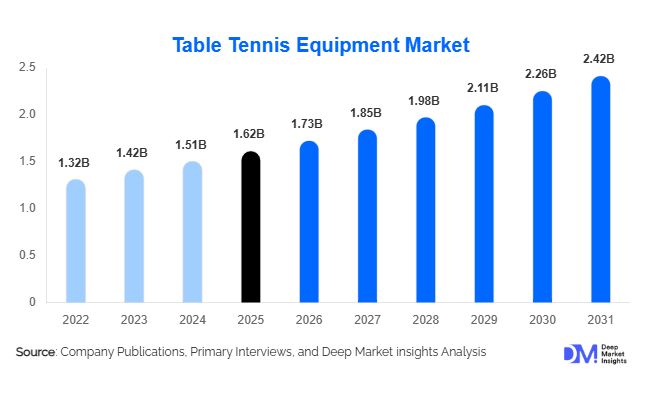
Table Tennis Equipment Market Trends
Smart Training Systems and AI-Based Coaching Solutions
Technology integration is becoming one of the defining trends within the table tennis equipment market. Manufacturers are increasingly introducing AI-powered training robots, motion sensors, connected rackets, and smart tables capable of tracking player performance metrics such as spin rate, ball placement, speed, and reaction time. Professional academies and sports clubs are adopting robotics-assisted coaching systems that can simulate advanced playing styles and customizable practice scenarios. Mobile applications integrated with smart equipment are further improving player engagement by offering performance analytics and personalized training recommendations. These innovations are particularly appealing to younger players and technology-oriented consumers seeking immersive and data-driven training experiences.
Growing Popularity of Home and Recreational Table Tennis
The rising preference for home-based entertainment and wellness-focused recreational activities has significantly increased residential demand for table tennis equipment. Foldable tables, portable nets, bundled beginner kits, and weather-resistant outdoor tables are gaining traction among households globally. Urban residential complexes, hospitality venues, co-working spaces, and corporate offices are increasingly incorporating recreational gaming zones to improve wellness and social interaction. Consumers are also favoring compact and multi-functional table tennis products designed for smaller living spaces. The trend is especially strong across North America and Europe, where indoor recreational spending continues to rise alongside lifestyle-oriented sports participation.
Table Tennis Equipment Market Drivers
Rising Participation in Indoor Sports Activities
Growing awareness regarding health, fitness, and active lifestyles has substantially increased participation in indoor sports across multiple demographics. Table tennis benefits from low infrastructure requirements, affordability, and accessibility across age groups, making it attractive for schools, residential users, clubs, and corporate recreation programs. Urbanization and shrinking outdoor recreational spaces have additionally accelerated the popularity of indoor sports. Governments and educational institutions are also promoting indoor sporting activities through school sports programs and community wellness initiatives, further strengthening equipment demand globally.
Technological Advancements in Sports Equipment
Innovation in materials and sports engineering is driving premiumization within the market. Manufacturers are increasingly utilizing carbon-fiber composites, lightweight polymers, and advanced rubber technologies to improve racket performance and durability. Smart robotics-enabled training systems and AI-integrated analytics platforms are expanding the appeal of table tennis among competitive players and sports academies. Consumers are increasingly willing to pay premium prices for high-performance and technologically advanced equipment, enabling manufacturers to improve profitability and strengthen brand positioning within professional sports ecosystems.
Table Tennis Equipment Market Restraints
Intense Competition from Low-Cost Manufacturers
The global table tennis equipment market remains highly fragmented, with numerous regional and unorganized manufacturers competing aggressively on price. Low-cost imitation products and counterfeit sporting equipment, particularly across developing economies, place pressure on premium global brands and reduce pricing power. Recreational consumers often prioritize affordability over performance specifications, which can limit penetration of premium product categories. This pricing competition continues to challenge established manufacturers attempting to maintain brand differentiation and margins.
Raw Material Price Volatility and Supply Chain Challenges
Fluctuations in the prices of carbon fiber, rubber, wood, polymers, and aluminum components significantly impact manufacturing costs across the table tennis equipment industry. Supply chain disruptions, shipping inflation, and energy cost volatility have increased production expenses in recent years. Premium tournament-grade equipment is particularly vulnerable to cost increases because of its dependence on specialized materials and precision manufacturing processes. These challenges may restrict profit margins and create pricing instability within the market.
Table Tennis Equipment Market Opportunities
Expansion of School and Grassroots Sports Infrastructure
Governments across Asia-Pacific, Latin America, and parts of Europe are increasing investments in school-level sports infrastructure and indoor recreational facilities. Educational institutions are integrating table tennis into physical education programs due to the sport’s accessibility and low infrastructure requirements. This is creating strong opportunities for manufacturers supplying institutional-grade tables, training systems, rackets, and accessories. Emerging markets such as India, Indonesia, Vietnam, and Brazil are witnessing rapid growth in sports academy development and youth participation programs, further expanding long-term demand potential.
Growing Demand for Smart and Connected Equipment
The increasing adoption of AI-enabled training systems, robotics-assisted coaching platforms, and sensor-integrated equipment presents a major growth opportunity for industry participants. Smart table tennis solutions capable of providing real-time analytics, skill tracking, and remote coaching support are gaining traction among professional players and advanced amateurs. Sports technology startups and established manufacturers are investing heavily in connected ecosystems that combine hardware, software, and mobile applications. These innovations are expected to create premium product categories with higher margins and recurring software-based revenue streams.
Report Scope
| Report Metric | Details |
|---|---|
| Market Size in 2025 | USD 1.62 Billion |
| Market Size in 2026 | USD 1.73 Billion |
| Market Size in 2031 | USD 2.42 Billion |
| CAGR | 6.9% (2026-2031) |
| Base Year for Estimation | 2025 |
| Historical Data | 2022-2024 |
| Forecast Period | 2026-2031 |
| Report Coverage | Revenue Forecast, Competitive Landscape, Supply Chain Disruption, Growth Factors, Environment & Regulatory Landscape and Trends |
| Geographies Covered | North America, Europe, APAC, Middle East and Africa, LATAM |
| Countries Covered | U.S., Canada, U.K., Germany, France, Spain, Italy, Russia, Nordic, Benelux, Rest of Europe, China, Korea, Japan, India, Australia, Singapore, Taiwan, South East Asia, Rest of Asia-Pacific, UAE, Turky, Saudi Arabia, South Africa, Egypt, Nigeria, Rest of MEA, Brazil, Mexico, Argentina, Chile, Colombia, Rest of LATAM |
Explore more data points, trends and opportunities Download Free Sample Report
Product Type Insights
Rackets and bats dominate the table tennis equipment market, accounting for the largest share of global revenues due to frequent replacement cycles and continuous innovation in blade and rubber technologies. Professional and semi-professional players increasingly prefer carbon-fiber composite rackets designed for enhanced spin, speed, and control. Tables remain another major product category, particularly with growing demand for foldable indoor tables and weather-resistant outdoor variants used in residential and commercial settings. Ball demand continues to rise alongside institutional training programs and recreational adoption, while accessories such as robotic trainers, grip tapes, and cleaning systems are emerging as fast-growing premium categories. Smart tables integrated with performance tracking systems are also beginning to gain traction among professional clubs and sports academies.
Application Insights
Recreational and home entertainment applications represent the leading segment within the table tennis equipment market, supported by increasing consumer interest in indoor social activities and wellness-focused recreation. Professional tournaments and training applications continue to generate strong demand for premium-grade tables, rackets, and robotic coaching systems. Educational sports programs are expanding rapidly as schools and universities integrate indoor sports into extracurricular activities and wellness initiatives. Commercial leisure facilities, including hotels, resorts, gaming lounges, and co-working spaces, are increasingly installing table tennis infrastructure to improve customer engagement and employee recreation. Corporate wellness programs are additionally contributing to rising demand for recreational indoor sports equipment across developed economies.
Distribution Channel Insights
Online retail and e-commerce platforms dominate equipment sales globally due to broad product availability, transparent pricing, and easy access to international brands. Consumers increasingly rely on digital reviews, influencer recommendations, and comparison platforms before purchasing equipment online. Direct-to-consumer brand websites are gaining importance as manufacturers strengthen digital marketing strategies and expand global shipping capabilities. Specialty sports stores remain relevant for professional players who prefer physical product testing and expert consultation prior to purchase. Institutional and direct-to-club sales channels also contribute significantly to revenues through bulk procurement contracts with schools, sports academies, and recreational facilities.
Player Category Insights
Recreational and home users account for the largest market share, driven by rising adoption of indoor recreational activities among families and urban consumers. Amateur and club-level players represent another major consumer group, particularly in Europe and Asia-Pacific where organized leagues and local competitions are widespread. Professional players continue to drive demand for premium equipment categories such as tournament-grade rackets, high-performance rubber sheets, and advanced robotic trainers. Youth and junior participation is growing steadily due to school-level sports programs and academy expansion initiatives. Educational institutions are increasingly investing in affordable beginner equipment to encourage early-stage sports participation among students.
Explore more data points, trends and opportunities Download Free Sample Report
Table Tennis Equipment Market Segmentations
By Product Type
- Tables
- Rackets/Bats/Paddles
- Balls
- Nets & Posts
- Rubber & Blade Components
- Accessories
By Material Type
- Wood
- Carbon Fiber
- Composite Materials
- Aluminum & Steel Components
- Polymer/Plastic Materials
- Rubber-Based Materials
By Distribution Channel
- Specialty Sports Stores
- Online Retail & E-commerce Platforms
- Hypermarkets/Supermarkets
- Direct-to-Club/Institution Sales
- Brand-Owned Stores
- Third-Party Sporting Goods Retailers
By Application
- Professional Tournaments
- Training & Coaching
- Recreational & Home Entertainment
- Educational Sports Programs
- Commercial Leisure Facilities
By End Use
- Residential/Home Use
- Sports Clubs & Academies
- Schools & Universities
- Hospitality & Recreation Centers
- Corporate & Institutional Recreation
- Professional Sports Associations
Regional Insights
North America
North America represents a major regional market for table tennis equipment, led primarily by the United States and Canada. Rising demand for residential recreational equipment, corporate wellness programs, and indoor sports participation continues to support market growth. Consumers increasingly prefer foldable tables and beginner-friendly equipment designed for home entertainment. Institutional investments in schools and community recreation centers are also strengthening regional demand. E-commerce penetration remains particularly high across the region, enabling consumers to access premium international brands easily.
Europe
Europe remains one of the most mature markets for table tennis equipment, supported by strong club culture and organized amateur leagues. Germany leads regional demand due to widespread sports participation and institutional infrastructure. France, Sweden, and the United Kingdom also maintain strong market presence through recreational and professional applications. European consumers are increasingly favoring eco-friendly sporting goods and technologically advanced products. Demand for premium rackets, smart training systems, and sustainable manufacturing practices continues to rise across the region.
Asia-Pacific
Asia-Pacific dominates the global table tennis equipment market, accounting for nearly 45% of total revenues in 2025. China remains the largest producer, exporter, and consumer globally due to the sport’s cultural significance and strong government support for sports infrastructure. Japan and South Korea maintain strong demand for premium professional equipment and advanced training systems. India is emerging as one of the fastest-growing markets due to rising youth participation, sports academy expansion, and increasing middle-class recreational spending. Southeast Asian countries are also witnessing increasing adoption of recreational indoor sports.
Latin America
Latin America is gradually emerging as a developing market for table tennis equipment, with Brazil leading regional demand. Rising youth participation in sports programs, increasing investments in recreational infrastructure, and growing awareness regarding indoor wellness activities are supporting market growth. Argentina and Chile are also witnessing increasing institutional demand from schools and sports clubs. Budget-friendly recreational products remain particularly popular within the region due to price-sensitive consumer behavior.
Middle East & Africa
The Middle East & Africa region is witnessing growing adoption of indoor sports and recreational activities. UAE and Saudi Arabia are investing heavily in sports infrastructure as part of broader economic diversification and wellness initiatives. Hospitality and entertainment sectors across the Gulf region are increasingly incorporating indoor recreational facilities within commercial developments. South Africa remains one of the leading African markets due to established recreational sports infrastructure and increasing institutional investments in youth sports participation programs.
Key Players in the Table Tennis Equipment Market
- Butterfly (Tamasu Co., Ltd.)
- Double Happiness Shanghai (DHS)
- Stiga Sports AB
- JOOLA
- Nittaku Co., Ltd.
- Donic
- Tibhar
- XIOM
- Cornilleau
- Yasaka