Swimwear & Beachwear Market Size
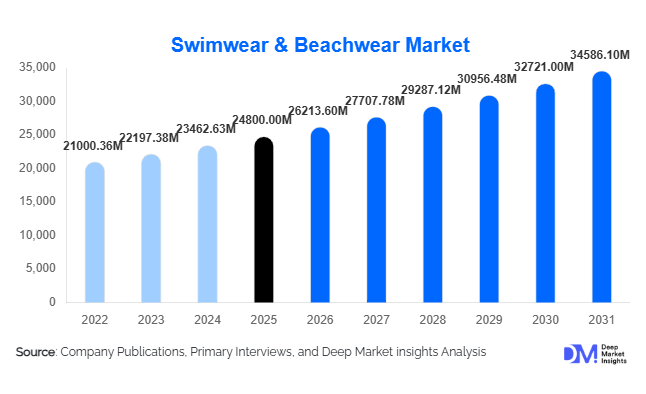
According to Deep Market Insights, the global swimwear & beachwear market size was valued at USD 24,800 million in 2025 and is projected to grow from USD 26,213.60 million in 2026 to reach USD 34,586.10 million by 2031, expanding at a CAGR of 5.7% during the forecast period (2026–2031). The swimwear & beachwear market growth is primarily driven by rising global tourism, the increasing popularity of fashion-oriented beachwear, and technological advancements in fabrics, enhancing performance and sustainability.
Key Market Insights
- Women’s swimwear dominates the global market, accounting for 52% of total demand, fueled by higher product variety, repeat purchases, and fashion-conscious consumers.
- Two-piece swimwear (bikinis and tankinis) leads the product segment, representing 28% of the market, due to strong demand from both recreational and fashion-driven consumers.
- North America holds the largest regional share (30%), supported by strong beach tourism, high disposable income, and well-established retail networks in the U.S. and Canada.
- Asia-Pacific is the fastest-growing region (7% CAGR), driven by rising middle-class income, domestic tourism, and social media influence in China, India, and Australia.
- Polyester-based swimwear dominates materials (35% share), due to its durability, cost-efficiency, and resistance to UV exposure and chlorine.
- Digital transformation is reshaping distribution, with online channels and direct-to-consumer platforms rapidly increasing market reach and improving consumer experience.
What are the latest trends in the swimwear & beachwear market?
Sustainable and Eco-Friendly Swimwear
Brands are increasingly incorporating recycled materials, such as regenerated nylon and ocean plastics, to meet rising consumer demand for sustainable apparel. Eco-conscious consumers are willing to pay premium prices for swimwear made from sustainable fabrics. Circular fashion initiatives, including take-back and recycling programs, are becoming mainstream. Leading players are emphasizing transparency in sourcing and production to strengthen brand loyalty and differentiate in a competitive market.
Technology-Enhanced Swimwear Design
Innovations in fabric technology, including UV protection, chlorine resistance, quick-drying materials, and body-compression features, are redefining consumer expectations. Smart sizing tools, AI-based design recommendations, and virtual try-on features are being integrated into online platforms to reduce returns and improve purchase confidence. These technological enhancements are particularly appealing to younger, fashion-conscious consumers who seek both performance and style.
What are the key drivers in the swimwear & beachwear market?
Growing Global Tourism and Beach Recreation
The increasing popularity of coastal tourism, beach vacations, and water sports activities is a key growth driver. Rising disposable incomes, affordable travel options, and the expansion of tourism infrastructure in Asia-Pacific and Latin America are boosting demand. Consumers are increasingly purchasing swimwear for vacation-oriented lifestyle needs rather than just functional purposes.
Fashion Integration and Social Media Influence
Swimwear has become a fashion statement, amplified by influencer marketing and seasonal collections. Social media platforms promote trends, drive brand awareness, and encourage frequent purchasing, particularly among younger demographics. Brands leveraging influencer collaborations and visually appealing campaigns are seeing higher engagement and repeat purchases.
Technological Innovations in Materials
Advancements in fabrics such as quick-dry, UV-protective, chlorine-resistant, and high-compression materials have increased product functionality, appealing to both recreational users and athletes. These innovations allow premium pricing and enable differentiation, expanding the market for performance-oriented swimwear.
What are the restraints for the global market?
Seasonality of Demand
Sales are highly seasonal, peaking in summer months in temperate regions, creating inventory and revenue management challenges. This can impact profitability and lead to periods of underutilised manufacturing capacity.
Price Sensitivity in Emerging Markets
While premium and sustainable swimwear segments are growing, cost remains a barrier for price-sensitive consumers in developing regions. Brands must balance affordability with innovation to penetrate these markets effectively.
What are the key opportunities in the swimwear & beachwear industry?
Expansion in Emerging Tourism Markets
Southeast Asia, the Middle East, and Africa are investing heavily in beach tourism infrastructure. New entrants can tap into these markets with culturally adapted swimwear designs and region-specific marketing strategies. Luxury resorts, eco-tourism projects, and international beach events are increasing the need for both functional and fashionable swimwear.
Inclusive and Adaptive Swimwear
The demand for maternity, plus-size, and disability-friendly swimwear is rising. Addressing these underserved segments provides new revenue streams while reinforcing brand loyalty. Inclusive sizing is becoming a key differentiator, especially in premium and mid-range segments.
Digital Transformation and Direct-to-Consumer Growth
Online sales channels and DTC platforms are expanding their reach globally. Technologies like virtual try-ons, AI-driven size recommendations, and personalised styling improve conversion rates. Smaller brands are using social media and influencer campaigns to compete effectively with global players.
Report Scope
| Report Metric | Details |
|---|---|
| Market Size in 2025 | USD 24800 Million |
| Market Size in 2026 | USD 26213.60 Million |
| Market Size in 2031 | USD 34586.10 Million |
| CAGR | 5.7% (2026-2031) |
| Base Year for Estimation | 2025 |
| Historical Data | 2022-2024 |
| Forecast Period | 2026-2031 |
| Report Coverage | Revenue Forecast, Competitive Landscape, Supply Chain Disruption, Growth Factors, Environment & Regulatory Landscape and Trends |
| Geographies Covered | North America, Europe, APAC, Middle East and Africa, LATAM |
| Countries Covered | U.S., Canada, U.K., Germany, France, Spain, Italy, Russia, Nordic, Benelux, Rest of Europe, China, Korea, Japan, India, Australia, Singapore, Taiwan, South East Asia, Rest of Asia-Pacific, UAE, Turky, Saudi Arabia, South Africa, Egypt, Nigeria, Rest of MEA, Brazil, Mexico, Argentina, Chile, Colombia, Rest of LATAM |
Explore more data points, trends and opportunities Download Free Sample Report
Product Type Insights
Two-piece swimwear (bikinis and tankinis) continues to lead the global market, accounting for approximately 28% of total market share. This dominance is primarily driven by strong fashion orientation, versatility in styling, and high demand among leisure travelers and younger demographics. The segment benefits significantly from social media influence, celebrity endorsements, and seasonal fashion cycles, which encourage frequent purchases and trend-driven consumption. Additionally, the growing popularity of beach vacations and resort wear culture has reinforced demand for mix-and-match swimwear options, further boosting this category. One-piece swimsuits maintain a strong presence, particularly in the competitive and performance swimwear segments, due to their functional design, hydrodynamic advantages, and suitability for professional athletes. Meanwhile, swim trunks and briefs dominate the men’s segment, supported by increasing participation in water sports and recreational swimming.
From a pricing perspective, the mid-range segment leads with approximately 40% share, as it strikes an optimal balance between affordability and quality. Consumers in both developed and emerging markets prefer mid-range products that offer durability, style, and brand value without premium pricing. Additionally, sustainable swimwear is emerging as a high-growth niche, driven by increasing environmental awareness and regulatory pressure on sustainable manufacturing. Although currently smaller in share, this segment is expected to witness accelerated adoption due to innovations in recycled fabrics and eco-friendly production processes.
Application Insights
The recreational and leisure segment dominates the market, accounting for nearly 60% of total demand, driven by the global expansion of tourism and increasing participation in beach and water-based activities. Rising disposable incomes, especially in emerging economies, and the growing popularity of wellness and outdoor lifestyles are key drivers supporting this segment’s leadership. Consumers are increasingly purchasing swimwear not just for necessity but as part of a broader lifestyle experience tied to travel and leisure. The fashion and lifestyle segment is the fastest-growing, expanding at a CAGR of approximately 7%. This growth is fueled by social media trends, influencer marketing, and the integration of swimwear into everyday fashion. Swimwear is increasingly being styled as outerwear, particularly in urban and resort settings, which is expanding its usage beyond traditional beach environments.
Competitive swimwear, which accounts for around 15% of the market, is supported by advancements in performance-enhancing fabrics and increased participation in professional swimming and water sports. Sponsorships, international sporting events, and institutional demand from training academies and clubs further contribute to the steady growth of this segment.
Distribution Channel Insights
Offline retail channels continue to dominate, accounting for approximately 55% of the market, driven by the consumer preference for physical product trials, especially for size-sensitive categories like swimwear. Specialty stores, department stores, and sports retail chains provide a tactile shopping experience, personalized assistance, and immediate product availability, which remain critical factors influencing purchase decisions.
However, online channels are rapidly gaining traction, supported by the growth of e-commerce platforms and brand-owned websites. The expansion of digital infrastructure, coupled with the adoption of AI-driven personalization tools such as virtual try-ons and size recommendation engines, is significantly enhancing the online shopping experience. These advancements are reducing return rates and increasing consumer confidence in online purchases. Direct-to-consumer (DTC) strategies are also becoming increasingly important, enabling brands to build stronger customer relationships, gather first-party data, and improve profit margins by reducing reliance on intermediaries. Social media integration and influencer collaborations are further accelerating online sales growth, particularly among younger consumers.
Explore more data points, trends and opportunities Download Free Sample Report
Swimwear & Beachwear Market Segmentations
By Product Type
- One-piece Swimwear
- Two-piece Swimwear
- Swim Trunks & Briefs
- Beachwear
- Rash Guards & Performance Swimwear
By Application
- Recreational & Leisure
- Fashion & Lifestyle
- Competitive Sports
By Distribution Channel
- Online Retail
- Specialty Stores
- Department Stores
- Sports Retail Chains
- Multi-brand Fashion Retailers
Regional Insights
North America
North America remains the largest regional market, accounting for approximately 30% of global demand. The United States is the primary contributor, followed by Canada. Growth in this region is driven by high disposable income levels, a well-established beach tourism industry, and strong consumer preference for branded and premium swimwear. Additionally, increasing awareness of sustainable fashion and the presence of leading global brands are supporting market expansion. The region also benefits from advanced retail infrastructure and high penetration of e-commerce, enabling seamless omnichannel shopping experiences.
Europe
Europe holds around 25% of the global market share, with key demand centers in Italy, France, Spain, and the United Kingdom. The region’s growth is driven by strong fashion consciousness, extensive Mediterranean coastline tourism, and increasing adoption of sustainable apparel. European consumers are highly responsive to eco-friendly and ethically produced swimwear, which is accelerating demand for sustainable product lines. Additionally, the region’s well-developed fashion industry and frequent product innovation cycles contribute to steady market growth.
Asia-Pacific
Asia-Pacific accounts for approximately 28% of the market and is the fastest-growing region, with a CAGR of around 7%. China, India, Japan, and Australia are key contributors. Growth is primarily driven by rising middle-class incomes, increasing domestic and international tourism, and expanding urbanization. The growing influence of social media and Western fashion trends is also encouraging higher adoption of swimwear, particularly among younger consumers. Furthermore, rapid expansion of e-commerce platforms and improving logistics infrastructure are enabling broader market access across both urban and semi-urban areas.
Latin America
Latin America represents approximately 10% of the global market, with Brazil, Mexico, and Argentina as major contributors. The region’s growth is supported by a strong beach culture, favorable climate conditions, and increasing participation in outdoor and water-based activities. Brazil, in particular, is a key market due to its globally recognized swimwear fashion industry. Rising disposable incomes and growing exposure to international brands are further driving demand, especially in urban centers.
Middle East & Africa
The Middle East & Africa region accounts for around 7% of the global market. Growth in this region is driven by the rapid expansion of luxury tourism in countries such as the UAE and Saudi Arabia, along with increasing investments in coastal infrastructure and resort development. In Africa, countries like South Africa and Kenya are witnessing rising intra-regional tourism, which is supporting demand for swimwear and beachwear. Additionally, the increasing adoption of modest swimwear in Middle Eastern markets is creating new growth opportunities and expanding the consumer base.
Key Players in the Swimwear & Beachwear Market
- Nike, Inc.
- Adidas AG
- PVH Corp.
- LVMH
- H&M Group
- Inditex (Zara)
- Speedo International
- Arena S.p.A.
- Decathlon S.A.
- Puma SE
- Calzedonia Group
- Billabong (Boardriders)
- Rip Curl Group
- Seafolly
- La Perla