Sun Care Products Market Size
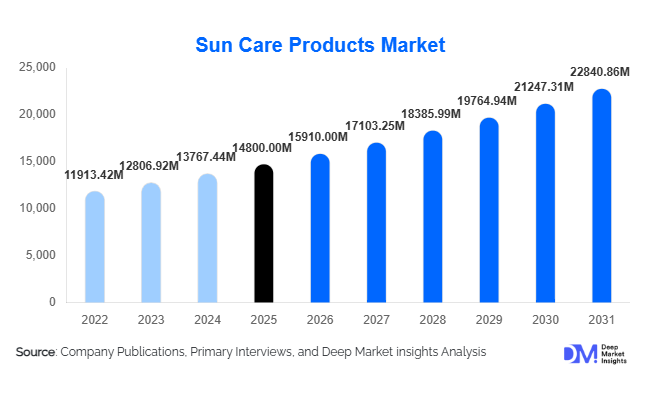
According to Deep Market Insights, the global sun care products market size was valued at USD 14,800 million in 2025 and is projected to grow from USD 15,910.00 million in 2026 to reach USD 22,840.86 million by 2031, expanding at a CAGR of 7.5% during the forecast period (2026–2031). The sun care products market growth is primarily driven by rising awareness of UV radiation risks, increasing skin cancer incidence, growing adoption of daily skincare routines, and rapid innovation in multifunctional cosmetic products combining sun protection with skincare benefits.
Key Market Insights
- Daily-use sun protection is becoming a global skincare norm, moving beyond seasonal beach-use applications into year-round personal care routines.
- SPF-infused cosmetics are gaining strong traction, particularly foundations, moisturizers, and BB creams integrated with UV protection.
- Asia-Pacific dominates consumption growth, driven by rising middle-class income, skincare awareness, and strong beauty industry penetration.
- Mineral and reef-safe sunscreens are expanding rapidly, supported by regulatory bans on harmful UV-filter chemicals in multiple countries.
- E-commerce is reshaping distribution, enabling global brands to penetrate emerging markets with direct-to-consumer strategies.
- Dermatologist-recommended and clinically tested products are increasingly influencing purchasing decisions across all regions.
What are the latest trends in the sun care products market?
Rise of Hybrid Skincare-Sun Protection Products
One of the most significant trends in the sun care products market is the increasing demand for multifunctional formulations. Consumers are increasingly preferring products that combine sun protection with anti-aging, hydration, pollution defense, and skin brightening benefits. SPF-infused serums, tinted sunscreens, and skincare-makeup hybrids are gaining popularity, particularly in urban populations with fast-paced lifestyles. This shift is enabling brands to move toward premiumization while improving user convenience. The integration of dermatological actives such as hyaluronic acid, niacinamide, and antioxidants is further enhancing product value and expanding application beyond traditional UV protection.
Clean Label, Mineral-Based, and Reef-Safe Innovation
Sustainability concerns are reshaping product innovation in the sun care industry. Consumers are increasingly avoiding chemical UV filters linked to environmental damage, leading to rapid adoption of mineral-based formulations using zinc oxide and titanium dioxide. Brands are investing heavily in reef-safe certifications, biodegradable packaging, and transparent ingredient labeling. Regulatory bans on oxybenzone and octinoxate in several regions have further accelerated this transition. As a result, companies focusing on clean beauty positioning and eco-conscious branding are gaining stronger consumer loyalty and a competitive advantage in global markets.
What are the key drivers in the sun care products market?
Rising Skin Health Awareness and UV Exposure Risks
Increasing awareness of skin damage caused by UV radiation, including premature aging, pigmentation, and skin cancer, is a primary driver of market growth. Dermatologists and public health organizations are actively promoting daily sunscreen usage, significantly expanding the consumer base. This shift has transformed sunscreen from an occasional product into an essential daily skincare item, particularly in urban populations exposed to high pollution and sunlight levels.
Growth of the Global Beauty and Personal Care Industry
The expansion of the global cosmetics and skincare industry is significantly boosting sun care demand. Consumers are increasingly integrating SPF into makeup and skincare routines, leading to the rise of multifunctional products. Premium beauty brands are incorporating sun protection into moisturizers, foundations, and anti-aging products, thereby expanding the market beyond traditional sunscreen categories. Rising disposable incomes and increasing grooming awareness among men and women are further strengthening demand globally.
Expansion of E-commerce and Digital Influence
The rapid growth of online retail channels is significantly driving market penetration. Consumers now have access to global brands, product comparisons, dermatologist reviews, and influencer recommendations through digital platforms. Social media marketing, skincare influencers, and dermatology-led education campaigns are heavily influencing purchasing behavior. This has especially benefited emerging markets, where offline distribution networks are still developing.
What are the restraints for the global market?
Concerns Over Chemical Ingredients and Regulatory Pressure
Growing concerns regarding the safety of chemical UV filters such as oxybenzone and octinoxate have created regulatory and consumer trust challenges. Several regions have introduced restrictions or bans due to environmental and health concerns. This has increased compliance costs for manufacturers and forced reformulation efforts, impacting profit margins and product development timelines.
Seasonal Demand Fluctuations in Certain Regions
In temperate and cold regions, sunscreen usage declines significantly during winter months, leading to seasonal demand variability. This creates challenges in production planning, inventory management, and revenue stability for manufacturers. Companies operating in these regions must rely on product diversification or global expansion strategies to balance demand fluctuations.
What are the key opportunities in the sun care products industry?
Expansion in Emerging Markets
Emerging economies across Asia-Pacific, Latin America, and Africa present significant growth opportunities due to rising disposable incomes, increasing urbanization, and growing skincare awareness. Countries such as India, China, Brazil, and Indonesia are witnessing the rapid adoption of sun protection products. Localized formulations designed for diverse skin types and climatic conditions offer strong potential for global and regional brands to expand their footprint.
Growth of Sustainable and Organic Product Lines
The increasing demand for natural, organic, and environmentally safe skincare products is creating opportunities for clean-label sun care innovations. Consumers are actively seeking reef-safe, vegan, and cruelty-free formulations. Brands investing in sustainable sourcing, biodegradable packaging, and transparent labeling are expected to gain stronger market positioning and long-term brand loyalty.
Integration of Dermatology and Personalized Skincare
Advancements in skin analysis technologies and AI-driven skincare recommendations are enabling personalized sun protection solutions. Dermatology-backed product customization based on skin type, UV exposure levels, and environmental conditions is emerging as a high-value niche. This trend is expected to redefine consumer engagement and product development strategies in the coming years.
Report Scope
| Report Metric | Details |
|---|---|
| Market Size in 2025 | USD 14800 Million |
| Market Size in 2026 | USD 15910.00 Million |
| Market Size in 2031 | USD 22840.86 Million |
| CAGR | 7.5% (2026-2031) |
| Base Year for Estimation | 2025 |
| Historical Data | 2022-2024 |
| Forecast Period | 2026-2031 |
| Report Coverage | Revenue Forecast, Competitive Landscape, Supply Chain Disruption, Growth Factors, Environment & Regulatory Landscape and Trends |
| Geographies Covered | North America, Europe, APAC, Middle East and Africa, LATAM |
| Countries Covered | U.S., Canada, U.K., Germany, France, Spain, Italy, Russia, Nordic, Benelux, Rest of Europe, China, Korea, Japan, India, Australia, Singapore, Taiwan, South East Asia, Rest of Asia-Pacific, UAE, Turky, Saudi Arabia, South Africa, Egypt, Nigeria, Rest of MEA, Brazil, Mexico, Argentina, Chile, Colombia, Rest of LATAM |
Explore more data points, trends and opportunities Download Free Sample Report
Product Type Insights
Sunscreen creams continue to dominate the global sun care products market, accounting for approximately 32% of total market share in 2025. This leadership is primarily driven by their versatility, ease of application, and compatibility with a wide range of skin types, making them the preferred choice for daily skincare routines. Cream-based formulations also allow for better incorporation of moisturizing agents, anti-aging compounds, and dermatologically active ingredients, which aligns with the growing demand for multifunctional skincare. Additionally, strong dermatologist recommendations and widespread availability across price points further reinforce their dominance.
Lotions and gels follow closely, benefiting from increasing consumer preference for lightweight, non-greasy textures, especially in humid and tropical climates. These formats are particularly popular in Asia-Pacific markets where climate conditions demand quick-absorbing formulations. Sprays and mists are rapidly gaining traction among younger demographics and sports enthusiasts due to their convenience, quick application, and suitability for on-the-go usage. Meanwhile, after-sun care products are witnessing steady growth as consumers become more aware of post-exposure skin repair, hydration, and soothing needs. Self-tanning products, although niche, are gaining popularity in North America and Europe, driven by aesthetic preferences for tanned skin without UV exposure risks.
Application Insights
Personal daily skincare remains the largest application segment, accounting for over 80% of total demand, driven by the global shift toward preventive skincare and routine-based sun protection. Increasing awareness of long-term skin damage, including premature aging and pigmentation, has positioned sunscreen as a daily essential rather than a seasonal product. The integration of SPF into everyday skincare products such as moisturizers, serums, and foundations is further accelerating this segment’s growth.
Professional applications in dermatology clinics and aesthetic centers are expanding rapidly, supported by the rise in cosmetic procedures such as chemical peels, laser treatments, and skin resurfacing, all of which require strict post-treatment sun protection. Outdoor activities, including sports, travel, and beach tourism, are also contributing significantly to demand for specialized products such as water-resistant, sweat-proof, and long-lasting sunscreens. Furthermore, the increasing convergence of cosmetics and sun care is creating hybrid application categories, particularly in premium beauty segments, where consumers seek multifunctional products that combine UV protection with makeup and skincare benefits.
Distribution Channel Insights
Traditional offline channels such as supermarkets, pharmacies, and drugstores continue to play a critical role in market distribution, owing to their strong product visibility, consumer trust, and accessibility. Pharmacies, in particular, are preferred for dermatologist-recommended and clinically tested products, especially in developed markets. However, the most significant growth is being observed in the online retail segment, which is rapidly transforming the distribution landscape.
E-commerce platforms offer a wider assortment of products, competitive pricing, and access to global brands, making them highly attractive to consumers. Influencer marketing, online reviews, and targeted digital advertising are further accelerating online sales. Specialty beauty stores maintain strong performance in premium and luxury segments by offering curated product selections and personalized customer experiences. Additionally, direct-to-consumer (D2C) channels are gaining momentum as brands invest in their own digital platforms to enhance margins and build direct relationships with consumers. Subscription-based skincare models and auto-replenishment services are also emerging as innovative distribution strategies, particularly among urban consumers.
End-Use Insights
The personal use segment dominates the sun care products market, driven by the widespread adoption of daily skincare routines and increasing consumer awareness regarding UV protection. This segment benefits from continuous product innovation, including lightweight formulations, tinted sunscreens, and multifunctional skincare products. The growing influence of social media and dermatology-backed education campaigns has further reinforced daily usage habits among consumers.
Professional use is steadily expanding, particularly in dermatology clinics, spas, and beauty salons, where sun protection is an essential component of post-treatment care. The increasing popularity of aesthetic and dermatological procedures has significantly boosted demand for specialized sun care formulations designed for sensitive or treated skin. Emerging end-use applications in sports and outdoor industries are also contributing to growth, with rising demand for high-performance sunscreens that offer durability, sweat resistance, and extended protection. Additionally, export-driven demand is playing a crucial role, with countries such as France, South Korea, and the United States serving as key exporters of advanced and premium sun care products to global markets.
Explore more data points, trends and opportunities Download Free Sample Report
Sun Care Products Market Segmentations
By Product Type
- Sunscreen Creams
- Sunscreen Lotions
- Sunscreen Gels
- Sunscreen Sprays & Mists
- Sun Protection Sticks
- After-Sun Care Products
- Self-Tanning Products
- SPF Lip Care Products
By SPF Level
- SPF 0–15 (Low Protection)
- SPF 16–30 (Moderate Protection)
- SPF 31–50 (High Protection)
- SPF 50+ (Very High Protection)
By Formulation Type
- Chemical Sunscreens
- Mineral Sunscreens
- Hybrid Formulations
By Distribution Channel
- Supermarkets & Hypermarkets
- Pharmacies & Drugstores
- Specialty Beauty Stores
- Online Retail (E-commerce)
- Convenience Stores
Regional Insights
North America
North America accounts for approximately 28% of the global sun care products market, with the United States being the largest contributor. The region’s growth is primarily driven by high awareness of skin cancer risks, supported by strong public health campaigns and dermatological recommendations. The presence of established skincare brands and high consumer spending on premium products further strengthens demand. Additionally, the growing trend of multifunctional and dermatologist-tested products is driving innovation. Canada is also witnessing steady growth, supported by increasing outdoor recreational activities and rising awareness of year-round UV protection, even in colder climates.
Europe
Europe holds around 24% market share, led by countries such as Germany, France, and the United Kingdom. The region’s growth is strongly influenced by stringent regulatory frameworks governing cosmetic safety and environmental impact, which have accelerated the adoption of organic, mineral-based, and reef-safe formulations. High consumer awareness and preference for sustainable and clean-label products are key growth drivers. Additionally, Europe’s strong tourism sector, particularly in Mediterranean countries, contributes to seasonal spikes in demand. The presence of leading global skincare manufacturers in France and Germany also supports innovation and export-driven growth.
Asia-Pacific
Asia-Pacific is the largest and fastest-growing regional market, accounting for approximately 34% of global demand. Key markets such as China, Japan, South Korea, and India are driving growth through rising disposable incomes, rapid urbanization, and a deeply ingrained skincare culture. The popularity of K-beauty and J-beauty trends has significantly influenced product innovation and consumer preferences. Climate conditions, including high temperatures and UV exposure levels, further necessitate daily sunscreen use. India and Southeast Asia are experiencing particularly strong growth due to expanding middle-class populations and increasing awareness campaigns. The region is also a major manufacturing hub, supporting both domestic consumption and global exports.
Latin America
Latin America, led by Brazil and Mexico, is witnessing steady growth in sun care product demand. High sun exposure levels, beach-centric lifestyles, and outdoor cultural activities are key drivers in this region. Brazil, in particular, represents a significant market due to its large population and strong personal care industry. Increasing awareness of skin health and expanding retail infrastructure are further supporting market growth. Additionally, rising middle-class incomes and urbanization are enabling greater access to premium sun care products.
Middle East & Africa
The Middle East & Africa region is experiencing growing demand due to extreme UV exposure and harsh climatic conditions. Gulf countries such as the UAE and Saudi Arabia are key markets, driven by high disposable incomes, luxury skincare preferences, and the strong retail presence of global brands. The increasing influence of beauty and wellness trends is also supporting premium product adoption. In Africa, South Africa is a leading market, supported by rising dermatological awareness and improving access to skincare products. Additionally, growing tourism across the region is contributing to increased consumption of sun protection products, particularly in resort and outdoor settings.
Key Players in the Sun Care Products Market
- L'Oréal Group
- Johnson & Johnson
- Beiersdorf AG
- Procter & Gamble
- Unilever
- Shiseido Company
- Kao Corporation
- Edgewell Personal Care
- Coty Inc.
- Amorepacific Corporation
- Clarins Group
- Estée Lauder Companies
- Pierre Fabre Group
- Bioderma Laboratories
- Chanel