Street Furniture Market Size
According to Deep Market Insights, the global street furniture market size was valued at USD 7,850 million in 2025 and is projected to grow from USD 8,415.20 million in 2026 to reach USD 11,913.47 million by 2031, expanding at a CAGR of 7.2% during the forecast period (2026–2031). The street furniture market is experiencing growth primarily driven by rapid urbanization, increasing investments in smart city infrastructure, and a rising demand for sustainable and multifunctional public amenities. Governments and municipalities worldwide are focusing on enhancing urban livability through improved public spaces, which is accelerating the deployment of benches, transit shelters, kiosks, and smart infrastructure solutions.
Key Market Insights
- Smart street furniture is gaining traction globally, driven by the integration of IoT, solar power, and digital connectivity features.
- Asia-Pacific dominates the market, supported by large-scale urbanization and infrastructure investments in China and India.
- Government-led urban development initiatives are the primary demand drivers, accounting for the majority of installations worldwide.
- Metal-based furniture leads in material usage, due to durability, cost-efficiency, and resistance to environmental conditions.
- Advertising-supported street furniture models are expanding, enabling revenue generation through digital displays and transit shelters.
- Sustainability trends are reshaping product innovation, with increased adoption of recycled materials and eco-friendly designs.
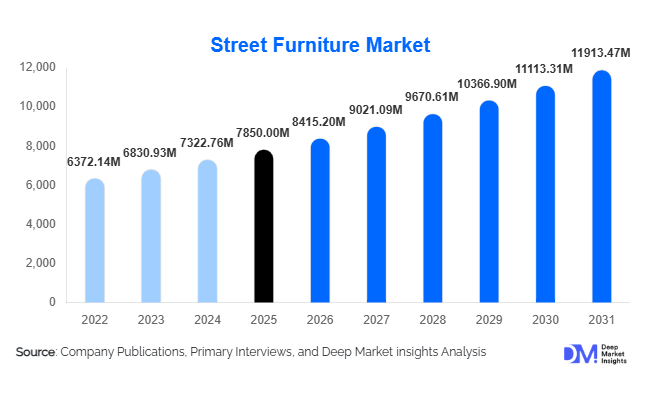
What are the latest trends in the street furniture market?
Rise of Smart and Connected Street Furniture
The integration of smart technologies into street furniture is transforming urban infrastructure. IoT-enabled benches, solar-powered kiosks, and Wi-Fi-equipped transit shelters are becoming increasingly common in major cities. These solutions provide added functionality such as device charging, environmental monitoring, and real-time information services. Municipalities are leveraging smart furniture to collect urban data, improve operational efficiency, and enhance citizen engagement. The trend is particularly strong in developed regions and rapidly urbanizing cities, where digital transformation is a key priority.
Sustainability and Circular Material Adoption
Environmental sustainability is emerging as a central theme in the street furniture market. Manufacturers are increasingly utilizing recycled plastics, sustainably sourced wood, and low-carbon materials to meet regulatory standards and consumer expectations. Solar-powered lighting and energy-efficient designs are further enhancing sustainability credentials. Lifecycle management and modular designs are also gaining popularity, enabling easier maintenance and replacement while reducing waste. This trend is especially prominent in Europe, where stringent environmental regulations are driving the adoption of eco-friendly solutions.
What are the key drivers in the street furniture market?
Rapid Urbanization and Infrastructure Development
Global urbanization continues to accelerate, particularly in emerging economies, creating significant demand for public infrastructure. Expanding cities require functional and aesthetic street furniture to support pedestrian movement, public transportation, and community engagement. Governments are investing heavily in urban renewal and smart city projects, directly boosting demand for benches, shelters, and wayfinding systems. This trend is expected to remain a key growth driver over the forecast period.
Smart City Initiatives and Government Funding
Government-led smart city initiatives are driving the adoption of technologically advanced street furniture. Investments in digital infrastructure, public safety, and urban mobility are encouraging municipalities to deploy connected and multifunctional solutions. Funding programs and policy support are accelerating the modernization of existing infrastructure, particularly in regions such as the Asia-Pacific, Europe, and the Middle East.
What are the restraints for the global market?
High Installation and Maintenance Costs
The deployment of advanced street furniture, particularly smart and connected units, involves significant upfront investment. Maintenance costs associated with technology integration, repairs, and upgrades can further strain municipal budgets. This is a key challenge for developing regions with limited financial resources, potentially slowing adoption rates.
Durability and Vandalism Concerns
Street furniture is exposed to harsh environmental conditions and potential vandalism, leading to increased maintenance requirements and reduced lifespan. Ensuring durability while maintaining cost efficiency remains a challenge for manufacturers. These concerns can impact procurement decisions and long-term investment planning for municipalities.
What are the key opportunities in the street furniture industry?
Smart City Integration and Data Monetization
The expansion of smart cities presents significant opportunities for integrating street furniture with digital ecosystems. Connected furniture can collect valuable data on urban mobility, environmental conditions, and user behavior, enabling data-driven decision-making for city planners. Companies that offer integrated hardware and software solutions can capitalize on this growing demand.
Advertising-Supported Infrastructure Models
Street furniture is increasingly being used as a platform for digital advertising, particularly in transit shelters and kiosks. This model allows municipalities to offset installation costs while generating recurring revenue. High-traffic urban areas offer lucrative opportunities for advertisers, making this a key growth avenue for market participants.
Report Scope
| Report Metric | Details |
|---|---|
| Market Size in 2025 | USD 7850 Million |
| Market Size in 2026 | USD 8415.20 Million |
| Market Size in 2031 | USD 11913.47 Million |
| CAGR | 7.2% (2026-2031) |
| Base Year for Estimation | 2025 |
| Historical Data | 2022-2024 |
| Forecast Period | 2026-2031 |
| Report Coverage | Revenue Forecast, Competitive Landscape, Supply Chain Disruption, Growth Factors, Environment & Regulatory Landscape and Trends |
| Geographies Covered | North America, Europe, APAC, Middle East and Africa, LATAM |
| Countries Covered | U.S., Canada, U.K., Germany, France, Spain, Italy, Russia, Nordic, Benelux, Rest of Europe, China, Korea, Japan, India, Australia, Singapore, Taiwan, South East Asia, Rest of Asia-Pacific, UAE, Turky, Saudi Arabia, South Africa, Egypt, Nigeria, Rest of MEA, Brazil, Mexico, Argentina, Chile, Colombia, Rest of LATAM |
Explore more data points, trends and opportunities Download Free Sample Report
Product Type Insights
Benches represent the largest segment, accounting for approximately 22% of the global market in 2025, primarily driven by their universal applicability across parks, streetscapes, transit hubs, and commercial zones. Their dominance is supported by relatively low installation costs, high replacement frequency, and growing emphasis on inclusive urban design that prioritizes pedestrian comfort and accessibility. Additionally, innovations such as ergonomic designs, vandal-resistant materials, and integration of solar charging features are further strengthening demand for benches globally.
Transit shelters and kiosks form the second-largest segment, benefiting from sustained investments in public transportation infrastructure and increasing adoption of digital advertising displays. Governments and municipalities are leveraging these structures not only for commuter convenience but also as revenue-generating assets through advertising partnerships. Waste management units are witnessing strong growth momentum due to rising regulatory focus on urban cleanliness, waste segregation, and recycling initiatives, particularly in Europe and the Asia-Pacific. Emerging product categories such as bike racks, micro-mobility docking stations, and smart kiosks are expanding rapidly, supported by the proliferation of shared mobility services and smart city deployments. These segments are expected to outpace traditional categories in growth rate, driven by evolving urban mobility patterns and the need for integrated infrastructure solutions.
Application Insights
Urban public spaces dominate the market, contributing nearly 40% of total demand, as governments increasingly prioritize urban beautification, pedestrian-friendly infrastructure, and community engagement. The leading position of this segment is driven by large-scale investments in parks, plazas, and streetscape enhancement projects aimed at improving the quality of life in densely populated cities. Transportation infrastructure is another major application segment, supported by the continuous expansion of bus, metro, and rail networks worldwide. The growing need for passenger comfort, safety, and real-time information systems is driving demand for advanced transit shelters and integrated street furniture solutions.
Commercial spaces, including shopping malls, business districts, and mixed-use developments, are adopting premium street furniture to enhance customer experience and brand perception. Institutional applications such as universities, healthcare facilities, and government complexes provide steady demand due to ongoing infrastructure upgrades. Meanwhile, residential developments and smart city projects are emerging as high-growth segments, driven by integrated urban planning and increasing demand for modern, multifunctional public amenities.
Distribution Channel Insights
Government procurement and public tenders dominate the distribution landscape, accounting for the majority of street furniture installations globally. This dominance is driven by the public nature of infrastructure projects and the central role of municipalities in urban planning and development. Long-term contracts and bulk procurement strategies further reinforce this channel’s leadership. Public-private partnerships (PPPs) are gaining significant traction, particularly in advertising-supported models where private players fund installation in exchange for advertising rights. This model is becoming increasingly popular in high-density urban areas, enabling cost-sharing and revenue generation for municipalities.
Direct sales to infrastructure developers, urban planners, and large commercial projects also represent a key channel, especially for customized and high-end solutions. Additionally, collaborations with architects and urban design firms are influencing product innovation and selection, ensuring alignment with modern urban aesthetics and functionality requirements.
End-Use Insights
Urban infrastructure and transportation sectors remain the largest end users of street furniture, driven by continuous investments in public amenities and mobility systems. The transportation segment is among the fastest-growing, supported by global expansion of metro rail systems, bus rapid transit networks, and integrated mobility hubs. Emerging applications in smart mobility ecosystems are creating new growth avenues, including e-bike docking stations, EV charging-enabled benches, and integrated mobility hubs. These solutions are becoming critical components of sustainable urban transport strategies.
Export-driven demand is also a notable trend, with Asia-Pacific serving as a major manufacturing hub supplying cost-effective street furniture to North America and Europe. The growing standardization of urban infrastructure and increasing cross-border procurement are further supporting this trend. Additionally, rising investments in smart cities and digital infrastructure are expected to significantly boost end-use demand across multiple sectors.
Explore more data points, trends and opportunities Download Free Sample Report
Street Furniture Market Segmentations
By Product Type
- Benches
- Transit Shelters
- Waste Management Units
- Bollards
- Kiosks
- Bike Racks & Micro-Mobility Infrastructure
- Planters & Green Infrastructure
- Signage & Wayfinding Systems
By Application
- Urban Public Spaces
- Transportation Infrastructure
- Commercial Spaces
- Institutional Infrastructure
- Residential & Smart City Projects
By Distribution Channel
- Government Tenders & Public Procurement
- Public-Private Partnerships (PPP)
- Direct Sales to Developers
- Architect & Urban Planner Collaborations
Regional Insights
North America
North America accounts for approximately 22% of the global market, led by the United States and supported by Canada. The region’s growth is primarily driven by the modernization of aging urban infrastructure and the increasing adoption of smart city technologies. Strong municipal budgets and federal funding programs for infrastructure renewal are accelerating replacement demand for existing street furniture. Additionally, rising focus on public safety, ADA-compliant accessibility standards, and integration of smart features such as Wi-Fi and surveillance systems are key drivers supporting regional growth.
Europe
Europe holds around 27% market share, with major contributions from Germany, the UK, France, and Italy. The region’s leadership is driven by stringent environmental regulations, strong emphasis on sustainable urban planning, and widespread adoption of eco-friendly materials. Government policies promoting circular economy practices and carbon reduction are encouraging the use of recycled and low-impact materials in street furniture manufacturing. Furthermore, high urban density and mature public transportation networks are sustaining steady demand, while smart city initiatives across Western Europe are driving adoption of connected infrastructure solutions.
Asia-Pacific
Asia-Pacific dominates the market with nearly 38% share in 2025, with China and India as the largest contributors. Rapid urbanization, population growth, and large-scale government investments in infrastructure development are the primary drivers of regional demand. National programs focused on smart cities and urban renewal are accelerating the deployment of both conventional and smart street furniture. Additionally, the presence of cost-effective manufacturing hubs and strong export capabilities further strengthens the region’s position. Increasing adoption of micro-mobility solutions and expansion of public transportation networks are also contributing to sustained growth.
Latin America
Latin America exhibits moderate growth, with Brazil and Mexico leading the market. The region’s demand is driven by urban development initiatives, improving public transportation infrastructure, and government efforts to enhance urban livability. Investments in city beautification and tourism infrastructure are also supporting the adoption of street furniture. However, budget constraints and economic volatility in some countries may limit large-scale deployments. Despite these challenges, increasing public-private partnerships and gradual modernization of urban infrastructure are expected to drive steady growth.
Middle East & Africa
The Middle East & Africa region is emerging as the fastest-growing market, with a CAGR exceeding 9%. Countries such as the UAE and Saudi Arabia are investing heavily in large-scale smart city and urban development projects, which are driving demand for advanced and technologically integrated street furniture. Mega-projects, tourism development initiatives, and increasing focus on sustainable urban planning are key growth drivers in the Middle East. In Africa, urbanization and infrastructure development in countries such as South Africa and Kenya are supporting gradual market expansion. The combination of high investment intensity in the Middle East and growing urban demand in Africa positions this region as a significant future growth hub.