Sticky Note Market Size
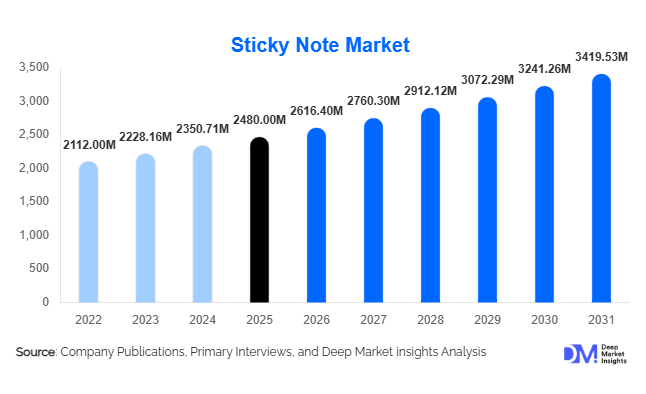
According to Deep Market Insights, the global sticky note market size was valued at USD 2,480 million in 2025 and is projected to grow from USD 2,616.40 million in 2026 to reach USD 3,419.53 million by 2031, expanding at a CAGR of 5.5% during the forecast period (2026–2031). The sticky note market growth is primarily driven by rising demand for workplace productivity tools, expanding educational infrastructure, and the increasing popularity of visual collaboration methods in corporate and academic environments.
Sticky notes remain one of the most widely used office stationery products globally due to their versatility, affordability, and simplicity in organizing tasks, reminders, and ideas. Despite the increasing use of digital productivity tools, physical sticky notes continue to hold relevance in hybrid workspaces, classrooms, and creative environments where tactile note-taking and visual brainstorming are essential.
The market is also benefiting from innovations such as eco-friendly paper materials, plant-based adhesives, reusable sticky notes, and designer formats tailored for modern consumers. Growing corporate branding activities have further expanded demand for customized sticky notes used in promotional campaigns, conferences, and marketing events. Emerging economies in Asia-Pacific and Latin America are also contributing significantly to demand due to the expansion of educational institutions, small businesses, and office employment.
Key Market Insights
- Corporate offices remain the largest consumer segment, accounting for nearly 46% of total sticky note demand globally.
- Standard 3×3 inch sticky notes dominate the market, representing the most widely used size format across offices and schools.
- North America leads global consumption, supported by strong office supply demand and established stationery distribution networks.
- Asia-Pacific is the fastest-growing region, driven by expanding education sectors and rising office employment in China and India.
- Eco-friendly sticky notes made from recycled paper are gaining traction as sustainability becomes a priority for corporate procurement.
- E-commerce platforms are reshaping distribution, enabling manufacturers to reach both institutional buyers and individual consumers.
What are the latest trends in the sticky note market?
Eco-Friendly and Sustainable Sticky Notes
Sustainability has emerged as a key trend shaping the sticky note market. Increasing environmental awareness among consumers and organizations has driven demand for eco-friendly stationery products made from recycled paper and biodegradable adhesives. Many manufacturers are introducing FSC-certified paper materials, chlorine-free processing methods, and recyclable packaging to reduce environmental impact.
Large corporate buyers and educational institutions are adopting sustainable procurement policies that prioritize environmentally responsible office supplies. As a result, manufacturers investing in green production methods and plant-based adhesives are gaining competitive advantages. The adoption of eco-label certifications and carbon-neutral manufacturing practices is also increasing, allowing companies to position their products as environmentally responsible alternatives.
Customization and Promotional Branding
Customized sticky notes are becoming increasingly popular as companies use them for marketing and promotional purposes. Businesses often print logos, slogans, and advertising messages on sticky notes distributed at conferences, trade shows, and corporate events. Advances in digital printing technology have enabled manufacturers to offer low-volume customized orders at competitive prices.
The promotional products industry is driving demand for customized sticky notes, particularly in North America and Europe where branded office supplies are commonly used for corporate marketing campaigns. Small businesses and start-ups are also adopting branded stationery to strengthen brand visibility in offices and co-working spaces.
What are the key drivers in the sticky note market?
Expansion of Hybrid Work and Visual Collaboration
The adoption of hybrid and flexible work models has increased reliance on visual collaboration tools such as sticky notes. Organizations implementing agile project management frameworks frequently use sticky notes for task boards, brainstorming sessions, and workflow visualization.
Even in digitally integrated workplaces, physical sticky notes provide a simple and effective method for quick communication and idea generation. Their role in design thinking workshops, team meetings, and innovation sessions continues to support strong demand from corporate environments.
Growth in Global Education Infrastructure
The expansion of schools, universities, and training institutions worldwide is a major driver for the sticky note market. Students and teachers frequently use sticky notes for annotations, reminders, and interactive classroom activities. Rapid growth in student enrollment across emerging economies has strengthened the demand for affordable stationery products.
Educational institutions often procure stationery supplies in bulk, providing stable demand for manufacturers. Government investments in education infrastructure in countries such as India, Indonesia, and Brazil are further supporting long-term market growth.
What are the restraints for the global market?
Competition from Digital Productivity Tools
Digital note-taking applications and task management platforms are gradually replacing some traditional uses of sticky notes. Mobile applications, cloud-based collaboration software, and digital whiteboards allow teams to share reminders and organize tasks electronically, reducing reliance on physical notes in technology-driven workplaces.
Volatility in Raw Material Costs
Sticky notes are primarily manufactured using paper derived from wood pulp, making the industry sensitive to fluctuations in pulp prices. Rising costs of paper and adhesives can reduce manufacturer profit margins, particularly for smaller producers with limited supply chain control. Manufacturers must manage pricing strategies carefully to maintain competitiveness while offsetting raw material cost increases.
What are the key opportunities in the sticky note industry?
Eco-Friendly Product Innovation
The growing demand for environmentally sustainable stationery products presents a significant opportunity for sticky note manufacturers. Companies that invest in biodegradable adhesives, recycled paper materials, and sustainable packaging can attract corporate and institutional buyers seeking environmentally responsible office supplies.
Eco-friendly sticky notes are increasingly being adopted by businesses with sustainability goals, making this segment one of the fastest-growing within the market.
Expansion in Emerging Markets
Emerging economies in Asia-Pacific, Latin America, and Africa offer strong growth opportunities due to expanding education infrastructure and increasing office employment. Countries such as India, Vietnam, and Indonesia are witnessing rapid growth in school networks and small business establishments, creating new demand for office stationery products.
Manufacturers that establish regional production facilities or distribution partnerships can capture this demand while reducing logistics costs.
Report Scope
| Report Metric | Details |
|---|---|
| Market Size in 2025 | USD 2480 Million |
| Market Size in 2026 | USD 2616.40 Million |
| Market Size in 2031 | USD 3419.53 Million |
| CAGR | 5.5% (2026-2031) |
| Base Year for Estimation | 2025 |
| Historical Data | 2022-2024 |
| Forecast Period | 2026-2031 |
| Report Coverage | Revenue Forecast, Competitive Landscape, Supply Chain Disruption, Growth Factors, Environment & Regulatory Landscape and Trends |
| Geographies Covered | North America, Europe, APAC, Middle East and Africa, LATAM |
| Countries Covered | U.S., Canada, U.K., Germany, France, Spain, Italy, Russia, Nordic, Benelux, Rest of Europe, China, Korea, Japan, India, Australia, Singapore, Taiwan, South East Asia, Rest of Asia-Pacific, UAE, Turky, Saudi Arabia, South Africa, Egypt, Nigeria, Rest of MEA, Brazil, Mexico, Argentina, Chile, Colombia, Rest of LATAM |
Explore more data points, trends and opportunities Download Free Sample Report
Product Type Insights
Standard sticky notes dominate the global sticky notes market, accounting for nearly 48% of total demand. Their widespread adoption is largely attributed to affordability, simplicity, and versatility across offices, educational institutions, and households. Standard square and rectangular formats remain the preferred choice for quick reminders, task lists, and temporary labeling applications. The strong presence of these products in bulk corporate procurement and school stationery supply continues to reinforce their leadership position in the market.Pop-up sticky notes designed for dispenser systems are also witnessing increasing adoption, particularly within corporate and administrative environments. These products enable convenient one-handed dispensing, improving usability during meetings, brainstorming sessions, and workflow management activities. As organizations increasingly adopt collaborative work environments and visual task management techniques, the demand for dispenser-compatible sticky notes is expected to grow steadily.
Specialty sticky notes, including arrow flags, shaped notes, tab markers, and checklist formats, are expanding the product portfolio and gaining traction among creative professionals, educators, and students. These products enhance visual organization and facilitate document indexing, project planning, and study management. Designer and printed sticky notes are also experiencing growing popularity as consumers increasingly seek aesthetically appealing stationery products that combine functionality with personalization.Leading Segment Driver – Standard Sticky Notes: The dominance of standard sticky notes is primarily driven by their low production cost, wide availability, and universal usability across professional, academic, and household environments. Bulk purchasing by organizations and schools further strengthens demand for standard formats.
Material Insights
Conventional paper sticky notes represent the dominant material segment, accounting for nearly 72% of the global market. Paper remains the most cost-effective substrate for large-scale manufacturing and offers an ideal surface for handwriting using pens, pencils, and markers. Its lightweight nature, ease of printing, and recyclability further support widespread adoption across multiple end-use applications.Recycled paper sticky notes are experiencing strong growth as businesses, educational institutions, and government agencies increasingly adopt sustainable procurement practices. The rising emphasis on environmental responsibility and corporate sustainability initiatives is encouraging manufacturers to expand their eco-friendly product lines. Many organizations now prioritize stationery products made from recycled materials as part of their environmental commitments.
Synthetic and plastic film sticky notes, though representing a smaller portion of the market, serve specialized applications requiring durability, water resistance, and extended usability. These materials are commonly used in industrial environments, laboratories, construction sites, and outdoor settings where conventional paper notes may deteriorate due to moisture or physical wear.Leading Segment Driver – Paper-Based Sticky Notes: The continued dominance of paper sticky notes is primarily supported by their cost efficiency, ease of mass production, excellent writing compatibility, and increasing availability of recycled paper variants that align with sustainability initiatives.
Distribution Channel Insights
Office supply retail stores remain the largest distribution channel for sticky notes, representing approximately 38% of global sales. These stores serve as primary procurement points for corporate offices, educational institutions, and government organizations that regularly purchase bulk stationery supplies. Established office supply chains also offer extensive product assortments, competitive pricing, and reliable supply, making them a preferred purchasing channel for institutional buyers.Supermarkets, hypermarkets, and general retail stores also contribute significantly to market distribution by targeting household consumers and small businesses. These outlets enable convenient access to stationery products during routine shopping trips, particularly for personal and household uses.
E-commerce platforms are rapidly emerging as one of the fastest-growing distribution channels. Online marketplaces allow customers to easily compare products, review pricing options, and purchase customized sticky note packs. Additionally, manufacturers are increasingly leveraging direct-to-consumer online sales channels to expand market reach, introduce personalized designs, and offer subscription-based stationery supply models.Leading Segment Driver – Office Supply Retail Stores: The dominance of office supply retailers is driven by long-standing relationships with corporate buyers, bulk procurement requirements, and the ability to offer comprehensive stationery portfolios under one retail channel.
End-Use Insights
Corporate offices represent the largest end-use segment for sticky notes, accounting for approximately 46% of global demand. Organizations widely use sticky notes for project planning, workflow visualization, meeting reminders, brainstorming sessions, and collaborative planning activities. The continued adoption of agile project management techniques and visual workspaces further supports the extensive use of sticky notes in corporate environments.Educational institutions represent the second-largest end-use segment, driven by growing student populations and increased classroom learning activities. Teachers and students frequently use sticky notes for note-taking, study organization, textbook annotations, and interactive classroom exercises. Educational stationery demand continues to support consistent consumption across schools, colleges, and universities worldwide.
Household consumers are emerging as a fast-growing segment as sticky notes are increasingly used for home organization, shopping lists, reminders, and personal planning. The rising popularity of home offices and productivity tools has also contributed to increased household usage of sticky notes.Leading Segment Driver – Corporate Offices: The widespread adoption of sticky notes in corporate environments for collaboration, brainstorming, project planning, and task management continues to drive the dominance of this segment.
Explore more data points, trends and opportunities Download Free Sample Report
Sticky Note Market Segmentations
By Product Type
- Standard Sticky Notes
- Pop-Up / Dispenser Sticky Notes
- Lined Sticky Notes
- Grid / Checklist Sticky Notes
- Printed / Designer Sticky Notes
- Erasable / Reusable Sticky Notes
- Specialty Sticky Notes
By Material
- Conventional Paper Sticky Notes
- Recycled Paper Sticky Notes
- Synthetic / Plastic Film Sticky Notes
- Fabric / Cloth Sticky Notes
- Biodegradable / Plant-Based Sticky Notes
By Distribution Channel
- Office Supply Retail Stores
- Supermarkets & Hypermarkets
- E-commerce Platforms
- B2B Corporate Procurement
- Institutional / Educational Supply Channels
By End User
- Corporate Offices & Businesses
- Educational Institutions
- Government & Public Sector
- Household / Individual Consumers
- Creative & Design Professionals
Regional Insights
North America
North America accounts for nearly 40% of the global sticky note market, with the United States representing the largest contributor to regional demand. The region benefits from a highly developed corporate sector, extensive office infrastructure, and strong institutional procurement practices that drive consistent consumption of office stationery products. In addition, the presence of major stationery brands and well-established office supply retail chains enhances product availability across commercial and consumer markets.
Regional growth is further supported by widespread adoption of collaborative workplace practices such as brainstorming sessions, agile project management, and visual planning tools, all of which frequently utilize sticky notes. The continued expansion of remote and hybrid work models has also increased demand for home office stationery products. Furthermore, North American consumers demonstrate strong preference for branded and premium stationery products, encouraging manufacturers to introduce innovative formats, dispenser-compatible designs, and visually appealing stationery collections.
Europe
Europe represents approximately 29% of the global sticky note market, with Germany, the United Kingdom, and France emerging as the largest consumers within the region. The presence of a well-structured corporate procurement ecosystem and an extensive network of retail stationery stores contributes significantly to regional demand. Businesses across Europe continue to rely on sticky notes for office communication, documentation marking, and project coordination.
One of the primary drivers of regional market growth is the increasing emphasis on sustainability and environmentally responsible office supplies. European governments and organizations have introduced policies encouraging the use of recycled materials and eco-friendly stationery products. As a result, recycled paper sticky notes and environmentally certified office supplies are experiencing increased adoption across both public and private sector institutions.
Asia-Pacific
Asia-Pacific holds roughly 26% of global demand and represents the fastest-growing regional market for sticky notes. Rapid economic development, expanding service industries, and growing employment in office-based occupations are significantly contributing to rising demand for stationery products. Countries such as China, Japan, South Korea, and India play important roles in both consumption and manufacturing within the regional market.
China serves as a major manufacturing hub for sticky notes, supplying large volumes of cost-effective stationery products to global markets while also maintaining strong domestic demand. Meanwhile, India is experiencing rapid market expansion driven by increasing school enrollments, growing corporate office infrastructure, and the proliferation of small and medium-sized enterprises. Rising disposable incomes and expanding retail distribution networks across Asia-Pacific countries are further supporting increased consumption of stationery products including sticky notes.
Latin America
Latin America accounts for approximately 5% of global sticky note demand, with Brazil and Mexico representing the largest markets within the region. The expansion of organized retail networks and the growing presence of international office supply brands have improved product availability across urban and semi-urban areas.
Regional market growth is supported by increasing investments in educational infrastructure, including new schools, universities, and training institutions that require large volumes of stationery products. Additionally, the gradual expansion of corporate offices and service industries across major Latin American cities is contributing to rising demand for office supplies used in administrative and organizational tasks.
Middle East & Africa
The Middle East and Africa region represents around 4% of the global sticky note market. Demand is primarily concentrated in countries such as the United Arab Emirates, Saudi Arabia, and South Africa, where expanding business environments and education sectors are driving consumption of office and school stationery products.
Regional growth is supported by ongoing economic diversification initiatives, particularly in Gulf Cooperation Council countries that are investing heavily in corporate infrastructure, education, and knowledge-based industries. The development of modern retail formats, including large stationery chains and online marketplaces, is also improving product accessibility across the region. As educational institutions expand and office employment continues to grow, the demand for practical organizational tools such as sticky notes is expected to increase steadily across Middle Eastern and African markets.
Key Players in the Sticky Note Market
- 3M
- Hopax Inc.
- Deli Group
- Kokuyo Co., Ltd.
- ACCO Brands
- Hamelin Group
- Guangbo Group
- Navneet Education Limited
- M&G Stationery
- Avery Products Corporation
- Shachihata Inc.
- 3L Office Products
- Lyreco
- Staples Inc.
- Stick’N (Brand)